The Progression of ELD SKI LL AREA PROFI CI ENCY LEVEL DESCRI PTORS, - - PDF document

the progression of eld
SMART_READER_LITE
LIVE PREVIEW

The Progression of ELD SKI LL AREA PROFI CI ENCY LEVEL DESCRI PTORS, - - PDF document

Specially Designed Academic Instruction in English Levels of English Fluency for Secondary Students Presentation LESS THAN REASONABLY FLUENT REASONABLY FLUENT CSUN RIAP ESL 1A ESL 1B ESL 2A ESL 2B ESL 3 ESL 4 PRP RFEP ESL A/B October


slide-1
SLIDE 1

1

1

Specially Designed Academic Instruction in English

Presentation CSUN RIAP

October 4, 2008

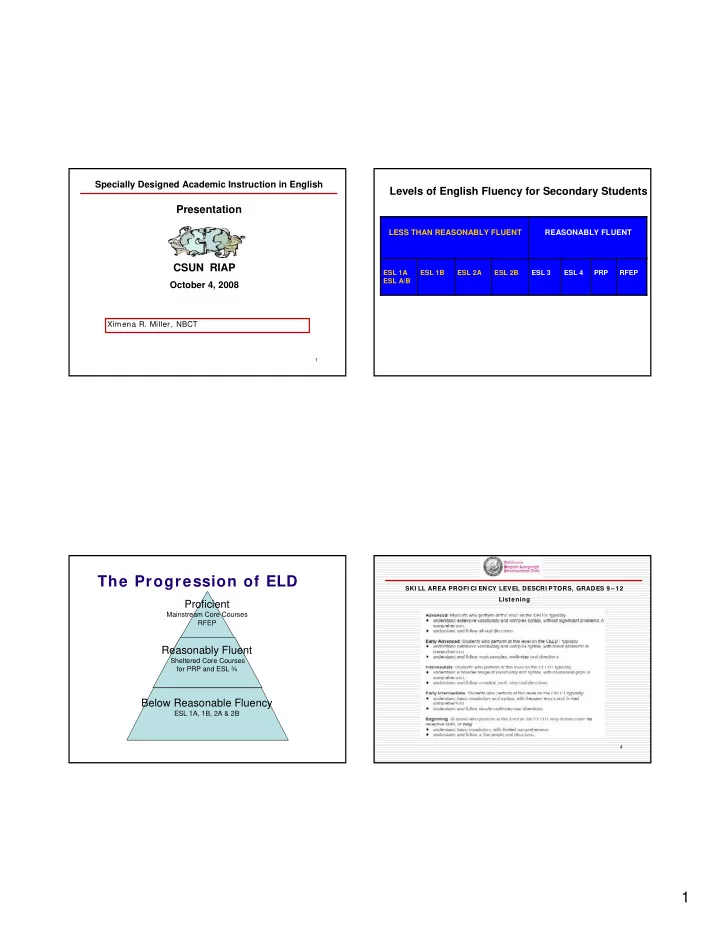
Ximena R. Miller, NBCT LESS THAN REASONABLY FLUENT REASONABLY FLUENT

ESL 1A ESL A/B ESL 1B ESL 2A ESL 2B ESL 3 ESL 4 PRP RFEP

Levels of English Fluency for Secondary Students Proficient

Mainstream Core Courses RFEP

Reasonably Fluent

Sheltered Core Courses for PRP and ESL ¾

Below Reasonable Fluency

ESL 1A, 1B, 2A & 2B

The Progression of ELD

4

SKI LL AREA PROFI CI ENCY LEVEL DESCRI PTORS, GRADES 9 – 1 2 Listening

slide-2
SLIDE 2

2

5

SKI LL AREA PROFI CI ENCY LEVEL DESCRI PTORS, GRADES 9 – 1 2 Speaking

6

SKI LL AREA PROFI CI ENCY LEVEL DESCRI PTORS, GRADES 9 – 1 2 Reading

7

SKI LL AREA PROFI CI ENCY LEVEL DESCRI PTORS, GRADES 9 – 1 2 W riting

8

SDAIE Strategies

1.When asked to consider an idea or an answer to a question, students are given time to quietly think or write their ideas on paper (think).

  • Each student turns to another student nearby and tells or reads

his or her own thoughts (pair, share). This strategy increases student-to-student interaction and allows students to use academic language in a meaningful context.

Think Pair Share

slide-3
SLIDE 3

3

9

Circle Map Circle Map

The Circle Map is designed for:

  • Defining a word or concept
  • Determining students’ prior knowledge of a concept
  • Brainstorming ideas and thoughts about a topic

10

SDAIE Circle Map SDAIE Circle Map

SDAIE What is SDAIE? How did you learn this?

11

SDAIE Strategies

  • 1. Students are given a series of statements that relate to a reading

selection, lecture or video.

  • 2. Students indicate agreement or disagreement with the statement.
  • 3. After the information has been presented, students check to see if

they were correct. This strategy assists the teacher in identifying prior knowledge of students and helps students focus on specific content themes.

Anticipation Guide

12

SDAIE

Truth or Myth?

1.) ______ Using SDAI E strategies with ESL 1A & 1B students ______ will give them full access to grade-level content. 2.) ______ SDAI E strategies include differentiation of ______ instruction during lesson delivery and assessment. 3.) ______ Clarification and supplementary materials in the ______ primary language are SDAI E techniques. 4.) ______ Teachers of Sheltered (content) classes should ______ assist EL students in the development of speaking and writing skills.

Before Presentation After Presentation

Anticipation Guide

slide-4
SLIDE 4

4

13

What is SDAIE?

Specially Designed Academ ic I nstruction in English ( SDAI E) – AKA Sheltered I nstruction is a process by which subject m atter instruction is made more meaningful and accessible to English learners. Subject m atter and its associated vocabulary, concepts and skills are taught by using language in context to make the inform ation comprehensible. I s SDAI E/ Sheltered I nstruction just good teaching?

14

SDAIE and Good Teaching Comparison

Wait-time Key Vocabulary Adapted Content Language Objectives Clarification in L1 Appropriate Speech for Proficiency Level Supplementary Materials Student Background Experiences Pacing Students Engaged Content Objectives Vocabulary Review Hands-On Materials Feedback Provided Meaningful Activities Links to Past Learning Review and Assessment Clear Explanation of Tasks Supplementary Materials High-Order Thinking Skills Grouping Strategies

Features Essential to Sheltered Instruction Features Shared between Sheltered and Good Instruction

15

SDAIE

  • An instructional approach
  • A synthesis of techniques

addressing the core curriculum

  • A strategy to teach

content subjects while students continue to acquire English

  • A strategy that depends
  • n prior knowledge
  • Richly contextualized
  • A rigorous curriculum
  • A good pedagogy for

English learners and English-speaking students

  • The sam e thing as ESL

(ELD)

  • Rem edial instruction
  • Watered-down content
  • A substitute for primary

language

  • A subject area
  • Submersion in English
  • Teaching about the

language

IS… IS NOT…

16

SDAIE Strategies

  • 1. Form teams of four students.
  • 2. Number students from 1 to 4.
  • 3. Present a question or problem.
  • 4. Students discuss the answer. The team must reach consensus on

the answer. They make sure everyone on the team knows the answer.

  • 5. Randomly call a number from 1 to 4 (use a spinner, draw popsicle

sticks out of a cup, roll a die, etc.).

  • 6. Students with that number raise their hand.
  • 7. Randomly choose one of these students.
  • 8. The selected student answers the question.

Num bered Heads Together

slide-5
SLIDE 5

5

17

SDAIE Strategies

  • The group discussion provides each student with

language and concept understanding.

  • The random selection of one student to provide

the answer allows for evaluation of both individual and group progress. Num bered Heads Together ( Cont.)

  • 9. The other teams may agree/ disagree with the answer by showing

a thumbs up or a thumbs down hand signal. 10.Teams showing disagreement may be asked to explain/ defend their position.

18

SDAIE Strategies Practice

Num bered Heads Together Activity # 2

  • 1. Form teams of four.
  • 2. Number team members from 1 to 4.
  • 3. Share one way in which this strategy could be used with your

classes.

  • 4. One of your team members will be asked to share the team’s

answer with the whole group.

19

SDAIE

Truth or Myth?

1.) ______ Using SDAI E strategies with ESL 1A & 1B students ______ will give them full access to grade-level content. 2.) ______ SDAI E strategies include differentiation of ______ instruction during lesson delivery and assessment. 3.) ______ Clarification and supplementary materials in the ______ primary language are SDAI E techniques. 4.) ______ Teachers of Sheltered (content) classes should ______ assist EL students in the development of speaking and writing skills.

Before Presentation After Presentation

Anticipation Guide

Master Plan Roster

Student Nam es

CL26