The California 2012 ELD Standards: Building Capacity and Internal - - PDF document

the california 2012 eld standards
SMART_READER_LITE
LIVE PREVIEW

The California 2012 ELD Standards: Building Capacity and Internal - - PDF document

The California 2012 ELD Standards: R.Linquanti Building Capacity and Internal Accountability for CA ELD WestEd Standards Based Instructional Practices The California 2012 ELD Standards: Building Capacity and Internal Accountability for ELD


slide-1
SLIDE 1

The California 2012 ELD Standards: Building Capacity and Internal Accountability for CA ELD Standards‐Based Instructional Practices

R.Linquanti WestEd

22nd Annual English Learner Leadership Conference February 14, 2013 Santa Rosa, CA

1

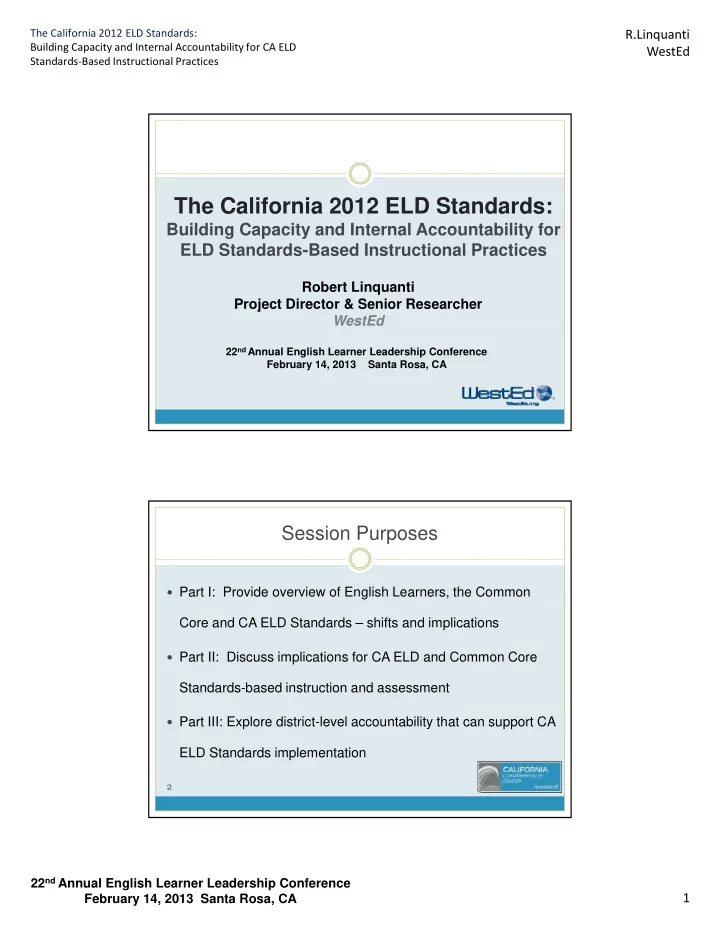
The California 2012 ELD Standards:

Building Capacity and Internal Accountability for ELD Standards-Based Instructional Practices

Robert Linquanti Project Director & Senior Researcher WestEd WestEd

22nd Annual English Learner Leadership Conference February 14, 2013 Santa Rosa, CA

Session Purposes

Part I: Provide overview of English Learners, the Common

Core and CA ELD Standards – shifts and implications

Part II: Discuss implications for CA ELD and Common Core

Standards-based instruction and assessment

2

Part III: Explore district-level accountability that can support CA

ELD Standards implementation

slide-2
SLIDE 2

The California 2012 ELD Standards: Building Capacity and Internal Accountability for CA ELD Standards‐Based Instructional Practices

R.Linquanti WestEd

22nd Annual English Learner Leadership Conference February 14, 2013 Santa Rosa, CA

2

Part I:

OVERVIEW OF ENGLISH LEARNERS, THE CA COMMON CORE & CA ELD STANDARDS

3

Who Are English Learners?

ELs very diverse yet seen monolithically

  • ELs very diverse, yet seen monolithically
  • EL status is temporary, instructionally dependent
  • Successful ELs exit EL cohort, leaving more

lower-performing and newly arrived

  • Better performing by definition, exited ELs may

still have linguistic academic needs still have linguistic, academic needs

slide-3
SLIDE 3

The California 2012 ELD Standards: Building Capacity and Internal Accountability for CA ELD Standards‐Based Instructional Practices

R.Linquanti WestEd

22nd Annual English Learner Leadership Conference February 14, 2013 Santa Rosa, CA

3

Educators Have a Dual Obligation to English Learners

  • 1. Provide meaningful access to
  • de

ea g u access to grade-level academic content via appropriate instruction

  • 2. Develop students’ academic

English language proficiency Interconnected not separate!

(Lau v. Nichols; Castañeda v. Pickard; NCLB)

Interconnected, not separate! Simultaneous, not sequential!

Common Core Standards change the game for ELs and their teachers

slide-4
SLIDE 4

The California 2012 ELD Standards: Building Capacity and Internal Accountability for CA ELD Standards‐Based Instructional Practices

R.Linquanti WestEd

22nd Annual English Learner Leadership Conference February 14, 2013 Santa Rosa, CA

4

Common Core Standards: Major Shifts What do the New ELA Standards Imply?

“Students can, without significant scaffolding,

comprehend and evaluate complex texts across a comprehend and evaluate complex texts across a range of types and disciplines…can construct effective arguments and convey intricate or multifaceted information. Likewise, students are able independently to discern a speaker’s key points, request clarification, and ask relevant questions. They build on others’ ideas, articulate their own y , ideas, and confirm they have been understood.”

(CCSS for English Language Arts & Literacy in History/Social Studies,

Science, and Technical Subjects, p. 7)

slide-5
SLIDE 5

The California 2012 ELD Standards: Building Capacity and Internal Accountability for CA ELD Standards‐Based Instructional Practices

R.Linquanti WestEd

22nd Annual English Learner Leadership Conference February 14, 2013 Santa Rosa, CA

5

“Mathematically proficient students understand

and use stated assumptions definitions and

What do the New Math Standards Imply?

and use stated assumptions, definitions, and previously established results in constructing

  • arguments. They make conjectures and build a

logical progression of statements to explore the truth of their conjectures…They justify their conclusions, communicate them to others, and respond to the arguments of others.”

(CCSS for Mathematics, p. 6)

What does New Science Framework Imply?

K-12 Science Framework (NRC, 2012, pp 45 49)

Among essential science practices:

  • Constructing explanations and designing solutions
  • Engaging in argument from evidence
  • Obtaining, evaluating, and communicating information
  • pp. 45, 49)
slide-6
SLIDE 6

The California 2012 ELD Standards: Building Capacity and Internal Accountability for CA ELD Standards‐Based Instructional Practices

R.Linquanti WestEd

22nd Annual English Learner Leadership Conference February 14, 2013 Santa Rosa, CA

6

Old Paradigm

Content (ELA) Language

  • stly vocabulary,

grammar M

New Paradigm

Discourse Complex texts Explanations Argumentation Text types / structures

Language Content

Δ Vocabulary practices

slide-7
SLIDE 7

The California 2012 ELD Standards: Building Capacity and Internal Accountability for CA ELD Standards‐Based Instructional Practices

R.Linquanti WestEd

22nd Annual English Learner Leadership Conference February 14, 2013 Santa Rosa, CA

7

The New Paradigm: Language Uses within Content Practices

Content

Discourse Complex texts Explanation

Language

Explanation Argumentation Text types Sentence structures

ΔVocabulary

practices

Language Arts

2012 CA ELD Standards

CA ELD Standards Overview

Development process CA ELD Standards

  • Design Considerations
  • Key shifts from the 1999 CA ELD standards
  • Elements of the CA ELD Standards
  • Proficiency Level Descriptors (PLDs)
  • Grade level standards: Components and Structure

14

slide-8
SLIDE 8

The California 2012 ELD Standards: Building Capacity and Internal Accountability for CA ELD Standards‐Based Instructional Practices

R.Linquanti WestEd

22nd Annual English Learner Leadership Conference February 14, 2013 Santa Rosa, CA

8

ELD Standards Development Timeline

15

Aligned with and to be used in tandem with CCSS for

ELA & Lit

CA ELD Standards: Design

ELA & Literacy

Highlight and amplify the critical language uses,

knowledge about language, and skills using language in the CCSS necessary for ELs to be successful in school

Provide fewer, clearer, higher standards so teachers

can focus on what’s most important

slide-9
SLIDE 9

The California 2012 ELD Standards: Building Capacity and Internal Accountability for CA ELD Standards‐Based Instructional Practices

R.Linquanti WestEd

22nd Annual English Learner Leadership Conference February 14, 2013 Santa Rosa, CA

9

Some Differences

1999 CA ELD Standards From… 2012 CA ELD Standards To… Five English Language Proficiency (ELP) levels Three ELP levels: emerging, expanding, bridging (each with entry/progress thru, exit) Early literacy skills embedded in the ELD Standards Foundational Literacy Skills aligned and applied appropriately depending on individual student needs ELD Standards as “junior” ELA Standards or as an “onramp” to the ELA Standards ELD Standards working in tandem with ELA and other content standards and seen as the “diamond lane” for acceleration

Key Shifts

1999 CA ELD Standards From the idea of… 2012 CA ELD Standards To understanding… English as a set of rules

  • English as a meaning-making resource with

different language choices based on audience, task, and purpose Grammar as syntax with discrete skills at the center

  • An expanded notion of grammar with

discourse, text structure, syntax, and vocabulary addressed within meaningful contexts contexts Language acquisition as an individual and lock-step linear process

  • Language acquisition as a non-linear,

spiraling, dynamic, and complex social process Adapted from Walqui (2012)

slide-10
SLIDE 10

The California 2012 ELD Standards: Building Capacity and Internal Accountability for CA ELD Standards‐Based Instructional Practices

R.Linquanti WestEd

22nd Annual English Learner Leadership Conference February 14, 2013 Santa Rosa, CA

10

Key Shifts

1999 CA ELD Standards From the idea of… 2012 CA ELD Standards To understanding… Language development Language development focused on Language development focused on accuracy and grammatical correctness Language development focused on interaction, collaboration, comprehension, and communication with strategic scaffolding to guide appropriate linguistic choices Simplified texts and activities,

  • ften separate from content

knowledge Complex texts and intellectually challenging activities with content integral to language learning Instruction that treats reading, writing, listening, and speaking as isolated and separate skills Instruction that artfully integrates reading, writing, speaking and listening, and language awareness Adapted from Walqui (2012)

Key Theme

1999 CA ELD Standards 2012 CA ELD Standards

I i i ELD D di d E D i i h Instruction in ELD as separate and isolated from instruction in ELA OR as indistinguishable from ELA Content instruction that

  • Dedicated ELD instruction that

builds into and from instruction in ELA and literacy in the content areas Content instruction that Content instruction that misses opportunities to develop academic language Content instruction that expects and supports language uses as specified in common core & ELD Standards

slide-11
SLIDE 11

The California 2012 ELD Standards: Building Capacity and Internal Accountability for CA ELD Standards‐Based Instructional Practices

R.Linquanti WestEd

22nd Annual English Learner Leadership Conference February 14, 2013 Santa Rosa, CA

11

Table Talk: Differences, shifts, themes

Do these differences shifts and Do these differences, shifts, and

themes seem like positives to you? Why or why not?

What challenges and

t iti ill th h

We stE d.o rg

  • pportunities will these changes

mean for your district? Why?

21

Take 5 mins.

CA ELD Standards: Elements

Overview & Proficiency Level Descriptors (PLDs): Alignment to CCSS for ELA & Literacy CA’s EL Students

See Handouts

Grade Level ELD Standards: Section 1: Goal, Critical Principles, At-a-glance Overview Section 2: Elaboration on Critical Principles

  • Part I:

Interacting in Meaningful Ways

  • Part II:

Learning About How English Works

  • Part III:

Using Foundational Literacy Skills Proficiency Level Descriptors (PLDs) Structure of the grade level standards Part III: Using Foundational Literacy Skills Appendices: Appendix A: Foundational Literacy Skills Appendix B: Learning About How English Works Appendix C: Theory and Research Appendix D: Context, Development, Validation Glossary of Key Term s

slide-12
SLIDE 12

The California 2012 ELD Standards: Building Capacity and Internal Accountability for CA ELD Standards‐Based Instructional Practices

R.Linquanti WestEd

22nd Annual English Learner Leadership Conference February 14, 2013 Santa Rosa, CA

12

CA ELD Standards: Elements

Overview & Proficiency Level Descriptors (PLDs): Alignment to CCSS for ELA & Literacy CA’s EL Students

Proficiency Level Descriptors (PLDs)

Structure of the grade level standards

Proficiency Level Descriptors (PLDs) Overview

  • Describe student knowledge, skills, and abilities

across a continuum identifying what ELs know across a continuum, identifying what ELs know and can do

  • Provide three proficiency levels: Emerging,

Expanding, and Bridging – at early and exit stages

  • Guide targeted instruction in ELD, as well as

differentiated instruction in academic content areas

slide-13
SLIDE 13

The California 2012 ELD Standards: Building Capacity and Internal Accountability for CA ELD Standards‐Based Instructional Practices

R.Linquanti WestEd

22nd Annual English Learner Leadership Conference February 14, 2013 Santa Rosa, CA

13

Include:

Proficiency Level Descriptors (PLDs) Overview, cont’d.

See Handouts

Overall Proficiency: A general descriptor of ELs’

abilities at entry to/progress through, and exit from the level

Extent of linguistic support needed per the

linguistic and cognitive demands of tasks at early linguistic and cognitive demands of tasks, at early stages and as ELs develop Include:

Descriptors for early stages of and exit from each proficiency

Proficiency Level Descriptors (PLDs) Overview, cont’d.

See Handouts Descriptors for early stages of and exit from each proficiency level, using ELD standard structure:

Three Modes of Communication:

Collaborative (engagement in dialogue with others) Interpretive (comprehension and analysis of written and spoken

texts)

Productive (creation of oral presentations and written texts)

Two dimensions of Knowledge of Language:

Metalinguistic Awareness (language awareness & self-monitoring) Accuracy of Production (acknowledging variation)

slide-14
SLIDE 14

The California 2012 ELD Standards: Building Capacity and Internal Accountability for CA ELD Standards‐Based Instructional Practices

R.Linquanti WestEd

22nd Annual English Learner Leadership Conference February 14, 2013 Santa Rosa, CA

14

How do the

Proficiency Level Descriptors What’s New & Different?

  • Modes of Communication and
  • Knowledge of Language

descriptors link to the Common Core and communicate expectations for English Learner engagement? g g

Take 5 mins.

CA ELD Standards: Elements

Grade Level ELD Standards: Section 1: Goal, Critical Principles, At-a-glance Overview Section 2: Elaboration on Critical Principles

  • Part I:

Interacting in Meaningful Ways

  • Part II:

Learning About How English Works

  • Part III:

Using Foundational Literacy Skills

slide-15
SLIDE 15

The California 2012 ELD Standards: Building Capacity and Internal Accountability for CA ELD Standards‐Based Instructional Practices

R.Linquanti WestEd

22nd Annual English Learner Leadership Conference February 14, 2013 Santa Rosa, CA

15

The 2012 ELD Standards: Structure and Components Each grade level’s standards include: include:

Section 1: 2-page “At a Glance” Section 2: Grade level standards

Part I: Interacting in Meaningful Ways Part II: Learning about How English 29

Works

Part III: Using Foundational Literacy

Skills

Walk-Through of the CA 2012 ELD Standards’ Structure and Components: Grade 5 Example

See Handouts

slide-16
SLIDE 16

The California 2012 ELD Standards: Building Capacity and Internal Accountability for CA ELD Standards‐Based Instructional Practices

R.Linquanti WestEd

22nd Annual English Learner Leadership Conference February 14, 2013 Santa Rosa, CA

16

ELD Standard Strands How do they work?

Review these ELD

standard strands in

I.A.3 (offering opinions) p.3 I.B.7 (evaluating language

Grade 5 Example See Handout pairs/teams

What do they

communicate to students and teachers?

How are they different?

( g g g choices) p.5 I.C.11 (supporting opinions) p.7 II.A.1 (understanding text structure) p.8 II.B.3 (using verbs & verb phrases) p.9 II.C.6 (connecting ideas) p.10

31

Take 10 mins.

What changes across proficiency levels?

5th Grade, Part I

32

5th Grade, Part II

Take 5 mins.

slide-17
SLIDE 17

The California 2012 ELD Standards: Building Capacity and Internal Accountability for CA ELD Standards‐Based Instructional Practices

R.Linquanti WestEd

22nd Annual English Learner Leadership Conference February 14, 2013 Santa Rosa, CA

17

Part III: Using Foundational Literacy Skills

Foundational literacy skills

33

Foundational literacy skills alignment charts for ELD in Appendix A

CA ELD Standards: Elements

Appendices: Appendix A: Foundational Literacy Skills Appendix B: Learning About How English Works Appendix C: Theory and Research Appendix D: Context, Developm ent, Validation

slide-18
SLIDE 18

The California 2012 ELD Standards: Building Capacity and Internal Accountability for CA ELD Standards‐Based Instructional Practices

R.Linquanti WestEd

22nd Annual English Learner Leadership Conference February 14, 2013 Santa Rosa, CA

18 Research on English Learners

  • English learners benefit from reading foundational skills instruction

Appendix A: Foundational Literacy Skills

  • Oral English proficiency is crucial for English literacy
  • Native language literacy facilitates English literacy learning

Reading Foundational Skills Alignment Charts

  • Student language and literacy characteristics
  • Considerations for literacy foundational skills instruction

C C C S S

35

  • CA Common Core Reading Standards: Foundational Skills

Alignment Charts

  • K – 5, by grade
  • 6 – 12, by grade span

Appendix A: Foundational Literacy Skills

36

slide-19
SLIDE 19

The California 2012 ELD Standards: Building Capacity and Internal Accountability for CA ELD Standards‐Based Instructional Practices

R.Linquanti WestEd

22nd Annual English Learner Leadership Conference February 14, 2013 Santa Rosa, CA

19

Appendix B: Part II: Learning About How English Works

Provides guidance on how to apply Part II of the standards in

g pp y tandem with Part I

Discusses some of the language Demands of the CCSS Shows differences between everyday and academic English Provides ideas and strategies to support transition to

academic English

37

g

Appendix B: Part II: Learning About How English Works

38

slide-20
SLIDE 20

The California 2012 ELD Standards: Building Capacity and Internal Accountability for CA ELD Standards‐Based Instructional Practices

R.Linquanti WestEd

22nd Annual English Learner Leadership Conference February 14, 2013 Santa Rosa, CA

20

Appendix C: Theoretical Foundations and Research Base Theories and research discussed in sections:

  • Interacting in Meaningful and Intellectually
  • Interacting in Meaningful and Intellectually

Challenging Ways

  • Scaffolding
  • Developing Academic English
  • The Importance of Vocabulary
  • The Importance of Grammatical and Discourse-

39

The Importance of Grammatical and Discourse Level Understandings

  • Other Relevant Guidance Documents

Appendix C: Theoretical Foundations and Research Base

40

slide-21
SLIDE 21

The California 2012 ELD Standards: Building Capacity and Internal Accountability for CA ELD Standards‐Based Instructional Practices

R.Linquanti WestEd

22nd Annual English Learner Leadership Conference February 14, 2013 Santa Rosa, CA

21 Appendix C: Theoretical Foundations and Research Base

Examples of planned scaffolding:

Taking into account what students already know, including

primary language and culture, and relating it to what they are to learn;

Selecting and sequencing tasks, such as modeling and

explaining, and providing guided practice, in a logical order;

Frequently checking for understanding during instruction, as

ll i t i t i t l th h t

41

well as gauging progress at appropriate intervals throughout the year;

Choosing texts carefully for specific purposes (e.g.,

motivational, linguistic, content);

Appendix C: Theoretical Foundations and Research Base

Examples of planned scaffolding:

Providing a variety of collaborative grouping processes; Constructing good questions that promote critical thinking and

extended discourse;

Using a range of information systems, such as graphic

  • rganizers, diagrams, photographs, videos, or other

multimedia to enhance access to content; and

42

Providing students with language models, such as sentence

frames/starters, academic vocabulary walls, language frame charts, exemplary writing samples, or teacher language modeling (e.g., using academic vocabulary or phrasing).

slide-22
SLIDE 22

The California 2012 ELD Standards: Building Capacity and Internal Accountability for CA ELD Standards‐Based Instructional Practices

R.Linquanti WestEd

22nd Annual English Learner Leadership Conference February 14, 2013 Santa Rosa, CA

22 Appendix C: Theoretical Foundations and Research Base

Examples of just-in-time scaffolding:

Prompting a student to elaborate on a response to extend his Prompting a student to elaborate on a response to extend his

  • r her language use and thinking;

Paraphrasing a student’s response and including target

academic language as a model while, at the same time, accepting the student’s response using everyday or “flawed” language; and

Adjusting instruction on the spot based on frequent checking

43

for understanding;

Linking what a student is saying to prior knowledge or to

learning to come (previewing).

Part II:

DESIGN FOR CA ELD STANDARDS-BASED INSTRUCTION ACROSS THE DISCIPLINES [THANKS TO PAM SPYCHER FOR THIS WORK]

44

slide-23
SLIDE 23

The California 2012 ELD Standards: Building Capacity and Internal Accountability for CA ELD Standards‐Based Instructional Practices

R.Linquanti WestEd

22nd Annual English Learner Leadership Conference February 14, 2013 Santa Rosa, CA

23

L a ng ua g e

L

e a rning la ng ua g e

L

e a rning la ng ua g e

L

e a rning thro ug h la ng ua g e

L

e a rning a b o ut la ng ua g e

45

  • Ha llida y (1994)

ELD Standards: The Left Hand Column

Emphasizes the interconnectedness between content knowledge and language Shows the many-to-many CCSS and ELD Standards alignments Related to register variables:

  • The nature of the social activity (the field
  • r content of the discourse)
  • The relationship between the participants

46

The relationship between the participants in the activity (the tenor of the discourse)

  • The role language plays in the activity

(the mode of discourse)

slide-24
SLIDE 24

The California 2012 ELD Standards: Building Capacity and Internal Accountability for CA ELD Standards‐Based Instructional Practices

R.Linquanti WestEd

22nd Annual English Learner Leadership Conference February 14, 2013 Santa Rosa, CA

24 Re g iste r:

T he type o f i la ng ua g e use d in pa rtic ula r so c ia l situa tio ns whe n c o mmunic a ting with a pa rtic ula r se t

  • f pe o ple .

47

Re g iste r te lls wha t yo u’ re trying to a c c o mplish

Examples of Register Differences

Three examples: Cl i d Closing correspondence:…. Sincerely, Best, Love, Later Most expository text does not use first person point

  • f view

Linking clauses for comparison: Conjunctions

48

Linking clauses for comparison: Conjunctions

More Oral (Everyday) More Written (AL) But Although On the other hand Rather Conversely

slide-25
SLIDE 25

The California 2012 ELD Standards: Building Capacity and Internal Accountability for CA ELD Standards‐Based Instructional Practices

R.Linquanti WestEd

22nd Annual English Learner Leadership Conference February 14, 2013 Santa Rosa, CA

25

  • Partner A explain to Partner B what happened

when you got a speeding ticket as if you were

Playing with Register

talking to your best friend and/or spouse.

  • Partner B explain what happened when you got a

speeding ticket as if you were telling a young child.

  • Partner A explain what happened when you got a

speeding ticket as if you were trying to persuade a t ffi t j d t l t ff th h k

49

traffic court judge to let you off the hook.

  • Partner B explain what happened when you got a

speeding ticket as if you were telling your mom.

Register awareness helps teachers understand that:

  • All language is equally valuable.
  • None is inherently “better” than another.
  • Effective communicators use the register expected

based on a given context.

  • Students benefit when they’re aware of register

and dialect differences and resources.

50

slide-26
SLIDE 26

The California 2012 ELD Standards: Building Capacity and Internal Accountability for CA ELD Standards‐Based Instructional Practices

R.Linquanti WestEd

22nd Annual English Learner Leadership Conference February 14, 2013 Santa Rosa, CA

26

Academic Registers: Characteristics

Informationally dense

I f ti d i ti htl k d i t

Information and reasoning are tightly packed into

the grammar

Technical and abstract vocabulary are used

Authoritatively presented

No room for objection; authority is often masked Modal verbs (should, could, would) and adverbs

(certainly, probably) to indicate possibility

51 Highly structured

Clause-combining and clause-embedding Organizational structure leads to a cohesive text Schleppegrell 2004

Multiple Levels of Talking About Language

Text level Sentence level Clause level G

/Ph l l

52

Group/Phrase level Word level

slide-27
SLIDE 27

The California 2012 ELD Standards: Building Capacity and Internal Accountability for CA ELD Standards‐Based Instructional Practices

R.Linquanti WestEd

22nd Annual English Learner Leadership Conference February 14, 2013 Santa Rosa, CA

27

ELD Standards, 1st Grade, Part I

53

ELD Standards, 1st Grade, Part I

54

slide-28
SLIDE 28

The California 2012 ELD Standards: Building Capacity and Internal Accountability for CA ELD Standards‐Based Instructional Practices

R.Linquanti WestEd

22nd Annual English Learner Leadership Conference February 14, 2013 Santa Rosa, CA

28

ELD Standards, 1st Grade, Part II

55

ELD Standards, 1st Grade, Part II

56

slide-29
SLIDE 29

The California 2012 ELD Standards: Building Capacity and Internal Accountability for CA ELD Standards‐Based Instructional Practices

R.Linquanti WestEd

22nd Annual English Learner Leadership Conference February 14, 2013 Santa Rosa, CA

29

Multiple Levels of Talking About Language

Text level Sentence level Clause level G

/Ph l l

57

Group/Phrase level Word level

Part II: Learning about How English Works 58

slide-30
SLIDE 30

The California 2012 ELD Standards: Building Capacity and Internal Accountability for CA ELD Standards‐Based Instructional Practices

R.Linquanti WestEd

22nd Annual English Learner Leadership Conference February 14, 2013 Santa Rosa, CA

30

Genre (Text Types)

A genre is:

A “staged goal-oriented social process” (Martin & Rose 2008 A staged, goal oriented social process (Martin & Rose, 2008,

  • p. 9)

Used to get something done through language

A genre has:

A particular social purpose

A ti l ll t t i ti

59 A particular overall structure or organization Language features typical of the genre

Why Talk About Genres/Text Types?

Genre analysis…

helps us compare and contrast different types of helps us compare and contrast different types of

genres,

helps the features of the genres stand out, makes explicit why some texts are more

successful/appropriate and when others aren’t.

60

slide-31
SLIDE 31

The California 2012 ELD Standards: Building Capacity and Internal Accountability for CA ELD Standards‐Based Instructional Practices

R.Linquanti WestEd

22nd Annual English Learner Leadership Conference February 14, 2013 Santa Rosa, CA

31 Information Text: Argument (expository) Literary Text: Story (narrative) Purpose Persuade the reader to agree with a claim or Entertain and tell about events people agree with a claim or point of view about events, people, and experiences Structure Statement/claim, supporting arguments, details, reaffirmation Orientation, events, complication, resolution Language F t Sequenced logically ith ti Sequenced in time ( ti

61

Features with connectives (first, therefore); present tense; evaluative vocabulary (needlessly, obvious) (once upon a time, after awhile); action and saying verbs; dialogue; past tense; descriptive vocabulary (lovely)

Joint Construction of Text

Teacher guides/leads the students to

use genre-specific language.

Students actively participate in

constructing the text.

Lots of rereading revising reflecting Lots of rereading, revising, reflecting,

and talking about the text.

slide-32
SLIDE 32

The California 2012 ELD Standards: Building Capacity and Internal Accountability for CA ELD Standards‐Based Instructional Practices

R.Linquanti WestEd

22nd Annual English Learner Leadership Conference February 14, 2013 Santa Rosa, CA

32

Some Que stions T e a c he rs Ca n Ask to Guide Stude nts in Joint Construc tion

What words or phrases would we expect to

see/should we use:

  • At the beginning?
  • To add information?
  • To signal that the end of the report/story/persuasive text,

etc ? etc.?

  • To signal there’s a problem coming?
  • To show what the character said and how they said it?

See Handout

64

slide-33
SLIDE 33

The California 2012 ELD Standards: Building Capacity and Internal Accountability for CA ELD Standards‐Based Instructional Practices

R.Linquanti WestEd

22nd Annual English Learner Leadership Conference February 14, 2013 Santa Rosa, CA

33

Unpack the sentence for its meaning

(as though you were explaining it to a first grader) “Although many countries are addressing pollution, environmental degradation continues to create g devastating human health problems each year.”

Unpacked:

  • Pollution is a big problem around the world.
  • A lot of countries are doing something about pollution.
  • Pollution destroys the environment.
  • The ruined environment leads to health problems in people.

65

The ruined environment leads to health problems in people.

  • The health problems are still happening every year.
  • The health problems are really, really bad.
  • Even though the countries are doing something about pollution, there are still

problems.

What’s happening in the original sentence?

“Alth h t i dd i ll ti

Dependent clause: Dependent upon the meaning of the main clause and can’t stand on its own.

“Although many countries are addressing pollution, environmental degradation continues to create

66

devastating human health problems each year.”

Independent/main clause: Contains a complete idea and can stand independently.

slide-34
SLIDE 34

The California 2012 ELD Standards: Building Capacity and Internal Accountability for CA ELD Standards‐Based Instructional Practices

R.Linquanti WestEd

22nd Annual English Learner Leadership Conference February 14, 2013 Santa Rosa, CA

34

What’s happening in the original sentence?

“Although many countries are addressing pollution,

Dependent clause: Dependent upon the meaning of the main clause and can’t stand on its own.

g y g p , environmental degradation continues to create devastating human health problems each year ”

“Although” signals a relationship of concession.

67

devastating human health problems each year.

Independent/main clause: Contains a complete idea and can stand independently. Different kinds of subordinating conjunctions create different types of relationships between clauses.

What’s happening in the original sentence?

“Alth h t i dd i ll ti

Nominalization: Condenses information from one part of speech (usually verbs) into nominal groups.

“Although many countries are addressing pollution, environmental degradation continues to create

68

devastating human health problems each year.”

slide-35
SLIDE 35

The California 2012 ELD Standards: Building Capacity and Internal Accountability for CA ELD Standards‐Based Instructional Practices

R.Linquanti WestEd

22nd Annual English Learner Leadership Conference February 14, 2013 Santa Rosa, CA

35

What’s happening in the original sentence?

“Alth h t i dd i ll ti

Nominalization: Condenses information from one part of speech (usually verbs) into nominal groups.

“Although many countries are addressing pollution, environmental degradation continues to create

69

devastating human health problems each year.”

In science, nominalization accumulates information and repackages it in order to use it to further explain things or to sum things up.

Nominalization

From History Textbook: The destruction of the buffalo and removal of Native The destruction of the buffalo and removal of Native Americans to reservations emptied the land for grazing cattle.

In history, nominalization is often used to “reify” processes or events, enabling the historian to interpret and evaluate them. It also hides agency

70

It also hides agency.

slide-36
SLIDE 36

The California 2012 ELD Standards: Building Capacity and Internal Accountability for CA ELD Standards‐Based Instructional Practices

R.Linquanti WestEd

22nd Annual English Learner Leadership Conference February 14, 2013 Santa Rosa, CA

36

What’s happening in the original sentence?

“Although many countries are addressing pollution Although many countries are addressing pollution, environmental degradation continues to create devastating human health problems each year ”

71

devastating human health problems each year.

Long noun phrase: Expanded by adding pre-modifiers to the head noun.

Unpacking Sentences: Your Turn

The release of a new bipartisan Senate plan to

  • verhaul the nation’s immigration laws and a policy
  • verhaul the nation s immigration laws and a policy

address given Tuesday by President Barack Obama have launched dramatic new momentum on a long- stalled issue. Washington Post, 1-30-13

72

g , By Rosalind S. Helderman and Tara Bahrampour

slide-37
SLIDE 37

The California 2012 ELD Standards: Building Capacity and Internal Accountability for CA ELD Standards‐Based Instructional Practices

R.Linquanti WestEd

22nd Annual English Learner Leadership Conference February 14, 2013 Santa Rosa, CA

37

Unpacking Sentences: Your Turn

The release of a new bipartisan Senate plan to

  • verhaul the nation’s immigration laws and a
  • verhaul the nation s immigration laws and a

policy address given Tuesday by President Barack Obama have launched dramatic new momentum on a long-stalled issue. Washington Post, 1-30-13

Three long noun phrases Simple sentence (one clause)

73

g , By Rosalind S. Helderman and Tara Bahrampour

Planning for Instruction

  • 1. Know students’ language strengths and language

learning needs learning needs

  • 2. Identify the language demands of the texts and

tasks used for the topic

  • 3. Select the most critical language to focus on
  • 4. Design tasks and activities to focus on the

language within intellectually rich and engaging

74

language within intellectually rich and engaging contexts

  • 5. Evaluate learning
slide-38
SLIDE 38

The California 2012 ELD Standards: Building Capacity and Internal Accountability for CA ELD Standards‐Based Instructional Practices

R.Linquanti WestEd

22nd Annual English Learner Leadership Conference February 14, 2013 Santa Rosa, CA

38

Challenges for Students: They need to…

t t i f l t t

  • extract meaning from complex texts
  • explain and demonstrate their knowledge using

complex language in varying contexts

  • engage in productive group work with peers and

effective interactions with teachers

Challenges for Teachers: They need to…

  • teach for understanding and productive

teac

  • u de sta d g a d p oduct e

application – more complicated than teaching discrete skills and knowledge

  • see themselves as teachers of disciplinary

language uses in addition to content area

  • develop new ways of motivating and enabling

p y g g students to use language in the classroom to perform in the content areas

slide-39
SLIDE 39

The California 2012 ELD Standards: Building Capacity and Internal Accountability for CA ELD Standards‐Based Instructional Practices

R.Linquanti WestEd

22nd Annual English Learner Leadership Conference February 14, 2013 Santa Rosa, CA

39

Challenges for Support Systems

  • Existing supports for teachers and

administrators –coaching and supervision, professional learning communities, and professional development opportunities – must recognize and build capacity to meet increased demands surrounding content and language demands surrounding content and language.

Scaffolding: Planned and Just-in-Time

Gibbons, 2009 ELD Standards Appendix C. p. 3-5

slide-40
SLIDE 40

The California 2012 ELD Standards: Building Capacity and Internal Accountability for CA ELD Standards‐Based Instructional Practices

R.Linquanti WestEd

22nd Annual English Learner Leadership Conference February 14, 2013 Santa Rosa, CA

40

Fostering academic discourse skills

  • Establish routines and expectations for

equitable, accountable conversations

  • Carefully construct questions to promote

extended academic content discussions

  • Provide appropriate linguistic support (I

agree with ____ that _____. However, ____.)

ELD Standards Appendix C. p. 2

Effective formative assessment is a process teachers and students use

Teachers adjust teaching in response to

assessment evidence

Students receive feedback on learning with

advice on how they can improve

Students participate through self-assessment Strengthens teacher capacity to stage EL

language and content learning

Heritage, 2008, 2010

slide-41
SLIDE 41

The California 2012 ELD Standards: Building Capacity and Internal Accountability for CA ELD Standards‐Based Instructional Practices

R.Linquanti WestEd

22nd Annual English Learner Leadership Conference February 14, 2013 Santa Rosa, CA

41

Table Talk

Discuss implications you see for: Discuss implications you see for:

curriculum instruction professional development leadership

We stE d.o rg

Part III:

DISTRICT-LEVEL EL ACCOUNTABILITY POLICIES & PRACTICES THAT SUPPORT CA ELD STANDARDS IMPLEMENTATION CA ELD STANDARDS IMPLEMENTATION

82

slide-42
SLIDE 42

The California 2012 ELD Standards: Building Capacity and Internal Accountability for CA ELD Standards‐Based Instructional Practices

R.Linquanti WestEd

22nd Annual English Learner Leadership Conference February 14, 2013 Santa Rosa, CA

42

Meaningful Accountability Requires a Stable EL Subgroup

Students Who Began as ELs

T

  • ta l E

ng lish L e a rne r (T E L ) g roup inc lude s:

Students Who Began as ELs

(English Proficient Learners – RFEPs)

Met District reclass criteria

Should m eet grade-level

Current ELs

1-5 yrs in District schools

Long-term ELs

g proficiency; Counted in subgroup to hold accountable for equity & access

schools

Should m eet annual ELP & academ ic progress goals

g

6 or m ore yrs. in District Schools % should decrease annually

Working Group on E L L Polic y, 2011 (www.E llpolic y.org )

CA ELs and former ELs (RFEP) by grade

200000

Ever- EL K-5 6-12 Total EL 86% 43%

1,435,734

RFEP 14% 57%

794,467

80000 100000 120000 140000 160000 180000 RF E P E L

RFEP 14% 57%

794,467

Source: CDE DataQuest, 2010-11 CELDT & CST

20000 40000 60000 K 1st 2nd 3rd 4th 5th 6th 7th 8th 9th 10th 11th 12th

slide-43
SLIDE 43

The California 2012 ELD Standards: Building Capacity and Internal Accountability for CA ELD Standards‐Based Instructional Practices

R.Linquanti WestEd

22nd Annual English Learner Leadership Conference February 14, 2013 Santa Rosa, CA

43

80% 90% 100%

District A ELs, Long-Term ELs and Former ELs (RFEP) by grade

20% 30% 40% 50% 60% 70% 80% RF E P L

  • T

E L E L K 1 2 3 4 5 6 7 8 9 10 11 12 RF E P 0% 0% 13% 25% 38% 46% 57% 61% 64% 58% 62% 69% 70% L

  • T

E L 0% 0% 0% 0% 0% 36% 32% 29% 28% 32% 26% 21% 24% E L 100% 100% 87% 75% 62% 18% 11% 10% 8% 10% 12% 10% 7% 0% 10%

LTEL:EL Ratio 2:1 3:1 3:1 3.5:1 3:1 2:1 2:1 3.5:1

L

  • ng - te rm E

L : 6 or more ye a rs in L E A

Ever EL 45% 18% 37% Current EL 33% 67%

ELs’ English Language Proficiency Level Affects their Academic Performance

75th %ile Highest Median Mean 25th %ile Lowest

Linquanti, 2011

slide-44
SLIDE 44

The California 2012 ELD Standards: Building Capacity and Internal Accountability for CA ELD Standards‐Based Instructional Practices

R.Linquanti WestEd

22nd Annual English Learner Leadership Conference February 14, 2013 Santa Rosa, CA

44

Exhibit 17 Percent of Initial ELP Level 1 ELs Attaining the English-Proficient Threshold Across Analytic Approaches and Grade Clusters Predicted Beyond Observed Years

It Takes ELs Time to Learn Academic English

Note: Based on Current Practice!

Cook, Linquanti, Chinen & Jung, 2012

Long-term ELs reflect our need to strengthen practice

“The trajectory to The trajectory to

becoming a Long Term English Learner begins in elementary school.”

(Olsen 2010)

slide-45
SLIDE 45

The California 2012 ELD Standards: Building Capacity and Internal Accountability for CA ELD Standards‐Based Instructional Practices

R.Linquanti WestEd

22nd Annual English Learner Leadership Conference February 14, 2013 Santa Rosa, CA

45

CA’s Former ELs (RFEPs) needing academic support after exiting

90% 100%

e ls

RF E Ps in CA: CST

  • E

L A, 2010- 11

10% 20% 30% 40% 50% 60% 70% 80%

% Stude nts in CST L e ve

2nd 3rd 4th 5th 6th 7th 8th 9th 10th 11th Ba sic 14% 23% 9% 19% 30% 29% 30% 30% 38% 37% Be low Ba sic 3% 3% 1% 2% 4% 5% 6% 6% 9% 11% F a r Be low Ba sic 1% 0% 0% 0% 1% 1% 2% 2% 3% 5% 0%

79% of all former ELs tested are in grades 6-11 37% of former ELs score below grade level on CST-ELA exam

Source: CDE 2011

Implications of new standards for internal accountability

Opportunities,challenges and expectations for

teachers, students, and administrators will increase

Disciplinary practices, analytic tasks, receptive & productive

language functions across the curriculum Current large-scale assessment systems will shift to

capture language uses inherent in new standards

Window of opportunity during lag time

Building instructional capacity is crucial

90

g p y

No performance without capacity, no capacity without support Do teachers & administrators know what it looks like? Engaging in productive struggle on key problems of practice

slide-46
SLIDE 46

The California 2012 ELD Standards: Building Capacity and Internal Accountability for CA ELD Standards‐Based Instructional Practices

R.Linquanti WestEd

22nd Annual English Learner Leadership Conference February 14, 2013 Santa Rosa, CA

46

Internal accountability priorities

Professional learning for teachers & administrators

Unpacking the common core and ELD standards Unpacking the common core and ELD standards Engaging problems of practice

Teacher observation and feedback

Protocols aligned to disciplinary practices, analytic tasks,

language functions

Do we know what to look for? 91

How can we measure progress?

Beyond current large-scale assessments

Challenges for Assessment Systems

The new content assessments: t i ld lid i f f EL t i l l f

must yield valid inferences for ELs at varying levels of

English language proficiency

must be unbiased with respect to language, even while

language has become part of the new definition of content The new English language proficiency

assessments:

must reflect and measure language demands inherent in

content standards

must capture breadth, depth, and complexity of receptive

and productive language uses

slide-47
SLIDE 47

The California 2012 ELD Standards: Building Capacity and Internal Accountability for CA ELD Standards‐Based Instructional Practices

R.Linquanti WestEd

22nd Annual English Learner Leadership Conference February 14, 2013 Santa Rosa, CA

47

Comprehensive Assessment System

Summative: Long-term (big picture) Formative: Continuous (as & for learning) Interim: Periodic (dipstick)

Effective formative assessment is a process teachers and students use

Teachers adjust teaching in response to

assessment evidence

Students receive feedback on learning with

advice on how they can improve

Students participate through self-assessment Strengthens teacher capacity to stage EL

language and content learning

Heritage, 2008, 2010

slide-48
SLIDE 48

The California 2012 ELD Standards: Building Capacity and Internal Accountability for CA ELD Standards‐Based Instructional Practices

R.Linquanti WestEd

22nd Annual English Learner Leadership Conference February 14, 2013 Santa Rosa, CA

48

The critical nexus for assessment

Assessing language critical to the content Assessing the content using construct-relevant language

The ELP/D Framework

http://www.ccsso.org/Resources/Publications/The_Common_Core_and_English_Language_Learners.html

slide-49
SLIDE 49

The California 2012 ELD Standards: Building Capacity and Internal Accountability for CA ELD Standards‐Based Instructional Practices

R.Linquanti WestEd

22nd Annual English Learner Leadership Conference February 14, 2013 Santa Rosa, CA

49

www.ell.stanford.edu

The Bottom Line: Under Common Core and new ELD standards…

Students learn content using

language

Students learn language

engaging with content

Both explicit, standards-

We stE d.o rg

based ELD and language-rich content teaching and learning are needed

slide-50
SLIDE 50

The California 2012 ELD Standards: Building Capacity and Internal Accountability for CA ELD Standards‐Based Instructional Practices

R.Linquanti WestEd

22nd Annual English Learner Leadership Conference February 14, 2013 Santa Rosa, CA

50

Timeline for related CCSS Implementation

ELD implementation plan approved (2013) ELD implementation plan approved (2013) ELD professional development materials produced

(2013-14)

ELA/ELD Curriculum Framework developed by

Instructional Quality Commission (2014-15)

SBAC assessment developed (2014-15)

p ( )

Next-generation ELD assessment developed (2015-

16)

99

Questions? Comments? Concerns?

THANKS! rlinqua@wested.org

100