The Prehistory of Strings From current-algebra to the Veneziano - - PowerPoint PPT Presentation

the prehistory of strings
SMART_READER_LITE
LIVE PREVIEW

The Prehistory of Strings From current-algebra to the Veneziano - - PowerPoint PPT Presentation

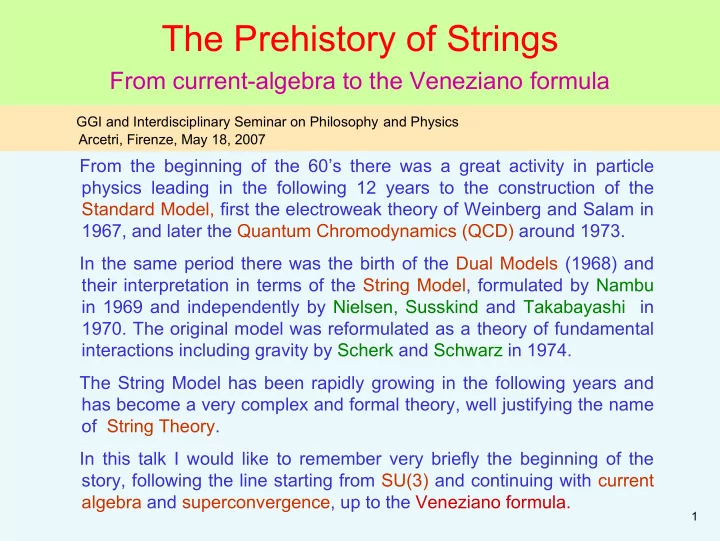
The Prehistory of Strings From current-algebra to the Veneziano formula GGI and Interdisciplinary Seminar on Philosophy and Physics Arcetri, Firenze, May 18, 2007 From the beginning of the 60s there was a great activity in particle physics


slide-1
SLIDE 1

The Prehistory of Strings

From current-algebra to the Veneziano formula

From the beginning of the 60’s there was a great activity in particle physics leading in the following 12 years to the construction of the Standard Model, first the electroweak theory of Weinberg and Salam in 1967, and later the Quantum Chromodynamics (QCD) around 1973. In the same period there was the birth of the Dual Models (1968) and their interpretation in terms of the String Model, formulated by Nambu in 1969 and independently by Nielsen, Susskind and Takabayashi in

  • 1970. The original model was reformulated as a theory of fundamental

interactions including gravity by Scherk and Schwarz in 1974. The String Model has been rapidly growing in the following years and has become a very complex and formal theory, well justifying the name

  • f String Theory.

In this talk I would like to remember very briefly the beginning of the story, following the line starting from SU(3) and continuing with current algebra and superconvergence, up to the Veneziano formula.

GGI and Interdisciplinary Seminar on Philosophy and Physics Arcetri, Firenze, May 18, 2007

1

slide-2
SLIDE 2

SU(3) symmetry

Let me start from 1961, which has been very important for at least three

  • reasons. One is the first attempt by Glashow to unify the weak and

electromagnetic interactions, with the introduction of the weak isospin. The second one is the introduction by Ne’eman and Gell-Mann of SU(3) as an approximate symmetry of strong interactions. This gave a simple scheme to classify the known mesons and baryons into octets (or nonets) and decuplets. The third one is the first proposal by Gell-Mann of the current algebra.

Pseudoscalar and vector meson octets Baryon octet and baryonic resonances decuplet

2

slide-3
SLIDE 3

Vector and axial vector currents

In another paper of 1961 Gell-Mann proposed that the hadronic e.m. current and the vector currents of the weak interactions belong to the same SU(3) octet Jμ

i (i= 1,…,8):

  • electromagnetic current: Jμ

em = Jμ 3 + Jμ 8

  • weak current ΔS=0, ΔQ=+1: Jμ

ΔS=0 = Jμ 1 + i Jμ 2

  • weak current ΔS=ΔQ=+1: Jμ

ΔS=1 = Jμ 4 + i Jμ 5

Similarly, the axial vector currents Jμ5

i form another octet.

The weak interactions, responsible e.g. of the baryonic β-decay, were given by the Feynman-Gell-Mann V–A theory of 1958, in the current by current form Lw = GÁμℓμ , where Áμ and ℓμ are the hadronic and the leptonic currents. In the framework of SU(3), the hadronic current was given by Cabibbo in 1963 by Ám = cos θ [(Jμ

1 + i Jμ 2 ) – (Jμ5 1 + i Jμ5 2 )]

+ sin θ [(Jμ

4 + i Jμ 5 ) – (Jμ5 4 + i Jμ5 5 )] 3 1 3

slide-4
SLIDE 4

The quark model

The absence of candidates for the fundamental 3 representation of SU(3) suggested Gell-Mann in 1964 the hypothesis of the quarks. According to this model, all the known particles are bound states of three quarks, named u (for “up”), d (for “down”) and s (for “strange”) (They are the “light” quarks of today). They have fractional charges, namely Q=+⅔, –⅓, –⅓ (in e units) respectively, and baryonic charge B=+⅓.

  • Mesons = qq̅

(e.g. π + = ud̅ ; K− = sd̅ )

  • Baryons = qqq (e.g. p = uud ; Λ = [ud]s )

The quark model also supplies a field-theoretical expression for the currents: Jμ

i = ½ q̅ γμλi q; Jμ5 i = ½ q̅ γμγ5λi q

where q=q(x) is the quark 3x4 spinor field and λi are the 3x3 matrices of the SU(3) generators.

4

slide-5
SLIDE 5

Current Algebra

In the paper of 1961 quoted before, Gell-Mann proposed that the vector charges Fi (t) = ∫J0i (x) d3x and the axial charges F5i (t) = ∫J05i (x) d3x satisfy the equal time commutation relations [Fi (t) , Fj (t) ] = ifijk Fk [Fi (t) , F5j (t) ] = ifijk F5

k

[F5i (t) , F5j (t) ] = ifijk Fk representing the SU(3)⊗SU(3) Lie algebra, where fijk are the SU(3) structure constants. Gell-Mann pointed out that this algebra could give important predictions, because the equations are non-linear and therefore they fix the magnitude of the charges. In 1964 Gell-Mann extended the charge algebra to the current algebra, i.e. the local equal time commutators given by the quark model [J0

i(x,t) , J0 j(y,t)] = ifijk J0 k(x,t)δ(x–y), etc. 5

slide-6
SLIDE 6

Sum rules

The first idea to exploit the CA relations is to take them between one particle states and to insert a complete set of states. Take e.g. the commutator [F5

+ , F5 – ] = 2 F3

where F5

± = F1 5 ± F2 5 and F3=I3 is the isotopic spin operator. We get:

∑n [ |<a|J05

+(0)|n>|2 − |<a|J05 –(0)|n>|2 ] (2π)3 δ(pn–pa) = 4Ea I3(a)

This formula ( for finite pa) has however two basic drawbacks: a) q2 = (pa–pn)2 = (Ea–En)2 > 0 and this forbids to relate the sum to a scattering process where q2<0; b) q2 increases without limit with the mass of n and this makes it difficult to guess the convergence of the series. A good idea was devised by Fubini and Furlan and is to take the limit pa → ∞. The method has been called

6

slide-7
SLIDE 7

The infinite momentum limit

For pa = pn = p and |p| → ∞ we have q2 = (Ea–En)2 = [(p2+ma

2)½ – (p2+mn 2)½ ]2 → 0

for any intermediate state. This changes the previous sum rule in a fixed q2=0 sum rule. An important ingredient is the PCAC. The matrix elements <a|J05

± (0)|n>

can be written in the form <a|J05

±(0)|n> = −i(Ea–En)−1 <a|∂μ Jμ5 ±(0)|n>

and the divergence of the axial current is related to the pion field by the PCAC relation of Gell-Mann and Levy (1960) ∂μ Jμ5

±(x) = fπ f(x)

This allows one to express the matrix element of the axial current in terms

  • f the anπ vertex.

It is important to notice that the local commutator of the time components of the currents would lead to sum rules with q2 ≠ 0.

7

slide-8
SLIDE 8

Some relevant sum rules

  • Starting from the axial charge commutator, the PCAC relation and the

infinite momentum sum rule, Adler and Weisberger in 1964 were able to calculate the renormalization factor of the axial vector coupling constant of the neutron β decay, in terms of the total cross section of pion-proton

  • scattering. The result is correct within 5%.

Other important relations are:

  • The Callan-Treiman relation (1965), connecting the leptonic decays of the

K meson K→πlν and K→ππlν.

  • The Cabibbo-Radicati sum rule (1966), giving a combination of the e.m.

form factors of the nucleon in terms of the photon-nucleon total cross

  • section. This was the first tested sum rule at q2 ≠ 0.
  • The Weinberg calculation (1966) of the K→ππlν form factors, from which

the decay rate of K+ → π+π–e+ν results in excellent agreement with experiment.

  • The Weinberg theory of multiple pion production and the calculation of

the pion scattering lengths (1966).

8

slide-9
SLIDE 9

Scattering and Superconvergence

A different subject developed in the years 1966-68: the superconvergence. This property was discovered by De Alfaro, Fubini, Furlan and Rossetti studying the sum rules from the local current commutators. However it has nothing to do with currents and is only concerned with strong interactions. Consider the two-body scattering a+b → c+d The scattering is described by a scattering amplitude defined as follows.

  • The scattering matrix S is a unitary operator that transforms the initial state (at t→−∞) into the

state evolved at t→+∞.

  • The transition matrix T is defined by S=I+iT. The unitarity relation S†S=I then gives T ─T† = iT†T.
  • For a scatterig process | i > → | f > we define the scattering amplitude Mf i by

< f | T | i > = (2π)4 δ(Pf – Pi) Mf i

  • The amplitude Mfi is then expanded as

Mf i = ∑r Kr

f i Ar (s,t,u)

where Kr

f i are covariant factors depending on spin, isotopic spin and momentum components of the

external particles and Ar (s,t,u) are invariant amplitudes, depending only on the Mandelstam variables s, t and u (only 2 independent).

9

slide-10
SLIDE 10

The invariant amplitude A(s,t,u) has the following fundamental properties.

  • Crossing symmetry. The same amplitude (in different regions) describes the reactions ab→cd,

bd̅→a̅c, ad̅→cb̅ and their inverses (by CPT).

  • Unitarity. The amplitude obeys the unitarity relation coming from that for Mf i :

Mf i – Mi f

* = i(2π)4 ∑n Mn f * Mn i δ(Pn – Pi)

  • Analyticity. A(s,t,u) at fixed t is analytic in the complex plane of the variable ν =¼(s–u), with

singularities (poles and cuts) on the real axis and obeys a dispersion relation of the form

  • Asymptotic behaviour. In the Regge Pole Model, for s→∞ and fixed t we have

A(s,t) → β(t)ξ(t) s α(t) where α(t) is the Regge trajectory, β(t) is an etire function of t and ξ(t) = (1 ± e–iπα) Γ(–α). In the following we shall always consider linear trajectories, i.e. with α (t)=α0+ α ’ t.

a b c d s → t ↑

s = (pa+pb)2 t = (pb–pd)2 u= (pa–pd)2 s+t+u= Σi mi

2

' ' ) , ' ( Im 1 ) , ( ν ν ν ν π ν d t A t A

− =

10

if Im A(ν’,t) → 0 for ν’ → ∞

slide-11
SLIDE 11

Superconvergence sum rules

Consider the scattering of particles with spin, for example the ρπ forward (t=0)

  • scattering. There are 3 kinds of invariant amplitudes, with helicity flip in the t

channel of 0,1 and 2, that we shall call A0, A1 and A2. Their large s behaviours are sα, sα–1, sα–2 respectively, where α=α(0) is the leading Regge trajectory. Consider in particular the amplitudes with isospin 1 in the t channel, which are dominated by the ρ-trajectory, with α(0)≈0.5. The amplitudes A1(ν) and A2 (ν) are convergent for ν→∞, are odd functions of ν by crossing symmetry, hence with an even absorptive part, and obey the dispersion relation Now for A2(ν) we have for large ν (≈ ½ s): νA2(ν)→0. Then from the above DR we obtain

∫ Im A2(ν) d ν = 0

which is the superconvergence relation. When Im A2 is expressed by unitarity as a sum of contributions of the intermediate states in the s and u channels we get a superconvergence sum rule (SSR).

' ' ) ' ( Im 1 ) ( ν ν ν ν π ν d A A

+∞ ∞ −

− =

11

slide-12
SLIDE 12
  • The first important example was the sum rule obtained by Drell and Hern

in 1966. They considered the spin-flip amplitude of the photon-proton Compton scattering and obtained a relation giving the anomalous magnetic moment of the proton (from the single proton intermediate state) in terms of the γp total cross section.

  • De Alfaro, Fubini, Furlan and Rossetti, in the original SSR paper, studied

the ρ-π forward scattering and considered two SSR, the one for A2 seen before and the one for A1 and isospin 2 in the t channel. Saturating the SSR

  • nly with the low-lying resonances ω and φ, they obtained a relation

between the coupling constants gωρπ and gφρπ , in good agreement with experiment.

  • Igi and Matsuda and independently Logunov, Soloviev and Tavkhelidze

and Raoul Gatto in 1967 analyzed the πN scattering with charge exchange (π–p→π0n). This is not a SSR, because the integral does not converge, due to asyptotic ρ-trajectory contribution. Taking this out, they obtained a relation between the πp total cross sections and the parameters of the ρ-trajectory.

First applications of SSR

12

slide-13
SLIDE 13

Finite energy sum rules

An important step forward was made by Dolen, Horn and Schmid in 1967. Inspired by the previous Authors, they extended the SSR to the following relation, called a finite energy sum rule (FESR):

∫0 Im A(ν,t) d ν = ∑ i

Here N is a finite value of ν, αi=αi(t) and the r.h.s. is the sum of all Regge

  • terms. Notice that the SSR is reobtained in the limit N → ∞, if αi < –1. This

relation, however, holds for any value of αi . The Authors applied the FESR to the scattering π– p → π0 n. From the low- energy πN data they predicted the parameters of the ρ-meson Regge trajectory as functions of t. The importance of the FESR lies just in this property, that it relates the low- energy data in the s and u channels to the Regge trajectories in the t

  • channel. We can say that such a relation represents a sort of bootstrap.

N

βi(t) N αi+1 Γ (αi+2) ________

13

slide-14
SLIDE 14

SSR for two meson scattering

Let me now come to my personal reminiscences. In the spring of 1967, i.e. exactly 40 years ago, I went for two weeks to Israel, at the Weizmann Institute, to collaborate with Gabriele Veneziano to the new idea of

  • superconvergence. There I met Hector Rubinstein and Miguel Virasoro, and

togather we started a collaboration that went on for more than one year. In a first paper we discussed the saturation of the SSR at t ≠ 0. Separating the resonance from the Regge contribution we obtained a FESR that can be analytically continued to the region where the integral of the SSR would

  • diverge. Studying in particular the ρπ scattering, we recognized the

necessity of the Regge contribution to satisfy the SSR at all t. We then analyzed the saturation of SSR for several processes of meson- meson scattering, of the type PP→PV, PV→PV, PP→PT, where P,V,T stand for pseudoscalar, vector and tensor (spin 2) mesons. .

14

slide-15
SLIDE 15

The scattering ππ→πω

The most interesting case was the ππ→πω scattering, where the s, t and u channels are identical. There is only one invariant amplitude A(s,t,u), fully symmetric in the Mandelstam variables s, t and u and dominated by the ρ- meson.

) , , ( , ; , | | , ;

3 2 1 2 1 3

u t s A p p p e p b p a M p c e

abc σ ρ ν μ μνρσ

ε ε = 〉 〈

a, p1 b, p2 c, p3 ω, eμ

a, b, c = pion isospin components pi = pion momenta; eμ = ω-polarization We take the amplitude A(ν,t) as a function of the independent variables ν=¼(s–u) and t. The behaviour for large ν is given by A(ν,t) → β(t) ξ(α(t)) (ν ⁄ ν1)α(t)–1 where ξ(α) = (1 – e–iπα ) ⁄ sin(πα) β(t) = β ⁄ Γ(α)

15

slide-16
SLIDE 16

Bootstrap of the ρ-trajectory

We considered the sum rule for a general moment n, where ν̅ is the limit of the resonance region and ν1 is an arbitrary scale parameter. Since A(ν,t) is an even function of ν by s-u crossing symmetry, and then Im A(ν,t) is odd, the first nontrivial moment in the sum rule is n=1. For the resonance part on the l.h.s. we considered the ρ-meson and the higher resonances ρ3 and ρ5 with spin j=3 and j=5 respectively, lying on the leading ρ- trajectory, and for the high energy on the r.h.s. the ρ-trajectory itself.

1 1 ) ( 1

) ( ) ( ) , ( Im

+ −

⎟ ⎟ ⎠ ⎞ ⎜ ⎜ ⎝ ⎛ + =

n t n

n t t d t A ν ν ν α β ν ν ν

α ν

t

α(t)

1 3 5

  • ρ
  • ρ3

ρ5

16

slide-17
SLIDE 17

The preceding sum rule represents a consistency condition for the parameters of the ρ-trajectory and can be seen as a true bootstrap of the ρ- trajectory itself. The numerical results were very good even with the insertion

  • f the ρ alone and became better with the higher resonances, as shown in

the figures.

17

slide-18
SLIDE 18

Saturarion of the SR with ρ and ρ3 :

18

slide-19
SLIDE 19

Saturation of the SR with ρ(1–), ρ3(3–) and ρ5(5–):

19

slide-20
SLIDE 20

The concept of “duality”

Rn(t) _______ The bootstrap, however, is not yet duality. We can define a dual model as a model of scattering theory based on the narrow resonance approximation, i.e. in which only single particles are exchanged. Consider the scattering of 2→2 spinless particles. In a dual model the invariant amplitude at fixed t can be expanded in terms of s and u poles: A(s,t) = ∑n + ∑m , u = –s –t+∑ mi

2

where Rn(t) and Rm(t) are polynomials in t and sn , um are the m2 values of the

  • resonances. Furthermore Rn(t) will be the product of the vertices (abn) and

(ncd) and similarly for Rm(t). The same amplitude at fixed s can also be expanded in terms of the t and u poles: A(s,t) = ∑n + ∑m s – sn Rm(t) u – um ______ Sn(s) ______ t – tn S̃m (s) ______ u – um

20

slide-21
SLIDE 21

In the case that there are no resonances in the u channel, as in π+π– scattering, the duality relation has the simple form A(s,t) = ∑n = ∑n’ This relation can be represented graphically as follows: = ∑n a b c d a b n c d = ∑n’ a b c d n’ Rn(t) s – sn ______ Sn’ (s) ______ t – tn’

21

slide-22
SLIDE 22

General comments

Some general comments are needed.

  • A dual amplitude requires an infinite number of particles. Consider the

scattering of two spinless particles of equal mass in the c.m.s. of the s

  • channel. The contribution of an intermediate state of spin l is of the form

Al (s) Pl (cos θ); cos θ = 1 + 2t/ (s – 4m2) where θ is the scattering angle. Since Pl is a polynomial, a finite number of such contributions still gives a polynomial in t and cannot give a pole. Furthermore the asymptotic behaviour in s would be s–1, and not sα(t).

  • The dual amplitude is quite different from the one of perturbative field theory

at lowest order, where the pole (Born) terms in the s,t and u channels have to be added. Furthermore, field theory at higher orders gives many-particle intermediate states, as is required by unitarity.

  • In fact the dual model is not unitary. This can be seen at least in two ways.

(i) The unitarity relation gives Im A as a sum of contributions of all the physical intermediate states, including many-particle states. (ii) The intermediate particles are coupled to the external ones; therefore they can decay (when allowed) with a certain rate. This gives the resonance a finite width and places a pole in the complex s plane out of the real axis.

22

slide-23
SLIDE 23

Difficulties of strong interaction theories

At the end of the 60’s, i.e. before QCD, a fundamental theory of strong interactions did not exist. There were some general theories, but with a limited use.

  • Field theory was very successful in describing e.m. and (after 1967) weak
  • interactions. For strong interactions, however, there are some basic difficulties.

(i) There are too many hadrons and too many forces to construct a sensible interaction Lagrangian. Infinite component field theories have also been considered, but the arbitrariness is too big to build a useful theory. On the

  • ther hand, the idea to take few elementary particles (the quarks!) to explain

the spectrum of the hadrons and their interactions was at the time far from

  • feasibility. (ii) The theory is based on perturbative expansion by Feynman

diagrams, but here the coupling constants are large, then the higher order corrections are also large and the perturbative expansion becomes meaningless.

  • S-matrix theory. The ambitious program enounced by Chew (1960-65) can

be condensed in the principle of the bootstrap of strong interactions. It affirms that the experimental data are self-determined through the principles of the S-matrix. This would give an infinite set of coupled non-linear equations, whose solution is of course hopeless. Therefore, even if the principles are correct, in practice some drastic approximations are necessary.

23

slide-24
SLIDE 24

The Veneziano formula

Soon after our collaboration on superconvergence and the bootstrap, Gabriele Veneziano had the brilliant idea of his famous formula. He considered the simple case of the scattering ππ→πω and was looking for an amplitude with the following analytic properties: (i) an infinite set of poles in the s and u channels at fixed t ; (ii) asymptotic behaviour for large s and fixed t like sα(t) ; (iii) complete crossing symmetry in the three channels. He started from the large s behaviour of the amplitude we considered for the bootstrap, that can be written in the form A(s,t,u) → β Γ ( 1–α(t) ) (–α(s) )α(t)–1 The idea was to hold the first factor, that gives the poles for α(t) = n ≥ 1, and to consider the second factor as valid only asymptotically. Therefore he replaced this factor by (–α(s) )α(t)–1 → Γ ( 1–α(s) ) ⁄ Γ ( 2–α(s)–α(t) )

24

slide-25
SLIDE 25

This has the following nice properties: (i) it has poles for α(s) = n ≥ 1; (ii) it avoids simultaneous poles in s and t; (iii) it has the right asymptotic behaviour. Finally, the complete crossing-symmetric Veneziano amplitude is given by A(s,t,u) = β [ B(1–α(t) , 1–α(s) ) + B(1–α(t) , 1–α(u) ) + B(1–α(s) , 1–α(u) ) ] where B(x,y) is the Euler Beta function, given by This amplitude has all the required properties for a dual amplitude, i.e. in the narrow resonance approximation. In particular it has infinite simple poles in each channel and the right asymptotic behaviour. It turns out that the poles are located not only on the leading Regge trajectory, but also on the daughter trajectories. The spectrum problem is very interesting, but it goes beyond the limits of this talk. dt t t y x y x y x B

y x

− −

− = + Γ Γ Γ =

1 1 1

) 1 ( ) ( ) ( ) ( ) , (

25

slide-26
SLIDE 26

References

EW

  • S. L. Glashow, Nucl. Phys. 22, 579 (1961).

SU(3)

  • Y. Ne’eman, Nucl. Phys. 26, 222 (1961).
  • M. Gell-Mann, Report CTSL 20 (1961), unpublished.
  • N. Cabibbo, Phys. Rev. Lett. 10, 531 (1963).

QM

  • M. Gell-Mann, Phys. Lett. 8, 214 (1964).
  • G. Zweig, CERN Report no. 8182 (1964), unpublished.

CA

  • M. Gell-Mann, Phys. Rev. 125, 1067 (1962).
  • M. Gell-Mann, Physics 1, 63 (1964).
  • S. Fubini and G. Furlan, Physics 1, 229 (1965).
  • S. L. Adler, Phys. Rev. Lett. 14, 1051 (1965); Phys. Rev. 140, B736 (1965).
  • W. I. Weisberger, Phys. Rev. Lett. 14, 1047 (1965); Phys. Rev. 143, 1302 (1966).
  • C. G. Callan and S. B. Treiman, Phys. Rev. Lett. 16, 153 (1966).
  • N. Cabibbo and L. A. Radicati, Phys. Letters 19, 697 (1966).
  • S. Weinberg, Phys. Rev. Lett. 17, 336 (1966).
  • S. Weinberg, Phys. Rev. Lett. 16, 879 (1966).
  • S. Weinberg, Phys. Rev. Lett. 17, 616 (1966).

SSR

  • V. De Alfaro, S. Fubini, G. Furlan and C. Rossetti, Phys. Lett. 21, 576 (1966).
  • S. D. Drell and A. C. Hearn, Phys. Rev. Lett. 16, 908 (1966).

26

slide-27
SLIDE 27
  • K. Igi and S. Matsuda, Phys. Rev. Lett. 18, 625 (1967).
  • A. A. Logunov, L. D. Soloviev and A. N. Tavkhelidze, Phys. Lett. 24 B, 181 (1967).
  • R. Gatto, Phys. Rev. Lett. 18, 803 (1967).
  • R. Dolen, D. Horn and C. Schmid, Phys. Rev. Lett. 19, 402 (1967); Phys. Rev. 166, 1768 (1968).

ARVV

  • M. Ademollo, H. R. Rubinstein, G. Veneziano and M. A. Virasoro, Nuovo Cimento 51 A, 227 (1967).

Idem, Phys. Rev. Lett. 19, 1402 (1967). idem, Phys. Lett. 27 B, 99 (1968). idem, Phys. Rev. 176, 1904 (1968). G.V.

  • G. Veneziano, Nuovo Cimento 57 A, 190 (1968).
slide-28
SLIDE 28

The Weizmann Institute of Science

slide-29
SLIDE 29

Edi and Gabriele at Akko

slide-30
SLIDE 30

Miguel, Gabriele and Edi with other people at Kibbutzim “Maagan Michael”

slide-31
SLIDE 31

Edi and Gabriele on the border of the Dead Sea

slide-32
SLIDE 32

The ruins of Massada over the Dead Sea