The patients The patients and how that may impact the - - PDF document

the patients the patients
SMART_READER_LITE
LIVE PREVIEW

The patients The patients and how that may impact the - - PDF document

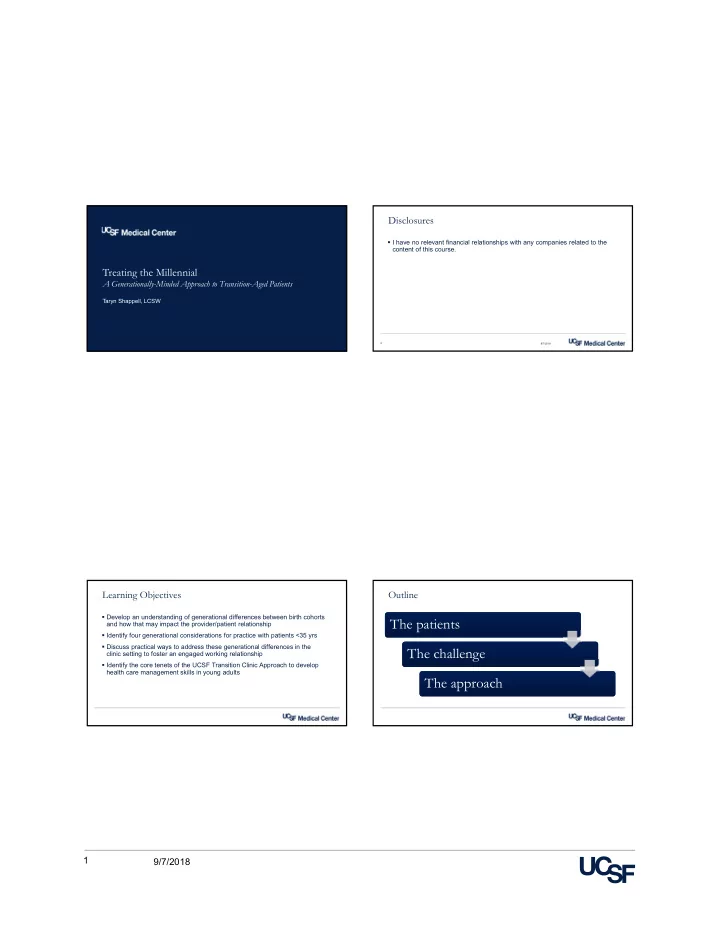
Disclosures I have no relevant financial relationships with any companies related to the content of this course. Treating the Millennial A Generationally-Minded Approach to Transition-Aged Patients Taryn Shappell, LCSW 2 9/7/2018 Learning


slide-1
SLIDE 1

9/7/2018 1

Treating the Millennial

A Generationally-Minded Approach to Transition-Aged Patients

Taryn Shappell, LCSW

Disclosures

  • I have no relevant financial relationships with any companies related to the

content of this course.

9/7/2018 2

Learning Objectives

  • Develop an understanding of generational differences between birth cohorts

and how that may impact the provider/patient relationship

  • Identify four generational considerations for practice with patients <35 yrs
  • Discuss practical ways to address these generational differences in the

clinic setting to foster an engaged working relationship

  • Identify the core tenets of the UCSF Transition Clinic Approach to develop

health care management skills in young adults

Outline

The patients The patients The challenge The challenge The approach The approach

slide-2
SLIDE 2

9/7/2018 2

The Patients (why are Millennials so different?)

  • Dr. Jean Twenge (UCSD)

9/7/2018 6

slide-3
SLIDE 3

9/7/2018 3

Boomers Gen X Millennials iGen

Our Challenges (what gets in the way?) Generational Considerations

  • Technology fluency
  • Information sources
  • Locus of self-control
  • Values

TECHNOLOGY FLUENCY INFORMATION CONFIDENCE VALUES

Generational Considerations

Acquired proficiency/fluency A few known, trusted sources Self-assured and capable Time and achievement

Native language Multiple sources, trusted & not Anxious Individuality

slide-4
SLIDE 4

9/7/2018 4

Generational Considerations

9/7/2018 13

TECHNOLOGY FLUENCY INFORMATION CONFIDENCE VALUES

Generational Considerations

Acquired proficiency/fluency A few known, trusted sources Self-assured and capable Time and achievement

Native language Multiple sources, trusted & not Anxious Individuality

So What Helps?

  • Acknowledge the difference
  • Ask “given that I’m unable to text medical information, what is the next best

way for us to communicate outside of visits?”

  • Have them save your phone number as a contact during your visit

9/7/2018 15

TECHNOLOGY FLUENCY INFORMATION CONFIDENCE VALUES

Generational Considerations

Acquired proficiency/fluency A few known, trusted sources Self-assured and capable Time and achievement

Native language Multiple sources, trusted & not Anxious Individuality

slide-5
SLIDE 5

9/7/2018 5

So What Helps?

  • Assume they’ve Googled it
  • Ask, “where have you looked for information on this already?”
  • Offer reputable information resources

9/7/2018 17

TECHNOLOGY FLUENCY INFORMATION LOCUS OF SELF-CONTROL VALUES

Generational Considerations

Acquired proficiency/fluency A few known, trusted sources Internal Time and achievement

Native language Multiple sources, trusted & not External Individuality

So What Helps?

  • Honest, straightforward expectation
  • No assumptions or scare tactics!
  • Empower them to use what they know to make an informed choice

9/7/2018 19

TECHNOLOGY FLUENCY INFORMATION LOCUS OF SELF-CONTROL VALUES

Generational Considerations

Acquired proficiency/fluency A few known, trusted sources Internal Time and achievement

Native language Multiple sources, trusted & not External Individuality

slide-6
SLIDE 6

9/7/2018 6

So What Helps?

  • Affirm their uniqueness

9/7/2018 21

Our Approach (so what do we do?) Our Approach

  • Skills-focused
  • Individually-tailored
  • DBT-informed

Our Approach

  • Skills-focused
  • Build skills before giving responsibility
  • Concrete list of skills
slide-7
SLIDE 7

9/7/2018 7

Our Approach

  • Individually tailored
  • Developmentally appropriate
  • Considerate of knowledge & culture

Our Approach

  • DBT-informed
  • Support-oriented
  • Cognitive-based
  • Collaborative

taryn.shappell@ucsf.edu