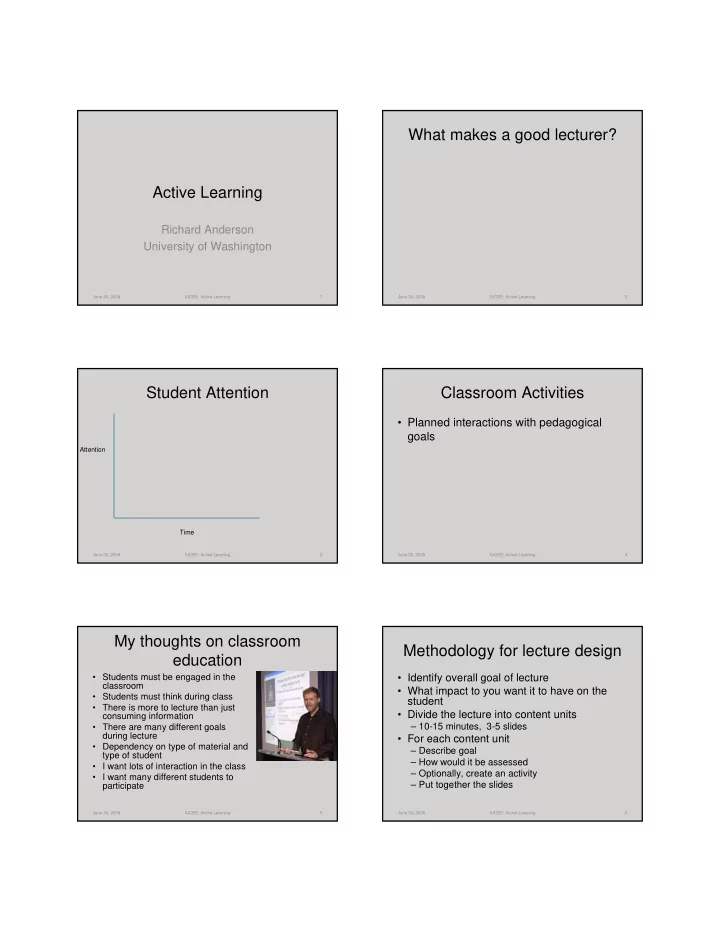
What makes a good lecturer? Active Learning Richard Anderson - - PDF document

what makes a good lecturer active learning
SMART_READER_LITE
LIVE PREVIEW

What makes a good lecturer? Active Learning Richard Anderson - - PDF document

What makes a good lecturer? Active Learning Richard Anderson University of Washington June 30, 2008 IUCEE: Active Learning 1 June 30, 2008 IUCEE: Active Learning 2 Student Attention Classroom Activities Planned interactions with


slide-1
SLIDE 1

Active Learning

Richard Anderson University of Washington

June 30, 2008 1 IUCEE: Active Learning

What makes a good lecturer?

June 30, 2008 IUCEE: Active Learning 2

Student Attention

June 30, 2008 IUCEE: Active Learning 3

Time Attention

Classroom Activities

  • Planned interactions with pedagogical

goals

June 30, 2008 IUCEE: Active Learning 4

My thoughts on classroom education

  • Students must be engaged in the

classroom

  • Students must think during class
  • There is more to lecture than just

consuming information

  • There are many different goals

during lecture

  • Dependency on type of material and

type of student

  • I want lots of interaction in the class
  • I want many different students to

participate

June 30, 2008 IUCEE: Active Learning 5

Methodology for lecture design

  • Identify overall goal of lecture
  • What impact to you want it to have on the

student

  • Divide the lecture into content units

– 10-15 minutes, 3-5 slides

  • For each content unit

– Describe goal – How would it be assessed – Optionally, create an activity – Put together the slides

June 30, 2008 IUCEE: Active Learning 6

slide-2
SLIDE 2

Classroom Assessment Techniques

  • Thomas Angelo,

Patricia Cross

  • Introduce classroom

assessment

  • Catalog of different

assessment techniques

June 30, 2008 IUCEE: Active Learning 7

What is the difference between formative and summative assessments?

  • Formative
  • Summative

June 30, 2008 IUCEE: Active Learning 8

Characteristics of classroom assessments

  • Learner centered
  • Teacher directed
  • Mutually beneficial
  • Formative
  • Context sensitive
  • Ongoing
  • Rooted in good teaching practive

June 30, 2008 IUCEE: Active Learning 9

Seven basic assumptions of Classroom Assessment

  • 1. The quality of student learning is directly,

although not exclusively, related to the quality of teaching. Therefore, one of the most promising ways to improve learning is to improve teaching.

  • 2. To improve their effectiveness, teachers

need first to make their goals and objectives explicit and then to get specific, comprehensible feedback on the extent to which they are achieving those goals and

  • bjectives.

June 30, 2008 IUCEE: Active Learning 10

Seven basic assumptions of Classroom Assessment

  • 3. To improve their learning, students need to

receive appropriate and focused feedback early and often; they also need to learn how to assess their own learning.

  • 4. The type of assessment most likely to

improve teaching and learning is that conducted by faculty to answer questions they themselves have formulated in response to issues or problems in their own teaching

June 30, 2008 IUCEE: Active Learning 11

Seven basic assumptions of Classroom Assessment

  • 5. Systematic inquiry and intellectual challenge are

powerful sources of motivation, growth and renewal for college teachers, and Classroom Assessment can provide such challenge.

  • 6. Classroom Assessment does not require

specialized training; it can be carried out by dedicated teachers from all disciplines.

  • 7. By collaborating with colleagues and actively

involving students in Classroom Assessment efforts, faculty (and students) enhance learning and personal satisfaction.

June 30, 2008 IUCEE: Active Learning 12

slide-3
SLIDE 3

Classroom Activities

  • Pedagogical Goals
  • Classroom Activities

Discussion Artifact

  • Use student generated example to explore

different aspects of a topic

  • Assess overall understanding
  • Diagnose misconceptions

Bangalore Precipitation and Temperature

January December Temperature Daily average, degrees C Use Blue Precipitation mm per month Use Red Student Submission 10 20 30 40 50 100 150 200

Bangalore Weather

June 30, 2008 IUCEE: Active Learning 16

Discovery Activity

  • Have students derive a concept from an

example

Topological Sort

  • Given a set of tasks with precedence

constraints, find a linear order of the tasks

  • Label vertices with integers 1, 2, . . ., n

– If v precedes w, then l(v) < l(w)

142 143 321 341 370 378 326 322 401 421 431

slide-4
SLIDE 4

Find a topological order for the following graph

E F D A C B K J G H I L

Collective Brainstorm

  • Generate student ideas for discussion
  • Build a list of ideas
  • Analyze and evaluate responses

Special problem: Large Size

  • List at least three problems trees must

face (& solve) because of their large sizes. 1. 2. 3.

21

Problem Introduction

  • Have students explore an instance of a

problem before topic is introduced Determine the LCS of the following strings

BARTHOLEMEWSIMPSON KRUSTYTHECLOWN

23

Submissions

slide-5
SLIDE 5

Challenge problems

  • Competition in getting solutions
  • Simultaneous work
  • Submission and discussion

Handwriting Recognition: Identify the following words Problem solving

  • Problems for students submission
  • Allow all students to work on the problems

(and not just the students who always answer first)

  • Observe student performance during

activity

June 30, 2008 IUCEE: Active Learning 27

How many self intersections can a piecewise linear curve with n segments have?

June 30, 2008 IUCEE: Active Learning 28