Table 1. Treatment of Group A Streptococcal Pharyngitis Treatment - - PowerPoint PPT Presentation

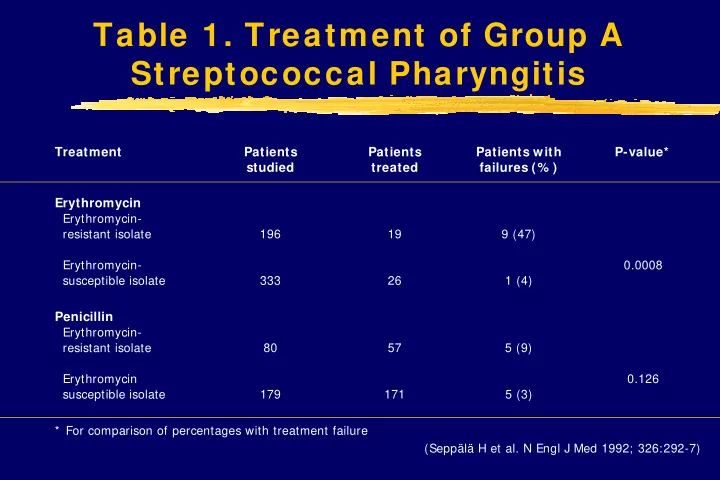
table 1 treatment of group a streptococcal pharyngitis
SMART_READER_LITE
LIVE PREVIEW

Table 1. Treatment of Group A Streptococcal Pharyngitis Treatment - - PowerPoint PPT Presentation

Table 1. Treatment of Group A Streptococcal Pharyngitis Treatment Patients Patients Patients with P-value* studied treated failures (% ) Erythromycin Erythromycin- resistant isolate 196 19 9 (47) Erythromycin- 0.0008 susceptible


slide-1
SLIDE 1

Table 1. Treatment of Group A Streptococcal Pharyngitis

Treatment Patients studied Patients treated Patients with failures (% ) P-value* Erythromycin

Erythromycin- resistant isolate 196 19 9 (47) Erythromycin- susceptible isolate 333 26 1 (4) 0.0008

Penicillin

Erythromycin- resistant isolate 80 57 5 (9) Erythromycin susceptible isolate 179 171 5 (3) 0.126 * For comparison of percentages with treatment failure (Seppälä H et al. N Engl J Med 1992; 326:292-7)

slide-2
SLIDE 2

Table 2. Results of follow -up study: eradication of Streptococcus pyogenes in relation to treatment of pharyngitis in pediatric patients in Italy

Antibiotic treatment

  • No. of patients

treated (n= 668)

  • No. (% ) of S.

pyogenes eradications 95 % CI

Penicillins 208 175 (84.1) 78.3-88.7 Cephalosporins 139 115 (82.7) 75.4-88.6 Macrolides 321 230 (71.7) 66.5-76.4 Erythromycin- susceptible strains 187 150 (80.2) 73.8-85.7 Erythromycin- resistant strains 134 80 (59.7) 50.9-68.1 (Varaldo PE et al. Clin Infect Dis 1999; 29:869-73)

slide-3
SLIDE 3

Table 3. Treatment of children w ith acute otitis media caused by

Streptococcus pneumoniae. Effect of resistance of amoxicillin and macrolides on the efficacy of amoxicillin/clavulanate and azithromycin Treatment

  • No. of patients

treated

  • No. (% ) of patients with

bacteriological success Amoxicillin/ clavulanate

Amoxi/clav-susceptible isolates * 20 18 (90) Amoxi/clav-nonsusceptible isolates * * 9 9 (100)

Azithromycin

Azithromycin-susceptible isolates * 25 23 (92) Azithromycin-resistant isolates * * * 8 3 (38) P= 0.004

* MIC < 0.25 µg/ml, * * MIC > 0.5 µg/ml, * * * MIC > 2µg/ml (Dagan et al. Pediatr Infect Dis J 2000; 19:95-104)

slide-4
SLIDE 4

Table 4. Treatment of children w ith acute otitis media caused by Streptococcus pneumonia. Bacteriologic efficacy of azithromycin and cefaclor

Treatment

  • No. of patients

treated No (%) of patients with bacteriologic failure Azithromycin Azithromycin-susceptible isolates (MIC < 0.06 µg/ml) 12 0 (0) Azithromycin-resistant isolates (MIC > 32.0 µg/ml) 6 6 (100) Cefaclor Cefaclor-susceptible isolates (MIC < 0.5 µg/ml) 14 3 (21) Cefaclor-nonsusceptible isolates (MIC > 0.5 µg/ml) 19 13 (68)

(Dagan R et al. Antimicrob Ag Chemother 2000; 44:43-50)

slide-5
SLIDE 5

Table 5. Outcomes in patients w ith macrolide-resistant pneumococcal infections experiencing clinical failure w hile undergoing treatment w ith macrolides

Macrolide (no. of patients) Days treated (median) Type of infection (no. of patients) Outcome

Erythromycin (3) 3-8 (4) Pneumonia (4) Cured (penicillin or cefotaxime) Azithromycin (4) 2-5 (3) Pneumonia (3 Bacteremia (1) Cured (amoxicillin, penicillin or ceftriaxone) Clarithromycin (3) 2-3 (3) Pneumonia (2) Pneumonia + empyema (1) Cured (ceftriaxone, cefuroxime or cefotaxime) Josamycin (2) 2-4 Pneumonia (1) Bacteremia (1) Cured (cefotaxime or amoxicillin/clavulanate (Garau J. Respir Med 2001; 95 (Suppl A), S5-S11)

slide-6
SLIDE 6

Table 6. Outcomes in patients w ith macrolide-resistant* pneumococcal infections experiencing clinical failure w hile undergoing treatment w ith macrolides

Patient; gender, age (yrs) Macrolide; days treated Disease Outcome

Male 46 Azithromycin; 3 Pneumonia Hypertension Cured (vancomycin + ceftriaxone) Female 58 Azithromycin; 5 Pneumonia Diabetes mellitus Cured (cefotaxime, azithromycin, levofloxacin) Male 77 Clarithromycin; 3 Pneumonia Multiple myeloma Cured (vancomycin) Female 5 Azithromycin, 5 Otitis media Acute lymphocytic leukemia Cured (ceftriaxone)

* Erythromycin MICs 8-16 µg/ml (Kelley M et al. Clin Infect Dis 2000; 31:1008-11)