INFECTIONS IN KIDS Community Acquired PNA Pharyngitis TO TREAT OR - - PDF document

infections in kids
SMART_READER_LITE
LIVE PREVIEW

INFECTIONS IN KIDS Community Acquired PNA Pharyngitis TO TREAT OR - - PDF document

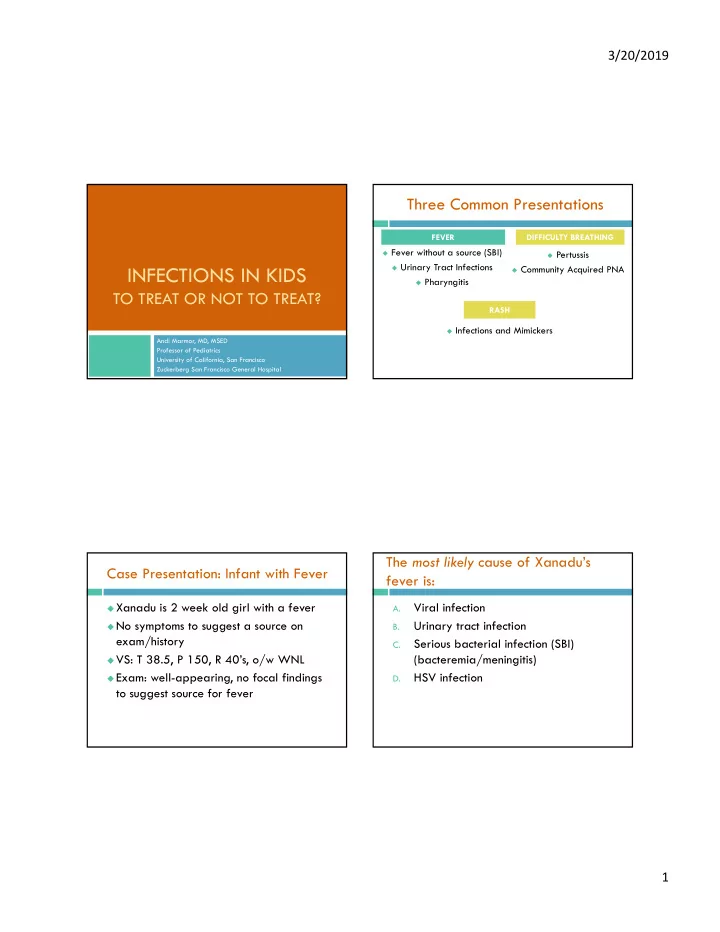
3/20/2019 Three Common Presentations FEVER DIFFICULTY BREATHING Fever without a source (SBI) Pertussis Urinary Tract Infections INFECTIONS IN KIDS Community Acquired PNA Pharyngitis TO TREAT OR NOT TO TREAT? RASH


slide-1
SLIDE 1

3/20/2019 1

INFECTIONS IN KIDS

TO TREAT OR NOT TO TREAT?

Andi Marmor, MD, MSED Professor of Pediatrics University of California, San Francisco Zuckerberg San Francisco General Hospital

Three Common Presentations

 Fever without a source (SBI)  Urinary Tract Infections  Pharyngitis  Pertussis  Community Acquired PNA

FEVER DIFFICULTY BREATHING RASH

 Infections and Mimickers

Case Presentation: Infant with Fever

Xanadu is 2 week old girl with a fever No symptoms to suggest a source on

exam/history

VS: T 38.5, P 150, R 40’s, o/w WNL Exam: well-appearing, no focal findings

to suggest source for fever

The most likely cause of Xanadu’s fever is:

A.

Viral infection

B.

Urinary tract infection

C.

Serious bacterial infection (SBI) (bacteremia/meningitis)

D.

HSV infection

slide-2
SLIDE 2

3/20/2019 2

THE FEBRILE INFANT

Everything you need to know about SBI in febrile infants - on ONE SLIDE

Schwartz, 2009, Gomez 2010, Greenhow, 2014

2-3%

E.Coli>GBS>S. aureus >enterococcus, S pneumo

13-18% <1%

Greenhow, 2014

  • E. Coli

E.Coli/GBSS. pneumo

Fever without a source (FWS): Infants <30 days

 Appearance and standard lab criteria do not reliably

rule out UTI/SBI in this age group

 Kupperman, 2019: validated prediction rule using

UA, ANC and PCT (n=913)

 Neg UA, ANC< 4090/µL, PCT < 1.71ng/mL  2 pts missed by rule, both UTI > 30d (sens 97.7, NPV

99.6)

 Option 1:  Urine, blood, CSF -> admit, empiric abx  Option 2:  Urine, blood ->If UA neg, ANC <4090 and PCT < 1.71,

admit without abx or LP

Fever without a source (FWS): Infants <30 days

Empiric antibiotics: amp/gent or

amp/cefotax

GBS, E. Coli > Staph, enteric GNR’s >>

enterococcus, S. pneumo

Cefotaxime: covers staph, better CSF

penetration, but broader

Ampicillin: previously included to cover

for Listeria- now very rare

Cefotaxime alone being considered in some

settings

DO NOT treat with gentamicin alone

slide-3
SLIDE 3

3/20/2019 3

FWS: Infants 30-90 days

UTI still the most common bacterial source,

  • ther SBI less likely

Viral source more reliable Named viral syndromes or + rapid viral test

(flu, RSV) SBI unlikely

Consider testing for UTI Inflammatory markers (CBC/CRP/PCT)

helpful in select infants

Well appearing, neg UA AND no viral source

Approach to Infant with FWS

Infant well-appearing? Stabilize, obtain cultures, start antibiotics Infant > 90 days? Close follow up Obtain urine for UA and culture Obtain rapid viral test if available Start treatment for UTI/pyelo

  • Consider obtaining blood

culture if < 2 mo Obtain blood for culture and inflammatory markers Close follow up Ceftriaxone Follow cultures for 48h no yes yes RVT+ UA- RVT- UA+ Supportive care and follow up Markers WNL WBC > 15 or < 5 CRP > 20mg/L PCT > 0.5ng/mL Infant >30 days? no yes no UA+ Start IV treatment for pyelo ANC<4090 and PCT<0.71? LP and start empiric abx Observe off abx UA- Obtain urine for UA and culture and blood for culture, ANC and PCT, admit yes no

Case Continued

Since Xanadu is less than 30 days, and

has no source for her fever, you obtain a UA/urine cx and blood cultures and perform an LP

Her UA is positive for LE and nitrites Now what do you do?

URINARY TRACT INFECTIONS (“PYELONEPHRITIS”)

slide-4
SLIDE 4

3/20/2019 4

Risk of UTI in Infants with FWS

2 4 6 8 10 12 14 16 18 20 1 m 3m 6m 12m 18m

Girls Uncirc Boys Circ Boys

Which infants <3 mo should we test for UTI?

2 4 6 8 10 12 14 16 18 20 1 m 3m 6m 12m 18m

Girls Uncirc Boys Circ Boys

ALL infants < 3 mo, T>38

Testing threshold ~2- 3% 2 4 6 8 10 12 14 16 18 20 1 m 3m 6m 12m 18m

Girls Uncirc Boys Circ Boys

Testing threshold ~5%

All Girls Circ boys <6 mo Uncirc boys <12 mo

Which infants >3 mo* should we test for UTI?

*T≥39 for ≥48hrs

Who should we test for UTI?

 All infants with FWS < 3 mo of age  Girls > 3 mo of age FWS (>39) and < 24 months  Boys > 3 mo of age Circumcised: FWS (>39) and < 6 mo Uncircumcised: FWS (>39) and < 12 mo  Additional Risk Factors: Length of fever (> 2 days) Race (non-black)

slide-5
SLIDE 5

3/20/2019 5

Diagnostic Dilemmas

 Collection of urine By catheter for: Infants < 3 mo of age (high risk) Ill-appearing/getting antibiotics Consider bag collection for: Low-risk infant (circ boy> 3 mo, girl/boy>1 year) If UA +, consider cath for culture  Results: + UA: start empiric treatment, send for cx Neg UA: UTI very unlikely, even in young infants Consider sending for culture in high risk neonate

Treatment

 Empiric treatment based on local E. Coli resistance

PO cephalexin safe, tasty, narrow spectrum IV if <2 mo, toxic or not tolerating PO Total course: 7-14 days (for pyelo) Imaging after UTI U/S in infants <3 mo, older kids if recurrent Voiding Cystourethrogram (VCUG) only if high

grade VUR/obstruction on U/S

Roberts 2011;Pediatrics128(3):595–610

Case Continued

Xanadu’s 6 yo brother Zaffre also has a

fever, and is complaining of a sore throat

His temp is 38.9, he has tender cervical

LAN and no cough or runny nose

www.accesspediatrics.com

What is Zaffre’s “modified Centor score?”

A.

1

B.

2

C.

3

D.

4

E.

5

slide-6
SLIDE 6

3/20/2019 6

Modified Centor Score

1 point each: Exudate or swelling on tonsils Tender/swollen ant cervical LN’s Temp > 38C Cough absent Age 3-14

____________ Max score = 5

Modified Centor Score

1 point each: Exudate or swelling on tonsils?? Tender/swollen ant cervical LN’s Temp > 38C Cough absent Age 3-14

____________ Score = 4-5

What does this mean?

What is Zaffre’s prior probability of a +

GAS culture?

A.

~25%

B.

~50%

C.

~75%

D.

~90%

Case Presentation: 3 yo with cough

Amaranth is a 3 yo who presents with 2

weeks of cough, keeps her awake, and

  • ccasional post-tussive vomiting

She has a PMH of bronchiolitis (6 mo) and

is up to date for age on vaccinations

VS: T 38.2, P 130, RR 42, O2 sat 95% Her mother wants to know if this could be

“the whooping cough”

slide-7
SLIDE 7

3/20/2019 7

PERTUSSIS Pertussis Epidemiology

Tdap Acellular pertussis

Phases of Pertussis

PHASE TIME COURSE DESCRIPTION Catarrhal 1-2 weeks Mild fever, cough, rhinorrhea Paroxysmal 1-6 weeks Older infants/children: Paroxysms, whoop, post-tussive emesis Young infants: apnea, cyanosis, bradycardia, poor feeding Convalescent Weeks-Months Improvement in severity and frequency of coughing episodes

Slide courtesy of Ellen Laves, MD

Pertussis: Clinical Diagnosis

Cough lasting >2 weeks + 1of the following: Apnea* Paroxysms of coughing Inspiratory “whoop” Post-tussive vomiting (least specific)

cdc.gov/pertussis

Older children *May occur without cough Neonates/young Infants

slide-8
SLIDE 8

3/20/2019 8

Pertussis: Laboratory Confirmation

Lab confirmation ONLY in those with

signs/symptoms consistent with pertussis

Posterior NP specimen (not pharynx/ant NP) PCR for pertussis False positives may occur Culture + for B. Pertussis Most SPECIFIC test Most sensitive in first 3 weeks

cdc.gov/pertussis

Pertussis: Treatment

 Major benefits: Prevent severe disease* in those at risk Prevent spread to high risk (HR) patient  Empiric treatment: high suspicion and/or HR Infants <1 year (< 3mo, preemie at highest risk) Pregnant women near term Unimmunized or underimmunized  Test and treat if +: HR but low clinical suspicion Patient LR but has HR contacts

*Only treatment BEFORE paroxyms may shorten course

Case Continued

Amaranth’s vaccination status and non-

specific clinical symptoms make pertussis less likely

However, her RR (42) and O2 sat (95%)

make you concerned for pneumonia

Well-appearing, in minimal resp distress

aside from tachypnea

Decreased breath sounds with crackles over

the LLL

What is the RECOMMENDED next step?

A.

Obtain a PA and lateral CXR

B.

Obtain a blood culture and CBC

C.

Obtain a sputum culture

D.

Start PO amoxicillin and discharge with close follow up

E.

Start IV cefuroxime and admit

slide-9
SLIDE 9

3/20/2019 9

PEDIATRIC COMMUNITY ACQUIRED PNEUMONIA Pediatric CAP: Diagnosis

Clinical Symptoms of acute illness (ie: fever) + resp

distress (tachypnea*, retractions, hypoxia) AND

Focal lung findings on exam OR on CXR Imaging Chest x-ray NOT recommended routinely in

  • utpatients

Does not distinguish between pathogens (viral,

atypical, etc)

Bradley JS, et al. Clin Infect Dis. 2011

*MOST SENSITIVE sign

Pediatric CAP: Labs

 Routine lab testing NOT recommended  Blood cultures:  Clinically worsening or hosp with mod/severe disease  Viral testing (flu, RSV)  IF no evidence of bacterial co-infection  CBC/CRP  Not recommended  Testing for Mycoplasma pneumoniae, S. pneumo  If available, may guide antibiotic selection

Bradley JS, et al. Clin Infect Dis. 2011

Pediatric CAP: Causes

Viral is most common < 2 yrs: S. pneumoniae, C.

Trachomatis

2-5 yrs S. pneumoniae, M.

pneumoniae, H influenzae,

  • C. pneumoniae

 M. pneumoniae, C.

pneumoniae > S. pneumoniae

2 MO TO 5 YRS: OVER 5 YEARS:

Bradley JS, et al. Clin Infect Dis. 2011

Based on age, severity, local resistance

slide-10
SLIDE 10

3/20/2019 10

Community Acquired Pneumonia: Treatment

 Inpatient or Outpatient 1st line treatment: Amoxicillin/ampicillin in infants and young children Consider Macrolide (azithro) in kids > 5  Ill patent or high-level PCN resistance: 3rd generation cephalosporin if suspect S. pneumo Vancomycin if suspicion for MRSA +Macrolides if suspicion high for M. pneumoniae

and C. pneumoniae

Bradley JS, et al. Clin Infect Dis. 2011

NAME THAT RASH

Toddler with fever, refusing po’s drooling… Examples of “atypical coxsackie”

Eurosurveillance.org Pediatrics.aapublications.org

slide-11
SLIDE 11

3/20/2019 11

5 yo comes back from camp with fever, cough and runny nose, then develops rash proceeding head to toe

Measles Fast Facts

 Droplet/airborne spread, ~90%  2 doses of vaccine = 97% effective  Dx by serology (IgM or rise in IgG) or PCR  High risk = <5yo or >20yo, pregnant,

immunocompromised

 Severe/fatal complications: Encephalitis: 1/1000 Resp/neurologic complication: 1-2/1000 Subacute sclerosing panencephalitis (SSPE): rare  No specific treatment (vit A for severe illness)

Kindergarten Immunization Rates 2017-18

2017-18 CDPH Kindergarten Immunization Assessment https://www.cdph.ca.gov

9 mo old with high fever for 3 d, fever gone then w/rash on chest head

slide-12
SLIDE 12

3/20/2019 12

5yo with this rash, few other symptoms 10 mo old with rash on day 7 of amoxicillin for AOM

From: Consultant 360

  • Rash started on day 6 of treatment
  • Started truncally, spread to head and

extremities, including palms and soles

  • Not itchy, otherwise well

Amoxicillin Drug Eruption

 Delayed hypersensitivity (T-cell mediated,

Type IV) reaction

Morbilliform, often includes palms and soles,

day 5-10 of treatment

 NOT a drug allergy, and not associated with

advancement to anaphylaxis

Allergy = itchy, urticarial, within hours, may

progress

 May affect up to 10% of pedi pts treated

with amox or PCN

 Future use of amox NOT contraindicated

7 yo with fever, sore throat now with dry, diffuse rash most pronounced

  • n trunk and face

Group A Streptococcal “Scarlet Fever”

slide-13
SLIDE 13

3/20/2019 13

5 yo with temp of 39 for 5 days Kawasaki Disease

Unknown etiology (?ID?) Clinical diagnosis: Fever x5d = 4/5

clinical criteria

Significance: coronary artery aneurysms Treatment: IVIG

C (conjunctivitis) R (rash) A (adenopathy) S (strawberry tongue) H (hands and feet)

Unusual color names…

Xanadu Zaffre Amaranth

References

  • 1. Greenhow TL, et al. The changing epidemiology of serious bacterial infections in young
  • infants. Pediatr Infect Dis Journal 2014; 33(6): 595-599
  • 2. Kupperman N et al. A clinical prediction rule to identify febrile infants 60 days and younger

at low risk for serious bacterial infections. JAMA Pediatr Feb 2019 (online)

  • 3. Roberts KB and the Subcommittee on Urinary Tract Infection, Steering Committee on Quality

Improvement and Management. Urinary tract infection: clinical practice guideline for the diagnosis and management of the initial UTI in febrile infants and children 2 to 24 months.”

  • Pediatrics. 2011;128(3): 595–610
  • 4. Lieberthal, A et al. The Diagnosis and Management of Acute Otitis Media. Pediatrics 2012;

131(3): e964-e999

  • 5. Bradley, J. et al. The Management of Community- Acquired Pneumonia in Infants and

Children Older Than 3 Months of Age: Clinical Practice Guidelines by the Pediatric Infectious Disease Society of America. Clin Inf Dis. 2011; 53(7): e25-e76