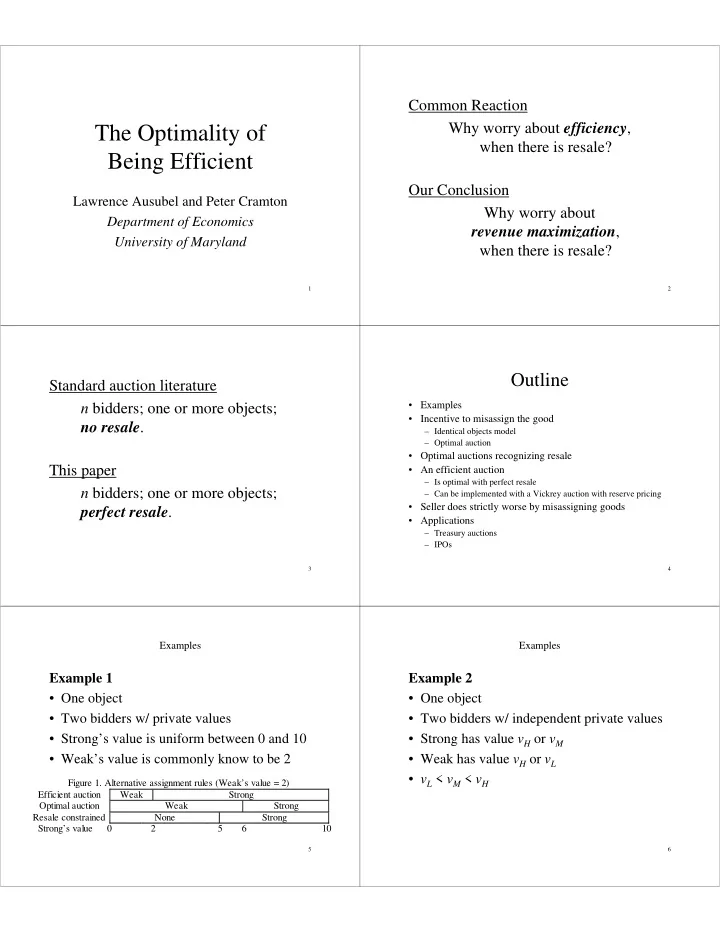
The Optimality of when there is resale? Being Efficient Our - - PDF document

the optimality of
SMART_READER_LITE
LIVE PREVIEW

The Optimality of when there is resale? Being Efficient Our - - PDF document

Common Reaction Why worry about efficiency , The Optimality of when there is resale? Being Efficient Our Conclusion Lawrence Ausubel and Peter Cramton Why worry about Department of Economics revenue maximization , University of Maryland


slide-1
SLIDE 1

1

The Optimality of Being Efficient

Lawrence Ausubel and Peter Cramton Department of Economics University of Maryland

2

Common Reaction Why worry about efficiency, when there is resale? Our Conclusion Why worry about revenue maximization, when there is resale?

3

Standard auction literature n bidders; one or more objects; no resale. This paper n bidders; one or more objects; perfect resale.

4

Outline

  • Examples
  • Incentive to misassign the good

– Identical objects model – Optimal auction

  • Optimal auctions recognizing resale
  • An efficient auction

– Is optimal with perfect resale – Can be implemented with a Vickrey auction with reserve pricing

  • Seller does strictly worse by misassigning goods
  • Applications

– Treasury auctions – IPOs

5

Examples

Example 1

  • One object
  • Two bidders w/ private values
  • Strong’s value is uniform between 0 and 10
  • Weak’s value is commonly know to be 2

Figure 1. Alternative assignment rules (Weak’s value = 2) Efficient auction Weak Strong Optimal auction Weak Strong Resale constrained None Strong Strong’s value 2 5 6 10

6

Examples

Example 2

  • One object
  • Two bidders w/ independent private values
  • Strong has value vH or vM
  • Weak has value vH or vL
  • vL < vM < vH
slide-2
SLIDE 2

7

Optimal auction, for some parameter values, takes the form:

Weak vH vL vH Either Bidder Strong Strong vM Weak Weak

Example

8

Optimal auction, for some parameter values, takes the form: Now introduce sequential bargaining as a resale mechanism, following the auction. Whenever Weak suboptimally wins the good, his value is vL , and Strong’s value is vM.. Can trade at ( vL+vM ) / 2. Inefficient allocation is undone! Seller’s revenues are strictly suboptimal (Theorem 5)

Weak vH vL vH Either Bidder Strong Strong vM Weak Weak Strong

Example

9

Identical Objects Model

  • Seller has quantity 1 of divisible good (value = 0)
  • n bidders; i can consume qi ∈ [0,λi]

q = (q1,…,qn) ∈ Q = {q | qi ∈ [0,λi] & Σiqi ≤ 1}

  • ti is i’s type; t = (t1,…,tn); ti ~ Fi w/ pos. density fi
  • Types are independent
  • Marginal value vi(t,qi)
  • i’s payoff if gets qi and pays xi:

v t y dy x

i i qi

( , ) −

z0

10

Identical Objects Model (cont.)

Marginal value vi(t,qi) satisfies:

  • Value monotonicity

– non-negative – increasing in ti – weakly increasing in tj – weakly decreasing in qi

  • Value regularity: for all i, j, qi, qj, t−i, ti′ > ti,

vi(ti,t−i,qi) > vj(ti,t−i,qj) ⇒ vi(ti′,t−i,qi) > vj(ti′,t−i,qj)

11

Identical Objects Model (cont.)

  • Bidder i’s marginal revenue:

marginal revenue seller gets from awarding additional quantity to bidder i

MR t q v t q F t f t v t q t

i i i i i i i i i i i

( , ) ( , ) ( ) ( ) ( , ) = − − ∂ ∂ 1

12

Revenue Equivalence

Theorem 1. In any equilibrium of any auction game in which the lowest-type bidders receive an expected payoff of zero, the seller’s expected revenue equals

E MR t y dy

t i q t i n

i

( , )

( ) 1z

=

L N M O Q P

slide-3
SLIDE 3

13

Optimal Auction

  • MR monotonicity

– increasing in ti – weakly increasing in tj – weakly decreasing in qi

  • MR regularity: for all i, j, qi, qj, t−i, ti′ > ti,

MRi(t,qi) > MRj(t,qj) ⇒ MRi(ti′,t−i,qi) > MRj(ti′,t−i,qj)

Theorem 2. Suppose MR is monotone and regular. Seller’s revenue is maximized by awarding the good to those with the highest marginal revenues, until the good is exhausted

  • r marginal revenue becomes negative.

14

Optimal Auction is Inefficient

  • Assign goods to wrong parties

– High MR does not mean high value

  • Assign too little of the good

– MR turns negative before values do

15

Three Seller Programs

  • 1. Unconstrained optimal auction

(standard auction literature) Select assignment rule and pricing rule to max E[Seller Revenue] s.t. Incentive Compatibility Individual Rationality

16

Three Seller Programs

  • 2. Resale-constrained optimal auction

(Coase Theorem critique) Select assignment rule and pricing rule to max E[Seller Revenue] s.t. Incentive Compatibility Individual Rationality Efficient resale among bidders

17

Three Seller Programs

  • 3. Efficiency-constrained optimal auction

(Coase Conjecture critique) Select assignment rule and pricing rule to max E[Seller Revenue] s.t. Incentive Compatibility Individual Rationality Efficient resale among bidders and seller

18

  • 1. Unconstrained optimal auction

Select assignment rule to All feasible assignment rules.} q t E MR t y dy Q

q t Q t i q t i n

i

( ) max ( , ) {

( ) ( ) ∈ = z

L N M O Q P

=

1

slide-4
SLIDE 4

19

  • 1. Unconstrained optimal auction

(two bidders)

quantity price d2 d1 MR1 MR2 D q S 1 p2 MR

20

  • 3. Efficiency-constrained optimal auction

Select assignment rule to Ex post efficient assignment rules.} q t E MR t y dy Q

R q t Q t i q t i n R

R i

( ) max ( , ) {

( ) ( ) ∈ = z

L N M O Q P

=

1

21

  • 3. Efficiency-constrained optimal auction

(two bidders)

quantity price d2 d1 MR1 MR2 D q=1 S p1

22

  • 2. Resale-constrained optimal auction

Select assignment rule to Resale -efficient assignment rules.} q t E MR t y dy Q

R q t Q t i q t i n R

R i

( ) max ( , ) {

( ) ( ) ∈ = z

L N M O Q P

=

1

23

  • 2. Resale-constrained optimal auction

(two bidders)

quantity price d2 d1 MR1 MR2 D MRR qR S 1 p1

24

Theorem 4. In the two-stage game (auction followed by perfect resale), the seller can do no better than the resale-constrained optimal auction.

  • Proof. Let a(t) denote the probability measure on

allocations at end of resale round, given reports t. Observe that, viewed as a static mechanism, a(t) must satisfy IC and IR. In addition, a(t) must be resale-efficient.

slide-5
SLIDE 5

25

Can we obtain the upper bound

  • n revenue?

resale process is coalitionally-rational against individual bidders if bidder i obtains no more surplus si than i brings to the table: si ≤ v(N | q,t) – v(N ~ i | q,t). That is, each bidder receives no more than 100% of the gains from trade it brings to the table.

26

Vickrey auction with reserve pricing

Seller sets monotonic aggregate quantity that will be assigned to the bidders, an efficient assignment q*(t) of this aggregate quantity, and the payments x*(t) to be made to the seller as a function of the reports t where Bidders simultaneously and independently report their types t to the seller.

{ }

* ( )

* *

ˆ ( ) ( ( , ), , ) , where ˆ ( , ) inf | ( , ) .

i i

q t i i i i i i i i i i i t

x t v t t y t y dy t t y t q t t y

− − − −

= = ≥

27

Can we attain the upper bound on revenue?

Theorem 5 (Ausubel and Cramton 1999). Consider the two-stage game consisting of the Vickrey auction with reserve pricing followed by a resale process that is coalitionally-rational against individual

  • bidders. Given any monotonic aggregate

assignment rule , sincere bidding followed by no resale is an ex post equilibrium of the two-stage game.

28

Examples

  • Example 3
  • Strong’s value is uniform between 0 and 20
  • Weak’s value is uniform between 0 and 10
  • MRs(s) = 2s – 20
  • MRw(w) = 2w – 10
  • Assign to Strong if s > w + 5 and s > 10
  • Assign to Weak if s < w + 5 and w > 5
  • Keep the good if s < 10 and w < 5

29

10 5 10 20 Strong Weak’s Value None Weak Weak Strong Strong’s Value Weak Optimal Assignment 10 5 10 20 Strong Weak’s Value Weak Strong Strong’s Value Weak Efficient Assignment 10 5 10 20 Strong Weak’s Value Strong Strong’s Value Weak Non-monotonic Assignment 10 6.2 10 20 Strong Weak’s Value Strong Strong’s Value Weak Resale-Constrained Assignment Strong Strong Strong Figure 3. Alternative Assignment Rules None None None

30

Can the seller do equally well by misassigning the goods?

slide-6
SLIDE 6

31

NO!

The seller’s payoff from using an inefficient auction format is strictly less than from using the efficient auction.

Can the seller do equally well by misassigning the goods?

32

Setup for “strictly less” theorem:

  • Multiple identical objects
  • Discrete types

33

Setup for “strictly less” theorem (continued):

  • Monotonic auction: The quantity assigned to each

bidder is weakly increasing in type.

  • Value regularity: Raising one’s own type weakly

increases one’s ranking in values, compared to

  • ther bidders.
  • MR monotonicity: Raising one’s own type weakly

increases everybody’s MR.

  • High type condition: The highest type of any agent

is never a net reseller.

34

Theorem 6. Consider a monotonic auction followed by strictly-individually-rational, perfect resale. If the ex ante probability of resale is strictly positive, then the seller’s expected revenues are strictly less than the resale-constrained optimum.

35

Get it right the first time,

  • r it will cost you!

36

Application 1 Treasury Auction

In the model without resale, the revenue ranking of: Pay-as-bid auction Uniform-price auction Vickrey auction is inherently ambiguous.

slide-7
SLIDE 7

37

Application 1 Treasury Auction

In the model with perfect resale, if each bidder’s value depends exclusively on his own type, then: Vickrey auction unambiguously revenue-dominates: Pay-as-bid auction and: Uniform-price auction.

38

Application 2 IPOs

Sycamore's highly anticipated initial public offering was priced at $38, but began trading at $270.875. The shares closed at $184.75, an increase of 386 percent. [T]he stock opened at 12:45 P.M. amid what one person close to the deal described as a “feeding frenzy.” Within 15 minutes, the stock rose to about $200, where it remained for most of the afternoon. About 7.5 million shares were sold in the offering, or about 10 percent of the company, and 9.9 million shares traded hands yesterday. It appeared that most of the institutional investors who had been able to buy at the offering price sold quickly to those who had been shut out. The day's explosive trading could raise questions about whether the deal's underwriters left money on the table that went to the initial institutional buyers of the stock rather than to

  • Sycamore. (New York Times, October 23, 1999)

39

Application 2 IPOs

Table 1. Recent IPO First-Day Premiums and Volume

a

Company Offering Price First-Day Closing Price Premium (First-Day Close / Offering Price) First-Day Trading Volume / Number Shares Offered Avis Rent-A-Car, Inc. 17 22.5 32.4% 74.8% eBay Inc. 18 47.4 163.2% 259.9% Guess?, Inc. 18 18.0 0.0% 53.9% Keebler Foods Company 24 26.8 11.7% 57.9% Pepsi Bottling Group, Inc. 23 21.7 −5.7% 61.6% Polo Ralph Lauren Corp. 26 31.5 21.2% 67.7% Priceline.com Inc. 16 69.0 331.3% 131.4%

40

It’s optimal to be efficient.