The Octopus Antenna A 4-B AND 8-E LEMENT D IPOLE A RRAY C ONSTRUCTED - - PowerPoint PPT Presentation
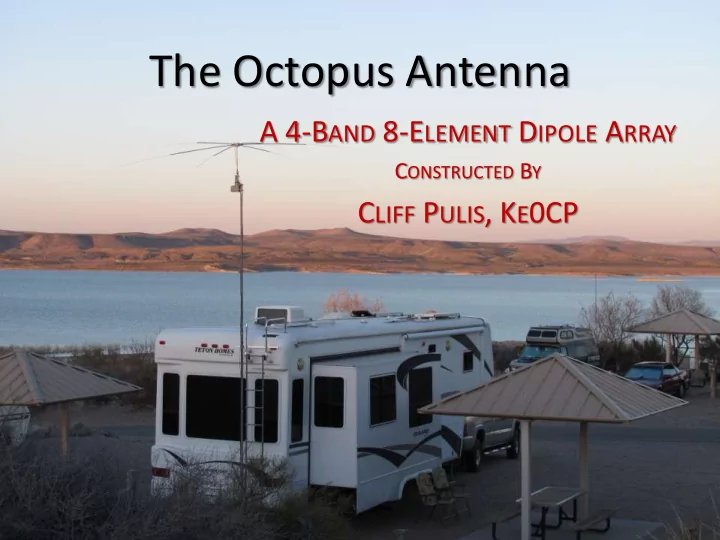
The Octopus Antenna A 4-B AND 8-E LEMENT D IPOLE A RRAY C ONSTRUCTED B Y C LIFF P ULIS , K E 0CP W HAT I S I T ? Multi-Band somewhat directional antenna Basic design uses 4-rigid dipoles (8 elements) arranged in a circular pattern
WHAT IS IT?
- Multi-Band—somewhat—directional antenna
- Basic design uses 4-rigid dipoles (8 elements)
arranged in a circular pattern ==> Octopus
- Antenna has small footprint but delivers impressive
performance (about 15’ in diameter)
- Original design featured in December 2007 QST Magazine, pp 36-38; Geoff
Haines, N1GY.
My antenna is 18 feet above ground and is turned by a rotator at the bottom of the sleeved pipe mast. I have had good results with the antenna 18 to 20 feet high. I have not been able to raise it any higher.
The rotator is from Radio Shack and is mounted on a stake in the ground. The inner pipe is mounted to the rotator. The outer (sleeved) pipe overlaps several feet and is attached to the antenna hub.
The inner and outer pipes are connected via a 10-24 bolt. The position of the outer pipe can be adjusted for height.
The mast assembly is supported by a clamp attached to the roof peak. The lateral support “sleeve bearing” is a piece of 1-1/2 inch SCH 40 PVC pipe held by the clamp (painted gray in this picture.) The main wind vector is against the roof peak.
HOW IS THE ANTENNA CONSTRUCTED?
- Uses 8 HamStick™ antenna elements
- 1 matched pair (dipole) for each amateur band
- Arranged in a circular pattern around a central
hub (pot-metal outdoor electrical junction box)
- Fed with 50-Ohm coaxial line
- Center lead connected to 4-adjacent elements (1
- f each dipole)
- Shield connected to the 4 remaining elements
The gray 20m element is a visual direction indicator.
Elements are for 40, 20, 15 & 10 meters. Single box hub design is shown.
HOW IT WORKS
- One element of each dipole is connected to the
coaxial center lead and one to the shield (180 degrees apart).
- No band switching required! Only the dipole tuned
for the band in use radiates. The others are in the reactive near field but seem to have little effect.
- Dipoles can be tuned to nearly 1:1 SWR. Easily done
with an antenna analyzer (MFJ-259B, or equivalent).
- Diploes exhibit between 1 and 2 S-units of directivity.
SOME “FACTS” TO CONSIDER
- Actual performance can deviate greatly from
theoretical (modeled) predictions.
- Higher up is not always better. There may be multiple
low elevation-angle lobes good for DX work.
- Larger antennas perform better than small ones – so
don’t expect miracles, even so...
- The Octopus is small, light-weight and easy to build.
And it works well!
THE ROTATOR CONTROL
How do you show the direction of 4 dipoles on one rotator dial? Each dipole is bi- directional so only
- ne direction is
shown.
20m, 10m, 40 m, 15m
OK, BUT DOES IT WORK?
A few contacts logged from Western U.S. with this antenna. Contacts in red were made from Belen. 49 Countries worked so far from Belen QTH.
Call Location R/ST Band Date Short Path
ZL1BD Hamilton, New Zealand 5/4 20m 9/19/2010 7,329 mi DU1IVT Paranaque, Philippines 5/9 15m 3/19/2011 7,858 YL2BJ Riga, Latvia 5/8 20m 8/22/2010 5,486 OE3DIA Vienna, Austria 5/5 15m 8/21/2010 5,700 RA1AOB
- St. Petersburg, Russia
5/9 15m 3/16/2011 5,481 F4GBU Paris, France 5/5 15m 10/21/1010 5,196 IZ5LDD Carmignano Prato, Italy 5/5 15m 3/16/2011 5,792 EI2HQ S.E. Ireland 5/3 15m 3/17/2011 4,754 CX2DK Montevideo, Uruguay 5/9 15m 3/19/2011 5,783 TI8II Puntarenas, Costa Rica 579 15m 10/27/2010 2,225
Stacked Hub Construction
One of two hubs showing assembled antenna mounting hardware (for 2 dipoles) before wiring. Note: the 2 grounded elements are near the junction box ground lug.
Stacked Hub Construction
Stacked hub configuration (4 dipoles) before wiring. Note: the 4 floating elements are in the same sector as are the 4 grounded elements.
Stacked Hub Construction
Explosion of antenna mounting hardware; grounded element
- n top, floating
element on bottom. Note: outer diameter
- f shoulder washers
is snug fit inside of conduit holes on junction box.
Stacked Hub Construction
Close-up of floating element mounting. Note: the shoulder washer fits inside the conduit hole and centers the 3/8” bolt so it does not ground to the junction box.
Completing the Hub Assembly
Some drilling is necessary to bolt both junction boxes together and make a hole for the coax center lead to pass from one box to the other. The grounded elements will be wired directly to the junction boxes.
Wiring the Hub Boxes
Upper box wired & ready for cover. Lower box wired showing inside of bottom cover. Mast will screw into center conduit hole in cover.
Completed Hub
Stacked boxes ready for elements, coax and mast.
MATERIALS & COST
Item
- Approx. Cost
Source 4-pair HamSticks™ 8 x $30 per element = $240 Lakeview Company Rotator $60 RadioShack Electrical Junction Boxes & Covers $18 Home Depot, etc. 8 Coupling Nuts & Bolts (3/8-24) $12 Home Depot, etc. Washers (SS & Nylon) $7 hardware store Insulating Shoulder Washers (3/8 x ¾) $5 internet SO-239 connector $5 ham supply store Mast Pipes & Fittings $25 hardware store
- Misc. hardware
$10 hardware store Approx total cost $382 Note: A single-box hub costs a little less but requires more drilling.
VARIATIONS ON DESIGN
- You can use elements for any band covered by HamSticks™
- With some creativity a vertical antenna can be added
above the hub.
- The elements could be remotely shorted together forming
a ground plane for the vertical.
- With a larger hub you might be able to add a 5th dipole.
- Some sort of quick-connect arrangement for the elements
would make assembly/disassembly easier.
- With different mounting hardware and the rotator at the
top of the mast this worked great on my RV.
Or you can always use the antenna for a bird rest!
73…