The objective of harvesting is to pick the fruits at the proper - - PDF document

the objective of harvesting is to pick the fruits at the
SMART_READER_LITE
LIVE PREVIEW

The objective of harvesting is to pick the fruits at the proper - - PDF document

4/2/2012 Importance of Quality Influence of Post-Harvest Operations, Packaging The word quality of fresh fruits is used in various ways: (i) market quality (ii) edible quality, (iii) shipping quality, (iv) table quality, (v) nutritional and


slide-1
SLIDE 1

4/2/2012 1

Influence of Post-Harvest Operations, Packaging and Storage on the quality of fruits

  • Prof. Susanta K. Roy

Professor Emeritus Amity International Center for Postharvest Technology and Cold Chain Management

Amity University Uttar Pradesh, Expressway, Sector-125, Noida INDIA

Importance of Quality

  • The word quality of fresh fruits is used in various ways: (i) market quality

(ii) edible quality, (iii) shipping quality, (iv) table quality, (v) nutritional quality, (vi) internal quality and (vii) appearance quality.

  • Quality is a combination of characteristics, attributes and properties

that give the commodity value to human food.

  • Producers are concerned at out: (i) high on yield, (ii) disease resistance,

(iii) ease of harvest, and (iv) shipping quality.

  • To receivers and market distributors, appearance quality is most

important; they are also keenly interested in firmness and long storage life.

  • Consumers consider good quality fruits which look good, are firm and
  • ffer good flavour and nutritive value.
  • Although consumers buy on the basis of appearance and feel, their

satisfaction and repeat purchases are dependent upon good edible quality.

Pre and Post Harvest Factors on Quality of Fruits

  • Genetic factors - Selection of variety, rootstocks
  • Pre-harvest environmental factors temperature, humidity, light,

wind, rain fall, snow, pollutants.

  • Cultural conditions—soil, nutrient and water supply, mulching,

pruning, thinning, agricultural chemicals, time and method of harvest.

  • Harvesting -Stage of maturity, ripeness, physiological age.
  • Post- harvest treatments
  • Post Harvest Environmental factors—temperature, relative

humidity, atmospheric composition, handling methods, duration between harvesting and consumption.

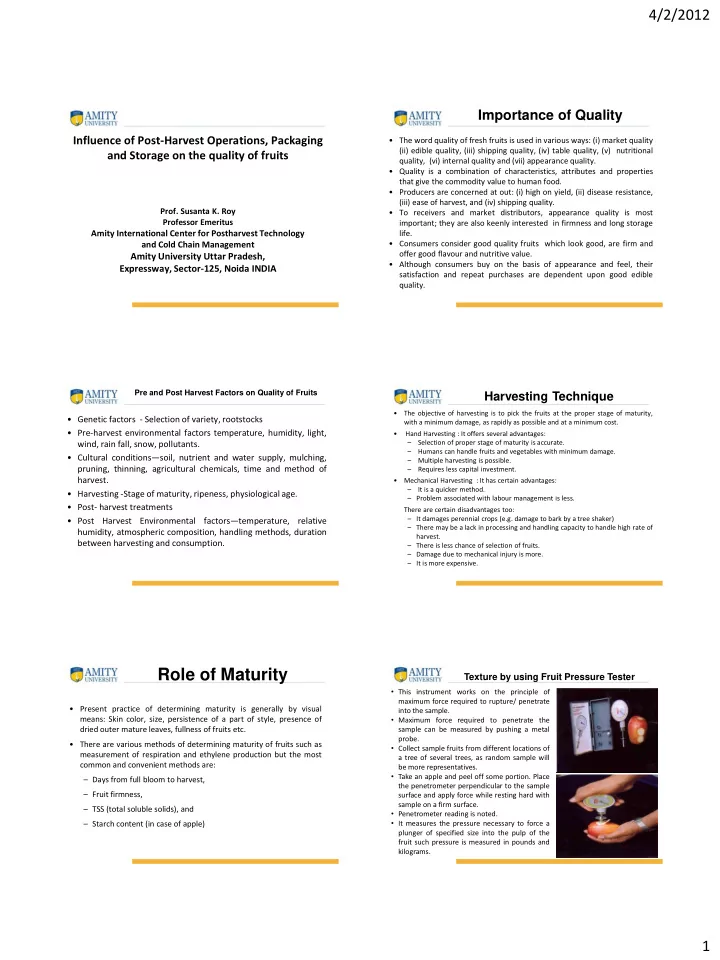
  • The objective of harvesting is to pick the fruits at the proper stage of maturity,

with a minimum damage, as rapidly as possible and at a minimum cost.

  • Hand Harvesting : It offers several advantages:

– Selection of proper stage of maturity is accurate. – Humans can handle fruits and vegetables with minimum damage. – Multiple harvesting is possible. – Requires less capital investment.

  • Mechanical Harvesting : It has certain advantages:

– It is a quicker method. – Problem associated with labour management is less. There are certain disadvantages too: – It damages perennial crops (e.g. damage to bark by a tree shaker) – There may be a lack in processing and handling capacity to handle high rate of harvest. – There is less chance of selection of fruits. – Damage due to mechanical injury is more. – It is more expensive.

Harvesting Technique

Role of Maturity

  • Present practice of determining maturity is generally by visual

means: Skin color, size, persistence of a part of style, presence of dried outer mature leaves, fullness of fruits etc.

  • There are various methods of determining maturity of fruits such as

measurement of respiration and ethylene production but the most common and convenient methods are: – Days from full bloom to harvest, – Fruit firmness, – TSS (total soluble solids), and – Starch content (in case of apple)

  • This instrument works on the principle of

maximum force required to rupture/ penetrate into the sample.

  • Maximum force required to penetrate the

sample can be measured by pushing a metal probe.

  • Collect sample fruits from different locations of

a tree of several trees, as random sample will be more representatives.

  • Take an apple and peel off some portion. Place

the penetrometer perpendicular to the sample surface and apply force while resting hard with sample on a firm surface.

  • Penetrometer reading is noted.
  • It measures the pressure necessary to force a

plunger of specified size into the pulp of the fruit such pressure is measured in pounds and kilograms.

Texture by using Fruit Pressure Tester

slide-2
SLIDE 2

4/2/2012 2

Total Soluble Solids (TSS)

  • TSS is measured with hand refractometer.
  • The refractometer is calibrated by using

two drops of distilled water on the prism

  • f the refractometer
  • Cover the lid and view the reading

through the eyepiece.

  • If the demarcation line between the light

and dark coincides to 0 of the scale then the instrument needs no calibration.

  • If the demarcation line does not coincides

to 0 then adjust the calibration knobs and set it to 0.

  • Extract the apple juice and put two drops
  • n the prism and read the value.

Starch Estimation

  • Early harvested fruits will contain

significant levels of starch that will be converted into sugars during

  • storage. Late harvested fruits will

contain little starch.

  • The

best method for starch estimation is the iodine test.

  • The apple is cut in half and a cut

cross section is dipped in an iodine potassium iodide solution for one minute.

  • The apple surface turns mostly

black the apple has a high starch content.

  • The solution for starch testing is

prepared by dissolving 58.1g of potassium iodide and 14.5 g of iodine in 2 litres distilled water.

Post Harvest Operation

Washing:

  • It is mainly done to meet the demand of the

consumer

  • Improve the appearance
  • Reduce

the primary load

  • f

microorganisms.

  • Remove spray residues before the produce

is ready for the fresh market.

  • Low concentration of chlorine is used in

water to prevent diseases.

  • Drying is an essential to remove the excess
  • f surface water.
  • Excess surface moisture removed

by passing the apples over sponge rollers.

  • Fruits after harvest are assembled in a packinghouse
  • Following operations are undertaken there before packaging

Sorting

  • Sorting is done manually as human eye can detect faulty fruits

easily.

  • This is not satisfactorily achieved in ordinary machines.
  • Only sophisticated equipment with an electronic eye can do this

job.

  • The apples for sorting generally move over a belt or roller

conveyer.

  • Roller conveyer is preferable as the sorter can see all sides of the

fruits.

  • Sorting is generally accomplished in a central packing shed with the

purpose is to: – Remove fruits unsuitable for sale because of injury or decay – Typical shape or colour of a variety sorted for fresh marketing.

  • Meet grade established by the consumer or marketing authority

Grading

  • Grading is necessary to get suitable returns with respect to the quality

attributes.

  • The main outlet for apple is usually the fresh market.
  • Most countries have their own standard for domestic and export trade.
  • Acceptability depends on size, attractiveness and quality of variety.
  • Considerable variations in quality primarily due to the factors namely

Genetic, Environmental and Agronomic

  • Grading manually or mechanically are based on:

– Soundness – Firmness – Cleanliness – Size and Shape – Weight and Colour – Maturity – Free from diseases, mechanical injury, insect damage etc.

  • Most of the fruits have a natural

waxy layer on the outer surface that gets partly removed during the washing process.

  • An extra discontinuous layer of wax

is applied artificially to replace natural wax and reduce the water loss during shipment and storage.

  • This gives a cosmetic appeal to the

consumers and covers up the minute injuries caused during post harvest handling.

  • It acts as a carrier of fungicide/

inhibitor for better shelf life.

Waxing

slide-3
SLIDE 3

4/2/2012 3

RECOMMENDATION FOR IMPROVEMENT

  • Harvest only when fruits reach maturity.
  • The fruit should be removed from the tree with the stalk.
  • Avoid dropping to reduce incidence of damaged fruit.
  • Fruits should be sorted, graded and placed in the ventilated plastic crates

and pre-cooled.

  • Precaution should be taken to see that the vent holes of the boxes are not

closed or blocked.

  • To avoid overfilling use ventilated CFB box with ventilated partition.
  • The packing sheds should be located near road head for easy shipment.
  • Boxes ready for shipment should be stacked in a ventilated shed to avoid the

temperature rise.

  • There should be minimum time gap between packing and shipping.
  • The boxes should not be over stacked in the truck
  • Palletisation and refrigerated transportation are essential.
  • Container Corporation of India Limited (CONCOR) can provide cool chain

facility

  • The increase in production of fruits will have significance only when it

reaches the consumer in good condition at a reasonable price.

  • Packaging of fruits is undertaken primarily to assemble the produce in

convenient units for marketing and distribution, therefore the package must reduce undue damage during handling and transportation.

  • The existing post harvest losses of fruits could be considerably reduced by

adopting improved packaging.

  • Economy and protection are both considered in selecting packaging

materials for fruits.

  • There are a few general rules to be considered (i) life of package must

exceed the life of the product, (ii) the package must give protection (iii) prevent microbial damage (iv) must minimize the physiological and biochemical changes and losses in weight.

  • The other important considerations in choosing a packaging material are
  • product shelf life,
  • systems of storage,
  • handling, transport and mechanization,
  • product display,
  • consumers attitude and
  • need for recycling, re-use and disposal.

Packaging

Existing Packaging Material & Problems

Packaging in wooden Box

  • The cushioning materials used in wooden boxes for

packaging of fruits mainly consists of paddy straw and newspaper.

  • Unlike in wooden boxes no cushioning material is

required in CFB boxes. For example in the case the apples are placed in paper pulp trays having standard fruit cavity without wrapping.

  • Generally 5 to 6 trays are used in boxes depending on

the grades of apples.

  • It has been observed that such type of packaging offer

great protection to the fruits during handling and transportation.

Cushioning Materials

Cushioned with Straw & Paper Wooden box containing Apples Wood, paper & Straw go waste Re-cyclable ventilated CFB Box

Improvement of Existing Packaging

  • This is actually a polyethylene or polypropylene

film which has property that under tension it stretches and when tension is released it comes back to its original forms.

  • This property can help in packaging a few (4 to 6)

fruits on a tray.

  • The whole operation can be carried out without

the application of heat.

  • This type of packaging can be carried out easily

without using any instrument or equipment.

  • Cling Film wrapping
  • Any locally available material can be used for

holding the fruits and then wrapping withstretch / cling film. This can be a popular and safe retail packaging.

  • Modified

atmosphere inside the package develops due to controlled respiration of fruit.

  • Inside the package O2 decreases and CO2

increases, as a result it has enhanced shelf life.

Stretch /Cling Film

slide-4
SLIDE 4

4/2/2012 4

  • In this method apples are wrapped in

heat shrinkable plastic film.

  • The whole operation is carried out in a

shrink-wrapping machine.

  • The main advantages of shrink film and

stretch / cling film wrapping of fruits are :

  • reduced weight loss and extended shelf

life;

  • minimized fruit deformation
  • Shrink wrapping
  • prevention of injury and reduced decay

by prevention of secondary infection of fruit packed in the same box.

Shrink-wrap

Palletisation:

  • By using pallets, post harvest loss of fruits in

CFB boxes can be considerably reduced.

  • All the subsequent operations become very

easy once the boxes are placed on the pallets. Containerization:

  • Though containers have been introduced in

India, these are not at present used for carrying fresh fruits.

  • In the advanced countries, refrigerated

containers are used for shipment of fruits.

  • One of the greatest advantages of the

container is that it can be placed on truck or rail.

  • Palletisation and containerization will go a long

way in establishing both internal and international trade of fruits on a firm footing.

Palletisation and Containerization

Importance of Pre-cooling

  • Prompt

pre cooling and temperature management is critical in lowering the rate of physiological activity of apple.

  • The fruits remain alive even after

harvest and carry

  • ut

transpiration, respiration and

  • ther life processes (ripening-

ethylene, injuries etc).

  • The energy that is needed for life

process comes from the food reserves that accumulated when the fruits were still attached to the tree.

Transpiration & Respiration

TRANSPIRATION

  • Fresh

commodities constantly lose water after harvest.

  • Lost water cannot be

replaced resulting in weight loss.

  • Low

temperature is essential in reducing water loss, shriveling and wilting. RESPIRATION

  • Energy produced through

respiratory activity is utilized in maintaining the life process.

  • Excess energy is released in

the form of heat called vital heat.

  • The amount of vital heat

varies with variety, maturity, stage of ripening, injuries, temperature and other stress related factors.

Ethylene

  • It is a naturally produced gas in all plant tissues and generally recognized

as a ripening hormone.

  • It can have important beneficial or detrimental effects on fresh

commodities, depending on management needs.

  • Rates of both production and action of ethylene are temperature

dependent

  • Rapid cooling and good temperature management is vital if fruit ripening

and other deterioration process are to be delayed.

Injuries

  • Physical injuries can result from

abuses to fresh commodities at any temperature, but temperature affects the severity

  • f the product response to

those injuries.

  • Bruises and other wounds cause

increased ethylene production, which may accelerate respiration, cause deterioration and initiate fruit ripening.

slide-5
SLIDE 5

4/2/2012 5

  • Prompt cooling and maintenance of low

temperature reduces the results of injuries of affecting all of these processes and the growth of decay organisms. Therefore we have to understand the importance of pre-cooling.

  • The quality of a fresh apple, depends on

initial quality at harvest, care exercised in physical handling, length of time since harvest and storage environment.

  • Prompt, thorough cooling to a fruit's

lowest safe temperature is imperative.

  • The fruit temperature is determined by

inserting the probe in the apple and the temperature is recorded from digital display

Measuring Temperature Methods of Pre-cooling

  • Prompt pre cooling is critical in lowering physiological activity.
  • The fruits remain alive even after harvest and carry out transpiration,

respiration and other life process.

  • The energy that is needed for life process comes from the food reserves that

accumulated when the fruits were still attached to the tree.

  • The optimum storage temperature is the single most important

tool responsible for maintaining quality and maximizing post- harvest life.

  • The ideal storage temperature is tailor made to that particular

fruit.

  • The function of fruit storage is to provide an environment that

minimises deterioration until finally consumed.

  • Proper temperature and humidity management can be very

effective tools in ensuring that produce remains in good condition throughout the storage period.

  • Reducing the temperature slows down the rate of respiration,

ethylene production and action, biochemical changes and biological heat production.

  • It also slows down transpiration loss, thereby reducing desiccation
  • f fruit and also checks the development of pathogens.

Storage

  • In a cool store, the temperature control is very
  • important. The temperature is brought down by

taking out the heat with the help of refrigeration .

  • The ideal environment condition for fresh fruit in

storage is the lowest temperature which does not cause chilling injury to the produce.

  • Any variation from the desired temperature is

detrimental.

  • Relative humidity of the storage room also has

considerable bearing on the keeping quality of fruit.

Cool Store

  • Modified atmosphere (MA) essentially means any deviation from the normal

atmospheric gas composition. If this deviation is strictly controlled with certain specific gaseous concentrations of N2, CO2 and O2 then it is termed as “Controlled Atmosphere” (CA).

  • Usually modification of atmospheres during storage of fruit involves reduction

in oxygen (O2) and or elevation of carbon dioxide (CO2) concentrations.

  • The beneficial effects of CA/MA treatments are retardation of ripening,

senescence and physiological changes. In addition it helps in reducing the physiological disorders e.g. chilling injury of various commodities.

  • Modified atmosphere can have a direct or indirect effect on post harvest

pathogens and consequently decay incidence and severity.

  • The design and construction of Controlled Atmosphere Stores require

precision control of the system. Thus the controlled atmosphere store has to be relatively gas-tight, and fitted with reliable refrigeration system with a means of measuring and controlling the concentrations of both carbon dioxide and oxygen (Kader 1985).

  • The recommended %O2 and %CO2 in controlled / modified atmosphere

storage of some important tropical and subtropical fruits.

Controlled/ Modified Atmosphere Storage

Training / Demonstration -1

  • Dr. Susanta K.Roy, Dr. Neeru Dubey and Dr. Shailendera K. Dwivedi
slide-6
SLIDE 6

4/2/2012 6

Physiological loss in weight (PLW %) Physiological Loss in Weight of fruit is mainly due to evaporation, respiration and degradation process occurring during post-harvest handling of fruits. Moisture content of the most of fruits is high and weight loss during transport and storage is an economic factor to be considered especially when sold by weight in market. The physiological loss in weight can be calculated by noting down the difference between the initial and subsequent weight every day. PLW (%)= Initial weight ─ Final weight × 100 Initial weight

Assessment of Physiological change & loss of quality

Refractometer Caliper Sizing rings Scale Temperature probe Psychrometer Pressure Tester Colour chart Laser thermometer

Post harvest tool kit : measuring maturity and quality of fruits and vegetables

ORGANOLEPTIC QUALITY

  • The organoleptic quality for assessing sensory attributes of the

samples was conducted by a panel of seven judges. The samples were rated on the Hedonic Rating Scale as given below (Amerineet

  • al. 1965).
  • Organoleptic score

Rating 9 Like extremely (LE) 8 Like very much (LVM) 7 Like moderately (LM) 6 Like slightly (LS) 5 Neither like nor dislike (NLNDL) 4 Dislike slightly (DS) 3 Dislike moderately (DM) 2 Dislike very much (DVM) 1 Dislike extremely (DE)