
SLIDE 1
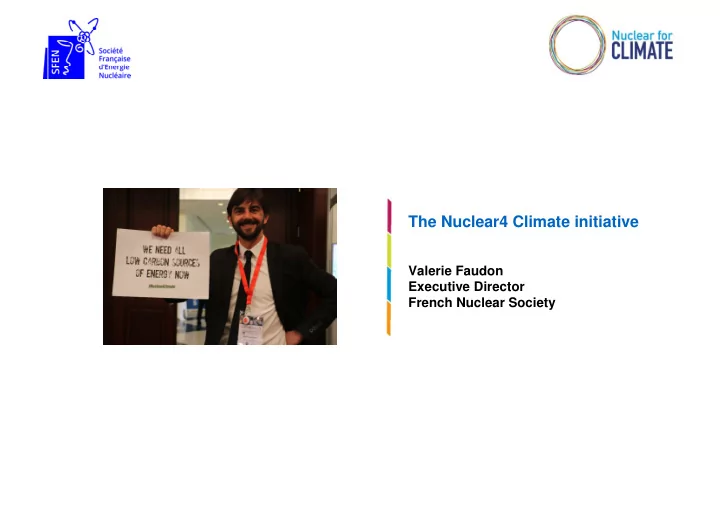
The Nuclear4 Climate initiative
Valerie Faudon Executive Director French Nuclear Society
The Nuclear4 Climate initiative Valerie Faudon Executive Director - - PowerPoint PPT Presentation
The Nuclear4 Climate initiative Valerie Faudon Executive Director French Nuclear Society To limit the temperature increase below 2C in 2050.. Today, it is about 30% 2013 world electricity generation by source Oil Gas 5% ..at least 80% of
Valerie Faudon Executive Director French Nuclear Society
Coal 41% Gas 22% Oil 5% Nuclear 11% Hydro 16% Other renewables 5% Other 32%
2013 world electricity generation by source
Source: AIE-WEO 2014
Source: IPCC WG1 2014
energy mix Electricity demand and share of electricity (IEA)
Source: AIE-AEN Technology roadmap 2015 Source: UN, World Bank
Once released, CO2 remains in the atmosphere for a long time. Carbon budget: cumulative CO2 emissions that must not be exceeded if we are to contain average global warming to 2°C.
500 1000 1500 2000 2500 3000 3500 Carbon budget Remaining Since pre- industrial era
Gt CO2
Source: IPCC
energy is available in 30 countries. Today, only 6 countries above 80% goal of low- carbon electricity, 4 of them have nuclear.
Sweden 40% nuclear Switzerland 40% nuclear France 75% nuclear Brazil 2 nuclear reactors
Since 1971 nuclear power has avoided the release of the equivalent of 2 years of CO2 emissions. By 2040, nuclear power should save the equivalent of 4 years of CO2 emissions.
Source: WEO 2014 Source: IAEA, IEA
IPCC WG3: only 8 scenarios out of 1 200 show limitation below 2° and nuclear phase-out.
Gross nuclear capacity should double by 2050, from 400 GWe to 930 GWe. Share of nuclear power in the global energy mix to increase from 11% to 17%. Stability in OECD (long time operations), and strong growth in BRICs & Middle East: 70+ reactors being constructed WW
Source: IEA technology roadmap, Jan 2015
IEA Scenario 2DS: Installed capacity by country
UNFCC Kyoto Protocol Nuclear energy discriminated against within the Marrakesh Accords (2002)
« Parties.. should refrain from using credits (from CDM1 or JI2 projects) generated from nuclear facilities to meet their commitments3 » -
1 Clean Development Mechanisms 2 Joint Implementation projects 3 emission targets agreed under the Kyoto protocols
An estimated investment in nuclear of USD 4.4 trillion needed WW by 2050*,
Source: OECD-AEN, 2DS
3
UNFCCC Protocols must allow countries who wish to use nuclear energy to have access to climate change financing, as is the case for all other low-carbon energy sources.