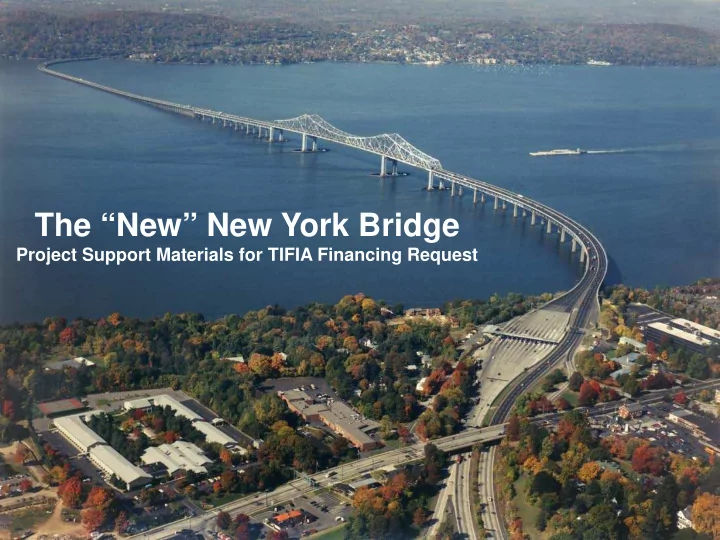
The New New York Bridge Project Support Materials for TIFIA - - PowerPoint PPT Presentation

the new new york bridge
SMART_READER_LITE
LIVE PREVIEW

The New New York Bridge Project Support Materials for TIFIA - - PowerPoint PPT Presentation

The New New York Bridge Project Support Materials for TIFIA Financing Request 1 Every Day and Every Dollar Count To replace the Tappan Zee Bridge, New Yorks new Design-Build project delivery approach is historic: Open and


slide-1
SLIDE 1

1

The “New” New York Bridge

Project Support Materials for TIFIA Financing Request

slide-2
SLIDE 2

2

Every Day and Every Dollar Count

To replace the Tappan Zee Bridge, New York’s new Design-Build project delivery approach is historic:

  • Open and transparent process
  • Concurrent environmental review and procurement
  • Aggressive, consolidated schedule
  • Cost savings, price certainty and risk sharing
  • Close collaboration with local, state and federal agencies
  • Cooperation from labor
  • Rigorous community outreach and planning

Supporting the “New” New York Bridge will provide a model project for cities and states nationwide

slide-3
SLIDE 3

3

Project Schedule

Why now, why this project?

  • Designated as a High-Priority Project by President Obama

– Largest of 3 accelerated TIFIA highway bridge projects in the US

  • The Project’s aggressive consolidated schedule addresses 4

components simultaneously:

– Accelerated EIS Process – Design-Build Procurement Process – Project Labor Agreement – Project Financial Plan

slide-4
SLIDE 4

4

Project Schedule

The Project’s aggressive consolidated schedule can serve as a best practice for cities and states nationwide:

2011 2012 J F M A M J J A S O N D J F M A M J J A S O N D

ACCELERATED EIS PROCUREMENT PLA FINANCIAL PLAN

Draft EIS 1/12 Final EIS 8/12 ROD 9/12 Release RFQ 11/11 Shortlisted Proposers 2/12 Release RFP 3/12 Select Preferred Bidder 10/12 Proposals Due 7/12 PLA Complete 7/12 Draft FP 12/11 Initiate TIFIA Application 8/12 Negotiations Begin 2/12

A new approach to project delivery: Addressing the EIS, Procurement, PLA, and Financial Plan in tandem

slide-5
SLIDE 5

5

Procurement

  • Governor Cuomo signed Design-Build legislation into law in 2011, to foster

creativity and innovation and help control costs

  • Transparent, open Design-Build procurement has attracted world-class

professional talent:

– Kiewit-Skanska-Weeks – Bechtel-Tutor Perini – Fluor-American Bridge-Granite-Traylor Brothers

  • Proposals under final review – Award in October 2012
  • “Smart Early Work,” Project Labor Agreement and competitive procurement likely

to result in Project cost lower than the $5.4 billion estimated by FHWA

  • Procurement process secured and verified by an independent auditor
  • TIFIA loan is an important component of financing plan
slide-6
SLIDE 6

6

Project Labor Agreement

Partnering with 14 construction unions including 26 locals yielded a PLA with $452 million in project savings, including:

  • 10 hour workdays
  • Apprenticeship and training

requirements

  • Lower shift differentials
  • Alternative Dispute Resolution for

Worker’s Compensation

  • Early arrival benefits
  • No-strike provision
  • Sets a new national precedent for

PLAs

slide-7
SLIDE 7

7

The “New” NYS Thruway Authority

  • Governor Cuomo appointed a new Board

Chairman and management, who have taken actions to stabilize finances and advance the “New” New York Bridge

  • The new Thruway Authority has:

– Enhanced transparency, in tandem with the Governor's new approach to governing – Refinanced potentially risky short-term debt – Right-sized Capital Program and deployed smart asset management systems – Reduced expenses by streamlining

  • perations

– Addressed high personnel and benefit costs

slide-8
SLIDE 8

8

The Need – Outdated and Overcrowded

  • Built to last 50 years, opened in 1955
  • 138,000+ vehicles cross the bridge

daily – 40% more than it was designed to handle

  • Traffic jams and long delays are a daily
  • ccurrence
  • Seven bridge lanes mismatched with

eight lanes at landings

  • Accident rate is 2x the average accident

rate on the rest of the 574-mile Thruway

  • No lanes or shoulders for emergency

services or disabled vehicles

  • No access for pedestrians or bicyclists
  • No mass transit capability
slide-9
SLIDE 9

9

An Essential Element for the Regional Economy

  • Serves as the critical link for 50

million vehicles per year

– Key access route to NYC and other areas for suburban commuters – Local, regional, and interstate commercial & passenger traffic

  • There are no nearby alternatives, and
  • ther Hudson crossings already over

capacity

  • By 2040, Westchester-Rockland

corridor population to increase by 17%, jobs to increase by 33%

  • A “New” New York Bridge will create
  • r sustain at least 45,000 jobs
slide-10
SLIDE 10

10

Current Bridge is Extremely Costly to Maintain

  • $750 million spent on bridge

maintenance over the past decade

  • $3-4 billion needed for major

structural overhaul and seismic protections, if bridge is not replaced

  • Keeping current bridge means:

– Growing safety concerns – Massive additional investment – No additional capacity – No mass transit component

slide-11
SLIDE 11

11

Process Reform Yields Results

  • Previous efforts to replace the bridge stalled:

– 13 years of study and inertia – 430 public meetings – 150 concepts – $88 million spent

  • Governor Cuomo initiated a new, accelerated

process to bring the Project to fruition:

– Comprehensive and thorough review, using past studies – “Smart Early Work” to shift risk and save money, including test pilings and soil borings – Accelerated EIS process concurrent with Design- Build procurement

slide-12
SLIDE 12

12

A Vital Regional Transportation Link To Last into the Next Century

  • Built to last 100+ years
  • Built with enhanced express

commuter bus service from

  • pening, and also to

accommodate future transit: Commuter rail or Bus Rapid Transit systems

  • During Bridge construction

project, local communities achieve consensus on mass transit options and funding through regional transit task force agreed upon by Governor and County Executives

slide-13
SLIDE 13

13

A Vital Regional Transportation Link To Last into the Next Century

  • 8 traffic lanes, matching landings on

both sides

  • Dedicated lanes and wide shoulders

for emergency vehicles

  • Enhanced express commuter bus

service

  • Dedicated walkway / bikeway
  • High-tech sensors provide real-time

data on traffic and road conditions

  • Improved toll collection and more E-Z

Pass lanes

slide-14
SLIDE 14

14

Final Environmental Impact Statement (FEIS)

Widespread Public Feedback:

  • 1,100+ people attended Public Hearings
  • 3,000 comments received and

responded to

  • Extended 60-day comment period

Public Support Shown for:

  • Building a better, safer bridge
  • Improving traffic operations
  • Providing mass transit options
  • Creating jobs

Comprehensive Environmental Review:

A National Model

slide-15
SLIDE 15

15

What we heard:

Concerns about noise, dust and air quality, local traffic

What we are doing:

  • Online, 24-hour real-time video,

noise and air quality monitoring

  • Stringent noise reduction

measures

  • State-of-the-art dust and

exhaust emissions controls

  • Transporting materials by barge

and direct Thruway access to reduce construction traffic

Mitigating Community Impacts

slide-16
SLIDE 16

16

What we heard: Concern about endangered

species, dredging, navigable waters

What we are doing:

  • Restricting dredging to three

months annually

  • Using innovative pile driving

procedures, including “bubble curtains” to protect endangered species, and vibration installation where possible

  • Accommodations for falcon

nesting

Protecting the River Environment

The National Marine Fisheries Service declared that the plan for building the bridge will not jeopardize endangered species

slide-17
SLIDE 17

17

What we heard:

Transit options must be incorporated into the bridge

What we are doing:

  • Enhanced express commuter

bus service on the bridge from the day it opens

  • Hundreds of millions of dollars

included in Project to make new bridge ready for BRT or commuter rail

Transit for the Future

slide-18
SLIDE 18

18

Governor Cuomo Says Projected Toll is Too High

Thruway, State, Federal & Local Officials will explore ways to Reduce Tolls

  • Working with Congressional

Members to maximize Federal Support

  • Expanding discount programs to

benefit Westchester & Rockland

  • Identifying ways to lower the Cost
  • f Credit and Borrowing
  • Reserving Bridge toll increases for

the Bridge & Regional Transportation

slide-19
SLIDE 19

19

TIFIA and Project Finance

  • Regional and National Significance

The significance of the Project warrants substantial federal participation

  • The Importance of TIFIA Support

The Project will be funded by toll revenues generated from the new bridge,

supporting toll revenue bonds and the TIFIA loan

  • Ensure Regional Economic Growth

A TIFIA loan equal to 49% of TIFIA-eligible Project costs, with its low interest

rates and flexible repayment terms, would promote economic growth by providing an essential regional link and stabilizing toll rates for commuters, residents and local businesses as well as interstate passenger and truck traffic.

slide-20
SLIDE 20

20

TIFIA Loan Request

TIFIA-ELIGIBLE PROJECT COSTS ($ millions, year-of-expenditure dollars) $4.6B Capital Cost Case $5.4B Capital Cost Case Project Capital Costs 4,600 5,400 Non-TIFIA financing fees 35 40 BAN interest fund deposits 9 9 Toll Revenue Bonds DSRF deposits 146 171 Toll Revenue Bonds interest during construction 206 243 Total TIFIA-Eligible Project Costs 4,996 5,864 TIFIA max % of Eligible Costs 49% 49% Maximum TIFIA Loan 2,448 2,873 The Thruway Authority is requesting TIFIA loans equal to 49% of total eligible Project costs, the maximum allowable under new guidelines

slide-21
SLIDE 21

21

Project Capital Cost

  • Official Project Capital Cost:

– EIS Estimated Range: $4.6 billion - $5.4 billion – Reviewed and affirmed by FHWA in 2012 – Includes large contingencies

  • All three submitted bids confirmed at or below $5.2 billion – below maximum

EIS estimate.

  • For TIFIA Loan, $4.6 billion Capital Cost estimate included to reflect:

– “Smart Early Work” that provides more certainty on soil conditions – Historic PLA agreement savings of over $450 million – Competitive process in which 3 major international syndicates have submitted bids

  • Final Project cost will be confirmed in October when preferred bidder is

selected.

slide-22
SLIDE 22

22

TIFIA and Project Financing

TIFIA-ELIGIBLE COSTS: SOURCES & USES OF FUNDS ($ millions, year-of-expenditure dollars)

$4.6B Capital Cost Case $5.4B Capital Cost Case

Sources Paygo 206 243 BANs net proceeds 7 7 TIFIA proceeds 2,448 2,873 Toll Revenue Bonds 2,333 2,743 Interest Income 15 14 Capital Funds reserve (14) (16) Total Sources 4,996 5,864 Uses TZ Project Capital Costs 4,600 5,400 Non-TIFIA financing fees 35 40 BAN interest fund deposits 9 9 Toll Revenue Bonds DSRF deposits 146 171 Toll Revenue Bonds interest during construction 206 243 Total Uses 4,996 5,864

slide-23
SLIDE 23

23

How Will the TIFIA Loan be Repaid?

  • Revenues from the increase in bridge tolls will be used pay back

funds borrowed for the project

  • The TIFIA loan will benefit from a system-wide pledge of revenues

generated by the Thruway Authority

– Thruway Authority has a more-than-50-year revenue history – There are few nearby alternatives to the bridge, and current toll rates are among the lowest in the Eastern United States – Authority’s financial condition is strong, evidenced by its A1 / A+ credit ratings

  • The TIFIA loan is expected to have an investment grade rating
  • These factors would allow cost of loan to be lower than for most other

TIFIA applicants. Reducing the cost of the loan allows for maximum TIFIA support for this Project, while at the same time preserving TIFIA’s ability to leverage resources nationally

slide-24
SLIDE 24

24

Conclusion

  • The regional and national significance of the Project warrants

significant federal participation

  • A TIFIA loan at 49% of TIFIA-eligible Project costs will maximize the

economic impact of the Project, provide an essential regional link supporting mobility and commerce in New York, New Jersey and Southern New England, and stabilize toll rates for commuters, residents and local businesses as well as interstate passenger and truck traffic

  • With federal support, the “New” New York Bridge can serve as an

historic, best practice model for other major projects across America