
SLIDE 1
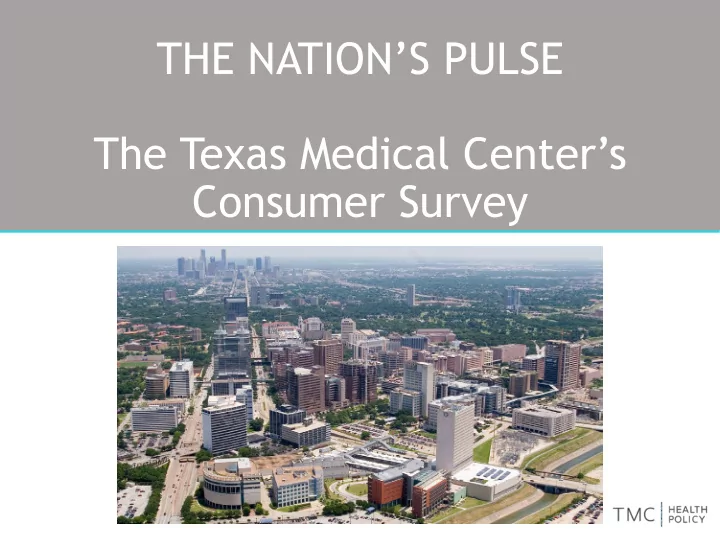
THE NATIONS PULSE The Texas Medical Centers Consumer Survey 2 - - PowerPoint PPT Presentation
THE NATIONS PULSE The Texas Medical Centers Consumer Survey 2 From the Texas Medical Center Health Policy Institute Arthur Tim Garson, Jr., MD, MPH Director Garson@TMC.edu Stephen H. Linder, PhD Associate Director
Arthur “Tim” Garson, Jr., MD, MPH Director Garson@TMC.edu Stephen H. Linder, PhD Associate Director SLinder@TMC.edu Ryan Holeywell TMC Director of Communications RHoleywell@TMC.edu
2
– with n=4020 and n=1018, so in both cases “small” differences count
3
Fixing Health Care: Priorities Fixing Health Care: Health Insurance and Health Care Delivery Fixing Health Care: Healthy Lifestyles Fixing Health Care: Presidential Election Insights
4
5
US Health Care Priorities (Mean Rank)
BASE: ALL QUALIFIED RESPONDENTS (n=4020) Q100 Below are several statements describing key US healthcare priorities. Based on your opinion, please rank these statements, in the order of priority where 1 is the highest priority and 7 is the lowest priority for the US healthcare system.
National
Reducing health care costs Increasing the affordability of health insurance premiums and deductibles Providing universal coverage so every citizen is insured Supporting medical breakthroughs to develop cures Increasing life expectancy in the United States Simplifying health care paperwork Having easier-to-understand health care bills
Highest Priority Lowest Priority
6
US Health Care Priorities (Mean Rank)
BASE: ALL QUALIFIED RESPONDENTS (n=4020) Q100 Below are several statements describing key US healthcare priorities. Based on your opinion, please rank these statements, in the order of priority where 1 is the highest priority and 7 is the lowest priority for the US healthcare system.
National
Reducing costs AFFORDABILITY UNIVERSAL COVERAGE Supporting medical breakthroughs to develop cures
Highest Priority Lowest Priority
Reducing costs AFFORDABILITY BREAKTHROUGHS Providing universal coverage so every citizen is insured
Democrats Republicans
Reducing costs AFFORDABILITY Supporting medical breakthroughs to develop cures UNIVERSAL COVERAGE
Independents
7
33% 28% 33% 6% Very likely Likely Somewhat likely Not at all likely
Likelihood to Only Vote for Candidates Who Prioritize Fixing Health Care
National
BASE: ALL QUALIFIED RESPONDENTS (n=4020) Q165 How likely are you to only vote for candidates who will make fixing healthcare a priority?
Party Affiliation
68% 60% 53% Democrats (A) Republicans (B) Independent (C)
% Important/ Very Important
61%
BC C
8
Strongly agree Somewhat agree Somewhat disagree Strongly disagree
BASE: ALL QUALIFIED RESPONDENTS (n=4020 National; n=1018 Texas) Q220 Now please tell us how much you agree or disagree with each of the statements below. .
18% 31% 24% 27%
National
I have to cut down on
for health care
49%
23% 33% 23% 21%
56%
Texas
9
Strongly agree Somewhat agree Somewhat disagree Strongly disagree
BASE: ALL QUALIFIED RESPONDENTS (n=4020 National; n=1018 Texas) Q220 Now please tell us how much you agree or disagree with each of the statements below.
26% 33% 19% 21%
I’m paying more out-of- pocket for my health care this year than two years ago
National
59%
30% 35% 18% 17%
65%
Texas
10
7% 3% 29% 24% 38%
BASE: ALL QUALIFIED RESPONDENTS (n=4020) Q217 When you receive a costly medical bill, which of the following best describes how you usually handle it? Select one response only.
Action When Receiving Costly Medical Bill
National
Pay in agreed upon installments Don’t pay Don’t pay until collection agency Pay what I can when I can Pay in full right away
11
23% 23% 20% 20% 53% 50% 45% 44%
Cost of procedures and tests he/she recommends Cost of drugs he/she prescribes Whether you can afford procedures and tests he/she recommends Whether you can afford the drugs he/she prescribes
BASE: ALL QUALIFIED RESPONDENTS (n=4020)
with you…?
National
Topics Discussed with Primary Care Physician
Actually Discuss Want to Discuss
12
Strongly agree Somewhat agree Somewhat disagree Strongly disagree
16% 31% 28% 25% 20% 32% 25% 23%
Choosing Any Doctor I Want Is Not As Easy As Two Years Ago
National
47% 52% Choosing Any Hospital I Want Is Not As Easy As Two Years Ago
BASE: ALL QUALIFIED RESPONDENTS (n=4020) Q220 Now please tell us how much you agree or disagree with each of the statements below.
13
14
BASE: QUALIFIED RESPONDENTS IN EXPANSION STATES (Total n=2693/Democrats n=1140/Republicans n=705/Independent n=667) Q110b Are you in favor of your state continuing Medicaid insurance coverage for low-income adults?
Support for Medicaid Continuation (% Yes in Expansion States)
76%
Yes
National
Party Affiliation
85% 65% 75% Democrats (A) Republicans (B) Independent (C)
BC B
15
BASE: QUALIFIED RESPONDENTS IN NON-EXPANSION STATES (Total n=1327/Democrats n=468/Republicans n=407/Independent n=380 - NATIONAL Q110a Are you in favor of your state expanding Medicaid insurance coverage to more low-income adults?
Support for Medicaid Expansion (% Yes in Non-Expansion States)
64%
Yes
National
81% 51% 59% Democrats (A) Republicans (B) Independent (C)
Party Affiliation
BC B
16
Texas
60%
BASE: QUALIFIED RESPONDENTS IN EXPANSION STATES (n=2693) Q120 How important is it to you that a political candidate you vote for feels the same way you do on the following…?
42% 28% 21% 8%
National
Importance that Candidate Feels the Same About Support for Medicaid Continuation Expansion States
Party Affiliation
81% 58% 66% Democrats (A) Republicans (B) Independent (C)
% Important/ Very Important
Very important Important Somewhat important Not at all important
71%
BC B
17
36% 29% 24% 11%
BASE: QUALIFIED RESPONDENTS IN NON-EXPANSION STATES (n=1327) Q120 How important is it to you that a political candidate you vote for feels the same way you do on the following…?
Importance that Candidate Feels the Same About Support for Medicaid Expansion Non-Expansion States
Very important Important Somewhat important Not at all important
Party Affiliation
76% 57% 61% Democrats (A) Republicans (B) Independent (C)
% Important/ Very Important
65%
BC National
18
Support for Proposed Changes to Medicaid
BASE: ALL QUALIFIED RESPONDENTS (n=4020) Q115 Recently, there have been some changes proposed to the Medicaid program. Which proposed changes to Medicaid listed below, if any, are you in favor of? Please select all that apply.
18% 14% 10%
Limit the total amount the federal government pays per person for Medicaid Allow states to limit the number of months an adult can receive Medicaid Exclude any poor adults from receiving Medicaid unless they are disabled
National
19
34% 29% 32% 5%
Very important Important Somewhat important Not at all important
BC 71% 61% 55% Democrats (A) Republicans (B) Independent (C) C
BASE: ALL QUALIFIED RESPONDENTS (n=4020) Q122 Are you in favor of the federal government providing Medicare insurance coverage for all US adults?
Support for Medicare for All US Adults
59%
National
71% 46% 55% Democrats (A) Republicans (B) Independent (C) BC B
Importance that Candidate Feels the Same
20
44% 31% 15% 11%
BASE: ALL QUALIFIED RESPONDENTS (n=4020) Q206 If the federal government offered a catastrophic health insurance plan that you could buy that only covered chronic diseases, accidents and pregnancy, BUT not routine illnesses, how likely would you be to consider this plan instead of your current plan/consider buying this plan]?
Likelihood of Buying/Considering Catastrophic Health Insurance Plan
National
Overall Likelihood Not at all likely Somewhat likely Insurance Status
52% 58% High School or less (A) More than High School (B)
Education
54% 58% Under $50K (A) $50K & above (B)
Income Residence Setting
64% 55% 50% Urban (A) Suburban (B) Rural (C)
56%
A A BC C 50% 74% Insured (A) Uninsured (B) A
Party Affiliation
53% 60% 57% Democrats (A) Republicans (B) Independent (C) A
21
55% 45%
Health Care Setting
Insurance Status
57% 28% Insured (A) Uninsured (B) 52% 56% High School or less (A) More than High School (B)
Education
49% 58% Under $50K (A) $50K & above (B)
Income
Receive care at PCP's office
BASE: ALL QUALIFIED RESPONDENTS (n=4020) Q450 Which setting do you go to most often for your healthcare needs?
Residence Setting
45% 59% 59% Urban (A) Suburban (B) Rural (C) B A A A A
National
22
23
72% 28%
Labeling Menus with Nutritional Info Would Help People Eat Healthier
69% 74% High School or less (A) More than High School (B)
Education
% Somewhat/Strongly Agree
Residence Setting
74% 73% 67% Urban (A) Suburban (B) Rural (C)
BASE: ALL QUALIFIED RESPONDENTS (n=4020) Q135 How much do you agree or disagree with each of these statements?
C C A
National
Party Affiliation
77% 69% 70% Democrats (A) Republicans (B) Independent (C) BC
24
51% 49%
Texas
56%*
Foods that Lead to Obesity Should Cost More
44% 55% High School or less (A) More than High School (B)
Education
45% 54% Under $50K (A) $50K & above (B)
Income
% Somewhat/Strongly Agree
Residence Setting
57% 50% 45% Urban (A) Suburban (B) Rural (C)
BASE: ALL QUALIFIED RESPONDENTS (n=4020 National; n=1018 Texas) Q135 How much do you agree or disagree with each of these statements?
BC A
National
C
25
46% 54%
Texas
Lowering the Legal Blood Alcohol Limit While Driving to 0%
% Somewhat/Strongly Support
Residence Setting
50% 44% 45% Urban (A) Suburban (B) Rural (C)
BASE: ALL QUALIFIED RESPONDENTS (n=4020 National; n=1018 Texas) Q145 How strongly would you support or oppose the following approaches to improve road safety?
BC
National
Party Affiliation
46% 48% 43% Democrats (A) Republicans (B) Independent (C)
48%
26
82% 18%
Texas
Preventing the Sale of All Tobacco Products to People Under 21 Years of Age
Insurance Status
82% 79% Insured (A) Uninsured (B) 80% 82% High School or less (A) More than High School (B)
Education
80% 82% Under $50K (A) $50K & above (B)
Income Residence Setting
82% 82% 81% Urban (A) Suburban (B) Rural (C)
BASE: ALL QUALIFIED RESPONDENTS (n=4020 National; 1018 Texas) Q155 How strongly would you support or oppose the following approaches to reduce tobacco-related illnesses…?
% Somewhat/Strongly Support
National
Party Affiliation
84% 83% 75% Democrats (A) Republicans (B) Independent (C) C C
83%
27
52% 48%
Texas
Banning the Sale of All Tobacco Products
Insurance Status
52% 52% Insured (A) Uninsured (B) 51% 53% High School or less (A) More than High School (B)
Education
49% 54% Under $50K (A) $50K & above (B)
Income
BASE: ALL QUALIFIED RESPONDENTS (n=4020 National; n=1018 Texas) Q155 How strongly would you support or oppose the following approaches to reduce tobacco-related illnesses?
Residence Setting
57% 51% 47% Urban (A) Suburban (B) Rural (C) % Somewhat/Strongly Support A BC
National
Party Affiliation
52% 54% 49% Democrats (A) Republicans (B) Independent (C) C
57%*
28
29
BASE: QUALIFIED RESPONDENTS WHO CONSIDER THEMSELVES DEMOCRATS, REPUBLICANS OR INDEPENDENT (NATIONAL: Democrats n=1608/Republicans n=1112/Independent n=1047); TEXAS: Democrats n=313/Republicans n=370/Independent n=260) Q170 Assuming President Trump runs for re-election in 2020, which of the statements is most true for how you feel today?
Stated Voting in 2020 Presidential Election
30
US Texas US Texas US Texas US Texas
Rep Dem All Ind
Republicans 35%
Likelihood that Trump’s Actions on Health Care Would Prevent From Voting for Him in 2020
(% Likely/Very Likely)
National
BASE: QUALIFIED DEMOCRATS, REPUBLICANS, INDEPENDENTS WHO PLAN TO VOTE FOR TRUMP IN 2020 (Democrats / Republicans/ Independents Planning to Vote for Trump in 2020 n=163/838/378 - NATIONAL) Q175 Again, assuming President Trump runs for re-election in 2020, how likely is it that his actions on each of the following will keep you from voting for him?
31
Democrats 60% Independents 37%
32
BASE: QUALIFIED RESPONDENTS WHO CONSIDER THEMSELVES DEMOCRATS, REPUBLICANS OR INDEPENDENT (Democrats n=1608/Republicans n=1112/Independent n=1047) Q170 Assuming President Trump runs for re-election in 2020, which of the statements is most true for how you feel today?
39% Reduction
33