The Multivariate Percentile Power Method Transformation Dr. - - PowerPoint PPT Presentation

β–Ά
the multivariate percentile power method transformation
SMART_READER_LITE
LIVE PREVIEW

The Multivariate Percentile Power Method Transformation Dr. - - PowerPoint PPT Presentation

The Multivariate Percentile Power Method Transformation Dr. Jennifer Koran Mathematics Colloquium Southern Illinois University Carbondale November 10, 2016 Power Method (PM) Transformation Headrick (2010): 1

slide-1
SLIDE 1

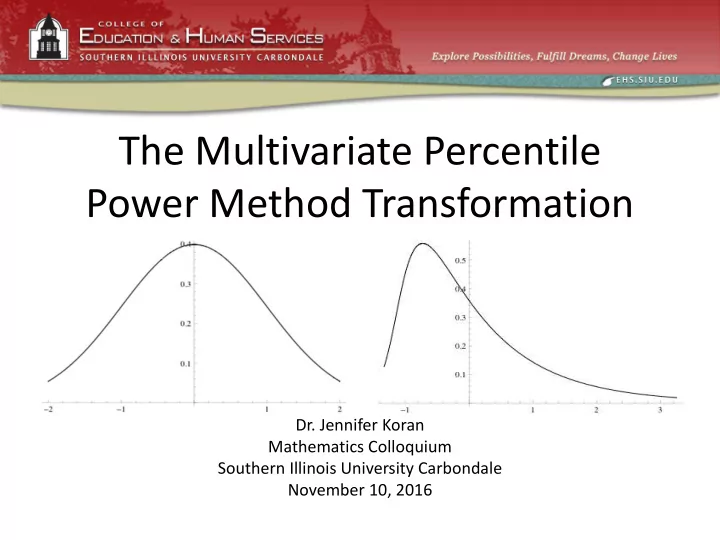
The Multivariate Percentile Power Method Transformation

  • Dr. Jennifer Koran

Mathematics Colloquium Southern Illinois University Carbondale November 10, 2016

slide-2
SLIDE 2

Power Method (PM) Transformation

Headrick (2010):

π‘ž(π‘Ž) = π‘‘π‘—π‘Žπ‘—βˆ’1

𝑛 𝑗=1

𝑔

π‘Ž 𝑨 = πœ’ 𝑨 = 2𝜌 βˆ’1

2 exp βˆ’ 𝑨2 2

πΊπ‘Ž 𝑨 = Ξ¦ 𝑨 = πœ’ 𝑣 𝑒𝑣

𝑨 βˆ’βˆž

, βˆ’βˆž < 𝑨 < +∞

slide-3
SLIDE 3

The conventional moment based Fleishman third-order power method

Headrick (2010), based on Fleishman (1978): 𝛽1 = 0 = 𝑑1 + 𝑑3 𝛽2 = 1 = 𝑑2

2 + 2𝑑3 2 + 6𝑑2𝑑4 + 15𝑑4 2

𝛽3 = 8𝑑3

3 + 6𝑑2 2𝑑3 + 72𝑑2𝑑3𝑑4 + 270𝑑3𝑑4 2

𝛽4 = 3𝑑2

4 + 60𝑑2 2𝑑3 2 + 60𝑑3 4 + 60𝑑2 3𝑑4 + 936𝑑2𝑑3 2𝑑4

+ 630𝑑2

2𝑑4 2 + 4500𝑑3 2𝑑4 2 + 3780𝑑2𝑑4 3

+ 10395𝑑4

4 βˆ’ 3.

?

slide-4
SLIDE 4

The percentile based power method uses four moment-like parameters

Karian and Dudewicz (2011, pp. 172-173): Median: 𝛿1 = πœ„0.50 Inter-decile range: 𝛿2 = πœ„0.90 βˆ’ πœ„0.10 Left-right tail-weight ratio : 𝛿3 =

πœ„0.50βˆ’πœ„0.10 πœ„0.90βˆ’πœ„0.50

Tail-weight factor: 𝛿4 =

πœ„0.75βˆ’πœ„0.25 𝛿2

Restrictions: βˆ’βˆž < 𝛿1 < +∞, 𝛿2 β‰₯ 0, 𝛿3 β‰₯ 0, 0 ≀ 𝛿4 ≀ 1 A symmetric distribution implies that 𝛿3 = 1. β€œpercentile skew” β€œpercentile kurtosis”

slide-5
SLIDE 5

Substitute the standard normal distribution percentiles (𝑨𝑣) into parameter equations

𝛿1 = π‘ž(𝑨0.50) = 𝑑1 𝛿2 = π‘ž(𝑨0.90) βˆ’ π‘ž(𝑨0.10) = 2𝑑2𝑨0.90 + 2𝑑4𝑨0.90

3

𝛿3 = π‘ž(𝑨0.50) βˆ’ π‘ž(𝑨0.10) π‘ž(𝑨0.90) βˆ’ π‘ž(𝑨0.50) = 1 βˆ’ 2𝑑3𝑨0.90 𝑑2 + 𝑑3𝑨0.90 + 2𝑑4𝑨0.90

2

𝛿4 = π‘ž(𝑨0.75) βˆ’ π‘ž(𝑨0.25) 𝛿2 = 2𝑑2𝑨0.75 + 2𝑑4𝑨0.75

3

2𝑑2𝑨0.90 + 2𝑑4𝑨0.90

3

where 𝑨0.50 = 0, 𝑨0.90 = 1.281 β‹―, 𝑨0.75 = 0.6744 β‹― from the standard normal distribution.

slide-6
SLIDE 6

closed-form expressions for the Percentile PM coefficients

𝑑1 = 𝛿1 𝑑2 = 𝛿2 𝛿4𝑨0.90

3

βˆ’ 𝑨0.75

3

2𝑨0.90

3

𝑨0.75 βˆ’ 2𝑨0.90𝑨0.75

3

𝑑3 = 𝛿2 1 βˆ’ 𝛿3 2 1 + 𝛿3 𝑨0.90

2

𝑑4 = βˆ’ 𝛿2 𝛿4𝑨0.90 βˆ’ 𝑨0.75 2𝑨0.90

3

𝑨0.75 βˆ’ 2𝑨0.90𝑨0.75

3

Boundary conditions for Percentile PM pdfs

slide-7
SLIDE 7

𝑑1 = 𝛿1 𝑑2 = 𝛿2 𝛿4𝑨0.90

3

βˆ’ 𝑨0.75

3

2𝑨0.90

3

𝑨0.75 βˆ’ 2𝑨0.90𝑨0.75

3

𝑑3 = 𝛿2 1 βˆ’ 𝛿3 2 1 + 𝛿3 𝑨0.90

2

𝑑4 = βˆ’ 𝛿2 𝛿4𝑨0.90 βˆ’ 𝑨0.75 2𝑨0.90

3

𝑨0.75 βˆ’ 2𝑨0.90𝑨0.75

3

Univariate Percentile PM Transformation process

π‘ž π‘Ž =

𝑗=1 𝑛

π‘‘π‘—π‘Žπ‘—βˆ’1

slide-8
SLIDE 8

Simulating correlated data

π‘žπΎ π‘ŽπΎ = 𝐾 π‘žπΏ π‘ŽπΏ = 𝐿 𝐷𝑝𝑠𝑠 π‘ŽπΎ, π‘ŽπΏ = 𝐷𝑝𝑠𝑠 J , 𝐿

?

Intermediate correlation Specified correlation

𝐷𝑝𝑠𝑠 π‘ŽπΎ, π‘ŽπΏ β‰  𝐷𝑝𝑠𝑠 J , 𝐿

slide-9
SLIDE 9

Multivariate Conventional PM

Vale and Maurelli (1983) πœπ‘˜π‘™ = 𝐹 π‘ž π‘Ž

π‘˜ π‘ž π‘Žπ‘™

= 𝑠

π‘˜π‘™ 𝑑 π‘˜2𝑑𝑙2 + 3𝑑 π‘˜4𝑑𝑙2 + 3𝑑 π‘˜2𝑑𝑙4 + 9𝑑 π‘˜4𝑑𝑙4 + 2𝑑 π‘˜1𝑑𝑙1𝑠 π‘˜π‘™ + 6𝑑 π‘˜4𝑑𝑙4𝑠 π‘˜π‘™ 2

Specified Correlation Matrix Ξ‘ 1 2 3 4 1 1 2 0.80 1 3 0.70 0.60 1 4 0.65 0.50 0.45 1 Intermediate Correlation Matrix

𝑆

1 2 3 4 1 1 2 0.897 1 3 0.831 0.666 1 4 0.750 0.580 0.489 1

slide-10
SLIDE 10

Multivariate Percentile PM with Spearman correlation

πœŠπ‘˜π‘™ = 6 𝜌 π‘œ βˆ’ 2 π‘œ βˆ’ 1 sinβˆ’1 𝑠

π‘˜π‘™

2 + 1 π‘œ βˆ’ 1 sinβˆ’1 𝑠

π‘˜π‘™

Specified Correlation Matrix Ξ 1 2 3 4 1 1 2 0.80 1 3 0.70 0.60 1 4 0.65 0.50 0.45 1 Intermediate Correlation Matrix, n = 25 𝑆 1 2 3 4 1 1 2 0.835 1 3 0.739 0.639 1 4 0.689 0.536 0.484 1

slide-11
SLIDE 11

Multivariate Percentile PM Transformation process

  • 1. Specify percentiles and obtain polynomial

coefficients to transform each variable

  • 2. Specify Spearman correlations for each pair of

variables

  • 3. Solve for intermediate Pearson correlations
  • 4. Simulate random normal variates with the

intermediate Pearson correlations

  • 5. Substitute the random normal variates into the

polynomial equations using the coefficients from Step 1

slide-12
SLIDE 12

The Simulation and Monte Carlo Study

  • Fortran algorithm
  • generate 25,000 independent sample estimates

for the specified parameters

– conventional skew (𝛽3) and kurtosis (𝛽4) and – left-right tail-weight ratio 𝛿3 and tail-weight factor 𝛿4

  • π‘œ = 25 and π‘œ = 750
  • Bias-corrected accelerated bootstrapped median

estimates, using 10,000 resamples [Spotfire S+]

slide-13
SLIDE 13

Distribution 1

Figure 1. The power method (PM) pdf of Distribution 1. Conventional PM Percentile PM Percentiles Skew: 𝛽3 = 0 Kurtosis: 𝛽4 = 25 𝑑1 = 0 𝑑2 = 0.2553 𝑑3 = 0 𝑑4 = 0.2038 Left-right tail-weight ratio: 𝛿3 = 1.0000 Tail-weight factor : 𝛿4 = 0.3105 𝑑1 = 0 𝑑2 = 0.4327 𝑑3 = 0 𝑑4 = 0.3454

πœ„ 𝑦 0.10 = βˆ’0.7560 πœ„ 𝑦 0.25 = βˆ’0.2347 πœ„ 𝑦 0.50 = 0 πœ„ 𝑦 0.75 = 0.2347 πœ„ 𝑦 0.90 = 0.7560

slide-14
SLIDE 14

Distribution 2

Figure 2. The power method (PM) pdf of Distribution 2. Conventional PM Percentile PM Percentiles Skew: 𝛽3 = 3 Kurtosis: 𝛽4 = 21 𝑑1 = βˆ’0.2523 𝑑2 = 0.4186 𝑑3 = 0.2523 𝑑4 = 0.1476 Left-right tail-weight ratio: 𝛿3 = 0.3130 Tail-weight factor : 𝛿4 = 0.3335 𝑑1 = βˆ’0.3203 𝑑2 = 0.5315 𝑑3 = 0.3203 𝑑4 = 0.1874

πœ„ 𝑦 0.10 = βˆ’0.6851 πœ„ 𝑦 0.25 = βˆ’4652 πœ„ 𝑦 0.50 = βˆ’0.2523 πœ„ 𝑦 0.75 = 0.1901 πœ„ 𝑦 0.90 = 1.0092

slide-15
SLIDE 15

Distribution 3

Figure 3. The power method (PM) pdf of Distribution 3. Conventional PM Percentile PM Percentiles Skew: 𝛽3 = 2 Kurtosis: 𝛽4 = 7 𝑑1 = βˆ’0.2600 𝑑2 = 0.7616 𝑑3 = 0.2600 𝑑4 = 0.0531 Left-right tail-weight ratio: 𝛿3 = 0.2841 Tail-weight factor : 𝛿4 = 0.1894 𝑑1 = βˆ’0.2908 𝑑2 = 0.8516 𝑑3 = 0.2908 𝑑4 = 0.0593

πœ„ 𝑦 0.10 = βˆ’0.9207 πœ„ 𝑦 0.25 = βˆ’0.6717 πœ„ 𝑦 0.50 = βˆ’0.2600 πœ„ 𝑦 0.75 = 0.3882 πœ„ 𝑦 0.90 = 1.2547

slide-16
SLIDE 16

Distribution 4

Figure 4. The power method (PM) pdf of Distribution 4. Conventional PM Percentile PM Percentiles Skew: 𝛽3 = 0 Kurtosis: 𝛽4 = 0 𝑑1 = 0 𝑑2 = 1 𝑑3 = 0 𝑑4 = 0 Left-right tail-weight ratio: 𝛿3 = 0.0000 Tail-weight factor : 𝛿4 = 0.1226 𝑑1 = 0 𝑑2 = 1 𝑑3 = 0 𝑑4 = 0

πœ„ 𝑦 0.10 = βˆ’1.2816 πœ„ 𝑦 0.25 = βˆ’0.6745 πœ„ 𝑦 0.50 = 0 πœ„ 𝑦 0.75 = 0.6745 πœ„ 𝑦 0.90 = 1.2816

slide-17
SLIDE 17

Marginal Results n = 25

Skew (𝛽3) and Kurtosis (𝛽4) results for the Conventional PM. Dist Parameter Estimate 95% Bootstrap C.I. Standard Error Relative Bias % 1 𝛽3 = 0

  • 0.0223
  • 0.0497,0.0045

0.013660

  • 𝛽4 = 25

4.4560 4.4011,4.5261 0.030200

  • 82.18

2 𝛽3 = 3 1.5750 1.5579,1.5911 0.008122

  • 47.50

𝛽4 = 21 3.6960 3.6452,3.7525 0.027010

  • 82.40

3 𝛽3 = 2 1.2780 1.2677,1.2893 0.005561

  • 36.10

𝛽4 = 7 1.5230 1.4849,1.5662 0.020430

  • 78.24

4 𝛽3 = 0 0.0034

  • 0.0038,0.0103

0.003626

  • 𝛽4 = 0
  • 0.1786
  • 0.1906,-0.1678

0.005579

  • Left-right tail-weight ratio 𝛿3 and tail-weight factor 𝛿4 results for Percentiles PM

Dist Parameter Estimate 95% Bootstrap C.I.

  • Stand. Error

Relative Bias % 1 𝛿3 = 1.0000 1.0050 0.9942, 1.0154 0.005348

  • 𝛿4 = 0.3105

0.3208 0.3191, 0.3227 0.000947

  • 2

𝛿3 = 0.3430 0.3466 0.3438, 0.3497 0.001485 1.04 𝛿4 = 0.3868 0.3972 0.3954, 0.3993 0.000983 2.70 3 𝛿3 = 0.4361 0.4472 0.4444, 0.4501 0.001464 2.53 𝛿4 = 0.4872 0.4960 0.4943, 0.4980 0.001003 1.80 4 𝛿3 = 1.0000 0.9978 0.9912, 1.0045 0.003380

  • 𝛿4 = 0.5263

0.5294 0.5279, 0.5310 0.000801

slide-18
SLIDE 18

Correlation Results n = 25

Correlation results for the Conventional PM, π‘œ = 25

Parameter Estimate 95% Bootstrap C.I. Standard Error RSE Relative Bias % 𝜍12

βˆ— = 0.80

0.8275 0.8258 , 0.8290 0.002612 0.0032 3.43 𝜍13

βˆ— = 0.70

0.7358 0.7340 , 0.7376 0.001944 0.0026 5.12 𝜍14

βˆ— = 0.65

0.6959 0.6943 , 0.6976 0.001575 0.0023 7.07 𝜍23

βˆ— = 0.60

0.6209 0.6185 , 0.6236 0.002075 0.0033 3.48 𝜍24

βˆ— = 0.50

0.5376 0.5354 , 0.5400 0.001595 0.0030 7.52 𝜍34

βˆ— = 0.45

0.4677 0.4650 , 0.4700 0.001638 0.0035 3.93

Correlation results for the Percentiles PM, π‘œ = 25

Parameter Estimate 95% Bootstrap C.I. Standard Error RSE Relative Bias % 𝜊12 = 0.80 0.8141 0.8123 , 0.8146 0.002007 0.0025 1.76 𝜊13 = 0.70 0.7138 0.7119 , 0.7162 0.002005 0.0028 1.97 𝜊14 = 0.65 0.6658 0.6646 , 0.6685 0.001954 0.0029 2.43 𝜊23 = 0.60 0.6142 0.6115 , 0.6154 0.001719 0.0028 2.37 𝜊24 = 0.50 0.5154 0.5131 , 0.5177 0.001809 0.0035 3.09 𝜊34 = 0.45 0.4646 0.4631 , 0.4685 0.001534 0.0033 3.23

slide-19
SLIDE 19

Marginal Results n = 750

Skew (𝛽3) and Kurtosis (𝛽4) results for the Conventional PM. Dist Parameter Estimate 95% Bootstrap C.I. Standard Error Relative Bias % 1 𝛽3 = 0 2.562 2.5383, 2.5823 0.01117

  • 26.5

𝛽4 = 25 22.15 21.6873, 22.6698 0.24850

  • 81.5

2 𝛽3 = 3 2.180 2.1668, 2.1944 0.00697

  • 12.3

𝛽4 = 21 13.36 13.0936, 13.6467 0.14100

  • 49.7

3 𝛽3 = 2

  • 0.0051
  • 0.0265, 0.0163

0.01100

  • 𝛽4 = 7

18.57 18.2203, 18.9412 0.18330

  • 53.4

4 𝛽3 = 0 1.54 1.5246, 1.5539 0.00743

  • 15.8

𝛽4 = 0 12.91 12.6537, 13.1903 0.13610

  • 45.0

Left-right tail-weight ratio 𝛿3 and tail-weight factor 𝛿4 results for Percentiles PM. Dist Parameter Estimate 95% Bootstrap C.I.

  • Stand. Error

Relative Bias % 1 𝛿3 = 1.0000 1.0000 0.9978, 1.0020 0.001062

  • 𝛿4 = 0.3105

0.3108 0.3105, 0.3112 0.000171 0.11 2 𝛿3 = 0.3430 0.3432 0.3426, 0.3438 0.000308

  • 𝛿4 = 0.3868

0.3873 0.3869, 0.3877 0.000203 0.14 3 𝛿3 = 0.4361 0.4359 0.4353, 0.4364 0.000287

  • 𝛿4 = 0.4872

0.4874 0.4870, 0.4877 0.000189

  • 4

𝛿3 = 1.0000 1.0000 0.9991, 1.0014 0.000539

  • 𝛿4 = 0.5263

0.5264 0.5261, 0.5267 0.000159

slide-20
SLIDE 20

Correlation Results n = 750

Correlation results for the Conventional PM, π‘œ = 750

Parameter Estimate 95% Bootstrap C.I. Standard Error RSE Relative Bias % 𝜍12

βˆ— = 0.80

0.8012 0.8009 , 0.8018 0.000622 0.0008 0.15 𝜍13

βˆ— = 0.70

0.7037 0.7033 , 0.7042 0.000496 0.0007 0.53 𝜍14

βˆ— = 0.65

0.6546 0.6542 , 0.6549 0.000330 0.0005 0.71 𝜍23

βˆ— = 0.60

0.6007 0.6001 , 0.6012 0.000464 0.0008 0.11 𝜍24

βˆ— = 0.50

0.5022 0.5018 , 0.5026 0.000266 0.0005 0.45 𝜍34

βˆ— = 0.45

0.4506 0.4501 , 0.4510 0.000271 0.0006 0.12

Correlation results for the Percentiles PM, π‘œ = 750

Parameter Estimate 95% Bootstrap C.I. Standard Error RSE Relative Bias % 𝜊12 = 0.80 0.8001 0.8001 , 0.8005 0.000338 0.0004 0.02 𝜊13 = 0.70 0.7004 0.7000 , 0.7007 0.000322 0.0005 0.05 𝜊14 = 0.65 0.6502 0.6499 , 0.6506 0.000303 0.0005

  • 𝜊23 = 0.60

0.6002 0.5999 , 0.6006 0.000302 0.0005

  • 𝜊24 = 0.50

0.5000 0.4995 , 0.5005 0.000328 0.0007

  • 𝜊34 = 0.45

0.4502 0.4497 , 0.4506 0.000293 0.0007

slide-21
SLIDE 21

Multivariate Percentile PM with Pearson correlation

πœπ‘˜π‘™ = 𝐹 π‘ž π‘Ž

π‘˜ π‘ž π‘Žπ‘™

βˆ’ π‘›π‘˜π‘›π‘™ π‘€π‘˜π‘€π‘™ Where 𝐹 π‘ž π‘Ž

π‘˜ π‘ž π‘Žπ‘™

= 𝑑

π‘˜1 𝑑𝑙1 + 𝑑𝑙3 + 𝑑𝑙3 𝑑𝑙1 + 𝑑𝑙3

+ 𝑠

π‘˜π‘™ 𝑑 π‘˜2𝑑𝑙2 + 3𝑑 π‘˜4𝑑𝑙2 + 3𝑑 π‘˜2𝑑𝑙4 + 9𝑑 π‘˜4𝑑𝑙4

+ 𝑠

π‘˜π‘™ 2 2𝑑 π‘˜3𝑑𝑙3 + 𝑠 π‘˜π‘™ 3 6𝑑 π‘˜4𝑑𝑙4

π‘›π‘˜ = 𝑑

π‘˜1 + 𝑑 π‘˜3 and π‘€π‘˜ = 𝑑 π‘˜2 2 + 2𝑑 π‘˜3 3 + 6𝑑 π‘˜2𝑑 π‘˜4 + 15𝑑 π‘˜4 2

slide-22
SLIDE 22

Application

  • Secondary analysis of data collected in settings for which

privacy rules restrict individually identifiable information by law

– Education: the Family Educational Rights and Privacy Act (FERPA) – Healthcare: the Health Insurance Portability and Accountability Act (HIPAA)

  • The researcher may be restricted to the use of descriptive

distributional statistics commonly released to the public, such as

– Means – Standard deviations – Percentiles – Correlations

slide-23
SLIDE 23

SAS/IML macro %simPPM

  • Available for download with Koran and

Headrick (2016; open-access)

http://digitalcommons.wayne.edu/jmasm/vol15/iss1/42

  • Options

– Univariate – Multivariate: Spearman or Pearson correlations

  • Include the following lines to access the macro

filename simppm "directory of file simPPM"; %include simppm(simPPM) / nosource2;

slide-24
SLIDE 24

Preparing to Call %simPPM

Need the following: 1) the number of variables, 2) the file path and name of percentiles file, 3) the file path and name of specified correlation file, 4) an indication of whether the specified correlations are Pearson or Spearman (1 for Pearson, 2 for Spearman), 5) the desired sample size, 6) a random number seed (optional), and 7) the file path and name for output file.

slide-25
SLIDE 25

Empirical example 1: Idaho Standards Achievement Test

  • mathematics scale scores for 25 third grade

students.

  • 2011 scale score to percentile rank conversion

tables for the ISAT are publicly available

  • Macro call:

%simPPM(1, C:\SAS\ex1percentiles.txt, , , 25, 54321, C:\SAS\ex1simdata.txt) – ex1percentiles.txt file saved in the folder C:\SAS\

slide-26
SLIDE 26

external Percentiles File - five rows

1. 10th percentile 2. 25th percentile 3. 50th percentile 4. 75th percentile 5. 90th percentile

  • columns = number of

variables to be simulated

  • ASCII (text) file
  • space delimited
  • there cannot be any

missing values ex1percentiles.txt

slide-27
SLIDE 27

Output file

slide-28
SLIDE 28

Empirical example 2: General Social Survey

Percentiles and Pearson correlations from π‘œ = 527 respondents in the 2012 General Social Survey

  • 1. respondent's age (AGE)
  • 2. "Approximately how much money or the cash

equivalent of property have you contributed in each of the fields listed in the past 12 months?

  • b. Education" (TOTEDUC)

Simulate 1000 responses to these two survey items

slide-29
SLIDE 29

Macro call:

%simPPM(2, C:\SAS\ex2percentiles.txt, C:\SAS\ex2correlations.txt, 1, 1000, 7654321, C:\SAS\ex2simdata.txt)

Percentiles File (ex2percentiles.txt):

Arrange the 10th, 25th, 50th, 75th, and 90th percentiles for the AGE and TOTEDUC

slide-30
SLIDE 30

external Correlation File

  • ASCII (text) file
  • space delimited
  • as many rows and columns

as there are variables to be simulated

  • the variables appear in the

same order as in the percentiles file

  • the correlations arranged in

a full symmetric matrix with ones on the diagonal.

  • there cannot be any

missing values

Correlations File (ex2correlations.txt):

slide-31
SLIDE 31

Output

slide-32
SLIDE 32

The Multivariate Percentile Power Method transformation:

  • matches distributions for which conventional

skew and kurtosis are unavailable but percentiles are available

  • is superior to the multivariate conventional

power method in matching nonnormal distributions, especially for small sample size

  • has a unique, closed form solution for the

polynomial coefficients

slide-33
SLIDE 33

presenter contact information

  • Dr. Jennifer Koran

jkoran@siu.edu

  • pen-access download

Journal of Modern Applied Statistical Methods:

http://digitalcommons.wayne.edu/jmasm/vol15/iss1/42

slide-34
SLIDE 34

References

Fleishman, A. I. (1978). A method for simulating non-normal distributions. Psychometrika, 43, 521-532. doi: 10.1007/BF02293811 Headrick, T. C. (2010). Statistical simulation: power method polynomials and other

  • transformations. Chapman & Hall/CRC.

Karian, Z. A., & Dudewicz, E. J. (2011). Handbook of fitting statistical distributions with R. Boca Raton FL: CRC Press. Koran, J., & Headrick, T.C. (2016). A percentile-based power method in SAS: Simulating multivariate non-normal continuous distributions. Journal of Modern Applied Statistical Methods, 15(1). Available from http://digitalcommons.wayne.edu/jmasm/vol15/iss1/42 Koran, J., Headrick, T.C., & Kuo,T.-C. (2015). Simulating univariate and multivariate nonnormal distributions through the method of percentiles. Multivariate Behavioral Research, 50, 216-232. doi: 10.1080/00273171.2014.963194 Vale, C. D., & Maurelli, V. A. (1983). Simulating multivariate nonnormal distributions. Psychometrika, 48, 465-471. doi: 10.1007/BF02293687