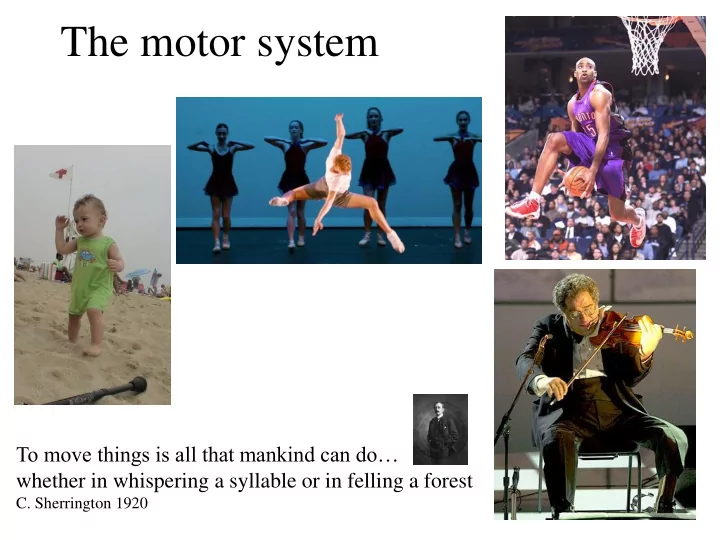
SLIDE 1 The motor system
To move things is all that mankind can do… whether in whispering a syllable or in felling a forest
SLIDE 2
- Principles
- Components: Muscles, Spinal cord and
spinal tracts, Subcortical areas, Cortical fields.
SLIDE 3 Three main types of movements
- Reflex
- Rhythmic
- Voluntary
SLIDE 4 Stretch reflex: contraction of same and synergist and relaxation of anatgonist Noxious stimuli excites ipsilateral flexor, and excites contralateral extensor
- Reflex: involuntary coordinated patterns of muscle
contraction and relaxation elicited by peripheral stimuli (~40ms)
SLIDE 5 Rhythmic: Chewing, swallowing, and scratching, quadrupedal locomotion.
- The spinal cord and brain stem.
- Triggered by peripheral stimuli that activate the underlying
circuits.
SLIDE 6
CPG: central pattern generators
SLIDE 7
Voluntary movements: principles
Goal directed Reaching (~120 ms)
SLIDE 8 Feedback control (error correction)
- 1. Gain
- 2. Delay (phase lag)
Vision Proprioception
SLIDE 9 Feed-forward (open loop)
- 1. Very hard computationally
SLIDE 10 Feedback control (error correction) Feedforward (open loop)
Notice onset of muscles
SLIDE 11 Improve with practice
- Co-contraction of muscles
- Internal models: a neural representation of the relationship
between the hand and the environment (how the arm would respond to the neural command).
SLIDE 12 Inverse and forward internal models
An internal model is used either:
- to predict the movement consequences of a motor commands
(forward model).
- to determine the motor commands needed to achieve a desired movement
trajectory (inverse model).
SLIDE 13
Motor programs and Invariants
Motor equivalence (Donald Hebb, 1950)
SLIDE 14 Pre-planning in vectors
Is there online visual feedback? No - scaling of acceleration and speed Invariant time (Isochrony)
SLIDE 15 Kinematic transformation: to transform a target position into a command to the skeletal system to move the hand i.e. to convert between coordinate systems; Dynamic transformation: relate motor commands to the motion of the system; in the reaching task here considered, the forces applied changed the system without changing the kinematics.
SLIDE 16 Building blocks – segmentation - primitives
Isogony (equal angles) Isochrony (duration independent of length) 2/3 power law: speed as a function of curvature
SLIDE 17 Designing a complex trajectory with limitations
- Antagonistic muscles
- Equilibrium point trajectory
Emilio Bizzi
SLIDE 18 Stable behavioral gestures
Graziano MS
SLIDE 19 Speed – accuracy tradeoff (Woodsworth, 1890)
Less time for feedback corrections? No, even without sensory feedback
Variability/noise of the components (neurons! much more than muscles)
SLIDE 20 Overcoming noise: optimization principles
- Minimum jerk (smooth acceleration)
- Minimum signal-dependent noise
- Optimal control: minimize only what is relevant,
and ignore other variables.
SLIDE 21 Hierarchical
- rganization
- Cortex
- Basal-ganglia, cerebellum
- Brain stem
- Spinal tracts
- Spinal cord
- Muscles
SLIDE 22 Muscles
- 1. smooth muscles
- 2. cardiac muscles
- 3. skeletal muscles
SLIDE 23 Muscle fiber Sarcomere: functional unit
Structure
myofibril
SLIDE 24 The “engine”
Cross bridges ->
Sacroplasmic reticulum
SLIDE 25 Force depends on length
Deformation + overlap
SLIDE 26
Force depends also on velocity
SLIDE 27 The force of a single muscle fiber is a function of
- Stimulation rate
- Stimulation pattern
- The muscle length
- The velocity of contraction
- The fiber type
- The fiber organization
- The duration of exercise -
fatigue
Fused tetanus Unfused tetanus Twitch
SLIDE 28
Motor unit: motor neuron and the muscle fibers it innervates ( one to many )
SLIDE 29 3 types of motor unit:
Recruited by order of force (low to high)
SLIDE 30
Muscle proprioceptive organs
Spindle: length Golgi tendon: tension Parallel
Serial
SLIDE 31
The muscle spindles are sensitive to changes in length
SLIDE 32
Active range can be dynamically modulated
SLIDE 33
Golgi tendon organs are sensitive to the tension
SLIDE 34
Spinal cord, Brain stem and spinal tracts
SLIDE 35 Spinal cord
Motor nuclei: cell bodies of motor neurons that innervate a muscle.
Medial nuclei are long across segments Lateral are shorter
- 1. Local interneurons
- 2. Propriospinal (across segments)
- 3. Projection (to upper centers)
- 4. Motor neurons
SLIDE 36
SLIDE 37 Medial pathways (vestibulospinal, reticulospinal,tectospinal), terminates in ventromedial (axial) for postural control. Lateral pathways (rubrospinal) terminates in dorsolateral.
Brain stem pathways
SLIDE 38
The corticospinal tract
SLIDE 39
Modulation by task and descending pathways
SLIDE 40
Cortex
and control of voluntary movement
SLIDE 41 Somato-topical organization
SLIDE 42 Stimulation in M1
Electrical and magnetic stimulation Lowest intensity Twitch in single muscle/joint Large (Betz) cells in lamina V
Many locations -> same muscle Location - > several muscles
SLIDE 43
Cortical inputs
SLIDE 44
Neurons can be context-dependent
SLIDE 45
Premotor areas Premotor dorsal (PMd), premotor ventral (PMv), supplementary motor area (SMA), cingulate (CMA) – Multi-joint representation – Complex, meaningful – Sensorimotor transformations – Preparatory (set) activity – Bimanual coordination (SMA) – Sequence learning (SMA) – Self-initiation (PMv, SMA) vs. cue-driven (PMd) – Language, theory of mind
SLIDE 46
The basal Ganglia
SLIDE 47
SLIDE 48
Cortico loops
SLIDE 49 Action - Selection
Direct pathway: facilitates movement. Indirect pathway: inhibits movement.
SLIDE 50 Parkinson and Dopamine
Loss of dopaminergic input leads to increase in the indirect and decrease in the direct pathway => increase GPi => inhibition =? Hypokinesia
SLIDE 51
Treatment: pallidotomy or DBS