SLIDE 1
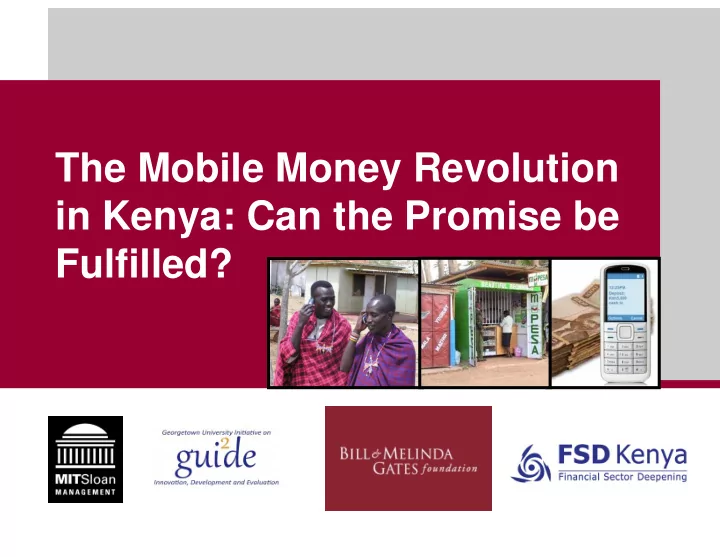
The Mobile Money Revolution in Kenya: Can the Promise be Fulfilled?
SLIDE 2 An Efficient Financial System
- Decades of research: efficient financial systems are key to
economic growth and poverty reduction
- One major reason financial markets in the developing world lack
efficiency is high transaction costs – Traditionally, financial systems have been bank based: branches are few and far between and accounts expensive to maintain
- How can we lower transaction costs?
SLIDE 3
Mobile Money: First Four Years
SLIDE 4
The Industry: Next Four Years
SLIDE 5 Household Survey
- Large household panel survey across most of Kenya (92%
coverage)
- Conducted in 2008, 2009, 2010, 2011 and 2014
– Last two rounds excluded Nairobi
SLIDE 6
M-PESA Adoption by Households
SLIDE 7
What Did Mobile Money Do?
SLIDE 8 Financial Health/Wellbeing
- A core component of financial health/wellbeing is resilience, the
ability to respond to unexpected negative events, or shocks
SLIDE 9 Resilience and Social Economies
- Little private insurance and few public sector safety nets
- Instead: social ties create an insurance network to pool risk: is
this efficient? – Ideal network is as different in risk profile from you as possible – But transactions have to cross geographical space which has costs
SLIDE 10
Financial Intermediation
SLIDE 11 Transaction Costs
- Kenyans faced large costs of transacting with the financial system
– The distance to the closest bank branch in 2007 was 9.2 km – 32% of households lived more than 10 km from a bank branch – 19% of households lived more than 20 km from a bank branch
- M-PESA lowered transaction costs dramatically
– Costs: for average distance of 200 km, KShs 35 vs. a KShs 460 bus – Distance to an agent was 4.9 km in 2007 (fell to 1.9 km by 2011) – 46% of households lived within 1 km of an agent
SLIDE 12
Financial Service Points, 2007-2011
SLIDE 13
The Effects of Lower Transaction Costs
SLIDE 14 Resilience: Overall
No Shock Negative Shock
Household Consumption Per Capita
+ 4.6%
M-PESA Users Nonusers
SLIDE 15 Resilience: Remittances
No Shock Negative Shock
Likelihood of receiving remittances
+ 4.8%
M-PESA Users Nonusers
SLIDE 16 Resilience to Health Events
Consumption M-PESA Users Nonusers
No Shock Food
+ 4.7%
Medical
+ 29.6% + 33.4%
Total Expenditure
+ 11.8%
Non-Food
+ 10.2%
SLIDE 17 Eight Years Later….
– Increases savings – Increases consumption and reduces poverty – Does not increase (physical) assets – Increases use of a bank account – Changes occupational choice (less likely to be a farmer, more likely to be in a business), especially for women in the household
SLIDE 18
Can the Promise be Fulfilled?
SLIDE 19
Financial Service Points, 2007-2011
SLIDE 20
Financial Service Points, 2011-2015
SLIDE 21 Access, 2007-2015
Bank Branches Bank Agents Mobile Money Agents 2007 9.2 km NA 4.9 km 2011 7.0 km 5.2 km 1.9 km 2015 6.0 km 1.9 km 1.4 km
Average Distance to Closest Financial Institution
SLIDE 22 Few Spillovers
- By the end of 2014, outside Nairobi, 96% of households used M-
PESA for P2P transactions
- Less than a third use it for:
– Paying bills – Receiving payments or wages from an organization – Paying for other goods or services
- Only 5% use it to repay loans
- Little P2B, B2B, G2P
SLIDE 23 Conclusions
- Lowering the transaction costs of interacting with the financial
system has improved the lives of Kenyans – Resilience and vulnerability – Savings and investment – Occupational shifts for adults, especially women
- Financial markets interact with all other markets: little evidence of
spillovers
- Still a long way to go and a much harder way to go