The Megalopolis and Global Integration Zones in European planning - - PowerPoint PPT Presentation

the megalopolis and global integration zones in european
SMART_READER_LITE
LIVE PREVIEW

The Megalopolis and Global Integration Zones in European planning - - PowerPoint PPT Presentation

The Megalopolis and Global Integration Zones in European planning thought Chapter author: Andreas Faludi, Delft University of Technology Presented by: Karen Leone de Nie, CQGRD Megacities, Megaregions and Spatial Planning Symposium


slide-1
SLIDE 1

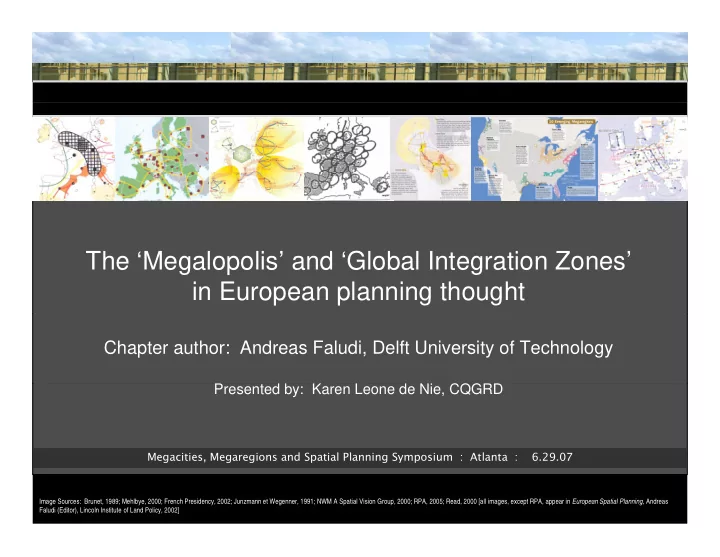
The ‘Megalopolis’ and ‘Global Integration Zones’ in European planning thought

Chapter author: Andreas Faludi, Delft University of Technology

Presented by: Karen Leone de Nie, CQGRD

M i i M i d S i l Pl i S i A l 6 29 07 Megacities, Megaregions and Spatial Planning Symposium : Atlanta : 6.29.07

Image Sources: Brunet, 1989; Mehlbye, 2000; French Presidency, 2002; Junzmann et Wegenner, 1991; NWM A Spatial Vision Group, 2000; RPA, 2005; Read, 2000 [all images, except RPA, appear in European Spatial Planning, Andreas Faludi (Editor), Lincoln Institute of Land Policy, 2002]

slide-2
SLIDE 2

European Planning Thought

United United States States Spatia United United States States

Focus on population growth and urban growth management

al Planning in

A recent history: A recent history: 2001 Lincoln Institute of Land Policy Course 2005 Towards and American Spatial Development

n the U

2005 Towards and American Spatial Development Perspective (Carbonell, Yaro) 2006 America 2050

US

slide-3
SLIDE 3

European Planning Thought

Europe Europe Spatia Europe Europe

Focus on economic growth and the effects of population decline

al Planning in

A recent history: A recent history: 1957 Treaty establishing European Economic Community had no interest in spatial planning

n Europ

Community had no interest in spatial planning 1970s European Parliament began to make real movement on regional policy and planning 1980s regional policy becomes more than

pe

g p y distributing funds 1999 European Spatial Development Perspective

slide-4
SLIDE 4

European Planning Thought

The The European uropean Spatial patial Development Development Perspective erspective

ESDP

The The European European Spatial Spatial Development Development Perspective Perspective (ESDP) (CEC, 1999) bears witness to the influence of two planning traditions:

P, a wit

p g

tness t

  • The French amén

The French aménagem gement du nt du territoi territoire re, a form of regional economic development informed by spatial analysis and scenarios – in line with funding regional d l

  • tradi

development

tions

  • Comprehensive management of

Comprehensive management of urban growth urban growth – counter to members states desire for control over national territories

slide-5
SLIDE 5

European Planning Thought

The Blue Banana

coln] n Faludi, Linc runet, 1989 [i Source: Br

slide-6
SLIDE 6

European Planning Thought

The E

EU

Europea

EU = one

  • ne

global economic integration

an Pen

integration zone

coln]

ntagon

n Faludi, Linc

n

chon, 2000 [in Source: Sc

slide-7
SLIDE 7

European Planning Thought

US = four four global economic integration zones

The U

US four four global economic integration zones

Source: Mehlybe, 2000 [in Faludi]

US Zones

slide-8
SLIDE 8

European Planning Thought

Possible Ne

i, Lincoln]

ew Inte

000 [in Falud

gration

residency, 20

n Zone

ce: French P

es

Sourc

slide-9
SLIDE 9

European Planning Thought

The The current urrent debate debate in in Europe: Europe:

Consi

The The current current debate debate in in Europe: Europe:

  • Compensate the peripheral regions and regions

dering

suffering from the effects of industrial restructuring

  • Focus on the winners, mostly in the already

g a Cou

, y y prosperous regions in Europe

urse Change

slide-10
SLIDE 10

European Planning Thought

A role

  • le for
  • r sustainability:

sustainability:

Susta

A role role for for sustainability: sustainability:

  • Insofar as a high-quality environment may contribute

inabilit

to competitiveness (attracting knowledge workers)

  • Confronting the potential effects of climate change

ty, part

g p g and mounting energy prices on patterns of urban growth

t of the equation?