The Massachusetts Reclaimed Water Program Experience and New - - PDF document

the massachusetts reclaimed water program
SMART_READER_LITE
LIVE PREVIEW

The Massachusetts Reclaimed Water Program Experience and New - - PDF document

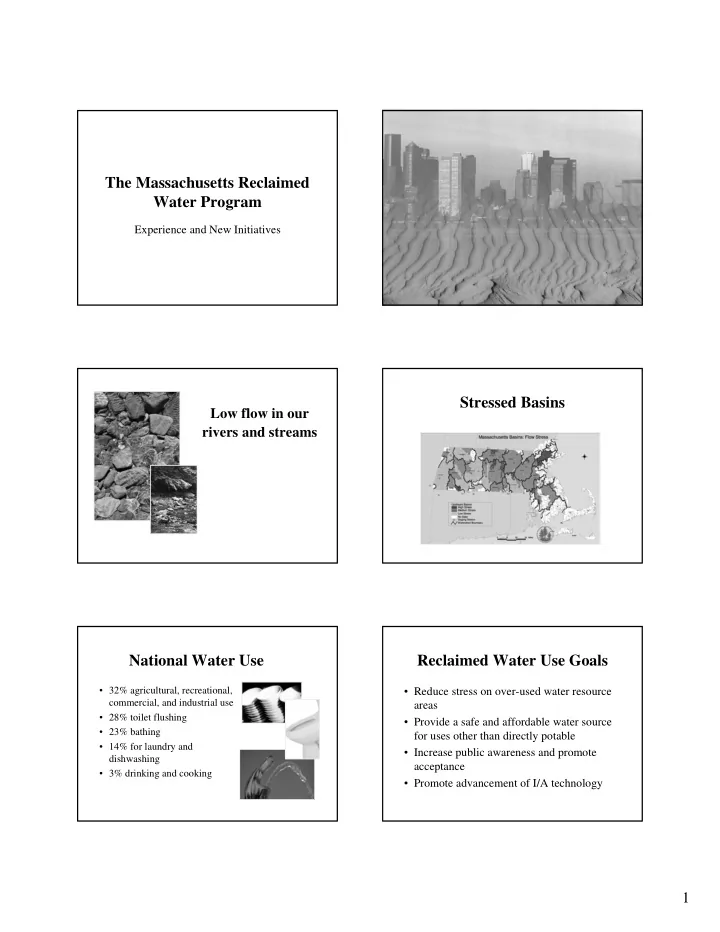
The Massachusetts Reclaimed Water Program Experience and New Initiatives Stressed Basins Low flow in our rivers and streams National Water Use Reclaimed Water Use Goals 32% agricultural, recreational, Reduce stress on over-used


slide-1
SLIDE 1

1

The Massachusetts Reclaimed Water Program

Experience and New Initiatives

Low flow in our rivers and streams

Stressed Basins National Water Use

  • 32% agricultural, recreational,

commercial, and industrial use

  • 28% toilet flushing
  • 23% bathing
  • 14% for laundry and

dishwashing

  • 3% drinking and cooking

Reclaimed Water Use Goals

  • Reduce stress on over-used water resource

areas

  • Provide a safe and affordable water source

for uses other than directly potable

  • Increase public awareness and promote

acceptance

  • Promote advancement of I/A technology
slide-2
SLIDE 2

2

Massachusetts Regulatory Approach

  • Initial guidelines developed in 1999
  • Hybrid of other state programs &

requirements

  • Rigorous water quality criteria
  • Best Management Practices (BMPs)
  • Enforceable contractual agreements
  • Public awareness

Reclaimed Water: Allowable Uses

  • Golf courses – spray irrigation
  • Landscaping – nurseries
  • Toilet flushing
  • Artificially recharging aquifers

Pilot Program

  • Evaluate uses not

specifically listed in guideline

Drip irrigation Powerplant process

and cooling water

Automated car

wash

Treatment Plant Criteria

  • Must meet specific water quality

criteria/monitoring

  • Must have permitted alternative

discharge site for golf course and landscaping use

  • Must have Class 1 reliability and

redundancy

  • Must have contractual agreement

Representative Standards for Reclaimed Water

Median ND*, max 14-7 day sample Max 200 <2 <5 Aquifer recharge Max 100 <5 Toilet Flushing Median ND*, max 14-7 day sample <2 Urban Reuse

Fecal Coliform/100 ml Turbidity (NTU) Land Use ND* = non-detectable

slide-3
SLIDE 3

3

Artificial Aquifer Recharge

  • Groundwater discharge into an approved

Zone II is considered reuse

  • Zone II boundary alteration
  • Time of travel evaluation – treated water

quality criteria

  • Zone II Nitrogen Loading Model
  • Monitoring of groundwater

DO NOT DRIN DO NOT DRINK

Challenges

  • Balancing Act

Cost – WWTP &

Monitoring

Public Health

  • Public Perception
  • Public apathy
  • Victim of our own

technology

Analysis of emerging

pollutants

New Program

  • MassDEP developing new regulations

2003: Study by CH2M HILL 2004: EPA Water Reuse Guidelines 2005: Task force Our Experience

MassDEP Task Force

  • Local officials
  • Consultants
  • Environmental groups
  • Industry representatives
  • MassDEP personnel

Proposed New Uses

  • Irrigation of fields, playgrounds, and

ballparks

  • Residential irrigation
  • Crop irrigation
  • Powerplants
  • Industrial Uses
slide-4
SLIDE 4

4

Schedule

  • Task force meetings
  • Draft regulations by summer 2006

MassDEP Contact

Alan Slater 1 Winter Street Boston, MA 02108 t: 617.292.5749 e: alan.slater@state.ma.us http://www.mass.gov/dep/water/wastewat.htm