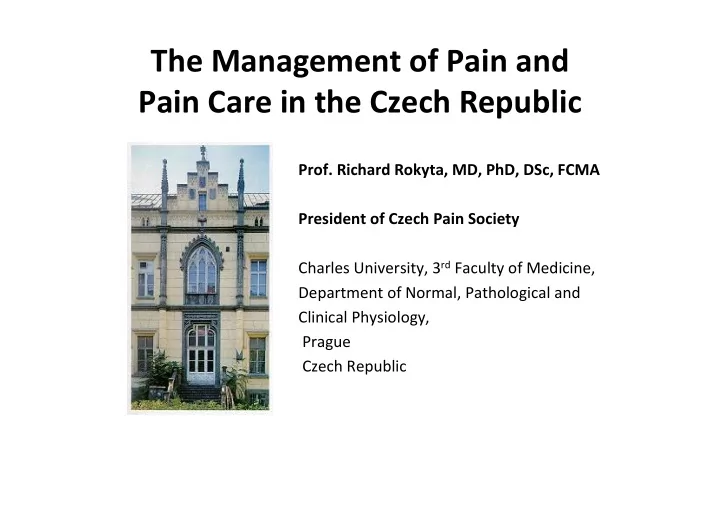
SLIDE 1 The Management of Pain and Pain Care in the Czech Republic
- Prof. Richard Rokyta, MD, PhD, DSc, FCMA
President of Czech Pain Society Charles University, 3rd Faculty of Medicine, Department of Normal, Pathological and Clinical Physiology, Prague Czech Republic
SLIDE 2
Key statement
The main reason of my presentation is to compare the management of pain in different European countries and the possibility how Czech Pain Society could support the development of the progress in pain care. The relatively long experience with the pain care as an independent discipline will be discussed.
SLIDE 3
The Czech Pain Society
The Czech Pain Society is a member of Czech medical societies of Jan Evangelista Purkyně. It has 337 regular members. Mostly they are the algesiologist, anaesthetists, neurologist, surgeons, rehabilitation medicine, palliative medicine and many doctors from other medical disciplines. The organisational background is the Board with 13 members and reviser board with 3 members.
SLIDE 4 Training, Conferences, Seminars and Congresses
Each year we organise the common congresses with Slovak Pain Society (one year in Czech Republic,
- ne year in Slovak Republic).
Every two years we are organising the Symposia about the treatment of pain in Brno together with Czech Neurological Society (ection for headache). In 2003 Czech Pain Society organised IVth EFIC Meeting in Prague (organisers J. Kozák, R. Rokyta) with 3000 participants.
SLIDE 5 Seminars
In addition to the above conventions we hold the annual spring seminars on various topics in pain (back pain, opioids in pain management, pain management in old age). Always in the autumn once every two years we are
- rganizing the Prague neuromodulation day.
Once a year the Institute for postgraduate studies
- rganizes seminars on various topics.
Many centers hold separate educational seminars.
SLIDE 6 Website,Journal Bolest (Pain), Textbook of Pain
Czech Pain Society is also involved in two information portals about the pain: www.pain.cz ,www.painnews.cz We are publishing the Journal Bolest (Pain) – editor in chief
- prof. Richard Rokyta.
- 4 years ago we published the monography Pain (Bolest), 700
pages, main editor prof. Richard Rokyta.
SLIDE 7 Pain care in the Czech Republic
8 multidisciplinary centres of pain with several specialists, 9 teaching centres with accreditations for effectuated postgraduate study, more then 100 algesiological out-patient clinics
Pain out-patients clinic performs basic patient examination and prescribed painkillers and perform other analgesic
- medication. More complex cases then recommends to the
Centre of pain.
SLIDE 8
Specialisation in Pain
Pain Care in the Czech Republic is a separate discipline with its own medical education and postgraduate qualifications. Up to end of 2010 was associated with palliative medicine, is separated since 1.1.2011 as an independent discipline. Pain care is organized on the basis of out –patient pain clinics, which is the essential element of the system. Now we have 100 out-patient pain clinics. In the out- patient pain clinic operates a medical doctor - mainly algesiologist who has an attestation (board certification) of pain and palliative medicine (since this year will need certification only from the pain).
SLIDE 9
Specialisation in Pain
Each out-patient clinic has a warranty, which is valuable for 2-5 years and endorsed by the regional supervisor, a member of Czech Pain Society. In these out-patients clinics come patients either from GP or they may come directly.
SLIDE 10
Pain Centres
Pain Centre is a comprehensive pain management centre, which also carry out a comprehensive examination of pain syndromes, provide highly qualified treatment and provide a broad medical services to both diagnostic and therapeutic. The head of the centre is algesiologist, also neurologist, psychologist, psychiatrist, rehabilitation specialist and other medical specialists are member of this centre.
SLIDE 11
Pain Centres
Aside from a wide range of drug treatment and rehabilitation centre providing therapy and invasive, neuromodulation therapy, psychotherapy, highly qualified and more specialized diagnostic and therapeutic procedures. In the Czech Republic exist eight centres, most of them carried neuromodulation therapy and participate in postgraduate education.
SLIDE 12 Types of Pain Centres
I and II. type of workplace
- have a multidisciplinary character
- The I. type of workplace is the establishment of the
Faculty Hospital, its composition and character is identical with type II. In addition has teaching activities for undergraduate and postgraduate medical students and health staff at all levels. It participats in pain research.
- It is designated as a Department or Centre for the pain
treatment, is or incorporated under the clinical Department or it is completely independent.
SLIDE 13 Types of Pain Centres
Type III workplace
- characterized as a out-patient clinic for the treatment of
pain, often attached to the appropriate Department (Resuscitation, Neurology). For example the workplace for headaches, back pain, etc.
- Workplace of this type regularly collaborates with
physicians at least of two other disciplines, with psychologist or psychiatrist.
- IV. Type of workplace
- Includes the separate out-patient clinic.
- It provides a special therapeutical method, also with
acupuncture, some physical methods and other alternative methods.
SLIDE 14 Pain Treatment
Intervention techniques (neuromodulation) In addition to conventional intervention techniques which are used at higher pain centres there are also 7 centres of neuromodulation, which carry mainly the following methods:
- SCS - spinal cord stimulation, mostly for FBSS
and angina pectoris
- MCS - the motor cortex stimulation, for
poststroke pains and other deceases
- PNS - peripheral nervous stimulation including
the occipital nerve stimulation
SLIDE 15 Education
By early 2011, conducted as a joint instruction with a field
- f palliative medicine and has been provided by the
Institute for postgraduate medical education (IPVZ). It consisted of a theoretical training lectures from different disciplines related to pain, and of course the general backgrounds of algesiology is taught. Another part of the training took place at accredited centres for teaching of pain (in the Czech Republic there are altogether 8 centres). The final test was to be submitted and postgraduate work, which addresses some of the problems of algesiology.
SLIDE 16
Education -changing
Since 2011, tuition goes largely to the University Medical Faculties and the part of organizational training remains in IPVZ. The division of fields of pain and palliative medicine is also changing the structure of training and especially the final exam that will be involved in far more university teachers (professors and associate professors of Medical Faculties).
SLIDE 17
SLIDE 18
Consumption of strong opioids in the Czech Republic
DOT = Days of Treatment PDT = Patient Treatment Days
SLIDE 19
Pain Care in the Czech Republic
We believe that the medical care for patients with pain in the Czech Republic is very good. Certainly contributed to the fact that we were together with the Slovak Republic the first in Europe, where the algesiology with palliative medicine was proclaimed as separate medical specialty. It is obvious that algesiology is build on the main tribes, which are of anesthesiology and neurology and possibly rehabilitation medicine. Therefore, in the pain centres is given mainly algesiologist, which usually has a practice of anaesthesia.
SLIDE 20 Summary
The mutual awareness of activities relating to the management of pain is important for further common action of European Union in this field. Therefore, the participation of representatives
- f the Czech organizers, including health care,
is relevant to the further development of the Pain Care in the Czech Republic.