The M AJORANA D EMONSTRATOR Ryan Martin, for the M AJORANA - - PowerPoint PPT Presentation

the m ajorana d emonstrator
SMART_READER_LITE
LIVE PREVIEW

The M AJORANA D EMONSTRATOR Ryan Martin, for the M AJORANA - - PowerPoint PPT Presentation

The M AJORANA D EMONSTRATOR Ryan Martin, for the M AJORANA Collaboration Lawrence Berkeley National Laboratory DBD 11, Osaka, Japan, November 2011 Outline 76 Ge for neutrinoless double-beta decay M AJORANA goals and expected


slide-1
SLIDE 1

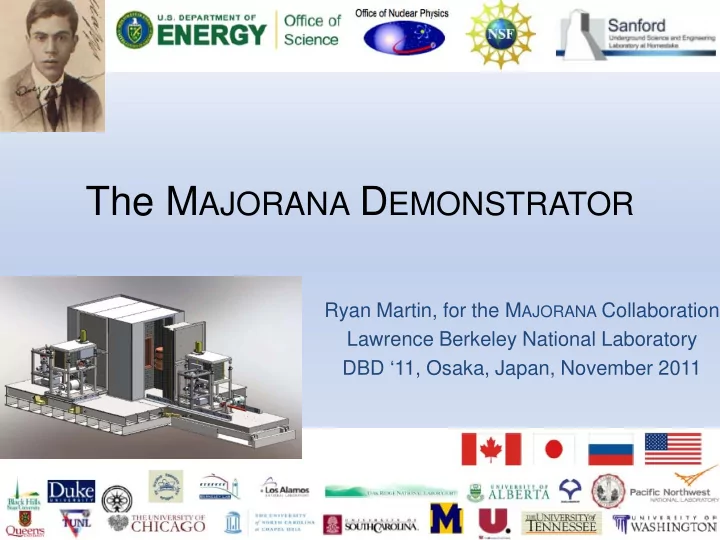
The MAJORANA DEMONSTRATOR

Ryan Martin, for the MAJORANA Collaboration Lawrence Berkeley National Laboratory DBD ‘11, Osaka, Japan, November 2011
slide-2
SLIDE 2

Outline

  • 76Ge for neutrinoless double-beta decay
  • MAJORANA goals and expected sensitivity
  • Backgrounds and mitigation
  • Technology choices and development status

2 Ryan Martin, The Majorana Demonstrator

slide-3
SLIDE 3

Germanium for neutrinoless double-beta decay experiments

Germanium detectors

  • Source is detector
  • Good energy resolution
  • Well established

technology

  • Intrinsically clean (high-

purity germanium)

76Ge isotope for 0νββ

  • Q-value of 2039keV

above most backgrounds

  • Can be enriched to >86%

in 76Ge (nat. abundance ~ 8%)

  • Slow 2νββ rate (1021 yr)
  • Best limit to date on 0νββ

3 Ryan Martin, The Majorana Demonstrator

slide-4
SLIDE 4

Tonne-scale sensitivity for Ge

Need tonne-year exposure to probe inverted hierarchy, atmospheric neutrino mass scale

4 Ryan Martin, The Majorana Demonstrator

slide-5
SLIDE 5

MAJORANA DEMONSTRATOR Goals

  • An R&D project towards a tonne scale germanium

experiment

  • Demonstrate a design that can achieve a background

rate of 1cnt/t/y/ROI when scaled to a 1 tonne detector (ROI = 4keV region around 2039keV)

  • Test Klapdor-Kleingrothaus claim
  • Agreement to work with GERDA to develop a design for

a tonne scale experiment

  • Potential for additional physics (eg. dark matter)

5 Ryan Martin, The Majorana Demonstrator

slide-6
SLIDE 6

The MAJORANA DEMONSTRATOR

  • 40kg of detectors, up to 30kg enriched to >86% 76Ge
  • 2 cryostats made of copper electroformed

underground, 7 strings of 5 detectors per cryostat

  • “Conventional” shielding (EfCu, Cu, Pb, poly),4π

active muon veto, Rn exclusion box

6 Ryan Martin, The Majorana Demonstrator

slide-7
SLIDE 7

MJD Sensitivity

7

With 30kg of enriched germanium detectors, ~1 yr to test KKDC claim at 90%

Ryan Martin, The Majorana Demonstrator

30 kg y

slide-8
SLIDE 8

MJD Schedule

MJD will proceed in 3 phases

  • Prototype Module (summer 2012):
  • above ground, commercial copper, 2-3

strings natGe

  • Test mechanical design
  • Test detector performance in cryostat and

Monte Carlo models (eg. granularity)

  • Cryostat 1 (spring 2013):
  • underground, electroformed copper, 3

strings enrGe, 4 strings natGe

  • Cryostat 2 (fall 2014):
  • underground, electroformed copper, up to 7

strings enrGe Prototype cryostat

8 Ryan Martin, The Majorana Demonstrator

Underground cryostat and “monolith”

slide-9
SLIDE 9

Backgrounds and mitigation

  • Detailed MC simulations to

understand background contributions

  • Intensive assay campaign to identify

clean materials

  • Clean handling
  • Special processes (electroforming)
  • Analysis cuts (“PSA”, “granularity”)
  • Natural radioactivity:

– in components (U, Th) – surface contaminants (α, β)

  • Cosmogenic:

– Activation (68Ge, 60Co) – Muons, fast neutrons

  • Irreducible:

– 2νββ decay – Neutrino scattering (reactor, solar, atm., geo, SN…)

9 Ryan Martin, The Majorana Demonstrator

Detector mount and Geant4 geometry:

slide-10
SLIDE 10

Backgrounds and mitigation

  • Deep underground
  • Muon veto
  • Fabricate materials underground

(copper)

  • Limit surface exposure (germanium)
  • Analysis cuts (68Ge tag using low

energy x-rays, Pulse Shape Analysis)

10

E/keV

Ryan Martin, The Majorana Demonstrator

Cosmogenic lines at low energy (from CoGeNT, PRL107 (2011) 141301):

  • Natural radioactivity:

– in components (U, Th) – surface contaminants (α, β)

  • Cosmogenic:

– Activation (68Ge, 60Co) – Muons, fast neutrons

  • Irreducible:

– 2νββ decay – Neutrino scattering (reactor, solar, atm., geo, SN…)

slide-11
SLIDE 11

Backgrounds and mitigation

  • Irreducible backgrounds
  • Energy resolution of germanium is

main mitigation

11 Ryan Martin, The Majorana Demonstrator

  • Natural radioactivity:

– in components (U, Th) – surface contaminants (α, β)

  • Cosmogenic:

– Activation (68Ge, 60Co) – Muons, fast neutrons

  • Irreducible:

– 2νββ decay – Neutrino scattering (reactor, solar, atm., geo, SN…)

Illustrative 0νββ spectrum (not normalized):

slide-12
SLIDE 12

MJD status and technologies

  • Underground lab
  • Electroformed copper
  • Thermal tests
  • Prototype cryostat fabrication
  • MJD detectors and status
  • Low noise/low background electronics
  • Detector integration tests
  • Detailed model and simulations
  • Calibration

12 Ryan Martin, The Majorana Demonstrator

Nov 2011

slide-13
SLIDE 13

The Sanford Underground Lab

  • MJD will be located at

4850’ level of Sanford Underground Lab at the Homestake mine in Lead, South Dakota

  • Beneficial occupancy

expected spring 2012

13 Ryan Martin, The Majorana Demonstrator

Outfitting of MJD lab Nov 2011

slide-14
SLIDE 14

Underground clean room

Ryan Martin, The Majorana Demonstrator 14

After de-watering Clean room

  • Underground clean

room was completed in spring 2011

  • Started storing natural

detectors underground in winter 2010

Underground detector storage

slide-15
SLIDE 15

Electroformed copper

  • Deployed 10 baths in

underground clean room (4850ft) [also: 6 baths at PNNL (100ft), Sept.2010]

  • Started underground

electroforming 21 July 2011

15 Ryan Martin, The Majorana Demonstrator

slide-16
SLIDE 16

MAJORANA detector cooling

  • Cooling to the cold plate provided by a thermosiphon
  • Detailed thermal model produced to understand cooling

power and needs

  • Cooling tests performed and design optimized (detector

blanks < 95K)

Prototype thermosiphon tested

16 Ryan Martin, The Majorana Demonstrator

Thermosiphon Test string

slide-17
SLIDE 17

MJD prototype cryostat components

Ryan Martin, The Majorana Demonstrator 17

Demonstrated e-beam weld for cryostat hoop Vacuum system for prototype Parts purchased! Purchased clean machining tools to be deployed in above ground clean room (then underground) Parts for thermosiphon

Most components for prototype in hand

slide-18
SLIDE 18

“PPC” detectors

  • P-type Point Contact

HPGe detectors

  • “Novel” technology
  • Small point contact to

readout charge, low capacitance

  • Thick outer contact

(n+, lithium diffused), strongly attenuates alphas

Semi coaxial detector Point contact detector

18 Ryan Martin, The Majorana Demonstrator

Weighting potential

  • P. N. Luke, F. S. Goulding, N. W. Madden, R. H. Pehl,

IEEE T. Nucl. Sci. 36 (1989) 926

  • P. S. Barbeau, J. I. Collar, O. Tench, J. Cosmol.
  • Astropart. Phys. 0709 (2007) 009.
  • E. Aguayo et al. [The Majorana Collaboration],

http://arxiv.org/abs/1109.6913 (2011)

slide-19
SLIDE 19

Properties of PPCs

  • Sharp weighting potential

allows multi-site events to be identified

  • Most backgrounds at 2MeV are

multi-site

  • Small capacitance results

in low noise and excellent performance at low energies

19 Ryan Martin, The Majorana Demonstrator

1332 keV multi-site event from PPC detector

PRL 101 251301 (2008)

slide-20
SLIDE 20

Natural detectors

  • Have tested a large number
  • f PPC detectors within the

collaboration

  • Have purchased all

detectors required for non- enriched component

  • “Modified – BEGe”

detectors purchased from Canberra in FY11-12 received and characterized (20+kg)

  • 19 BEGes now stored

underground

20 Ryan Martin, The Majorana Demonstrator

slide-21
SLIDE 21

PPCs tested by MJD

Ryan Martin, The Majorana Demonstrator 21

Institution Manufacturer

  • Dia. x length

[mm x mm] Type Date

LBNL Paul Luke Canberra USA 50 x 50 62 x 50 20 x 10 62 x 50 70 x 30 NPC Segmented-PPC Mini-PPCs (x3) PPC

  • Mod. BEGe

1987 2008 2009 2009 2011 Univ. Chicago Canberra France Canberra USA 50 x 44 60 x 30 PPC

  • Mod. BEGe (large)

2005 2008 PNNL Canberra France 50 x 50 PPC 2008 LANL PHDs Canberra USA ORTEC PGT 72 x37 70 x 30 62 x 51 67 x 54 70 x 30 PPC

  • Mod. BEGe (x39)

PPC PPC PPC 2008 2009-11 2009 2010 2010 UNC Canberra USA 61 x 30 61 x 32 70 x 30

  • Mod. BEGe (low bgd)
  • Mod. BEGe
  • Mod. BEGe (x3)

2009 2010 2011

slide-22
SLIDE 22

Enriched germanium processing

22

Enrichment to >86% at Electro-Chemical Plant (ECP) in Russia Reduction to Ge metal at Electrochemical Systems Inc. (ESI) Zone-refinement by commercial vendor Detector fabrication by commercial detector vendor Pull crystal by commercial vendor

Ryan Martin, The Majorana Demonstrator

slide-23
SLIDE 23

Enriched germanium status

  • Received first batch (29kg) of

GeO2 enriched in 76Ge on 12th September 2011 from ECP (Russia)

  • Verified to be 88% 76Ge,

meeting our specifications

  • Material stored at shallow site

(~100mwe)

  • Have successfully processed

natGe

Shipping/storing shield Samples to test isotopic purity Shallow site storage safe Oxide powder in storage contained

23 Ryan Martin, The Majorana Demonstrator

Batch Quantity Batch 1 20kg Batch 2 15.5kg From Russian collaborators 10-14kg

Enriched Ge procurements (elemental weight)

slide-24
SLIDE 24

Low background front-end electronics

Low Mass Front End (LMFE):

  • Fused silica substrate
  • Au-Cr traces
  • Amorphous-Ge resistor
  • Low background
  • Low noise

fused silica substrate Contact pad FET Pulser capacitively coupled R (aGe) 1.5cm

24 Ryan Martin, The Majorana Demonstrator

Det.

LMFE Cable Preamp

slide-25
SLIDE 25

Low background cable

  • Parylene coated copper
  • Tested signal cable with a detector
  • Components assayed clean, need to confirm for

assembled cable

  • Investigating commercial options in parallel

25 Ryan Martin, The Majorana Demonstrator

slide-26
SLIDE 26

Detector integration tests

Ryan Martin, The Majorana Demonstrator 26

PPC detector integration test with LMFE, prototype cable, mount (2010- 2011) String integration tests (on going) Preamplifier card (1 per detector) Preamplifier mother board (for 5 detectors)

slide-27
SLIDE 27

String test cryostat

Ryan Martin, The Majorana Demonstrator 27

String test cryostat and dewar Preamplifier mother board on string test cryostat

On-going tests to:

  • Test electronic readout (grounding,

cross-talk, etc.)

  • Test operation of multiple detectors
slide-28
SLIDE 28

Readout chain performance – Energy resolution

Ryan Martin, The Majorana Demonstrator 28

380eV at 60keV 230eV 85keV pulser

Low energy High energy Energy Specification Measured 1332keV <3.2keV 2.0keV 60keV <0.5keV 0.38keV

Energy resolution with readout chain meets specifications:

  • high energy for 0νββ
  • low energy for 68Ge tag
slide-29
SLIDE 29

Readout chain performance – Pulse shape analysis

Ryan Martin, The Majorana Demonstrator 29

232Th calibration data from prototype shows that with pulse shape analysis

cut:

  • Remove 93% of multi-site events (full energy peaks), background-like
  • Retain 90% of single-site events (208Tl double escape peak), 0νββ-like

Energy/channel

228Ac (1581) 228Ac (1588) 208Tl DEP (1592) 228Ac (1621) 228Ac (1626) 228Ac (1631) 228Ac (1638)

Raw With PSA cut

slide-30
SLIDE 30

MJD Simulations

  • Detailed Monte Carlo model to simulate backgrounds from 3800

components and detailed verification campaign

  • So far ~60kCPU hours of simulations, analysis in progress
  • U, Th, K chains for all components and 68Ge, 60Co for select components
  • Dominant contribution at Qββ is from multi-site events from U and Th (214Bi,

208Tl)

30 224Ra from HV nut Ryan Martin, The Majorana Demonstrator

slide-31
SLIDE 31

MJD Background Model

31

Radioactivity Cosmogenic activation Environmental µ-induced

  • Detailed background

model produced

  • Based on previous

assays and reasonable expectations

  • Expect 4c/t/y/ROI in

MJD

  • Translates to

1c/t/y/ROI for tonne- scale experiment:

– More self-shielding – Longer cooldown for 68Ge – Deeper (or improved shielding)

Ryan Martin, The Majorana Demonstrator

slide-32
SLIDE 32

MALBEK

Ryan Martin, The Majorana Demonstrator 32

  • 450g modified BEGe detector in a low background mount deployed at the

Kimballton Underground Research Facility (KURF) in Virginia (1450mwe)

  • Used to study low energy physics, understand backgrounds, test DAQ

(including low energy triggering) and validate Monte Carlo simulation package

  • Recently remounted detector removing Pb compononents, 210Pb

background down by x10

Data MC Detailed MC geometry Simulated spectrum MALBEK detector

NIM A 652 (2011) 692

slide-33
SLIDE 33

MJD calibration

  • Electroformed copper

calibration track, Rn exclusion, retractable line sources

  • Internal cosmogenic lines

for low energy

  • Dedicated pulser

distribution system

  • PSA, granularity, efficiency,

electronics response, energy, timing

33 Ryan Martin, The Majorana Demonstrator

Source drive motor

228Th source

slide-34
SLIDE 34

Summary

34

  • The MAJORANA DEMONSTRATOR is a prototype to

investigate the design for a tonne scale germanium 0νββ experiment

  • Detailed simulations suggest that the MJD design

will result in required level of backgrounds when scaled to a tonne scale experiment

  • Will start to operate with enriched germanium in

2013

  • Expected to test the KKDC claim with

approximately one year of data (with 2 cryostats)

Ryan Martin, The Majorana Demonstrator

slide-35
SLIDE 35

Black Hills State University, Spearfish, SD Kara Keeter Duke University, Durham, North Carolina , and TUNL Matthew Busch, James Esterline, Gary Swift, Werner Tornow Institute for Theoretical and Experimental Physics, Moscow, Russia Alexander Barabash, Sergey Konovalov, Igor Vanushin, Vladimir Yumatov Joint Institute for Nuclear Research, Dubna, Russia Viktor Brudanin, Slava Egorov, K. Gusey, Oleg Kochetov, M. Shirchenko, V. Timkin, E. Yakushev Lawrence Berkeley National Laboratory, Berkeley, California and the University of California - Berkeley Mark Amman, Marc Bergevin, Yuen-Dat Chan, Jason Detwiler, James Loach, Paul Luke, Ryan Martin, Alan Poon, Gersende Prior, Kai Vetter, Harold Yaver Los Alamos National Laboratory, Los Alamos, New Mexico Melissa Boswell, Steven Elliott, Victor M. Gehman, Andrew Hime, Mary Kidd, Ben LaRoque, Keith Rielage, Larry Rodriguez, Michael Ronquest, Harry Salazar, David Steele North Carolina State University, Raleigh, North Carolina and TUNL Dustin Combs, Lance Leviner, Albert Young Oak Ridge National Laboratory, Oak Ridge, Tennessee Jim Beene, Fred Bertrand, Greg Capps, Ren Cooper, Kim Jeskie, David Radford, Robert Varner, Chang-Hong Yu Osaka University, Osaka, Japan Hiroyasu Ejiri, Ryuta Hazama, Masaharu Nomachi, Shima Tatsuji Pacific Northwest National Laboratory, Richland, Washington Craig Aalseth, Estanislao Aguayo, Jim Fast, Eric Hoppe, Todd Hossbach, Richard T. Kouzes, Brian LaFerriere, Jason Merriman, Harry Miley, John Orrell, Nicole Overman, Doug Reid Queen's University, Kingston, Ontario Art McDonald South Dakota School of Mines and Technology, Rapid City, South Dakota Cabot-Ann Christofferson, Mark Horton, Stanley Howard University of Alberta, Edmonton, Alberta Aksel Hallin University of Chicago, Chicago, Illinois Juan Collar, Nicole Fields University of North Carolina, Chapel Hill, North Carolina and TUNL Padraic Finnerty, Florian Fraenkle, Graham Giovanetti, Matthew Green, Reyco Henning, Mark Howe, Sean MacMullin, David G. Phillips II, Jacqueline Strain, Kris Vorren, John F. Wilkerson University of South Carolina, Columbia, South Carolina Frank Avignone, Leila Mizouni University of South Dakota, Vermillion, South Dakota Vince Guiseppe, Tina Keller, Keenan Thomas, Dongming Mei,

Gopakumar Perumpilly, Chao Zhang

University of Tennessee, Knoxville, Tennessee Yuri Efremenko, Sergey Vasiliev University of Washington, Seattle, Washington Tom Burritt, Peter J. Doe, Greg Harper, Robert Johnson, Andreas Knecht, Jonathan Leon, Michael Marino, Mike Miller, David Peterson

  • R. G. Hamish Robertson, Alexis Schubert, Tim Van Wechel

The MAJORANA Collaboration

Students in red

slide-36
SLIDE 36

Backup slides

  • Chi-squared PSA
  • SSTC for 68Ge
  • Slow pulses (x2)
  • MALBEK lead background
  • Monolith
  • Glove box
  • S4 geometries
  • Depth dependent backgrounds
  • Background limits
  • 1TGe down select schedule

36 Ryan Martin, The Majorana Demonstrator

slide-37
SLIDE 37

Pulse shape analysis with PPCs

R.J. Cooper et al., Nucl. Instr. And Meth. A 629 303 (2011)

  • Pulse fitting method to

identify single-site events (0νββ-like)

  • Based on a library of

unique pulse shapes for each detector

  • Retain 98% of single-site

events (DEP) while only 1% of multi-site events (SEP)

  • Rely on PSA to remove

‘multi-site’ backgrounds

37

No PSA PSA Data Fit

Ryan Martin, The Majorana Demonstrator

slide-38
SLIDE 38

Time correlation cut (68Ge)

38

Raw Granularity Gran+PSA

  • 68Ge produced by cosmogenic activation
  • Sea-level activation rate 2.1 (30) atoms/kg/day for enrGe (natGe)
  • Assume 100 day exposure for enrGe, saturation for natGe
  • Highly suppressed by granularity (x1/4) and PSA (1/25x)
  • Tag 68Ge decays with 10.3keV and 1.1keV x-rays, then veto for ~5 x 68

minutes

  • 0.4 c/t/y/ROI (after analysis cuts)

68Zn 68Ge 68Ga

EC 270.8d EC (10%), β+(87%) 68min X-rays: 10.3keV (K, 86%) 1.1keV (L, 12%) Q=2.9MeV Q=106keV

Ryan Martin, The Majorana Demonstrator

slide-39
SLIDE 39

Detailed detector studies

Detailed scanning of detectors Slow pulses evident Slow pulses “leaking out” from 60keV 241Am peak

  • Slow, energy-degraded

pulses observed in CoGeNT

  • From energy

depositions near thick n+ contacts, where E- field is weak

  • Important to understand

for MJD low energy analysis

  • Several detailed

experiments performed

  • Quantitative model

produced

39 Ryan Martin, The Majorana Demonstrator

slide-40
SLIDE 40

Detailed detector studies (2)

Ryan Martin, The Majorana Demonstrator 40

  • β−γ coincidence

studies showed that the slow pulses are also delayed

  • Detailed model

being developed to quantitatively understand

slide-41
SLIDE 41

MALBEK Pb backgrouds

Ryan Martin, The Majorana Demonstrator 41

After removing Pb shims, backgrounds at low energy:

  • 16x improvement

[thres. – 1keV]

  • 7x improvement

[2keV-8keV]

slide-42
SLIDE 42

“Monolith”

42 Ryan Martin, The Majorana Demonstrator

  • Monolith allows detector and part of the shield to be removed

for modular deployment

  • Hovair purchased and delivered
slide-43
SLIDE 43

Glove box

  • Underground assembly will be performed in glove

box (Rn mitigation)

  • Design final

43 Ryan Martin, The Majorana Demonstrator

slide-44
SLIDE 44

MJD background limit

44 Ryan Martin, The Majorana Demonstrator

slide-45
SLIDE 45

Tonne-scale studies

45

  • Different geometries studied for tonne scale experiment, collaboration with

some members of GERDA

  • Engineering studies also performed
  • Collaboration with DUSEL/SURF engineers

Ryan Martin, The Majorana Demonstrator

slide-46
SLIDE 46

Depth-dependent backgrounds

46

  • Scaled backgrounds by

assuming 4300mwe (vs 3100mwe), better veto, thicker poly

  • For tonne scale experiment,

need to go to ~6000mwe for MJ- style design

  • Can go less deep with liquid

shield

Ryan Martin, The Majorana Demonstrator

http://arxiv.org/abs/1109.4154 (2011)

slide-47
SLIDE 47

Tonne-scale schedule

47

  • Technology selection will be based on outcome of R&D

and results from MJD and GERDA

Ryan Martin, The Majorana Demonstrator