The Logical Analysis of Plurals and Mass Terms Godehard Link (1983) - - PowerPoint PPT Presentation

the logical analysis of plurals and mass terms
SMART_READER_LITE
LIVE PREVIEW

The Logical Analysis of Plurals and Mass Terms Godehard Link (1983) - - PowerPoint PPT Presentation

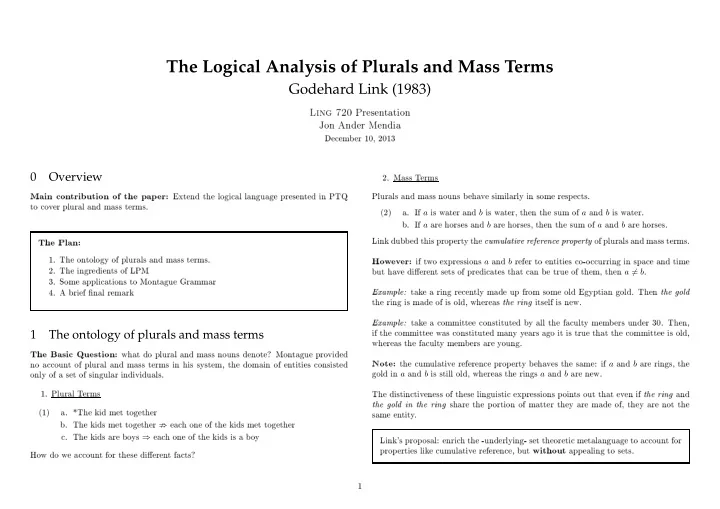
The Logical Analysis of Plurals and Mass Terms Godehard Link (1983) Ling 720 Presen tation Jon Ander Mendia Deem b er 10, 2013 0 Overview 2. Mass T erms Plurals and mass nouns b eha v e similarly in some resp ets.


slide-1
SLIDE 1

The Logical Analysis of Plurals and Mass Terms

Godehard Link (1983)

Ling 720 Presen tation Jon Ander Mendia De em b er 10, 2013

Overview

Main
  • n
tribution
  • f
the pap er: Extend the logi al language presen ted in PTQ to
  • v
er plural and mass terms. The Plan: 1. The
  • n
tology
  • f
plurals and mass terms. 2. The ingredien ts
  • f
LPM 3. Some appli ations to Mon tague Grammar 4. A brief nal remark

1 The ontology of plurals and mass terms

The Basi Question: what do plural and mass nouns denote? Mon tague pro vided no a oun t
  • f
plural and mass terms in his system, the domain
  • f
en tities
  • nsisted
  • nly
  • f
a set
  • f
singular individuals. 1. Plural T erms (1) a. *The kid met together b. The kids met together ea h
  • ne
  • f
the kids met together . The kids are b
  • ys ⇒
ea h
  • ne
  • f
the kids is a b
  • y
Ho w do w e a oun t for these dieren t fa ts? 2. Mass T erms Plurals and mass nouns b eha v e similarly in some resp e ts. (2) a. If a is w ater and b is w ater, then the sum
  • f a
and b is w ater. b. If a are horses and b are horses, then the sum
  • f a
and b are horses. Link dubb ed this prop ert y the umulative r efer en e pr
  • p
erty
  • f
plurals and mass terms. Ho w ev er: if t w
  • expressions a
and b refer to en tities
  • urring
in spa e and time but ha v e dieren t sets
  • f
predi ates that an b e true
  • f
them, then a = b . Example: tak e a ring re en tly made up from some
  • ld
Egyptian gold. Then the gold the ring is made
  • f
is
  • ld,
whereas the ring itself is new. Example: tak e a
  • mmittee
  • nstituted
b y all the fa ult y mem b ers under 30. Then, if the
  • mmittee
w as
  • nstituted
man y y ears ago it is true that the
  • mmittee
is
  • ld,
whereas the fa ult y mem b ers are y
  • ung.
Note: the um ulativ e referen e prop ert y b eha v es the same: if a and b are rings, the gold in a and b is still
  • ld,
whereas the rings a and b are new. The distin tiv eness
  • f
these linguisti expressions p
  • in
ts
  • ut
that ev en if the ring and the gold in the ring share the p
  • rtion
  • f
matter they are made
  • f,
they are not the same en tit y . Link's prop
  • sal:
enri h the
  • underlying-
set theoreti metalanguage to a oun t for prop erties lik e um ulativ e referen e, but without app ealing to sets. 1
slide-2
SLIDE 2

The Logical Analysis of Plurals and Mass Terms (Link 1983)

Jon Ander Mendia Idea 1: within the domain
  • f
en tities E w e an distinguish t w
  • dieren
t (sub)- domains: the domain A
  • f
atomi individuals and the domain D
  • f
stu
  • r
p
  • rtions
  • f
matter. (3) E as generated b y the predi ate P , where P = {a, b, c} : E an b e dened as a ( omplete b
  • lean)
algebra losed under join: E, ⊕ . A, the set
  • f
atoms, and D, the set
  • f
individual p
  • rtions
  • f
matter, are
  • mplete
join- subsemilatti es
  • f
E generated b y 1-pla e predi ates P . (4) On tology: a. S attered Singular En tities:

x, y ∈ D

(water, gold, air, et .) b. Con rete Singular En tities:

x, y ∈ A \ D

(the ring, the
  • mmitte
e, the gold in this ring, et .) . Plural En tities:

x, y ∈ E \ A

(the rings, the
  • mmitte
es, et .) Note: 1. Both mass terms and group nouns are atoms, they are dieren t en tities from the p
  • rtions
  • f
matter
  • r
individuals that they are
  • mp
  • sed
  • f
(re all the example
  • f
the ring and the
  • mmitte
e ab
  • ve
). 1 2. Plural en tities are just sums
  • f
individuals (and not sets), as
  • n rete
as the individuals that serv e to dene them and
  • f
the same logi al t yp e. 3. Substan es are abstra t en tities and annot b e dened in terms
  • f
their
  • n rete
manifestations (that's wh y water ∈ D whereas the water in this glass ∈ A ). 4. Joining together an y t w
  • n rete
individuals (in E \ D ) returns a plural en tit y (in E\A ), whereas joining together t w
  • p
  • rtions
  • f
matter (in D ) returns another p
  • rtion
  • f
matter, an atom in D . 2 5. The n ull elemen t is assigned the role
  • f
dumm y
  • b
je t to whi h no predi ate applies and whi h an tak e are
  • f
denotation gaps in the theory (≈
  • ur
  • n ept
  • f
garbage). 1 In the ase
  • f
group nouns, Link distinguishes to t yp es
  • f
predi ates: those that are p ermeable to the inner stru ture
  • f
group nouns and those that are not (variant vs. invariant pr e di ates ): i. V arian t Predi ate: The p ersonnel
  • mmittee
is
  • ld
  • the
professors is
  • ld
ii. In v arian t Predi ate: The p ersonnel
  • mmittee
met

the professors met 2 Graphi ally this is represen ted b y app ealing to t w
  • dieren
t instan tiations
  • f
the join
  • p
erator `⊕' for
  • n rete
individuals and `+' for p
  • rtions
  • f
matter. 2
slide-3
SLIDE 3

The Logical Analysis of Plurals and Mass Terms (Link 1983)

Jon Ander Mendia 6. Ev en though D ⊆ A ⊆ E , w e annot extend the algebra
  • f
the domain
  • f
indi- viduals do wn to the algebra
  • f
p
  • rtions
  • f
matter; they are dieren t stru tures. Idea 2: Elemen ts in E \ D and D are
  • nne ted
b y a
  • nstitution
r elation.

h

is the materialization fun tion denoting the
  • nstitution
relation. It maps an y individual
  • f E
in to its
  • rresp
  • nding
p
  • rtion
  • f
matter in D . Example: the departmen t
  • f
linguisti s has t w
  • dieren
t
  • mmittees:
the p ersonnel
  • mmittee c1
and the urri ulum
  • mmittee c2
. Both
  • mmittees
are formed b y all the professors in the departmen t (p1 ⊕ pn ), but they ha v e dieren t hairs, b
  • ard
mem b ers and se retaries; they are dieren t represen tativ e b
  • dies,
therefore, c1 = c2 = p1 ⊕pn . (5) a. The p ersonnel
  • mmittee
met y esterda y
  • the
urri ulum
  • mmittee
met y esterda y b. The professors in the departmen t are y
  • ung
  • the
urri ulum
  • mmittee
is y
  • ung
Ho w ev er, the materialization fun tion maps ev ery individual in to its
  • rresp
  • nding
material parts. Th us, if follo ws that: (6)

h(p1 ⊕ pn) = h(c1) = h(c2)

The same holds for the example with the rings: Example: t w
  • rings, r1
and r2 are made
  • f
p
  • rtions
  • f
  • ld
Egyptian gold g1 and g2 resp e tiv ely . Then, the rings r1 ⊕ r2 are made
  • f
the p
  • rtions
  • f
matter in g1 + g2 . (7)
  • a. g1 + g2 = h(r1 ⊕ r2)
  • b. g1 + g2 = r1 ⊕ r2

g1+g2

is the material fusion
  • f g1
and g2 , it's still a s attered singular en tit y , whereas

r1 ⊕ r2

is the plural en tit y
  • mp
  • sed
  • f
b
  • th
rings. Ev en though g1 + g2 and r1 ⊕ r2 ha v e the same materialization, the theory is su h that g1 + g2
  • nstitutes
but is not equal to r1 ⊕ r2 .

2 The Ingredients of LPM

2.1 Individuals

Plural morphology signals the presen e
  • f
a pluralization
  • p
eration `*' whi h generates all the individual sums
  • f
mem b ers
  • f
the extension
  • f
an y 1-pla e predi ate P. That is, E is losed under the join
  • p
eration: E, ⊕ , where a ⊕ b is the individual- sum (i-sum) a and b . Sums are partially
  • rdered
through an
  • rdering
relation ≤i
  • n E
expressed in the
  • b
je t language b y the t w
  • pla e
relation : the i(ndividual)-p art relation.
  • is
in terpreted in the seman ti s as the Bo
  • lean
relation ⊔i (where ⊔i denotes the join
  • p
eration ⊕ ). (8)
  • a. a b ↔ a ⊕ b = b
i a ≤i b
  • b. a ≤i b
i a ⊔i b = b . a b = 1 i a = 0 and i a ≤i b (b y (8b)) i a ⊔i b = b (b y def.
  • f
`⊔i ') i a ⊕ b = b So, the seman ti in terpretation
  • f
plurals is as follo ws: (9)
  • a. ∗P :=
[P ℄ the
  • mplete
joini
  • latti
e gener ate d by P
  • b. ∗P := {x ∈ E|∃X ⊆ P & X = ∅
  • st. x = supiX}
If P is a 1-pla e predi ate and ∗P is the
  • rresp
  • nding
plural predi ate, then w e an dene ⊛P , the prop er plural predi ate
  • f P
. (10)
  • a. ⊛P := ∗P \ A
  • b. σxPx := ιx(∗Px ∧ ∀y(∗Py → y x))
the sum
  • f
P's . σ∗xPx := ιx(⊛Px ∧ ∀y(∗Py → y x)) the pr
  • p
er sum
  • f
P's

σ∗xPx

arries the presupp
  • sition
that there at least t w
  • P
's; in this ase σ∗xPx and

σxPx

  • in ide.
(11)
  • a. σxPx =
supiP, where supi∅ =
  • b. σ∗xPx = σxPx
if P has > 2 elemen ts,
  • therwise

2.2 Stuff

D is losed under join making D a
  • mplete
(but not-ne essarily atomi ) join-semilatti e. Lik e E, D is losed under the join
  • p
eration `+'
  • n D
(denoted b y ⊔m ). Just lik e with individuals, there is a
  • rresp
  • nding
  • rdering
relation alled the material part (m- part) relation, denoted b y ⊤ (equiv alen t to in the
  • un
t domain). It establishes a preorder (it's not an ti-symmetri )
  • n
p
  • rtions
  • f
matter ≤m (akin to ≤i ). If t w
  • b
je ts are m-parts
  • f
ea h
  • ther
then they are materially equiv alen t. 3
slide-4
SLIDE 4

The Logical Analysis of Plurals and Mass Terms (Link 1983)

Jon Ander Mendia (12)
  • a. a b a⊤b
b. If a⊤b and b⊤a , then a is material ly e quivalent to b . x ≤m y i x ⊔m y = y Seman ti ally , ⊤ an b e dened in terms
  • f
the materialization fun tion h : (13)

a⊤b = 1

i a, b = 0 and h(a) ≤m h(b) and a ≤m b if a, b ∈ D Under the assumption that a, b ∈ D seman ti fa t ab
  • v
e follo ws trivially , giv en that h denotes the iden tit y fun tion
  • n D
. Building
  • n
h to
  • ,
w e an pro vide a seman ti in terpretation for the
  • nstitution
relation, denoted b y `⊲ ' in the
  • b
je t language and dene the
  • n ept
  • f
material fusion: (14)
  • a. a ⊲ b = 1
i b = 0 and a = h(b)
  • nstitution
r elation
  • b. a + b = h(a) ⊔m h(b)
if a = 0 and b = 0 material fusion Th us, if P is a mass term, P is a n um b er/quan tit y
  • f
p
  • rtions
  • f
matter losed under join.

2.3 The relation between individuals and stuff

In terestingly , the material part-whole relation in (12 ) an b e used to
  • rder
the indi- viduals
  • f
E materially : the seman ti
  • un
terpart
  • f
the
  • nstitution
relation `⊲ ' is pre isely the semilatti e homomorphism h from E \ 0 to D. (15)

h : E \ {0} → D

is a semilatti e homomorphims st. i.

h ↿ D = idD

(for all x ∈ D, h(x) = x) , and ii.

h(

supB) = suph [B ℄ , for all B ⊆ E \ {0} (16) The Homomorphi Relation:
  • a. x ≤i y ⇒ h(x) ≤ h(y)

(∀x, y ∈ E,

where x = 0)
  • b. x ≤m y
i h(x) ≤ h(y)

(∀x, y ∈ E \ {0})

Ho w is h useful for linguisti analysis? Consider that ev ery predi ate P has a mass term
  • rr
esp
  • ndent mP
. (17)
  • a. mP =
suph [P ℄ ( ompare with ∗P in (9a))

= {x ∈ D|x ≤

suph [P ℄}

= {x ∈ D|∃y ∈ ∗P

  • st. x ≤m h(y)}

= h(

supP ) Note that if P is already a mass term, it follo ws that P ⊆ mP . (18) a. There is apple in the salad
  • b. ∃x(mPx ∧ Qx)
, where P = is an apple, mP = is apple and Q = is in the salad. What is the relation b et w een the ar ds and the de k
  • f
ar ds ? W e use the notion
  • f
material fusion, denoted b y the µ-op erator: (19)

µxPx = ιx(x ⊲ σxPx)

Example: Let P = is a ar d fr
  • m
  • ne
  • f
the de ks
  • f
ar ds and Q = is a de k
  • f
ar ds, then σxPx = σxQx . And this is what w e w an t, for if w e ha v e to de ks
  • f
Bridge ards, then σxPx will
  • n
tain 104 atoms, whereas σxQx will
  • n
tain
  • nly
t w
  • .
Ho w ev er,

µxPx = µxQx

. Note that the µ-op erator builds des riptions
  • f
  • n rete
singular terms
  • ut
  • f
p
  • rtions
  • f
matter: (20)
  • a. x ⊲ σxPx = 1
i x ⊲ σxPx = 0 and x = h(x ⊲ σxPx)
  • b. µxPx = ιx(h(σxPx) ⊲ σxPx)
Similarly , re all the example
  • f
the rings: The
  • nstitution
relation denoted b y `⊲ ' relates the gold
  • r
the ring and the ring ; if r is a ring and g is the gold in r , then g ⊲ r (and same for plurals: g1 + g2 ⊲ r1 ⊕ r2 ).

2.4 Some examples

(21) a. The hild built the raft (Px: x is a hild )
  • b. ∃y(y = ιxPx ∧ Qy)
(Qx: x built the r aft ) (22) a. The hildren built the raft
  • b. ∃y(y = σ∗xPx ∧ Qy)
(23) a. T
  • m
and Jerry arried the piano (t: T
  • m,
j: Jerry )
  • b. P(t ⊕ j)
(Px : x arrie d the piano ) (24) a. John and P aul are p
  • p
stars and George is a p
  • p
star b.

⊛P(j ⊕ p) ∧ Pg ⇒⊛ P(j ⊕ p ⊕ g)

(Px : x is a p
  • pstar
) (25) a. W ater is w et
  • b. ∃x(Px → Qx)
(Px : x is water ) 4
slide-5
SLIDE 5

The Logical Analysis of Plurals and Mass Terms (Link 1983)

Jon Ander Mendia (26) a. The w ater
  • f
the Rhine is dirt y
  • b. Q(µxPx)
(Px : x is R hine water ) (27) a. The gold in the ring is
  • ld,
but the ring is not
  • ld
  • b. Qιx(Px ∧ x ⊲ a) ∧ ¬Qa
(Px : x is gold, Qx : x is
  • ld,
a: the ring )

3 Application to PTQ

With these ingredien ts, Link builds a mo del M for LPM: an
  • rdered
pair B, st.
  • 1. B = E, A, D, h
is a tuple where E is the domain
  • f
individuals in M , A is the set
  • f
atoms in M , D is the set
  • f
p
  • rtions
  • f
matter in M and h is the materialization fun tion in M . 2. is a rst
  • rder
assignmen t
  • f
denotations to the primitiv e expressions
  • f
LPM. The syn tax and seman ti s are as in PTQ, with the follo wing additions: 1. The ategory CN is split in to MCN (mass NPs), SCN (singular
  • un
t NPs) and PCN (plural
  • un
t NPs). 2. There is plural rule, where ζ ∈ PSCN ⇒ ζpl ∈ PP CN . So, he denes an In terpretation: E, A, D, h, I, J, , as dened ab
  • v
e and in PTQ. Here are some translations for quan tiers: let U b e the translation relation: (28) a. the U

λQλP∃x[Q(x) ∧ P(x) ∧ ∀y[Q(y) → y x]]

b. some, ∅pl U

λQλP∃x[Q(x) ∧ P(x)∧]

Both some and the an apply to singular and plural phrases: (29) a. some hild U

λP∃x[child′(x) ∧ P(x)]

b. (some) hildr en U

λP∃x[⊛child′(x) ∧ P(x)]

. (some) water U

λP∃x[water′(x) ∧ P(x)]

Note: it is
  • nly
the CN phrase whi h dieren tiates b et w een the appropriate singular and plural readings. As a
  • nsequen e
some an
  • m
bine with
  • njoined
CNs. (30)
  • a. (ζ
and η) U

λz∃x∃y[ζ′(x) ∧ η′(y) ∧ z = x ⊕ y]

b. b
  • y
and girl who dated ea h
  • ther
. λz∃x∃y[boy′(x) ∧ girl′(y) ∧ z = x ⊕ y ∧ dated-ea h-other(z)] This sho ws ho w pluralization has the for e
  • f
group formation. As a
  • nsequen e,
w e an
  • m
bine phrases lik e (ζ and η) with quan tiers lik e some and get the
  • rre t
in terpretation. (31) some ((b
  • y
and girl) su h that they met) U

λP∃z[∃x∃y[boy′(x) ∧ girl′(y) ∧ z = x ⊕ y ∧

meet'(z)] ∧ P(z)]

4 Wrapping Up

4.1 One final remark

Link's view
  • n
plurals is ex lusiv e, that is, plurals don't in lude atoms (⊛P = ∗P\

A

). Ho w ev er, from a linguisti p v., this is problemati : i. Do wn w ard en tailing
  • texts:
(32) a. No professors are in lass b. Are there professors in lass? ii. Plural NPs with quan tities less than 1: (33) Put 0.5 grams
  • f
salt in the soup

4.2 Summary

1. The logi
  • f
plurals and mass nouns share a
  • mmon
stru ture, a latti e, the dieren e b et w een b
  • th
latti es b eing that the former is atomi , whereas the latter is not. 2. The star
  • p
erator allo ws us to treat plural morphology
  • mp
  • sitionally
is a w a y su h that the parallels b et w een plurals and mass terms are aptured. 3. Plural en tities and group nouns are equiv alen t in that they are in ter hangeable in some en vironmen t (with invariant predi ates, see fn.1), but this not mak e them
  • referen
tial. This
  • n
trasts with redu tionists approa hes where b
  • th
the ar ds and the de k
  • f
ar ds denote the same set. Referen es Landman, F., 1991. Stru tures for seman ti s. Klu w er A ademi , Netherlands. Link, G., 1983. The logi al analysis
  • f
plurals and mass terms. In: Baeuerle, R. et. al. (Eds), Meaning, Use and In terpretation
  • f
Language. DeGruyter, pp. 303-329. Motague, R., 1974. The prop er treatmen t
  • f
quan ti ation in
  • rdinary
English. In: Thoma- son, R.H. (Ed.), F
  • rmal
philosoph y: Sele ted P ap ers
  • f
Ri hard Mon tague. Y ale Uni- v ersit y Press, pp. 247-270. P artee, B.H. et. al. 1990. Mathemati al metho ds in linguisti s. Dordre h t, Boston. 5