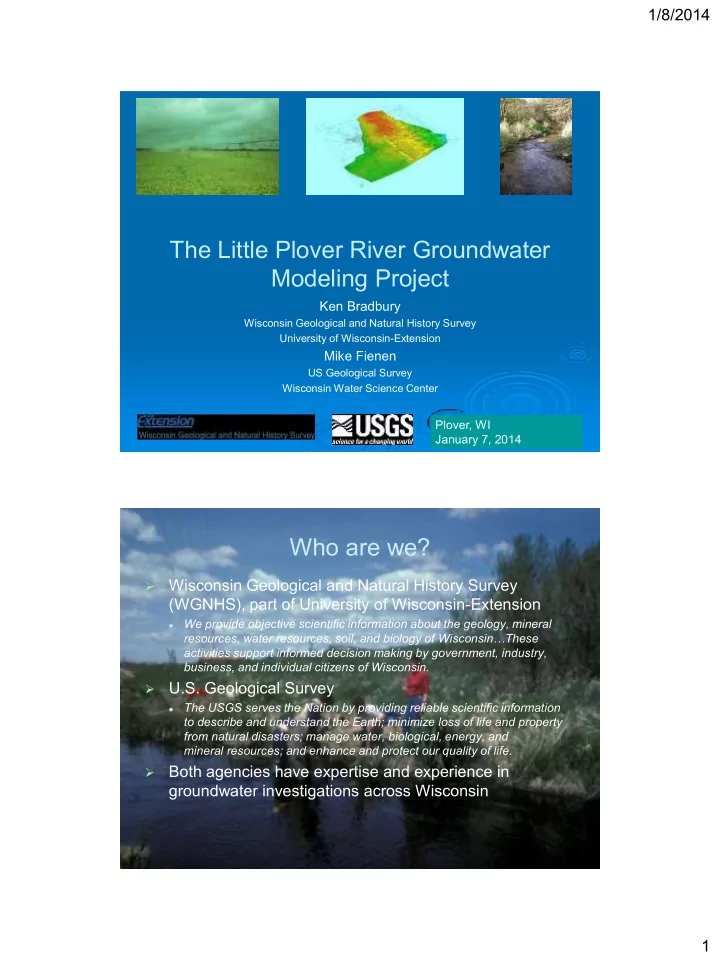
The Little Plover River Groundwater Modeling Project Ken Bradbury - - PDF document

the little plover river groundwater modeling project
SMART_READER_LITE
LIVE PREVIEW

The Little Plover River Groundwater Modeling Project Ken Bradbury - - PDF document

1/8/2014 The Little Plover River Groundwater Modeling Project Ken Bradbury Wisconsin Geological and Natural History Survey University of Wisconsin-Extension Mike Fienen US Geological Survey Wisconsin Water Science Center Plover, WI January


slide-1
SLIDE 1

1/8/2014 1

The Little Plover River Groundwater Modeling Project

Ken Bradbury

Wisconsin Geological and Natural History Survey University of Wisconsin-Extension

Mike Fienen

US Geological Survey Wisconsin Water Science Center

Plover, WI January 7, 2014

Who are we?

  • Wisconsin Geological and Natural History Survey

(WGNHS), part of University of Wisconsin-Extension

We provide objective scientific information about the geology, mineral resources, water resources, soil, and biology of Wisconsin…These activities support informed decision making by government, industry, business, and individual citizens of Wisconsin.

  • U.S. Geological Survey

The USGS serves the Nation by providing reliable scientific information to describe and understand the Earth; minimize loss of life and property from natural disasters; manage water, biological, energy, and mineral resources; and enhance and protect our quality of life.

  • Both agencies have expertise and experience in

groundwater investigations across Wisconsin

slide-2
SLIDE 2

1/8/2014 2

Why are we involved?

  • The WDNR requested our assistance
  • Project funding comes from DNR, with support from

both our agencies

  • We are interested as Wisconsin water scientists
  • We are interested in providing tools to help decision

makers make informed choices

  • We have no vested interest in the outcome of the

project

Why the Little Plover River?

Abundant background information already exists:

  • groundwater levels
  • streamflow
  • geology
  • aquifer parameters

Recent low flows and river dry-up have raised concerns Regulatory flow criteria exist The basin represents an excellent place to develop a modeling approach that can be used to assist decision-makers

slide-3
SLIDE 3

1/8/2014 3

Computer solution

Steps in groundwater modeling

Mathematical grid Real world Simulated groundwater levels, flow rates, concentrations

Use of flow models in groundwater management

  • Models are the current standard of professional

practice in hydrogeology

  • based on mathematical and physical principles;

give objective solutions

  • Integrate impacts from multiple stresses (wells)
  • Produce a complete water balance
  • Contain a database of hydrogeologic

information

“Hydrologists are occupied in studying aquifer dynamics. The principal tool for these investigations is the ground water model.” John Bredehoeft, 2002

slide-4
SLIDE 4

1/8/2014 4

Water budget basics

  • Like a bank balance, a water budget includes all

inflows and outflows of water

  • In Wisconsin, the most obvious evidence of

“deficit” in the water budget is decreased baseflow to streams, springs, lakes, and wetlands

  • Models inherently provide this water budget

accounting

Impermeable bedrock Groundwater flow

Groundwater moves in three dimensions. Groundwater divide Groundwater naturally discharges to surface water

slide-5
SLIDE 5

1/8/2014 5

Objectives

  • This project will develop the following:

1.

A groundwater flow and optimization model that will be a science- based expert system for decision support of water management in the Little Plover River Basin as a pilot location to evaluate techniques that might later be expanded to the entire central sands region.

2.

A platform to demonstrate fundamental scientific constraints inherent to the hydrologic system and context for the costs and benefits for differing scenarios.

3.

An educational tool for fostering science-based discussion for both the public and the technical community.

The model starts with geology. This is a map of the glacial geology of Portage County

slide-6
SLIDE 6

1/8/2014 6

What’s being simulated:

  • The topographic basin of the Little Plover
  • The surrounding region extending to

natural regional hydrogeologic boundaries (Wisconsin River, Tomorrow River, regional flow divides)

  • The sand-and gravel aquifer and

underlying sandstone aquifer

Model area

slide-7
SLIDE 7

1/8/2014 7

Close-up of the Little Plover basin Preliminary simulated water-table contours

slide-8
SLIDE 8

1/8/2014 8

The model grid is uniform with 100-ft spacing Modeled area, showing wells and streams

slide-9
SLIDE 9

1/8/2014 9

Modeled area, showing glacial geology Modeled area, showing simulated water levels

slide-10
SLIDE 10

1/8/2014 10

Model features:

  • Uses the industry standard modeling code

MODFLOW;

  • Transient, with simulation time scales ranging

from years to weeks;

  • 3-dimensional, allows for vertical flow
  • All permitted high-capacity wells in basin

simulated individually;

  • All significant streams, ditches, lakes, and

wetlands in the basin will be simulated;

  • Areally and temporally variable recharge and

evapotranspiration

  • Geology represented by multilayer

hydrostratigraphy;

  • Includes streamflow routing, and will include

the ability to simulate the manipulation of drainage ditches

Model features:

  • The model will be calibrated to measured water levels and streamflow

using state-of-the-science calibration and uncertainty methodology;

  • Three-dimensional, graphical visualization of the groundwater system;
  • Management optimization will enable the evaluation of costs and benefits
  • f various management scenarios such as:

Evaluations of locations and pumping rates of wells can be constrained by management criteria such as maintaining specific flow rates in streams or water levels near lakes

Evaluations of land use change (such as crop type) with associated costs can be assessed to balance resource constraints with costs and profits to farmers and other land users.

slide-11
SLIDE 11

1/8/2014 11

Management Optimization with Constraints

Water flows through the aquifer to supply water to a stream Pumping water can reduce water entering the stream Pumping more water can even pull water from the stream

Management Optimization with Constraints

Constrained optimization allows adjusting one part of the system to balance with a required condition on another part. For example, adjusting pumping rates to balance with streamflow or water levels.

slide-12
SLIDE 12

1/8/2014 12

Schedule…

  • November, 2013; funding received, project started
  • February, 2014; recharge estimation complete
  • June, 2014; geology, conceptual model, boundary conditions
  • August, 2014; steady-state calibration
  • October, 2014; transient calibration
  • November, 2014; scenario testing and management optimization

modeling based on discussions with user groups

  • March, 2015; Final Report, presentation of results

http://fyi.uwex.edu/littleplovermodel/