The Literature: Self-Synchronization and Shared Awareness Desired - - PDF document

the literature
SMART_READER_LITE
LIVE PREVIEW

The Literature: Self-Synchronization and Shared Awareness Desired - - PDF document

Enabling Adaptive C2 via Semantic Communication and Smart Push: A Model-based Network Communication Approach LtCol Carl Oros, USMC LtCol Carl Oros, USMC Brief to Brief to AFCEA-GMU C4I Center Symposium AFCEA-GMU C4I Center Symposium


slide-1
SLIDE 1

1

Enabling Adaptive C2 via Semantic Communication and Smart Push: A Model-based Network Communication Approach

LtCol Carl Oros, USMC

Brief to

AFCEA-GMU C4I Center Symposium “Critical I ssues in C4I ” Fairfax, VA 21 May 2008

LtCol Carl Oros, USMC

Brief to

AFCEA-GMU C4I Center Symposium “Critical I ssues in C4I ” Fairfax, VA 21 May 2008

2

From Power to the Edge

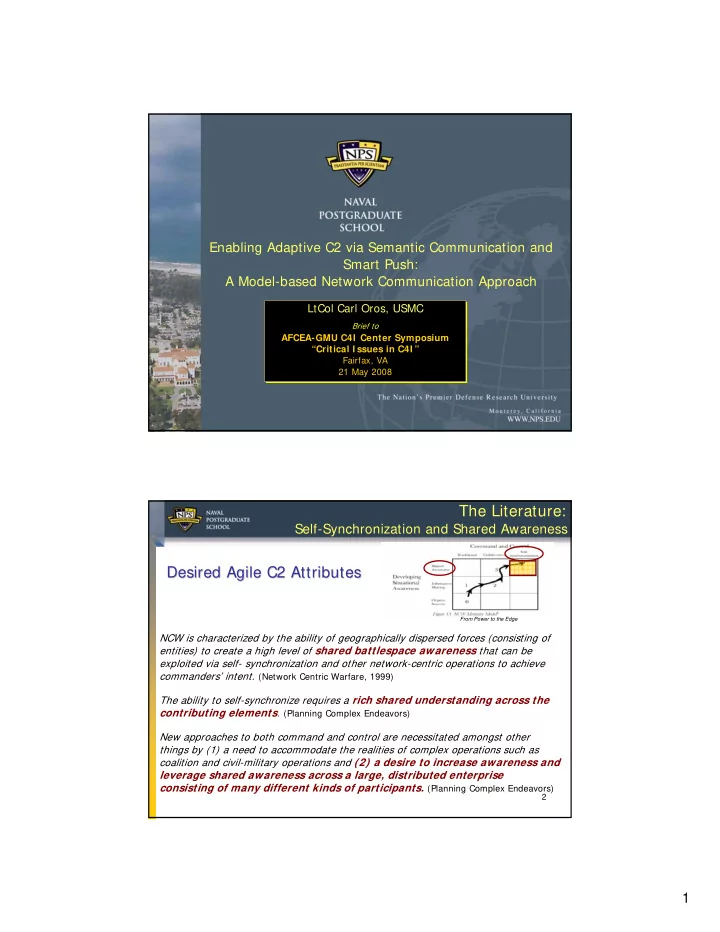
The Literature:

Self-Synchronization and Shared Awareness

NCW is characterized by the ability of geographically dispersed forces (consisting of entities) to create a high level of shared battlespace awareness that can be exploited via self- synchronization and other network-centric operations to achieve commanders’ intent. (Network Centric Warfare, 1999) The ability to self-synchronize requires a rich shared understanding across the

contributing elements. (Planning Complex Endeavors)

New approaches to both command and control are necessitated amongst other things by (1) a need to accommodate the realities of complex operations such as coalition and civil-military operations and (2) a desire to increase awareness and

leverage shared awareness across a large, distributed enterprise consisting of many different kinds of participants. (Planning Complex Endeavors)

Desired Agile C2 Attributes Desired Agile C2 Attributes

slide-2
SLIDE 2

2

3

The Future

The GI G will support and enable highly responsive, agile, adaptable, and information-centric operations characterized by:

  • An increased ability to share information
  • Greatly expanded sources and forms of

information and related expertise to support rapid, collaborative decision- making

  • Highly flexible, dynamic, and

interoperable communications, computing, and information infrastructures that are responsive to rapidly changing operational needs

  • Assurance and trust that the right

information to accomplish assigned tasks is available when and where needed, that the information is correct, and that the infrastructure is available and protected

Source: DoD GIG Architecture Vision 1.0 Jun 07, p. 2.

4

The Reality:

The Battle for An Nasiriyah 2003*

“The command group had little

situational awareness (SA) outside of

the three city blocks it occupied..” “The simultaneous engagements, urban terrain, and distances separating individual companies were

wreaking havoc on the Com. network. “

“Information that would normally come to the command group and be passed to the battalion commander and operations officer suffered delay and distortion through second-, third-, and fourth-party relays. Attempts by the command group to raise the battalion commander on radio only added to the congestion and were quickly

  • abandoned. “
  • Rohr, Karl.C., “Fighting Through the Fog of War”, Marine Corps Gazette, 2006, available: http://www.mca-marines.org/Gazette/2006/06rohr.html

Task Force Tarawa

slide-3
SLIDE 3

3

5

The Reality:

The Battle for An Nasiriyah, 23 March 2003*

  • “fires could only be in his zone against targets visually identified

as enemy”

  • “a firefight of this nature will have difficulty tracking other

friendly forces operating nearby but out of sight.“

  • “Some aircraft did not have the ability to communicate with the

FSCC”

  • “With communications disrupted, the air officer was not able to

coordinate the flow of aircraft.”

  • “(FACs) had to build the pilots’ SA and do weaponeering as the

aircraft checked in”

  • Rohr, Karl.C., “Fighting Through the Fog of War”, Marine Corps Gazette, 2006, available: http://www.mca-marines.org/Gazette/2006/06rohr.html

6

Challenges: The Evolving Environment

  • Traditional force structures

(Battalions, Companies) are being forced to disperse and operate on vast frontages & in urban settings

– A traditional battalion frontage is 1 -2 Km – Today, certain units are

  • perating in over 3600 sq. mile

area, controlling over 20 battle positions, and monitoring over 70 coalition positions

  • The nature of the threat has

– Increased the need for precision targeting – Forced the dispersion of forces, both in urban and in rural environs – Placed a high demand on the infostructure for focused information and actionable intelligence

slide-4
SLIDE 4

4

7

Challenges: System Bandwidth

  • Physical bandwidth and

available spectrum are limited resources

– FCS BW demand 10 x > Army capability

  • 43M lines of code (exceeds

JSF program as # 1)*

Source: Congressional Budget Office Study, “The Army’s Bandwidth Bottleneck”, 2003.

– A typical USMC MEF is doctrinally provisioned 2 Mbps for a corps sized force

  • BW demand will increase as

computer systems migrate to lower tactical echelons (Battalion and below)

8

Challenges: Cognitive Bandwidth

  • Human bandwidth is fixed

– InfoGlut (Denning): Computer generated information capabilities vastly exceed human info processing ability – Increases in System BW capability (broadband) exacerbates the problem: more data is transmitted to the user

  • A UAV has the potential to generate terabytes of data/hour.
  • 14,000 UAV hrs/month typical = petabytes (10 15)

monthly/exabytes (10 18) yearly for these systems alone. – AKA: Digital Landfills

Digital Landfills (Gen Tom Hobbins, USAF) – Service Oriented Architectures (SOA) & Data tagging will “unearth” more searchable data and further compound the problem

slide-5
SLIDE 5

5

9

The Resultant Dilemma: InfoGlut

  • Potential to overload the
  • perator with bits

bits, as we have with molecules molecules

10

The Recommended Solution

  • Shannon is not enough

– Shared awareness cannot be attained through physical bandwidth alone (i.e. “pipes”) – Bandwidth for mobile entities will always be in high demand – User bandwidth is fixed

  • Substantially reduce bit flow by only transmitting

significant bits

  • How?

– Equip entities/actors with a shared, stateful model (the “kernel”) – Transmit the “deltas” of these models when user defined conditions warrant it

slide-6
SLIDE 6

6

11

MCN-VIRT: Doing More with Less

  • Communicate significant bits

– Maintain a shared understanding of the dynamic situation

  • Agree upon semantics
  • Distribute a stateful, meaningful model
  • Filter bits by value

value & push them to the operator

  • Implication

– Decrease required BW (transmit “deltas” of the model – Increase available cognitive BW (reduce glut)

12

Model Model: A collection of our plans, assumptions, beliefs, and intent i.e. … An Operationalized World Model

– Today this model is instantiated in our:

  • Plans:

Plans: OPLANs, CONPLANs, OPORDs, FRAGOs, mission orders, Air Tasking Order (ATO), terrain models, maps

  • Select Systems

Select Systems: Theater Battle Management Corps System (TBMCS), Global C2 System (GCCS), C2PC/FBCB2, limited mission systems – Carried into battle by humans

  • n maps, knee-board cards,

Microsoft Office products, Face-2-Face briefs and in memory

slide-7
SLIDE 7

7

13

Today: Distributing the Battlefield Model

14

Today: Distributing the Battlefield Model

slide-8
SLIDE 8

8

15

Today: Distributing the Battlefield Model

16

A Stateful World Model Example

Planning Planned Execution

A dynamic model A dynamic model indexed in time indexed in time

Past

slide-9
SLIDE 9

9

17

Mission Thread HVT Scenario

18

Discovering Conditions of Interest

slide-10
SLIDE 10

10

19

Formalizing Valuable Information: Conditions of Interest

20

User Defined Conditions of Interest and Smart Push

  • Is the enemy position

still as expected?

  • Do I have fire

support available?

  • Msn #”X” enemy

position not as expected?

New grid: 12345678 New grid: 12345678 “Bat-25” On station

  • Who is the Msn’s FAC?
  • Where are the friendly

positions?

  • Are friendlies “danger close” to

my targeting solution?

slide-11
SLIDE 11

11

21

Take Away

MCN-VI RT:

  • Reduces InfoGlut by conserving Physical and

Human bandwidth

  • All actors/entities share a dynamic, semantic

model at its core

  • Communicates significant bits

– Pushes valuable bits to the operators when user defined conditions of interest (COIs) emerge

  • Promotes C2 agility/self-synchronization by

distributing a shared, stateful, operational model

22

Questions?

slide-12
SLIDE 12

12

23

Backup Back up

24

VIRT/MCN Defined

  • A Model

A Model-

  • based Communication Network (MCN) is

based Communication Network (MCN) is a state a state-

  • full distributed system of collaborating

full distributed system of collaborating nodes that maintains an optimal shared nodes that maintains an optimal shared understanding of the situation. understanding of the situation.

– – The situation at each node is composed of models of all The situation at each node is composed of models of all entities relevant to its mission entities relevant to its mission – – Understands the state of its collaborating nodes Understands the state of its collaborating nodes

  • Including missions, assumptions, and beliefs

Including missions, assumptions, and beliefs

  • VIRT: Services that deliver

VIRT: Services that deliver valued information at valued information at the right time to the right time to MCNs MCNs

– – VIRT services filter information so high value bits are VIRT services filter information so high value bits are prioritized and low value bits are depreciated prioritized and low value bits are depreciated

  • Dr. Rick Hayes
  • Dr. Rick Hayes-
  • Roth, NPS

Roth, NPS

Model Model-

  • based Communication Networks and VIRT:

based Communication Networks and VIRT: Orders of Magnitude Better for Information Superiority Orders of Magnitude Better for Information Superiority

slide-13
SLIDE 13

13

25

Semantic Object Model