The IPCC 2006 Guidelines and their evolution from the Revised 1996 - - PDF document

the ipcc 2006 guidelines and their evolution from the
SMART_READER_LITE
LIVE PREVIEW

The IPCC 2006 Guidelines and their evolution from the Revised 1996 - - PDF document

Task Force on INTERGOVERNMENTAL PANEL ON CLIMATE CHANGE Inventories IPCC National Greenhouse Gas Inventories Programme The IPCC 2006 Guidelines and their evolution from the Revised 1996 Guidelines Simon Eggleston IPCC National Greenhouse Gas


slide-1
SLIDE 1

1

IPCC National Greenhouse Gas Inventories Programme

INTERGOVERNMENTAL PANEL ON CLIMATE CHANGE Task Force on Inventories

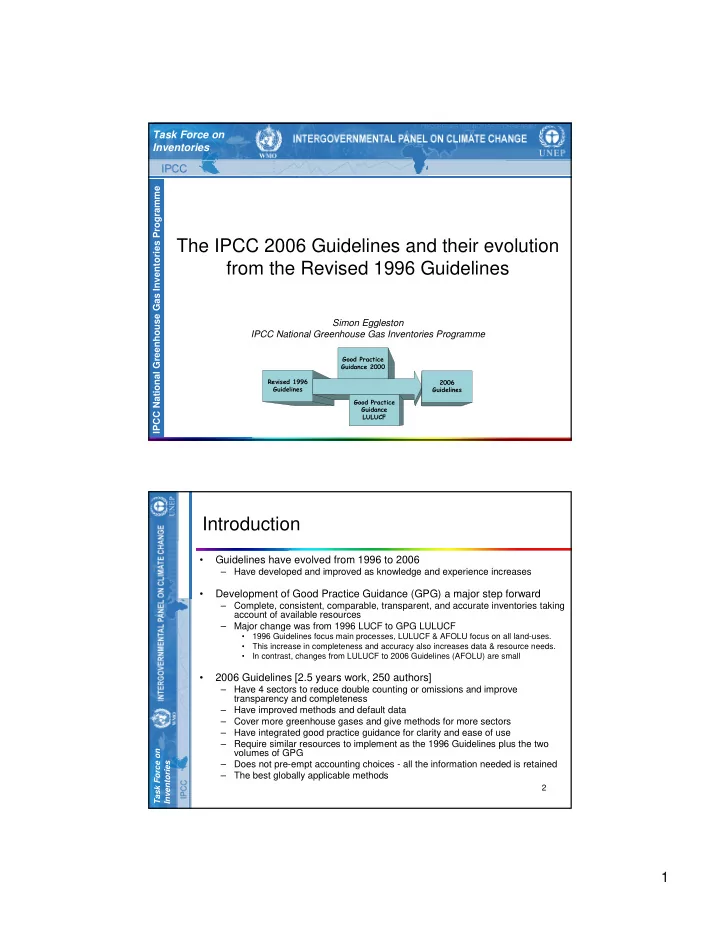
The IPCC 2006 Guidelines and their evolution from the Revised 1996 Guidelines

Simon Eggleston IPCC National Greenhouse Gas Inventories Programme

Good Practice Guidance 2000 Revised 1996 Guidelines Good Practice Guidance LULUCF 2006 Guidelines

2

INTERGOVERNMENTAL PANEL ON CLIMATE CHANGE

Task Force on Inventories

Introduction

  • Guidelines have evolved from 1996 to 2006

– Have developed and improved as knowledge and experience increases

  • Development of Good Practice Guidance (GPG) a major step forward

– Complete, consistent, comparable, transparent, and accurate inventories taking account of available resources – Major change was from 1996 LUCF to GPG LULUCF

  • 1996 Guidelines focus main processes, LULUCF & AFOLU focus on all land-uses.
  • This increase in completeness and accuracy also increases data & resource needs.
  • In contrast, changes from LULUCF to 2006 Guidelines (AFOLU) are small
  • 2006 Guidelines [2.5 years work, 250 authors]

– Have 4 sectors to reduce double counting or omissions and improve transparency and completeness – Have improved methods and default data – Cover more greenhouse gases and give methods for more sectors – Have integrated good practice guidance for clarity and ease of use – Require similar resources to implement as the 1996 Guidelines plus the two volumes of GPG – Does not pre-empt accounting choices - all the information needed is retained – The best globally applicable methods

slide-2
SLIDE 2

2

3

INTERGOVERNMENTAL PANEL ON CLIMATE CHANGE

Task Force on Inventories

History

  • Revised 1996 Guidelines

– Land-Use Change and Forestry (LUCF) identifies major land use processes

  • 2000 Good Practice Guidance

and Uncertainty Management

– Defines GPG for sectors except LUCF

  • Good Practice Guidance for Land

Use, Land-Use Change and Forestry (GPG LULUCF)

– Expanded guidance covering all pools – Land-based not process-based

  • 2006 IPCC Guidelines for

National Greenhouse Gas Inventories

– Now only 4 main sectors: Energy, IPPU (Industrial Processes and Product Use), AFOLU (Agriculture, Forestry and Other Land Use) and Waste

IPCC 2006 Guidelines for National Greenhouse gas Inventories, 2006 Good Practice Guidance for Land-use, Land Use Change and Forestry, 2003 Good Practice Guidance and Uncertainty Management in National Greenhouse Gas Inventories, 2000

Guidance used for reporting to the UNFCCC

Revised 1996 Guidelines for National Greenhouse Gas Inventories 1995 Guidelines for National Greenhouse Gas Inventories 1995 1996 2000 2003 2006 1997 1998 1999 2001 2002 2004 2005

4

INTERGOVERNMENTAL PANEL ON CLIMATE CHANGE

Task Force on Inventories

Methodological approaches unchanged

Continued from 1996 Guidelines, through GPG 2000 & LULUCF to 2006 Guidelines: Emission = [Emission Factor] x [Activity Data] In General:

Energy emissions

Based on carbon content of fuel

Industrial Processes

Based on chemistry of process Some use mass balance of product used

Land Use

Stock changes ⇒ Emissions/Removals

  • 1. Inputs (e.g. growth) - outputs (e.g. decay, harvest)
  • 2. Total Stock at end minus Total stock at beginning

Waste

Tracks carbon (fossil & biogenic) in waste

slide-3
SLIDE 3

3

5

INTERGOVERNMENTAL PANEL ON CLIMATE CHANGE

Task Force on Inventories

GPG and Sectoral Guidance

  • Good Practice inventories are defined as “those that contain neither
  • ver- nor under-estimates so far as can be judged, and in which

uncertainties are reduced as far as is practical”

  • GPG retains consistency with Revised 1996 Guidelines and is updated

and expanded in the 2006 Guidelines

– Approaches to Data Collection

6

INTERGOVERNMENTAL PANEL ON CLIMATE CHANGE

Task Force on Inventories

Tiers and Key Categories

slide-4
SLIDE 4

4

7

INTERGOVERNMENTAL PANEL ON CLIMATE CHANGE

Task Force on Inventories

“New” gases in 2006 Guidelines – Sources Identified in 2006 Guidelines

✔ ✔ C4F6, C5F8, c-C4F8O ✔ ✔ C3F7C(O)C2F5 ✔ ✔ ✔ CH2Cl2, CH3Cl ✔ ✔ CF3I, CH2Br2, CHCl3 ✔ ✔ ✔ ✔ halogenated ethers (e.g. C4F9OC2H5, CHF2OCF2OC2F4OCHF2, CHF2OCF2OCHF2) ✔ ✔ ✔ trifluoromethyl sulphur pentafluoride (SF5CF3) ✔ ✔ ✔ ✔ nitrogen trifluoride (NF3) GWP in AR4 GWP in TAR Halogenated Compounds Production Magnesium production Electronics Industries By-product & fugitive emissions

8

INTERGOVERNMENTAL PANEL ON CLIMATE CHANGE

Task Force on Inventories

Carbon Dioxide Equivalence

  • IPCC Guidelines do not specify any particular

parameters to convert mass of a gas to a equivalent mass of CO2 – users need to choose

– e.g. Kyoto Protocol uses GWP from IPCC SAR with 100 year time horizon – IPCC also has newer GWP values in TAR and AR4 – Alternatives to GWP have been discussed

  • Used only for:

– IPPU to aggregate the various fluorinated gases – Key Category Analysis – Uncertainty Assessment

slide-5
SLIDE 5

5

9

INTERGOVERNMENTAL PANEL ON CLIMATE CHANGE

Task Force on Inventories

Direct & Indirect Emissions: CO2 and N2O

01/05/2008 - 08/05/2008 NH3 & NOx CH4, CO & Hydrocarbons

Oxidises in the Atmosphere to form CO2 Sometimes called “Indirect CO2 Emissions” Deposition of N onto soils and the subsequent chemistry gives rise to N2O Emissions – “Indirect N2O” “Indirect N2O Emissions”

N2O

“Total” CO2 Emissions – the total increment in the atmosphere form direct and indirect sources

  • f CO2

CO2

Direct CO2 Emissions

CO2 CO2

2006 Guidelines “CO2 Emissions” 2006 Guidelines “CO2 Emissions” do not include this 2006 Guidelines includes ALL NH3 & NOx Emissions 2006 Guidelines give methods to calculate this

10

INTERGOVERNMENTAL PANEL ON CLIMATE CHANGE

Task Force on Inventories

Estimation of Actual Annual Emissions

  • In the 1996 Guidelines and Good Practice Guidance for a few

sources, the simplest methodology estimates a “potential emission” rather than the actual annual emission.

– This “potential emission” assumes all the emissions from an activity occur in the current year, ignoring the fact they will occur

  • ver many years (e.g. methane emissions from waste in landfills
  • ccurs over decades as the decay processes take place).
  • In the 2006 Guidelines, simple default methods estimate

emissions when they occur, thus removing the need for potential emissions.

  • The removal of potential emission estimates also allows the

emission reductions of abatement techniques to be properly estimated and ensures that the Tier 1 methods are compatible with higher tier methods. The areas where this occurred are:

– Actual emissions of fluorinated compounds – Methane from landfills

slide-6
SLIDE 6

6

11

INTERGOVERNMENTAL PANEL ON CLIMATE CHANGE

Task Force on Inventories

New Guidance in 2006 Guidelines

CO2 -Transport and Storage Electrical Equipment Urea-based Catalysts (Road Transport) Military Applications Accelerators Abandoned Underground Mines Medical Applications Propellant for Pressure and Aerosol Products Glass Production Ceramics Non Metallurgical Magnesia Production Complete, consistent treatment of fires Liming Caprolactam, Glyoxal & Glyoxylic Acid Settlements remaining Settlements Titanium Dioxide Production Some wetlands categories Petrochemical and Carbon Black Production Urea Application Indirect N2O Emissions from Manure Lead Production Harvested Wood Products Zinc Production Open Burning of Waste Integrated Circuit or Semiconductor Biological Treatment of Solid Waste TFT Flat Panel Display Photovoltaics Heat Transfer Fluid Fuel Combustion Other Product Manufacture and Use Fugitive Emissions from Fuels Mineral Industry Substitutes for Ozone Depleting Substances Land Use Chemical Industry Metal Industry Waste Electronics Industries Other Indirect N2O Emissions from the Atmospheric Deposition of N (excluding agriculture) 12

INTERGOVERNMENTAL PANEL ON CLIMATE CHANGE

Task Force on Inventories

Energy Sector – Fuel Combustion

  • Methods and categories largely unchanged
  • Improved default emission factors for fossil fuel use,

– based on survey of global data – uncertainties derived from range of data

  • 1A2 “Manufacturing Industries and Construction” –

suggested list of sub-categories to be reported, extended to include:

– Mining (excluding fuels) and Quarrying, Wood and Wood Products, Construction, Textile and Leather

  • New category: Road transport: Urea-based catalysts
slide-7
SLIDE 7

7

13

INTERGOVERNMENTAL PANEL ON CLIMATE CHANGE

Task Force on Inventories

Energy Sector – Fugitive Emissions

14

INTERGOVERNMENTAL PANEL ON CLIMATE CHANGE

Task Force on Inventories

Carbon Dioxide Capture and Storage

  • The impact of Carbon Dioxide Capture and Storage (CCS) is

covered comprehensively in the 2006 Guidelines:

– fugitive losses from CO2 capture and transport stages (estimated using conventional inventory approaches) – any losses from carbon dioxide stored underground (estimated by a combination of modelling and measurement techniques, - which would also be monitored for management purposes).

  • no assumptions of leakage rates are made

– methods reflect the actual emissions in the year in which they

  • ccur.

– methods are consistent with the IPCC Special Report on Carbon Dioxide Capture and Storage (2005). – CO2 captured from combustion of bio-fuels, are included in the inventory as a “negative emission” so that no distinction is needed between any subsequent leakage of this CO2 and that of CO2 from fossil sources.

slide-8
SLIDE 8

8

15

INTERGOVERNMENTAL PANEL ON CLIMATE CHANGE

Task Force on Inventories

IPPU ≈ Industrial Processes + Solvent Use

  • Solvent Use does not have much direct GHG emissions (it is mainly

NMVOC) while the use of products is broader than solvent use and can result in emissions

  • Quantities of CO2 for later use and short-term storage should not be

deducted from CO2 emissions except when the CO2 emissions are accounted for elsewhere in the inventory

– e.g. urea and methanol production – Ensures completeness and consistency,

  • Non-Energy Uses of Fossil Fuels

– Guidance on demarcation between the Energy and Industrial Processes and Product Use sectors has been improved, – Emissions from non-energy uses of fossil fuels are now reported under IPPU, rather than in Energy. – A method has been introduced for checking the completeness of carbon dioxide emission estimates from the non-energy uses.

  • To increase transparency several sources that were combined in
  • ther categories are reported separately in the 2006 Guidelines

16

INTERGOVERNMENTAL PANEL ON CLIMATE CHANGE

Task Force on Inventories

Industry & Solvent Classification

2006 Guidelines Revised 1996 Guidelines

2A Mineral Products 2G Other Product Use and Manufacture 2E Electronics Industry 2F Products used as Substitutes for Ozone Depleting Substances 2D Non-Energy Products & Solvent Use 2C Metal Industry 2B Chemical Industry 2A Mineral Industry 2F Consumption of Halocarbons & SF6 2E Production of Halocarbons & SF6 2D Other Production 2C Metal Production 2B Chemical Industry 3 Solvent Use

slide-9
SLIDE 9

9

17

INTERGOVERNMENTAL PANEL ON CLIMATE CHANGE

Task Force on Inventories

Evolution of IPCC Guidelines

18

INTERGOVERNMENTAL PANEL ON CLIMATE CHANGE

Task Force on Inventories

Evolution of IPCC Guidelines

slide-10
SLIDE 10

10

19

INTERGOVERNMENTAL PANEL ON CLIMATE CHANGE

Task Force on Inventories

Evolution of IPCC Guidelines

20

INTERGOVERNMENTAL PANEL ON CLIMATE CHANGE

Task Force on Inventories

Improvements in AFOLU Guidance

  • Wetlands

– 2006 GL has complete coverage of peatlands – 2006 GL improved coverage of flooded lands but some guidance is incomplete and awaits further scientific investigation

  • Fires

– Guidelines have increased consistency and coverage of fires – All emissions from fires reported in a separate category for increased transparency

  • Managed land is used in these guidelines as a proxy for

identifying anthropogenic emissions by sources and removals by sinks.

– use of managed land as a proxy for anthropogenic effects was introduced in the GPG-LULUCF and is consistent with the Revised 1996 Guidelines. – Managed land is land where human interventions and practices have been applied to perform production, ecological or social functions

slide-11
SLIDE 11

11

21

INTERGOVERNMENTAL PANEL ON CLIMATE CHANGE

Task Force on Inventories

Structure of the AFOLU Sector AFOLU AFOLU Sector Structure

22

INTERGOVERNMENTAL PANEL ON CLIMATE CHANGE

Task Force on Inventories

Waste

  • Landfill sites Solid Waste Disposal

– New Tier 1 model (spreadsheet available) – Only estimate actual emissions at all Tiers

  • New guidance for Biological Treatment of Waste

– Previously reported under “Other”

  • 2006 GL has separate categories for “Uncategorised

Waste Disposal Sites” and “Open Burning of Waste”

slide-12
SLIDE 12

12

23

INTERGOVERNMENTAL PANEL ON CLIMATE CHANGE

Task Force on Inventories

Summary

  • The same basic methodological approaches are used from

1996 Guidelines, through GPG 2000 & GPG LULUCF to 2006 Guidelines

  • The 2006 Guidelines maintain the methods of earlier

guidelines and integrate GPG

  • Improved guidance in some areas, more and improved default data
  • Wider coverage of gases
  • Additional sources covered
  • All estimates are now of actual annual emissions (“potential” emissions

not needed)

  • Categories simplified and clarified in some areas
  • Do not pre-empt accounting choices - all the information needed is

retained

24

INTERGOVERNMENTAL PANEL ON CLIMATE CHANGE

Task Force on Inventories

Summary

Energy Largely Unchanged

Improved defaults for fossil fuel combustion Some additional categories

e.g. CCS, Road Transport Urea Catalysts, uncontrolled burning of coal dumps Fugitive Emission categories simplified and clarified

IPPU

More process emissions identified Chemical production and use coverage clarified

Integration of agriculture & LULUCF reduces chance of double counting or omissions – some simplification of categories

The AFOLU Guidance in the 2006 Guidelines maintains the basic structure, definitions and methods of the GPG LULUCF Mapping between the GPG and the 2006 Guideline classification is straightforward. AFOLU effort and data requirements much the same as for LULUCF & Agriculture

Waste Largely Unchanged

Significant improvement to default method for landfills.

slide-13
SLIDE 13

13

IPCC National Greenhouse Gas Inventories Programme

INTERGOVERNMENTAL PANEL ON CLIMATE CHANGE Task Force on Inventories

Thank you

Guidelines in all UN languages can be downloaded from http://www.ipcc-nggip.iges.or.jp