SLIDE 1
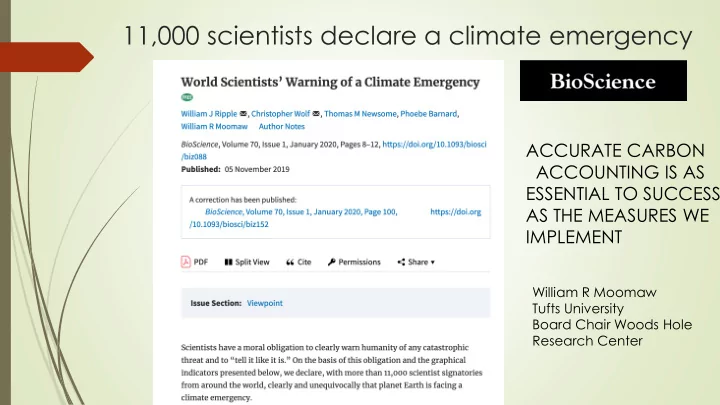
11,000 scientists declare a climate emergency
ACCURATE CARBON ACCOUNTING IS AS ESSENTIAL TO SUCCESS AS THE MEASURES WE IMPLEMENT
William R Moomaw Tufts University Board Chair Woods Hole Research Center
SLIDE 2
Global warming is reaching levels at which forests and other natural systems cease to be allies
Forest loss to wildfires releases CO2 & Black Carbon Thawing permafrost releases CO2 & CH4
SLIDE 3 CO2 ppm
Global average warming
Urgent action is needed to limit and reverse the growth of heat trapping gases in the atmosphere
Solomon et al 2009
SLIDE 4
Intergovernmental Panel on Climate Change Special Report Global Warming of 1.5oC
October 8, 2018 To keep temperatures from rising excessively “… global net anthropogenic carbon dioxide emissions (must) decline by about 45% from 2010 levels by 2030 … reaching net zero around 2050 …” Must simultaneously reduce combustion emissions and decrease atmospheric carbon dioxide by forest growth immediately. Continue to lower Concentrations below current levels to 350 ppm or lower after 2050 Moomaw 2020
SLIDE 5 Dynamics of carbon from repeated harvests for lumber or bioenergy
Tons per acre
22 22
Proforestation – Letting forests grow to their ecological capacity to store carbon and reach its biodiversity potential
SLIDE 6
Emissions from Harvesting US 2016 (Harris et al, 2016) Carbon from Oregon After 115 years (Hudiburg 2019)
Estimates of carbon storage in wood products is overestimated between 2-100-fold (Harmon, 2019)
SLIDE 7
Direct Emissions from Forest Bioenergy
Global emissions from forest bioenergy adds 4-5% to global fossil fuel CO2 emissions Particulate air pollution from bioenergy is especially harmful to human health
STOP Subsidizing Forest Bioenergy!
Southeast U.S. harvested for wood pellets to replace coal in Europe
SLIDE 8
Lands in North Carolina harvested to supply wood pellets for Europe
Wetland forests: “Enviva suppliers take extra care by using specialized harvesting equipment and techniques that minimize environmental impacts and protect soil and water quality”
http://www.envivabiomass.com/faq-forests-fiber-sourcing/#wetlands
SLIDE 9 IPCC AR 5 WG 3 11.13.4 GHG emission estimates of bioenergy
“The combustion of biomass generates gross GHG emissions roughly equivalent to the combustion of fossil fuels. If bioenergy production is to generate a net reduction in emissions, it must do so by offsetting those emissions through increased net carbon uptake of biota and soils.” “…bioenergy systems have often been assessed under the assumption that CO2 emitted from combustion is carbon
- neutral. … The shortcomings of this assumption have been
extensively discussed…”
SLIDE 10
SLIDE 11
Walker, et al. In preparation Not for distribution
Current Carbon Storage (Aboveground ca. 2016)
SLIDE 12
Walker, et al. In preparation Not for distribution
Potential Carbon Storage (Aboveground)
SLIDE 13
Walker, et al. In preparation Not for distribution
Unrealized Potential Carbon Storage (Aboveground)
SLIDE 14 Strategies for closing the sequestration gap
Preventing deforestation and degradation, the draining of wetlands and soil degradation are essential to avoid irreversible and catastrophic climate change before it is too late Proforestation management
among the most effective actions and least costly
storing additional atmospheric carbon dioxide (Moomaw et al, 2019)
Let More Grow