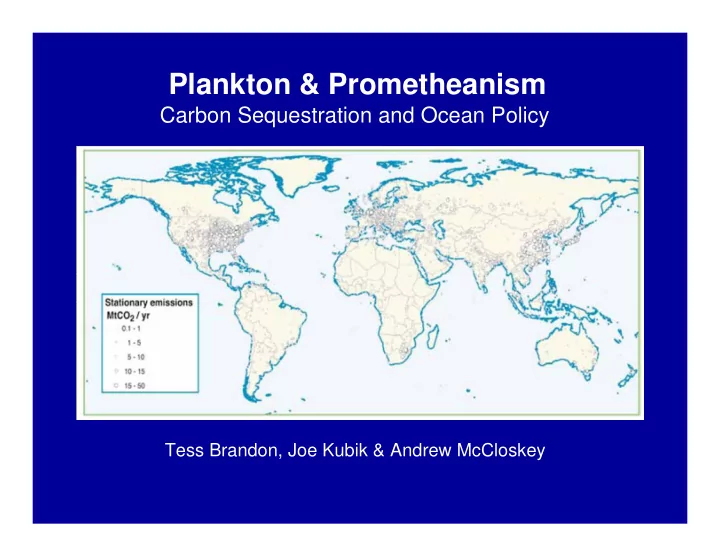
Plankton & Prometheanism Carbon Sequestration and Ocean Policy - - PowerPoint PPT Presentation

plankton prometheanism
SMART_READER_LITE
LIVE PREVIEW

Plankton & Prometheanism Carbon Sequestration and Ocean Policy - - PowerPoint PPT Presentation

Plankton & Prometheanism Carbon Sequestration and Ocean Policy Tess Brandon, Joe Kubik & Andrew McCloskey Overview Carbon Sequestration Overview Ocean Fertilization Ocean Policy Fisheries UNCLOS The Ocean as a


slide-1
SLIDE 1

Plankton & Prometheanism

Tess Brandon, Joe Kubik & Andrew McCloskey

Carbon Sequestration and Ocean Policy

slide-2
SLIDE 2

Overview

  • Carbon Sequestration

– Overview – Ocean Fertilization

  • Ocean Policy

– Fisheries – UNCLOS

  • The Ocean as a global resource
slide-3
SLIDE 3

Carbon Sequestration

  • Carbon dioxide Capture

and storage (CCS) is a way of separating CO2 from industrial and energy processes and transporting it for long- term storage and isolation from the atmosphere.

  • Two possibilities exist -

terrestrial/geological, and

  • ceanic

From IPCC Special Report on Carbon Sequestration

slide-4
SLIDE 4

Ocean Fertilization

  • Iron-rich Dust Phytoplankton Carbon Sink
  • Lots of uncertainty: ecosystem damage, nutrient

redistribution, creation of anoxic zones, ocean acidity

http://www.mbari.org/expeditions/SOFeX2002/history&purpose.htm

slide-5
SLIDE 5

Disconnect between Science and Government

  • The Department of Energy

has created an entire department called the Carbon Sequestration Core Program for research on carbon sequestration

  • Have introduced ocean

fertilization as a new and exciting technical fix for atmospheric carbon dioxide vs.

  • NSF and scientific

community want to study

  • cean fertilization for its

inherent value to understanding the physical and ecological processes and paleoclimate in the

  • cean, not because of its

potential as a solution to global warming.

slide-6
SLIDE 6

Overview

  • Carbon Sequestration

– Overview – Ocean Fertilization

  • Ocean Policy

– Fisheries – UNCLOS

  • The Ocean as a global resource
slide-7
SLIDE 7

International Ocean Policy: The Early Years

1609 - Mare Liberum

“The Freedom of the Seas” Doctrine

  • Open-pool resource
  • Inexhaustible resources
  • Colonial Legacy

Hugo Grotius

1839 - Three Mile Territorial Seas

  • est. between France & England

http://en.wikipedia.org/wiki/Hugo_Grotius

1945 – President Harry Truman

claims jurisdiction over the US continental shelf and coastal fisheries

slide-8
SLIDE 8

Fisheries and their Impact

Setting the Stage for UNCLOS

EVENTS

  • Hardin’s “Tragedy of the Commons:
  • pen access & overcapitaliza-tion
  • Transition of fish (as a resource)

from a nonrival to rival commodity

  • “Common Heritage of Mankind”
  • 3 Mile territorial zone becomes

inadequate (Treaty of Washington)

  • 1958 “Cod War” culmination of many

factors

CONCEPTS

http://img78.photobucket.com/

slide-9
SLIDE 9

UNCLOS (United Nations Convention on Law of the Sea)

“The problems of ocean space are closely interrelated and must be considered as a whole”

  • preamble of the Law of the Sea
  • Emphasizes precaution

The Primary Jurisdictions

  • Places restrictions upon the Mare

Liberum doctrine

  • Treats ocean governance and the ocean

itself as a connected whole

CONCEPTS

  • United States has refused to rafity
  • Most widely agreed on

international law (ratified by 139 UN nations)

  • Divides the seas up in to 4 main

jurisdictional zones

DETAILS

http://en.wikipedia.org/wiki/United_Nations_Convention_on_the_ Law_of_the_Sea

slide-10
SLIDE 10

Implications –

What does all this mean for ocean fertilization research?

  • What happens when (or if) ocean

fertilization pasts the research phase?

Exclusive Economic Zones in the Western Pacific

  • Part XIII of UNCLOS promotes scientific

research

  • However, Article 240, section (C): “Shall

not unjustifiably interfere with other legitimate uses..”

  • Would fall under the North-East Pacific,
  • r Pacific jurisdictional regions under

UNEP’s Regional Seas Programme

  • Ocean fertilization would most likely
  • ccur in international waters, where Mare

Liberum still applies.

http://walrus.wr.usgs.gov

slide-11
SLIDE 11

Overview

  • Carbon Sequestration

– Overview – Ocean Fertilization

  • Ocean Policy

– Fisheries – UNCLOS

  • The Ocean as a global resource
slide-12
SLIDE 12

Global Resource Management: A New Paradigm

Increasing Connectivity

  • Natural Resource Management:
  • Horizontal Connectivity
  • Vertical Connectivity
  • Economics and Politics:
  • Globalization
  • International Law

www.flickr.com

slide-13
SLIDE 13

The Ocean as a Global Resource

Equatorial Pacific Ocean Southern Ocean

  • NMFS and Fisheries Management
  • Ownership of the Ocean
  • Ecosystems-based Management
  • Deep-Ocean Carbon Sequestration
  • S.O. as the “great communicator”
  • Scientific Implications
  • Political Implications

฀topex-www.jpl.nasa.gov

slide-14
SLIDE 14

Looking Ahead: The Future of Ocean Policy

  • UNCLOS: first step in recognizing

that the ocean is a complex, interrelated system

  • Steps must still be taken in

abandoning Hugo Grotius’s Mare Liberum – the idea that the worlds

  • ceans are an open-pool resource
  • This includes:
  • 1. A restructuring of international

waters

  • 2. Realization that interaction

among stakeholders is necessary

  • 3. Ratification of UNCLOS by the

U.S.

U.S. Exclusive Economic Zones

www.afsc.noaa.gov/images/useez.jpg

slide-15
SLIDE 15

Looking Ahead: Ocean Fertilization

How It Might Look

  • Hybrid system between that

proposed by the Kyoto Protocol and that of US wetland mitigation banks

  • Semi-private carbon mitigation

banks based on a system of “carbon credits”

  • Limited number of permits allotted
  • UN pre-approves appropriate

areas

CONCEPTS

  • Lack of regulation could lead to

disastrous consequences

  • Would be treated like any other

private enterprise

  • International waters still function

under the concept of Mare Liberum

  • UNCLOS does not address the

issue of ocean fertilization, or any type of carbon sequestration involving the oceans

ISSUES

slide-16
SLIDE 16

Summary & Conclusions

  • Ocean fertilization as a Promethean

solution to climate change

  • Future ocean policy should

approximate guidelines of sustainable development

  • Open-pool resource Common-pool

resource

  • Realistic use: carbon credit market

Connections

"We all believe technology offers great promise to significantly reduce [greenhouse gas] emissions -- especially carbon capture, storage and sequestration technologies." President George W. Bush June 11, 2001

usinfo.state.gov

slide-17
SLIDE 17

Thank you! Questions?