Main parameters (invariants) 160 letters Omaha -Nebraska- -> - - PowerPoint PPT Presentation

main parameters
SMART_READER_LITE
LIVE PREVIEW

Main parameters (invariants) 160 letters Omaha -Nebraska- -> - - PowerPoint PPT Presentation

Internet C. Elegans Large Complex Networks: Deteministic Models (Recursive Clique-Trees) WWW Erds number Air routes http://www.caida.org/tools/visualization/plankton/ Francesc Comellas Proteins Departament de Matemtica Aplicada IV,


slide-1
SLIDE 1

Large Complex Networks: Deteministic Models

(Recursive Clique-Trees)

Francesc Comellas

Departament de Matemàtica Aplicada IV, Universitat Politècnica de Catalunya, Barcelona comellas@ma4.upc.edu

http://www.caida.org/tools/visualization/plankton/

WWW Internet

Power grid

Air routes

  • C. Elegans

Erdös number Proteins Complex systems Different elements (nodes) Interaction among elements (links)

Complex networks

Mathematical model: Graphs Real networks very often are Large Small-world

small diameter log(|V|), large clustering

Scale-free

power law degree distribution ( “hubs” )

Self-similar / fractal Deterministic models Based on cliques (hierarchical graphs, recursive clique-trees, Apollonian graphs) Most “real” networks are small-world scale-free self-similar

Small diameter (logarithmic) Milgram 1967 High clustering Watts & Strogatz 1998 Power law (degrees) Barabási & Albert 1999 Fractal Song, Havlin & Makse 2005,2006

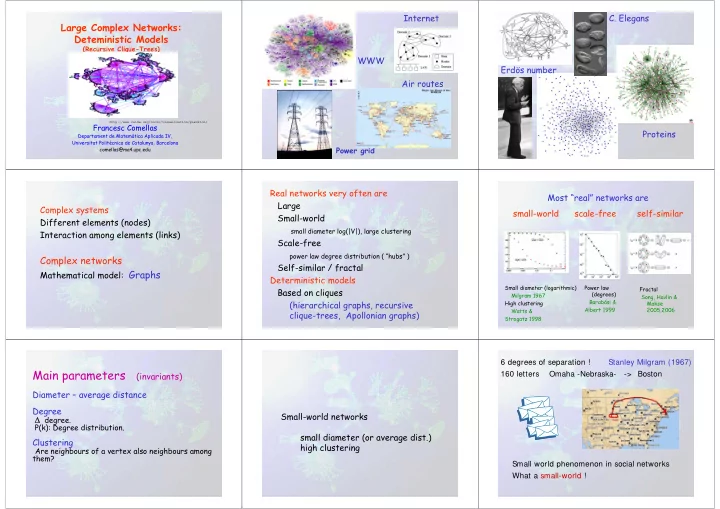
Main parameters

(invariants) Diameter – average distance Degree Δ degree.

P(k): Degree distribution.

Clustering

Are neighbours of a vertex also neighbours among them?

Small-world networks small diameter (or average dist.) high clustering

Small world phenomenon in social networks What a small-world ! 6 degrees of separation ! Stanley Milgram (1967) 160 letters Omaha -Nebraska-

  • > Boston
slide-2
SLIDE 2

Structured graph

  • high clustering
  • large diameter
  • regular

Random graph

  • small clustering
  • small diameter

Small-world graph

  • high clustering
  • small diameter
  • almost regular

|V| = 1000 Δ =10 D = 100 d =49.51 C = 0.67 |V|=1000 Δ =8-13 D = 14 d = 11.1 C = 0.63 |V|=1000 Δ = 5-18 D = 5 d = 4.46 C = 0.01

Watts & Strogatz, Collective dynamics of “small-world” networks, Nature 393, 440-442 (1998)

Clustering C(v) =

# of links among neighbors n(n-1)/2

Real life networks are clustered, large C(p), but have small average distance L(p ). Very often they are also scale-free Diameter or Average distance

Maximum communication delay

L Lrand C Crand N

WWW

3.1 3.35 0.11 0.00023 153127

Actors

3.65 2.99 0.79 0.00027 225226

Power Grid 18.7

12.4 0.080 0.005 4914

  • C. Elegans 2.65

2.25 0.28 0.05 282

Network characteristics

Degree distribution

Resilience

Erdös number

1- 509 2- 7494 N= 268.000 Jul 2004

(connected component)

D=23 R=12 D avg = 7.64 δ=1 Δ =509 Δavg = 5.37 C = 0.14 http://www.oakland.edu/enp/

Erdös number 0 --- 1 person Erdös number 1 --- 504 people Erdös number 2 --- 6593 people Erdös number 3 --- 33605 people Erdös number 4 --- 83642 people Erdös number 5 --- 87760 people Erdös number 6 --- 40014 people Erdös number 7 --- 11591 people Erdös number 8 --- 3146 people Erdös number 9 --- 819 people Erdös number 10 --- 244 people Erdös number 11 --- 68 people Erdös number 12 --- 23 people Erdös number 13 --- 5 people (MathSciNet Jul 2004)

Notable Erdös coathors:

Frank Harary (257 coautors) Noga Alon (143 coautors) Saharon Shela (136) Ronald Graham (120) Charles Colbourn (119) Daniel Kleitman (115)

  • A. Odlyzko (104)

Erdös did not write a joint paper with his PhD advisor, Leopold Fejér Some other Erdös coautors articles with Erdös András Sárközy 57 András Hajnal 54 Ralph Faudree 45 Richard Schelp 38 Vera Sós 34 Alfréd Rényi 32 Cecil C. Rousseau 32 Pál Turán 30 Endre Szemerédi 29 Ronald Graham 27 Stephan A. Burr 27 Joel Spencer 23 Carl Pomerance 21 Miklos Simonovits 21 Ernst Straus 20 Melvyn Nathanson 19 Richard Rado 18 Jean Louis Nicolas 17 Janos Pach 16 Béla Bollobás 15 Eric Milner 15 John L. Selfridge 13 Harold Davenport 7 Nicolaas G. de Bruijn 6 Ivan Niven 7 Mark Kac 5 Noga Alon 4 Saharon Shela 3 Arthur H. Stone 3 Gabor Szegö 2 Alfred Tarski 2 Frank Harary 2 Irving Kaplansky 2 Lee A. Rubel 2

Lars Ahlfors 1936 Finland 4 Jesse Douglas 1936 USA 4 Laurent Schwartz 1950 France 4 Atle Selberg 1950 Norway 2 Kunihiko Kodaira 1954 Japan 2 Jean-Pierre Serre 1954 France 3 Klaus Roth 1958 Germany 2 Rene Thom 1958 France 4 Lars Hormander 1962 Sweden 3 John Milnor 1962 USA 3 Michael Atiyah 1966 Great Britain 4 Paul Cohen 1966 USA 5 Alexander Grothendieck 1966 Germany 5 Stephen Smale 1966 USA 4 Alan Baker 1970 Great Britain 2 Heisuke Hironaka 1970 Japan 4 Serge Novikov 1970 USSR 3 John G. Thompson 1970 USA 3 Enrico Bombieri 1974 Italy 2 David Mumford 1974 Great Britain 2 Pierre Deligne 1978 Belgium 3 Charles Fefferman 1978 USA 2 Gregori Margulis 1978 USSR 4 Daniel Quillen 1978 USA 3

Fields medals

Alain Connes 1982 France 3 William Thurston 1982 USA 3 Shing-Tung Yau 1982 China 2 Simon Donaldson 1986 Great Britain 4 Gerd Faltings 1986 Germany 4 Michael Freedman 1986 USA 3 Valdimir Drinfeld 1990 USSR 4 Vaughan Jones 1990 New Zealand 4 Shigemufi Mori 1990 Japan 3 Edward Witten 1990 USA 3 Pierre-Louis Lions 1994 France 4 Jean Christophe Yoccoz 1994 France 3 Jean Bourgain 1994 Belgium 2 Efim Zelmanov 1994 Russia 3 Richard Borcherds 1998 S Afr/Gt Brtn 2 William T. Gowers 1998 Great Britain 4 Maxim L. Kontsevich 1998 Russia 4 Curtis McMullen 1998 USA 3 Vladimir Voevodsky 2002 Russia 4 Laurent Lafforgue 2002 France inf Andrei Okounkov 2006 USA 3 Terence Tao 2006 USA 3 Wendelin Werner 2006 France 3

slide-3
SLIDE 3

Scale-free networks

Scalability vs Fractality

7 0 8 5 9 93 10 806 11 90 12 5 13 1 14 0

SWCirculant

|V|=1000 Δ =8-13 D = 14 d = 11.1 Small World C = 0.63

Power grid

|V|=4491 δ =1 Δ =19 D = 46 d = 34.54 Small World C = 0.08

1 1227 2 1656 3 1060 4 401 5 252 6 137 7 84 8 46 9 27 10 26 11 11 12 5 13 5 14 3 15 0 16 0 17 0 18 1 19 1 A-L. Barabási i R. Albert, Emergence of scaling in random networks. Science 286, 509-510 (1999)

P(k) = k - γ

A: actors N=212.250 k=28.78 γ =2.3 B: WWW N=325.729 k=5.46 γ =2.67 C: power grid N= 4.94 k=2.67 γ =4

Real networks for which we know the topology: P(k) ~ k- γ But, usual random models give: P(k) ~ e- k

NON BI OLOGI CAL γ > 2 www (in) γ = 2.1 www (out) γ = 2.45 actors

γ = 2.3

citations

γ = 3

power grid

γ = 4

BI OLOGI CAL γ < 2 yeast protein-protein net γ = 1.5, 1.6, 1.7, 2.5

  • E. Coli metabolic net γ = 1.7, 2.2

yeast gene expression net γ = 1.4-1.7 gene functional interaction

γ = 1.6

Albert, Jeong, Barabási Nature 406, 378 (2000) What happens when nodes fail randomly ? And when there are intentionate attacks to the best connected nodes ?

Interest on scale-free nets: Resilience / Survival of the WWW

“vaccinate” high degree nodes !

Epidemics spreading / “vaccination” WWW, social networks

fc threshold λ power law exponent upper– totally random lower- acquaintance immunisation (red), double acq. imm. (green) method: * select a node at random * ask it to select a high degree node and immunize it

  • R. Cohen, D. ben-Avraham, S. Havlin;

Efficient immunization of populations and computers

  • Phys. Rev. Lett. 91, 247901 (2003)

Search in power-law networks

Adamic, Lukose, Puniyani, Huberman;

  • Phys. Rev. E 64, 046135 (2001)

From random “vaccination” Arnau d’Amaurí 1209. Besièrs Ca Caedit edite eos. . Novit Novit eni nim Dominus qui sunt sunt eius us

Kill them all, God will know his own

to selection (see figure) Even the Inquisition knew aboutscale-free networks!!

  • P. Ormerod, A.P. Roach;

The Medieval inquisition: scale-free networks and the suppression of heresy. Physica A 339 (2004) 645-652

spectral properties

  • Connectivity and vulnerability (diameter, cut sets,

distances between subsets)

  • Scalability, expansion (Cheeger constants)
  • Routings

(spanning trees)

  • Load balancing
  • Clustering (triangles)
  • Reconstruction (Ipsen & Mikhaliov, 2001)
  • Dynamical aspects (interlacing theorem)
slide-4
SLIDE 4

WWW / Internet eigenvalues

Faloutsos, Faloutsos & Faloutsos, 1999

Experimental and simulation results

Adjacency matrix eigenvalues

(Watts & Strogatz model, Scale-free models)

Farkas, Derenyi, Barabási & Vicsek Phys. Rev E 2001 Goh, Kahng & Kim 2001 Fan & Chen IEEE Circ. Sys. 2002 scale-free Watts-Strogatz

Normalized Laplacian eigenvalues

(meshes, random trees)

Vukadinovic, Huang, Erlebach 2002

How to model real networks ? Erdös-Rény, Watts-Strogatz Barabási-Albert

  • ther models ?

Why appears a power law?

  • 1. Networks grow continously by addition of new

nodes

  • 2. Growth is NOT uniform: A new node will join,

with high probability, an old well connected node

WWW: New documents point to “classic” references Erdös: I would prefer to publish with a well known mathematician

“Standard” model: Barabási, Albert; Science 286, 509 (1999) Preferential attachment : At each time unit a new node is

added with m links which connect to existing nodes . The probability P to connect to a node i is proportional to its degree ki

Mean Field Theory γ = 3

t k k k A k t k

i j j i i i

2 ) ( = = Π ∝ ∂ ∂

i i

t t m t k = ) (

, with initial condition

m t k

i i

= ) (

) ( 1 ) ( 1 ) ( ) ) ( (

2 2 2 2 2 2

t m k t m k t m t P k t m t P k t k P

i t i t i

+ − = ≤ − = > = <

3 3 2

~ 1 2 ) ) ( ( ) (

+ = ∂ < ∂ = ∴ k k t m t m k k t k P k P

  • i

A.-L.Barabási, R. Albert and H. Jeong, Physica A 272, 173 (1999)

Duplication models:

Fan Chung, Lu, Dewey, Galas; (2002) Nodes are duplicated together with all (or part) of their edges. can produce γ <2 as in biological networks keep some network properties

Fractal networks

slide-5
SLIDE 5

Motifs, graphlets

Milo, Shen-Orr, Itzkoviz, Kashtan, Chkovskii, Alon Science 298, 824-827 (2002) Pržulj, Corneil, Jurisica Bioinformatics 20, 3508-3515 (2004)

Song, Havlin, Makse Nature 433, 392-396 (2005) Nature Physics 2, 275-281 (2006)

Self-similarity of complex networks Origins of fractality in the growth of complex networks

WWW, protein interaction networks are fractal Internet (AS) is not fractal Barabási-Albert is not fractal

Real complex networks: self-organized criticality (SOC) by some optimization process ! !

Cliques-trees, as deterministic models for real networks. Hierarchical graphs Recursive clique-trees Apollonian graphs

Hierarchical graphs

γ = 1 + ( ln 5/ ln 4)

Ravasz, Barabasi. Hierarchical organization in complex networks

  • Phys. Rev. E (2003).

Real-life networks are fractal (Song, Havlin, Makse) but some fractal-looking graphs are not !

Barrière, Comellas, Dalfó (2006) .

Recursive clique-trees

  • F. Comellas, Guillaume Fertin, André Raspaud, Phys. Rev. E (2004)

SN Dorogovtsev, AV Gotsev, JFF Mendes., Phys. Rev. E (2002)

example q=2 example q=3

Recursive clique-trees

Initial graph: Kq -the complete graph with q vertices-. Operation: t>=0, obtain K(q,t+1) from K(q,t) by adding for every clique Kq of K(q,t+1): a: A new vertex u b: q edges joining u with the vertices of this clique F.Comellas, G. Fertin, A. Raspaud, Phys. Rev. E

slide-6
SLIDE 6

Recursive equivalent operation

  • Order, size
  • Degree distribution
  • Clustering

0.8 <= C <= 1

  • Diameter logarithmic

Distance-labeling and routing (example q=2) F.Comellas, G. Fertin, A. Raspaud, Sirocco 2003

Apollonian packings

Apollonian graphs

And let us not confine our cares To simple circles, planes and spheres, But rise to hyper flats and bends Where kissing multiple appears, In n-ic space the kissing pairs Are hyperspheres, and Truth declares - As n+ 2 such osculate Each with an n+ 1 fold mate The square of the sum of all the bends Is n times the sum of their squares.

Thorold Gosset, The Kiss Precise, Nature 139 (1937) 62.

Apollonian graphs d=2 d=3

Andrade et al. Phys. Rev. Lett. (2005) Doye, Massen Phys. Rev. E (2005) Zhang, Rong, Comellas, Fertin J. Phys.A (2006)

http://graphics.ethz.ch/~peikert/personal/packing/images/apoll3d.png

Discrete degree spectrum (with larger and larger jumps)

Random Apollonian graphs

Instead of adding simultaneously a new vertex to each clique (never used before), we add an unique vertex to a random clique. Initially A(d,0) is Kd+2 Step t choose clique Kd+1 NEVER USED and add a node (and the corresponding edges) Order increments by 1 at each step Nt = t+d+2

Degree distribution (self-averaging)

Given a vertex, when its degree increases by 1, the number of Kd+1 which contains it increases by d-1. Thus, when the vertex attains degree ki the number of Kd+1 is (d+1)+(ki -d-1)(d-1)=(d-1) ki - d2+d+2 with initial condition ki (ti) = d +1 we obtain

slide-7
SLIDE 7

If k >> d we have P(k) ~ k−γ with

γ=3 (for d=2, random seq.)

vs

γ=2.58496 (d=2 parallel)

Degree distribution when N=10000, d=2,3,4,5 HDRAN clustering N=10000, d=2,3,4,5

Clustering Average path length

  • Zhongzhi Zhang, Lili Rong, F. Comellas, Guillaume

Fertin, High dimensional Apollonian networks

  • J. Phys. A (2006)
  • Zhongzhi Zhang, Lili Rong, F. Comellas,

High dimensional random Apollonian networks Physica A (2006),

Deterministic recursive clique-trees Random recursive clique-trees

Deterministic vs Random Why the random approach produces a different distribution

  • F. Comellas, Hernan D. Rozenfeld, Daniel ben-Avraham

Synchronous and asynchronous recursive random scale- free nets

  • Phys. Rev. E (2005),

In many simulations choosing an edge might be biased. It is not the same to choose edge e from |E| edges than choose a node and then and adjacent node.

slide-8
SLIDE 8

Present and future work in SW-SF networks How to construct a better WWW (new topologies -Akamai) ? How to analyse very large graphs ?

  • mean field and other statistical methods
  • fractal techniques
  • spectral theory
  • new invariants
  • this workshop

How to deal with dynamical networks ? New communication protocols