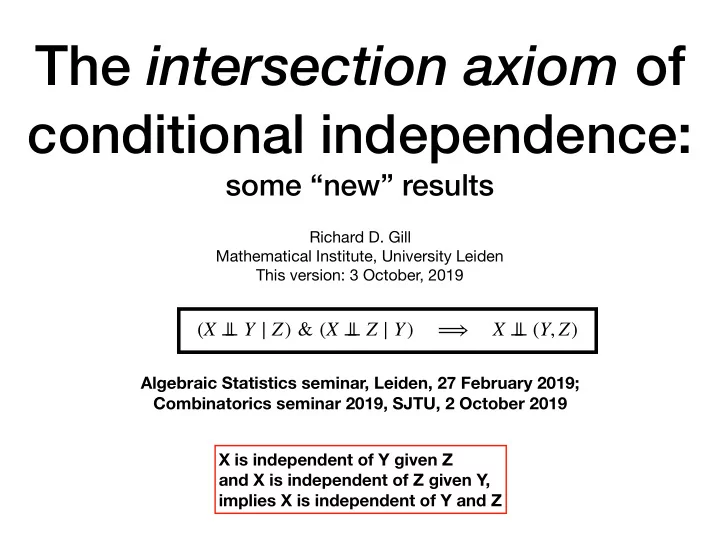
SLIDE 4 Algebraic Statistics Seth Sullivant
North Carolina State University E-mail address: smsulli2@ncsu.edu 2010 Mathematics Subject Classification. Primary 62-01, 14-01, 13P10, 13P15, 14M12, 14M25, 14P10, 14T05, 52B20, 60J10, 62F03, 62H17, 90C10, 92D15 Key words and phrases. algebraic statistics, graphical models, contingency tables, conditional independence, phylogenetic models, design of experiments, Gr¨
- bner bases, real algebraic geometry, exponential families,
exact test, maximum likelihood degree, Markov basis, disclosure limitation, random graph models, model selection, identifiability
- Abstract. Algebraic statistics uses tools from algebraic geometry, com-
mutative algebra, combinatorics, and their computational sides to ad- dress problems in statistics and its applications. The starting point for this connection is the observation that many statistical models are semialgebraic sets. The algebra/statistics connection is now over twenty years old– this book presents the first comprehensive and introductory treatment of the subject. After background material in probability, al- gebra, and statistics, the book covers a range of topics in algebraic statistics including algebraic exponential families, likelihood inference, Fisher’s exact test, bounds on entries of contingency tables, design of experiments, identifiability of hidden variable models, phylogenetic mod- els, and model selection. The book is suitable for both classroom use and independent study, as it has numerous examples, references, and
Graduate Studies in Mathematics Volume: 194; 2018; 490 pp; Hardcover MSC: Primary 62; 14; 13; 52; 60; 90; 92; Print ISBN: 978-1-4704-3517-2
Inspiration: study group