The inflammatory tumor micro-environment: a critical regulator of - - PowerPoint PPT Presentation

the inflammatory tumor micro environment
SMART_READER_LITE
LIVE PREVIEW

The inflammatory tumor micro-environment: a critical regulator of - - PowerPoint PPT Presentation

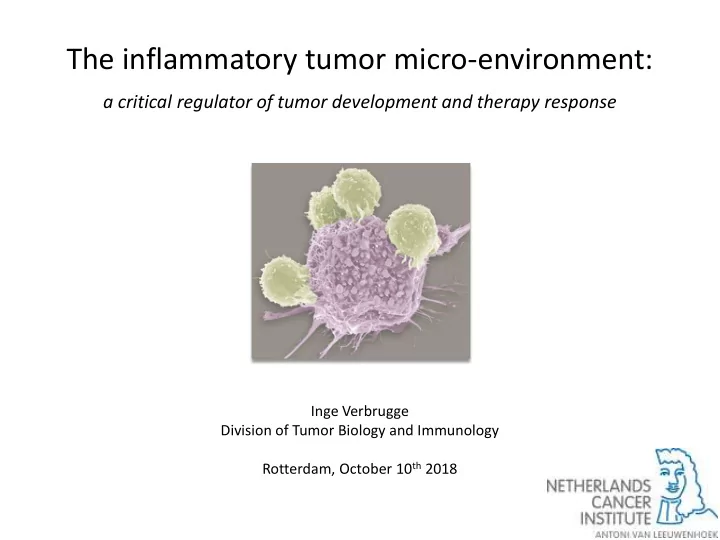
The inflammatory tumor micro-environment: a critical regulator of tumor development and therapy response Inge Verbrugge Division of Tumor Biology and Immunology Rotterdam, October 10 th 2018 Slide: Seth Coffelt Part 1: Micro environmental


slide-1
SLIDE 1

The inflammatory tumor micro-environment:

a critical regulator of tumor development and therapy response

Inge Verbrugge Division of Tumor Biology and Immunology Rotterdam, October 10th 2018
slide-2
SLIDE 2

Slide: Seth Coffelt

slide-3
SLIDE 3

Slide: Seth Coffelt

Part 1: Micro environmental regulation of tumor progression Clinical Associations

slide-4
SLIDE 4

Rudolf Virchow (1821-1902) German Pathologist

1863: First hypothesis linking inflammation and cancer development

slide-5
SLIDE 5

Image: Seth Coffelt

Inflammatory tumor micro-environment in human invasive breast cancer

Question: Can inflammation lead to cancer? Do you have examples?

slide-6
SLIDE 6

Chronic inflammation can promote tumorigenesis

1de Martel et al., Lancet Oncol 2012;13:607-615

Inflammatory Stimulus Malignancy Hepatitis Virus (B and C) Hepatocellular carcinoma Inflammatory Bowel Disease Colorectal Cancer Asbestos Mesothelioma Prostatitis Prostate Cancer Schistosmiasis Bladder Cancer

  • H. plyori-induced gastritis

Gastric Cancer Barrett’s metaplasia Oesophageal carcinoma Thyroiditis Papillary thyroid carcinoma Up to ~15% of cancers, tumor initiation attributed to infection1

slide-7
SLIDE 7

Sandler RS et al. New Engl. J. Med 2003;348:891-899

Anti-inflammatory drugs prevent tumor recurrence

Kaplan-Meier estimates of the time to a first adenoma in patients with previous colorectal cancer

slide-8
SLIDE 8

Macrophages in breast cancer

Leek RD et al., Cancer Res 1996;56:4625-4629 Steidl C et al., NEJM 2010;362:875-885

Macrophages in Hodgkin’s lymphoma

Influx of innate immune cells correlates with poor prognosis

slide-9
SLIDE 9

Pro-tumor Anti-tumor

Immune system and cancer: A double-edged sword

slide-10
SLIDE 10

De Visser KE et al., Nat Rev. Cancer 2006;6:24-37

Impaired immune responses correlate with higher cancer incidence

slide-11
SLIDE 11

Galon J et al., Science 2006;313:1960-1964

High-density tumor-infiltrating lymphocytes (TILs) correlate with survival advantage in colorectal tumors

slide-12
SLIDE 12

Slide: Seth Coffelt

Part 1: Micro environmental regulation of tumor progression Mechanisms

slide-13
SLIDE 13

Klemm F and Joyce JJ Trends in Cell Biology 2015; 25:198-213

  • 1. Tumor vasculature
  • 2. Cancer-associated

fibroblasts

  • 3. Inflammatory cells
  • 4. Extracellular

matrix

Major components of the tumor micro-environment

slide-14
SLIDE 14

Slide: Seth Coffelt

slide-15
SLIDE 15

Anti-tumor immunity Cancer Growth Chronic inflammation Tissue homeostasis

Controversial role of the immune system during cancer development

Pro-tumor Anti-tumor

slide-16
SLIDE 16

Quail DF and Joyce JA, Nature Medicine 2013;19:1423-1437

Establishment of inflammatory tumor micro-environment “Wounds that never heal”

slide-17
SLIDE 17

Slide: Seth Coffelt

Macrophage infiltration in breast cancer

What have experimental studies taught us regarding the role

  • f the immune system during cancer development?

What models are available to study this?

slide-18
SLIDE 18

Lin E.Y. et al., J. Exp. Med. 2001;193:727-740

Macrophages enhance breast cancer metastasis formation

  • MMTV-Polyoma virus Middle T (PyMT)-transgenic mice

– PyMT expression under control of MMTV promoter in mammary epithelium – Spontaneous development of breast cancer

slide-19
SLIDE 19

Macrophages contribute to cancer progression

Lin E.Y. et al., J. Exp. Med. 2001;193:727-740

Reconstitute CSF1R in Macrophage-deficient mice

Tumor grade

slide-20
SLIDE 20

Macrophages contribute to cancer progression at multiple levels

Pollard J. W., Nat Rev Cancer 2004;4:71-78

(e.g. CSF-1, VEGF ) (e.g. VEGF) (e.g. MMPs) (e.g. EGF)

slide-21
SLIDE 21

Hagerling C. et al., Trends Cell Biol 2015;25:214-220

Conversion of (innate) immune cells during cancer progression

slide-22
SLIDE 22

Slide: Seth Coffelt

Part 2: The inflammatory tumor micro-environment and anti-cancer therapy

slide-23
SLIDE 23

Anti-cancer therapies targeting the tumor micro-environment

Quail DF and Joyce JA, Nature Medicine 2013;19:1423-1437

slide-24
SLIDE 24

Klemm F. and Joyce JA, Trends in Cell Biology 2015;25:198-213

How the TME can influence response to anti-cancer therapies

slide-25
SLIDE 25

Slide: Seth Coffelt

T cell infiltration in breast cancer

slide-26
SLIDE 26

(Cytotoxic) T cell-mediated tumor cell kill

MHC I

slide-27
SLIDE 27

Chen DS and Mellman I, Immunity 2013;39:1-10

The Cancer Immunity Cycle

slide-28
SLIDE 28

α-PD-1, α-CD137

Costimulation Blocking coinhibition

Radio-immunotherapy promise: Achieving SYSTEMIC synergism by combining LOCAL radiotherapy with immune-modulation

Radio-immunotherapy: Concept

Verbrugge I et al., Cancer Res 2012;72:3163-3174 Verbrugge I et al., Radiation Res 2014;82:219-229 Kroon P et al., Cancer Immunol Immunother 2016;65:753-763

slide-29
SLIDE 29

Small animal image-guided radiotherapy: mimicking clinical protocols

Movies: Jan-Jakob Sonke

slide-30
SLIDE 30
  • Triple-negative breast cancer cell line
  • Derived from MMTV-Polyoma virus Middle T (PyMT)-transgenic mouse

Transplantable AT-3 breast cancer model

(

Radiotherapy Immunotherapy

slide-31
SLIDE 31

α-CD137 α-PD-1 Co-stimulation Blocking Co-inhibition

Immunotherapy improves the response to radiotherapy

Verbrugge I et al., Cancer Res 2012;72:3163-3174

Control Immunotherapy Radiotherapy Radio-immunotherapy

slide-32
SLIDE 32

Radiotherapy can improve immunotherapy responses to out-of-field tumor

Deng L et al., J Clin Invest 2014;124:687-695

Irradiated tumor Non-irradiated tumor

slide-33
SLIDE 33

α-PD-1, α-CD137

α-CD137 α-PD-1

(Chemo) Radio-immunotherapy to enhance tumor control

slide-34
SLIDE 34

Take home messages

Cancer development/progression:

  • A pre-existing inflammatory environment can promote tumor initiation (‘seed and soil’)
  • Innate and adaptive immune cells within the TME are diverse, plastic, and in constant

dialogue with each other and the developing tumor

  • Upon loss of tissue homeostasis, tumor cells facilitate formation of an inflammatory TME

that can support a growing tumor Response to therapy:

  • TME can impair and enhance the efficacy of therapeutic interventions through pre-

existing and therapy-induced mechanisms

  • TME may be targeted (‘re-educated’) to halt tumor progression
  • Targeting the TME in combination with novel or conventional therapies (e.g. chemo-,

radiotherapy, immunotherapy) most likely required to eliminate tumors

Anti-tumor immunity Cancer Growth Chronic inflammation Tissue homeostasis Pro-tumor Anti-tumor

slide-35
SLIDE 35

Juntendo University (Tokyo, Japan) Hideo Yagita (antibodies) Division of Tumor Biology and Immunology Paula Kroon Elselien Frijlink Andriy Volkov Irene vd Haar-Avila Victoria Iglesias-Guimarais Seth Coffelt Karin de Visser Blank group Jules Gadiot Marcel Deken Jannie Borst Department of Radiotherapy Artem Khmelinskii Marcel Verheij NKI core facilities

Acknowledgements