The Inconvenient Reality: The Impact of Alternative Energy on - - PowerPoint PPT Presentation

the inconvenient reality the impact of alternative energy
SMART_READER_LITE
LIVE PREVIEW

The Inconvenient Reality: The Impact of Alternative Energy on - - PowerPoint PPT Presentation

The Inconvenient Reality: The Impact of Alternative Energy on Agriculture and Key Materials P.D. Clark Director of Research, ASRL and Professor Emeritus of Chemistry, University of Calgary Liquid fuels Electricity (Transportation) Coal, Gas


slide-1
SLIDE 1

The Inconvenient Reality: The Impact of Alternative Energy on Agriculture and Key Materials

P.D. Clark Director of Research, ASRL and Professor Emeritus of Chemistry, University of Calgary

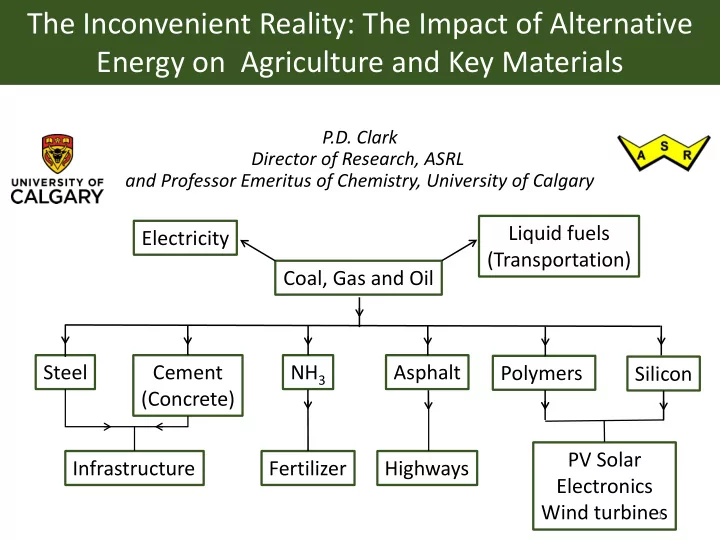
Electricity Coal, Gas and Oil Liquid fuels (Transportation) Steel Cement (Concrete) NH3 Asphalt Polymers Silicon Infrastructure Fertilizer Highways PV Solar Electronics Wind turbines

1

slide-2
SLIDE 2

2

Topics For Discussion

  • Why are oil, gas and coal so important to an industrialized economy?
  • Why have we not already made the transition to non-fossil fuel

energy?

  • Can wind and solar energy meet our goals?
  • Is nuclear power the answer?
  • Can we feed ourselves without fossil fuel? [No]
slide-3
SLIDE 3

Key Industrial Processes

Natural Gas Sweet Sour Crude Oil H2S H2S Sulfur CH4, [C2+] CO / H2 H2 NH3 Air N2 CH4, CO2, CH3OH, petrochemicals liquid fuels Ammonium phosphate fertilizer Processing H2 Phosphoric acid Phosphate

  • re

Gasoline Diesel Jet fuel Fuel oils Petrochemicals Olefins (C2 – C4) Aromatics (B, T, X) Petchem derivatives Polymers H2O Sulfuric acid

3

(Air)

slide-4
SLIDE 4

Worldwide Production of Sulfur (2016)

Mt per annum Sour natural gas [CH4 – H2S – CO2] 30.0 Sour crude oil 27.4 Oil sand bitumen 2.3 Metallurgical ore smelting 24*

* Produced as H2SO4 (72 Mt / a)

Fossil fuel supplies > 95% of the World’s elemental sulfur

4

slide-5
SLIDE 5

Io – Lot’s of Sulfur If We run Out!

http://apod.nasa.gov/apod/ap140330.html

5

slide-6
SLIDE 6

Venus – Sulfuric Acid When We Need It

http://www.universetoday.com/14131/pictures-of-planet-venus/

6

slide-7
SLIDE 7

A Brief History of Agriculture

Time Line (years, bp) End of last ice age 13,000 Human settlements, rudimentary farming 12,000 Wooden ploughs/animal labor 8,000 – 6,000 Fertilizer (manure) 7,000 Crop selection (yield) 8,000 Pigs, goats, chickens 2,000 New World / Asian crops 1,000 Dates Natural fertilizers (guano) 1850 - 1940 Fossil fuel powered tractor ~ 1,900 Artificial fertilizer (NH3, phosphates, potash) ~ 1,950 Improved mechanization ~ 1,950

7

slide-8
SLIDE 8

8

Harvesters

slide-9
SLIDE 9

Agriculture: The World’s Most Important Industry Fertilizers

Sulfur is the limiting element because H2SO4 digestion of insoluble phosphates is the only viable route to soluble P

N - NH3 50% of the N in our bodies arises from Haber-Bosch process

[N2 + 3 H2 2 NH3]. Supplied as urea, NH3 and ammonium nitrate

P - Used as soluble ammonium phosphates, manufactured by

digestion of complex calcium phosphates with H2SO4

K - From potash [KCl, K2O – derived salts] S - Applied as S8 or (NH4)2 SO4

9

slide-10
SLIDE 10

Population, Energy and Commodity Production 1951 1969 2000 2020

~ 100 ~ 280 ~ 480 ~ 600 Population: Energy Consumption: (Exajoule per annum) (Exa= 1018) ~ 2.2 billion ~ 3.6 billion ~ 6.0 billion ~ 7.8 billion Sulfur Production/ Consumption: (Excluding SO2 ore smelting) (mt/a) ~ 6 ~ 25 ~ 50 ~ 75 NH3 Production/ (mt/a) ~ 5 ~ 40 ~ 100 ~ 160

  • Population increase demands increased energy supply which, using fossil fuel,

provides the necessary sulfur and NH3

  • Sulfur and NH3 are the “cocaine” of the masses

10

slide-11
SLIDE 11

Power Density and the Feasibility of Electricity Generation From Alternative Sources

POWER SOURCE POWER DENSITY (W / m2) Low High Natural gas 200 2000 Coal 100 1000 Solar (PV) 4 10 20 Solar (CSP) 4 10 Wind 0.5 1.5 Biomass 0.5 0.6 Nuclear fission 2000 4000 (?)

References: V. Smil, Energy in Nature and Society: General Energetics of Complex Systems, MIT Press 2008

  • V. Smil, Power Density Primer: Understanding the Spatial Dimension of the

Unfolding Transition to Renewable Electricity Generation [www.vaclavsmil.com]

11

slide-12
SLIDE 12

Manufacture of a Wind Turbine

  • Electricity is distributed via a grid system dependent on steel and concrete

Blades: glass fibre in a polymer matrix (polyester, vinyl, epoxy) Steel column Reinforced concrete (steel, cement)

12

slide-13
SLIDE 13

Manufacture of Iron (Steel)

Hot air Off gases [N2, CO2, CO, NH3, H2S, HCN] Molten Fe Iron ore (Fe2O3) Coke Coal C + O2 CO / CO2 (Coke) Fe2O3 + 3CO 2Fe + 3CO2

  • Off-gases contain H2S, NH3, CO, H2 and organics
  • Replacement of coal/coke by charcoal from wood would

require the World’s entire wood output (V. Smil, Power Density 2015)

13

slide-14
SLIDE 14

Electricity Generation Using PV Solar Cells

14

[Silicon, Si]

slide-15
SLIDE 15

Manufacture of Silicon Metal

  • A typical charge consists of 450 Kg SiO2 and 250 Kg coke
  • An electric arc heats the system to ~ 2,350°C to melt the SiO2
  • Energy consumption for > 99.99% Si is 20,000 GJ/t
  • Steel and aluminum use 25 and 175 GJ/t

Electricity (coal) Carbon electrodes SiO2, coke Coal SiO2 + 2C SiC + CO2 2 SiC + SiO2 3Si + 2 CO T > 2,000°C

15

slide-16
SLIDE 16

Grafenrheinfeld Nuclear Power Plant, Grafenrheinfeld, Bavaria, Germany

Nuclear Power Plant

16

slide-17
SLIDE 17

Alternative Energy and Transportation

https://www.teslamotors.com/en_CA/

  • Lithium iron batteries – not enough lithium
  • Electricity must come from non-fossil fuel source
  • Can’t be made without steel, aluminium or polymers

17

slide-18
SLIDE 18

Public Transportation – Planes, Trains and Ocean Vessels

  • Construction and power density requirement

18

slide-19
SLIDE 19

Alternative Energy and Fertilizer

  • Energy from nuclear fission, solar and wind do not produce sulfur or any

commodities for fertilizer manufacture

  • Production of bio-mass for transportation fuels or for chemicals (polymers)

requires additional fertilizer

  • Replacement of coal/petroleum coke for steel making by wood charcoal

also requires additional fertilizer (as well as requiring a doubling of wood production)

Can fertilizer needs be met without fossil fuel?

19

slide-20
SLIDE 20

Can Phosphate Fertilizers Be Manufactured Without Sulfur?

  • 1. Re-cycle of waste gypsum (CaSO4) from previous

phosphate production

  • 2. Re-cycle of gypsum using H2S?
  • 3. Manufacture of elemental phosphorus
  • 4. Replacement of sulfuric acid by nitric acid
  • 5. Phosphate re-cycle

20

slide-21
SLIDE 21

Sulfuric Acid From Phosphogypsum

Phosphogypsum Calcium phosphate

  • re

SO3 2 [CaSO4] 2 SO2 + CO2 + 2 CaO H2SO4 Phosphoric acid [O2] H2O

Petroleum coke [C]

  • The reduction step occurs at around 1,000°C
  • The clinker product [CaO + other minerals] could

be used in cement or construction aggregates

  • Large CO2 emission
  • Unlikely to be commercialized

References:

  • GSR Gypsum Recycle Process, J Rossiter and D.K Kestner, Proceedings, Sulphur 1990, p. 345
  • Operation of a Sulphuric Acid Plant Based on Phosphogypsum, Z. Zhao and Y. Feng,

Proceedings, Sulphur 1990, p. 279.

21

slide-22
SLIDE 22

Replacement of Sulfur with Nitric Acid

  • Electrolysis of H2O supplies H2 and O2 (electricity supply?)
  • Nitric acid made by NH3 oxidation (known technology, N2O emission)
  • Digestion of phosphate rock provides two fertilizers

Ca3 (PO4)2 + 6 HNO3 3 Ca(NO3)2 + 2 H3PO4 Ca (NO3)2 + 4 H3PO4 + 8 NH3 CaHPO4 + 2 NH4NO3 + 3 (NH4)2 HPO4

“Phosphate rock” Fertilizer Fertilizer NH3

N2 + 3 H2 2 NH3 2 HNO3 + H2O H2O O2

electrolysis

22

[No fossil fuel]

slide-23
SLIDE 23

Phosphate Re-cycling From Sewage Sludge and Process Water

Sewage Water (NH4

+, PO4 3-)

Mg (OH)2 MgO Mg CO3 (Dolomite) MgNH4PO4 (Struvite) Slow release fertilizer

  • Phosphorus recycling comes with increased CO2 emission

Bio - solids Direct land application Fuel oil

  • r

CH4 ~ 700°C CO2 H2O CO2 [N, P, K, S]

23

slide-24
SLIDE 24

Practical and Feasible CO2 Reduction Strategies

These strategies are already in effect

  • 1. Replacement of coal by natural gas for electricity production
  • 2. Improved insulation of all buildings
  • 3. Increased efficiency for agriculture (fertilizer use, eliminate

food waste (30%), de-globalize)

  • 4. Grow your own food, reduce animal protein intake (pork,

poultry and eggs are good from an energy viewpoint)

  • 5. Examine all industrial operations from an energy perspective

[CO2 emission]

24

slide-25
SLIDE 25

Conclusion and Observations

  • 1. Oil, gas and coal provide key commodities as well as energy.
  • 2. Production of fertilizers, steel and cement requires gas, oil

and coal. Use of wood charcoal for steel would require more than double the World’s current wood production with a large increase in CO2 emission.

  • 3. Heavy oil and bitumen are more useful than low S, low

residuum shale oil.

  • 4. Low power density of wind/solar energy and materials

considerations render a zero-carbon economy as highly improbable.

  • 5. Long term, nuclear power generation should be developed further.

Why?

  • 5. Energy via electricity will be the basis of most new technology

25