The Implications of Packaging Plastic Recycling on Climate Change - - PowerPoint PPT Presentation

the implications of packaging plastic recycling on
SMART_READER_LITE
LIVE PREVIEW

The Implications of Packaging Plastic Recycling on Climate Change - - PowerPoint PPT Presentation

The Implications of Packaging Plastic Recycling on Climate Change Mitigation and Fossil Resource Savings A Case Study in Japan S.N.M.Menikpura, TOTOKI Yoshiaki and Janya SANG-ARUN Institute of Global Environmental Strategies (IGES) 3R


slide-1
SLIDE 1

S.N.M.Menikpura, TOTOKI Yoshiaki and Janya SANG-ARUN

Institute of Global Environmental Strategies (IGES)

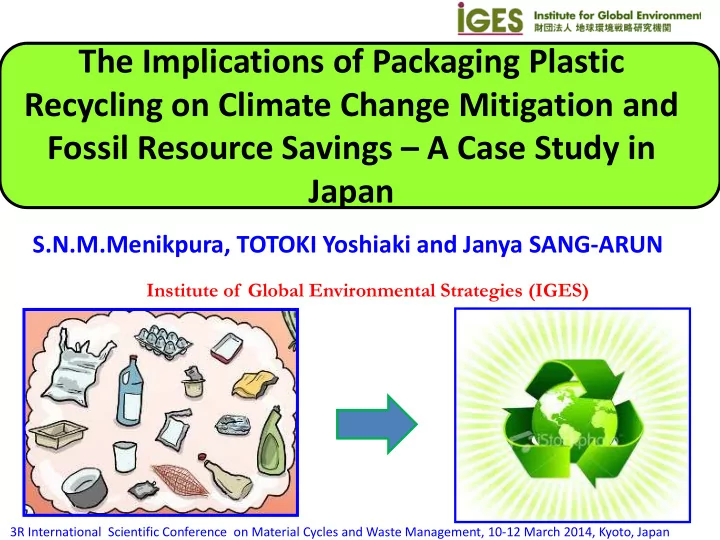
The Implications of Packaging Plastic Recycling on Climate Change Mitigation and Fossil Resource Savings – A Case Study in Japan

3R International Scientific Conference on Material Cycles and Waste Management, 10-12 March 2014, Kyoto, Japan

slide-2
SLIDE 2

Content

2

Introduction: Situation Packaging Plastic recycling Methodology : LCA framework for the assessment Indicators for the quantification of the impacts Results and Discussion

  • GHG emissions packaging plastic recycling
  • Fossil-fuel consumption from packaging plastic recycling

Conclusions Objectives of the study

slide-3
SLIDE 3

Introduction

  • The lack of adequate land for landfilling is a major problem

in Japan

  • Japan is pursuing a sound material recycle oriented society

both to achieve sustainable development while reducing the amount of waste and saving the landfill space

  • The highest fraction of recyclable represents plastic waste
  • The domestic plastic waste is treated by using mechanical

recycling (22%), liquefaction (4%), solid fuel (5%), waste power generation (36%), heat utilizing incineration (13%) incineration without power or heat (12%) and landfilling (10%)

3

slide-4
SLIDE 4
  • Yokohama, the largest Japanese city by population (3.67 million

people)

  • Yokohama city generated 1,240,000 tonnes in year 2013 under the

3R dream plan

  • The waste is treated using a combination of technologies, including

recycling (27.3%), incineration (71.9%) and landfilling (0.8%).

  • On average, 134 tonnes/day of source separated packaging plastic

waste is collected in Yokohama

  • The baled plastic is then transported to several facilities in different

prefectures for recycling

  • A significant fraction is transported and recycled

in Shizuoka prefecture

General description of study locations

Yokohama Shizuoka

4

slide-5
SLIDE 5

Objectives of the study

  • GHG emissions and their influence on climate change and the depletion of fossil

fuels are considered to be critical global environmental challenges. e.g. Around 4% of world petroleum is used as feedstock for plastic production and another 3-4% is expended to provide energy for manufacturing

  • Recycling activities contribute to the global environmental challenges of GHG

emissions and the depletion of fossil resources

  • However, material recovery from plastic recycling can offset the GHG emissions and

resource depletion that would otherwise occur through the production of virgin resin.

  • In this study, the effects of packaging plastic recycling on GHG mitigations and

resource saving were assessed using the case of packaging plastics recycling in Shizuoka.

Global warming World resource depletion

5

slide-6
SLIDE 6

Methodology

Framework for the assessment

  • Life Cycle Assessment (LCA) framework was designed considering all the phases of

the life-cycle

  • System expansion was used to account for the effects of material recovery. Credits

were provided to account for the avoided virgin production of materials which had been recovered as a result of recycling

6

slide-7
SLIDE 7
  • The functional unit was defined as 1 tonne
  • f packaging plastic waste recycled in a

recycling plant in Shizuoka

  • The recycled plastic in the Shizuoka plant

falls into three major categories viz: polyethylene (PE), polypropylene (PP) and polystyrene (PS) at 56%, 38% and 6% respectively

  • Plastic pellets are the final product from

the PE and PP recycling processes whereas plastics ingots are produced from recycling PS

  • Plant specific information was gathered on

energy and material consumption Shizuoka

  • plant. Additionally, literature data sources

were used to find the required information related to waste collection, transportation, baling etc.

Framework for the Assessment

56% 38% 6%

7

slide-8
SLIDE 8

Recycling activities are associated with a significant amount of fossil energy consumption and GHG emissions. In contrast, the materials recovered from recycling enable to gain environmental benefits from the avoided conventional production

I ndicators for the quantification of the im pacts

Indicator : GHG emissions

expressed in the unit of CO2 equivalent

Indicator : Fossil fuel consumption

expressed in the unit of crude oil equivalents (42 MJ/kg) N2O CO2 CH4 N2O CO2 CH4 N2O CO2 CH4 N2O CO2 CH4

8

slide-9
SLIDE 9

Results and Discussion

In order to calculate the overall GHG emissions and fossil fuel consumption from the packaging plastic recycling, overall fossil fuel and grid electricity consumption were accounted for, considering all the phases of their life cycle

Packaging plastic -1000 kg Recycled Plastic – 903 kg

Packaging Plastic recycling

Energy

Replace virgin Resin Production

  • Waste collection and transportation

(2.06L of diesel/tonne of plastic waste)

  • Grid electricity consumption for baling

(29.85 kWh/tonne of plastic waste)

  • Long distance transportation

(11.11 L of diesel/tonne of plastic waste)

  • Grid electricity consumption for recycling

process at Shizuoka (1,005.86 kWh/tonne of plastic waste)

  • Total GHG

emissions?

  • Total Fossil fuel

consumption ?

  • Total GHG

avoidance ?

  • Total fossil

fuel savings ?

9

slide-10
SLIDE 10

GHG em issions and GHG avoidance potential

  • GHG avoidance potential is higher than GHG emissions from recycling
  • Net GHG emissions from mixed packaging plastic recycling is -853 kg CO2-eq/tonne of

plastic

1 0

slide-11
SLIDE 11

Fossil energy consum ption and Fossil energy saving potential

  • Fossil energy savings potential is always higher that fossil energy consumption for recycling

activities

  • Net fossil fuel consumption is -1,374 kg crude oil-eq per tonne of recycled packaging plastic

1 1

slide-12
SLIDE 12

Conclusion

  • The results of packaging plastic recycling process in Yokohama

clearly show that it offers important prospects in terms of environmental benefits and thereby contribute to improve sustainability

  • The results of this study can be used as a probing tool to convince

all stakeholders involved in waste management of the benefits of packing plastics recycling and, as well as promoting and strengthening such recycling activities in Japan and elsewhere

  • The results can contribute to convincing decision and policy makers

involved in waste management about the need for strengthened support for such recycling to replace incineration and landfilling of this waste 1 2

slide-13
SLIDE 13

Acknow ledgem ent

The authors acknowledge;

  • The recycling plant in Shizuoka for providing necessary information

and data

  • Financial support from the Ministry of the Environment Japan

(MOEJ) under the project of MRV capacity building in Asia for the establishment of new market mechanisms 1 3

slide-14
SLIDE 14

Nirmala Menikpura, PhD Sustainable Consumption and Production (SCP) Group Institute of Global Environmental Strategies (IGES) E-mail: menikpura@iges.or.jp; samanthinir@yahoo.co.in

3R International Scientific Conference on Material Cycles and Waste Management, 10-12 March 2014, Kyoto, Japan