The Historical Development of the Maltese plural suffixes - iet and - - PDF document

the historical development of the maltese plural suffixes
SMART_READER_LITE
LIVE PREVIEW

The Historical Development of the Maltese plural suffixes - iet and - - PDF document

7/20/2018 The Historical Development of the Maltese plural suffixes - iet and -( i ) jiet JONATHAN GEARY, UNIVERSITY OF ARIZONA ICHL23, SAN ANTONIO, TX AUGUST 4, 2017 Introduction This paper explores the development of two Maltese suffixes


slide-1
SLIDE 1

7/20/2018 1

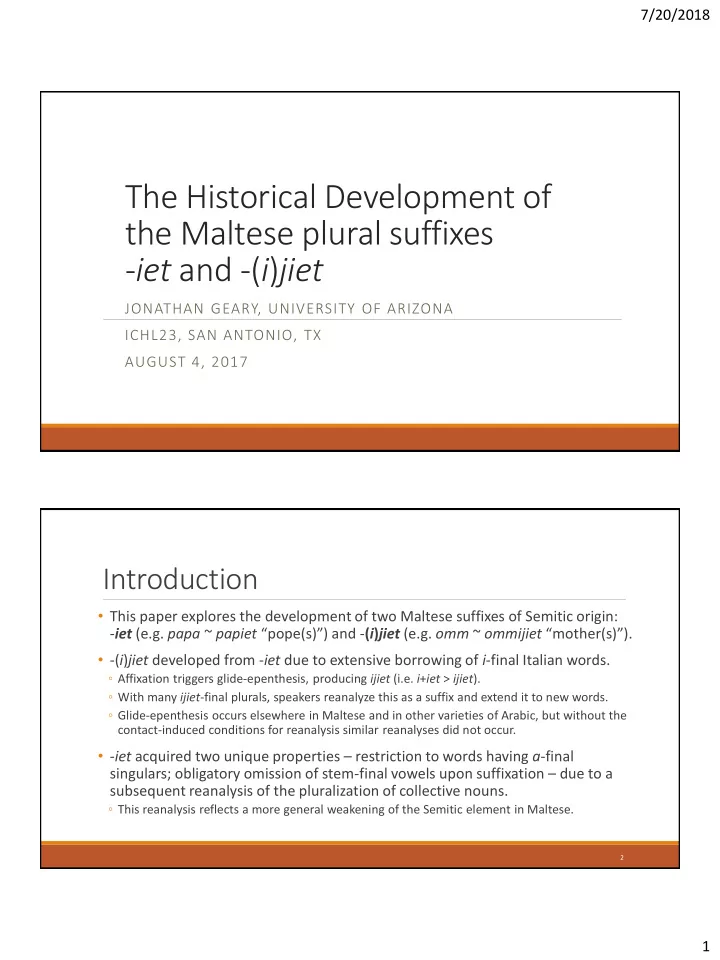
The Historical Development of the Maltese plural suffixes

  • iet and -(i)jiet

JONATHAN GEARY, UNIVERSITY OF ARIZONA ICHL23, SAN ANTONIO, TX AUGUST 4, 2017

Introduction

  • This paper explores the development of two Maltese suffixes of Semitic origin:
  • iet (e.g. papa ~ papiet “pope(s)”) and -(i)jiet (e.g. omm ~ ommijiet “mother(s)”).
  • -(i)jiet developed from -iet due to extensive borrowing of i-final Italian words.
  • Affixation triggers glide-epenthesis, producing ijiet (i.e. i+iet > ijiet).
  • With many ijiet-final plurals, speakers reanalyze this as a suffix and extend it to new words.
  • Glide-epenthesis occurs elsewhere in Maltese and in other varieties of Arabic, but without the

contact-induced conditions for reanalysis similar reanalyses did not occur.

  • -iet acquired two unique properties – restriction to words having a-final

singulars; obligatory omission of stem-final vowels upon suffixation – due to a subsequent reanalysis of the pluralization of collective nouns.

  • This reanalysis reflects a more general weakening of the Semitic element in Maltese.
2
slide-2
SLIDE 2

7/20/2018 2

History of Maltese

  • Maltese is a Semitic language which has been shaped by extensive contact with

Indo-European languages over the last millennium (Brincat 2011).

  • 870 – Arab invasion depopulates the island of Malta.
  • 1048 – Individuals from Muslim Sicily migrate to Malta, bringing with them Siculo-Arabic

(Agius 1996), which would ultimately develop into Maltese.

  • 1090 – Norman Conquest brings Siculo-Arabic into contact with Sicilian and Latin in Malta,

cuts the language off from Classical Arabic and other Arabic varieties.

  • 1530 – Malta is given to the Knights of St. John of Jerusalem; Italian introduced to the island.
  • 1798 – Napoleon briefly conquers Malta, bringing French into contact with Maltese.
  • 1800 – British Empire takes control of Malta, introducing English to the island and promoting

the use of Maltese in an attempt to suppress the use of Italian.

  • Today – Maltese and English are the two official languages of the Republic of Malta; Italian

also remains in use in Italian television programs.

3

Linguistic Background of Maltese

  • Contact with Indo-European languages has reshaped the structure of Maltese.
  • Semitic elements lacking counterparts in Indo-European are gradually falling out
  • f use; elements with counterparts in Indo-European (e.g. concatenative

morphology) have flourished (Mifsud 1995).

  • Today, Maltese possesses a range of

plural suffixes from various languages:

Suffix Source a) -iet /ɪːt/, -at /aːt/ < Ar.

  • āt ‹تا-›

b) -(i)jiet /(i)jɪːt/,

  • (i)jat /(i)jaːt/

< Ar.

  • āt ‹تا-›
4
slide-3
SLIDE 3

7/20/2018 3

Linguistic Background of Maltese

  • Contact with Indo-European languages has reshaped the structure of Maltese.
  • Semitic elements lacking counterparts in Indo-European are gradually falling out
  • f use; elements with counterparts in Indo-European (e.g. concatenative

morphology) have flourished (Mifsud 1995).

  • Today, Maltese possesses a range of

plural suffixes from various languages:

Suffix Source a) -iet /ɪːt/, -at /aːt/ < Ar.

  • āt ‹تا-›

b) -(i)jiet /(i)jɪːt/,

  • (i)jat /(i)jaːt/

< Ar.

  • āt ‹تا-›

c) -in /iːn/ < Ar.

  • īn ‹ني-›

d) -a < Ar.

  • a ‹ة-›

e) -ejn (du.) < Ar.

  • ajn ‹ني-›(du.)
5

Linguistic Background of Maltese

  • Contact with Indo-European languages has reshaped the structure of Maltese.
  • Semitic elements lacking counterparts in Indo-European are gradually falling out
  • f use; elements with counterparts in Indo-European (e.g. concatenative

morphology) have flourished (Mifsud 1995).

  • Today, Maltese possesses a range of

plural suffixes from various languages:

Suffix Source a) -iet /ɪːt/, -at /aːt/ < Ar.

  • āt ‹تا-›

b) -(i)jiet /(i)jɪːt/,

  • (i)jat /(i)jaːt/

< Ar.

  • āt ‹تا-›

c) -in /iːn/ < Ar.

  • īn ‹ني-›

d) -a < Ar.

  • a ‹ة-›

e) -ejn (du.) < Ar.

  • ajn ‹ني-›(du.)

f)

  • i

< Sc./It.

  • i

g) -s < En.

  • s
6
slide-4
SLIDE 4

7/20/2018 4

Linguistic Background of Maltese

  • Maltese -iet and -(i)jiet ultimately derive from Arabic -āt ‹ تا-›.
  • Imaala (Borg 1976) – Historical process whereby the long low vowel /aː/ raised and

fronted except in the neighborhood of historically back consonants. 1. Arabic šabbāt /ʃabː-aːt/ ‹ تابش›> Maltese xebbiet /ʃebː-ɪːt/ “young women” 2. Arabic šam‘āt /ʃamʕ-aːt/ ‹ تاعمش›> Maltese xemgħat /ʃem-aːt/ “candles” *xemgħiet /ʃem-ɪːt/

  • Each suffix has a low-vowel-preserving allomorph: -at /aːt/; -(i)jat /(i)jaːt/
7

Linguistic Background of Maltese

  • Historically, -iet pluralized feminine and collective nouns (Mifsud 1996).
  • Collectives historically were a type of syntactically singular noun that denoted an

uncountable genus, species, material, or “quality of being”.

  • Collectives are often treated as syntactically plural in modern Maltese (Mifsud ibid.).
  • Singulars were formed through the affixation of feminine -a or (infrequently)

masculine -u to the collective and denoted one unit of the collective.

  • Plurals were formed through the affixation of -iet and denoted quantities from two to

ten, after which the singular is used.

Collective Singular Plural Gloss lewż lewża lewżiet “almond” basal basla basliet “onion” nemel nemla/nemlu nemliet “ant” dud duda dudiet “worm”

8
slide-5
SLIDE 5

7/20/2018 5

Linguistic Background of Maltese

  • -iet triggers the deletion of the preceding vowel on V-final forms:

3. papa “pope” + -iet “pl.” > papiet

  • -(i)jiet occurs as -ijiet on C-final forms and as -jiet (with stem-final-V preserved)
  • r -ijiet (with stem-final-V deleted) on V-final forms.

4.

  • mm “mother” + -(i)jiet “pl.” > ommijiet

5. tabù “taboo” + -(i)jiet “pl.” > tabujiet 6. siġġu “chair” + -(i)jiet “pl.” > siġġijiet

9

Research Question

  • The present study explores the diachronic development of -(i)jiet.
  • Both -iet and -(i)jiet ultimately derive from Arabic -āt ‹ تا-› via imaala (Borg 1976), but the source
  • f the (i)j of the latter remains to be explored.
  • Likewise, the present study explores the behavior of -iet in modern Maltese.
  • Upon affixation to a V-final stem, -iet triggers vowel deletion (e.g. papa ~ papiet “pope(s)”).
  • This property is not shared by Maltese -(i)jiet, nor by Arabic -āt.
  • Aquilina (1987-90), the Maltese-English-Maltese dictionary considered to be the

standard dictionary of Maltese, was surveyed for all -iet-/-(i)jiet-suffixed plurals.

  • 1,449 -iet-suffixed plurals and 2,386 -(i)jiet-suffixed plurals were found in Aquilina (ibid.).
  • The distribution of these suffixes was then analyzed and compared.
10
slide-6
SLIDE 6

7/20/2018 6

Distribution of -iet and -(i)jiet

  • 1,449 words having an -iet-suffixed plural were found in Aquilina (1987-90).
  • -iet pluralizes 1,386 words having an a-final
  • singular. This is independent of morphology:
  • a is the singular suffix (e.g. lewża ~ lewżiet

“almond(s)” < collective lewż);

  • a is non-morphemic (e.g. papa ~ papiet “pope(s)”).
  • -iet also pluralizes 63 C-final singulars; no

V-final singulars which lack an a-final form.

  • A chi-squared goodness-of-fit test suggests

an association between pluralization via -iet and a-finality (χ2(1, N = 1,449) = 1208, p < 0.001).

11

Distribution of -iet and -(i)jiet

  • 2,386 words having an -(i)jiet-suffixed plural were found in Aquilina (1987-90).
  • -(i)jiet pluralizes 1,121 words having an

i-final singular. Most of these words:

  • are of Italian origin (e.g. uniformi ~ uniformijiet

“uniform(s)” < Italian uniforme); and/or

  • end in the Italian-origin suffix -(az)zjoni (e.g.

ekwazzjoni ~ ekwazzjonijiet “equation(s)”).

  • A chi-squared goodness-of-fit test suggests

that the distribution of -(i)jiet among i-final, C-final, and non-i V-final singulars is not due to random chance (χ2(2, N = 2,386) = 229.1, p < 0.001).

12
slide-7
SLIDE 7

7/20/2018 7

Distribution of -iet and -(i)jiet

  • The distribution of -iet and -(i)jiet suggests that the latter has been the more

productive suffix at a more recent point in Maltese history.

  • -(i)jiet can pluralize words of any language-of-origin:

7. Arabic dubb ‹ بد›“bear” > Maltese debb ~ debbijiet 8. Sicilian seggia “furniture” > Maltese siġġu ~ siġġijiet 9. Italian stazione “station” > Maltese stazzjon ~ stazzjonijiet

  • 10. French bureau

“desk, office” > Maltese burò ~ burojiet

  • 11. English shelter

> Maltese xelter ~ xeltrijiet

  • -iet pluralizes few recent (i.e. English) loans, and only ones having a-final singulars.
  • 12. English bricks

> Maltese coll. briks ~ sg. briksa ~ pl. briksiet

  • 13. English whaler

> Maltese wejla ~ wejliet

13

Distribution of -iet and -(i)jiet

  • The distribution of -iet and -(i)jiet suggests that the latter has been the more

productive suffix at a more recent point in Maltese history.

  • Maltese has two pairs of homophones where the older word takes -iet while the

newer one takes -(i)jiet.

  • 13. Arabic lift ‹ تفل›“turnip”

> Maltese lift ~ liftiet “turnip(s)”

  • 14. English lift

“elevator, lift” > Maltese lift ~ liftijiet “elevator(s), lift(s)”

  • 15. Sicilian aluzzu

“barracuda” > Maltese lizz ~ lizziet “barracuda(s)”

  • 16. English leads

> Maltese lizz ~ lizzijiet “shim(s)”

14
slide-8
SLIDE 8

7/20/2018 8 uniformi + -iet *uniform-iet uniformi-j-iet uniformijiet; stazzjon + -ijiet

  • The development of -(i)jiet was driven by the influx of i-final Italian words.
  • Hypothesis 1: Speakers pluralized such words with -iet.
  • Historically, -iet would not have triggered the deletion
  • f the final vowel.
  • Suffixation triggers j-epenthesis between the stem-final

and suffix-initial vowels.

  • Hypothesis 2: With a large number of plural words

now ending in the sequence ijiet, speakers reanalyzed this as a plural suffix and extended it to new words.

The emergence of -(i)jiet from -iet

15

The emergence of -(i)jiet from -iet

  • Glide-epenthesis is well-attested between stem-final and suffix-initial vowels:
  • 17. mdorri “one accustomed to s.t.” + -in “pl.” > mdorrijin
  • 18. gru “crane (coll.)”

+ -a “sg.” > gruwa; + -iet “pl.” > gruwiet

  • Glide-epenthesis is attested in other Arabic varieties: Eastern Libyan (Owens 1984),

Moroccan (Harrell 2004), Tunisian (Ben Abdelkader et al. 1977, Chekili 1982), Iraqi (Erwin 1963), and Syrian (Cowell 1964), and produces strings comparable to ijiet.

  • 19. badawi “Bedouin” + -a “fem. sg.” > badawiyya; + -aːt “fem. pl.” > badawiyyaːt
  • 20. taksi “taxi”

+ -aːt “pl.” > taksiyyaːt

  • 21. kiːlo “kilo”

+ -aːt “pl.” > kiːlowwaːt

(Eastern Libyan Arabic, Owens 1984: 60-1)

  • Language contact produced the conditions necessary for reanalysis only for the

Maltese sequence ijiet.

16
slide-9
SLIDE 9

7/20/2018 9

The emergence of -(i)jiet from -iet

  • Counter: Could the glide of -(i)jiet have come from the restoration of a weak

final-radical, or could this have played any role in the development of -(i)jiet?

  • I reject this hypothesis based on the behavior of words having a weak final-

radical upon taking a suffix.

  • When a stem having a root for which the final radical is a glide and ending in a

vowel (with the glide omitted) takes a suffix, the underlying glide is restored and the vowel is lost, creating a consonant-glide cluster.

  • 22. xidi “gadfly, horsefly” (root: x-d-j)

+ -a “sg.” > xidja; *xidija + -iet “pl.” > xidjiet; *xidijiet

17

The emergence of -(i)jiet from -iet

  • Counter: Could the glide of -(i)jiet have come from the restoration of a weak

final-radical, or could this have played any role in the development of -(i)jiet?

  • I reject this hypothesis based on the behavior of words having a weak final-

radical upon taking a suffix.

  • This behavior is unlike that of -(i)jiet; elsewhere, the -jiet allomorph only occurs

after a vowel (e.g. burò “desk, office” + -(i)jiet “pl.” > burojiet).

  • This behavior is attested in other varieties, including Moroccan (Harrell 2004) and

Tunisian Arabic (Chekili 1982), suggesting it is not a Maltese innovation.

18
slide-10
SLIDE 10

7/20/2018 10

Further developments in -iet

  • -iet acquired two unique properties due to a subsequent reanalysis of the

pluralization of collective/singular nouns.

  • -iet is largely restricted to words having a-final singulars;
  • upon affixation, -iet obligatorily deletes the preceding vowel.
  • Historically, -iet affixed to the collective. I propose that speakers reanalyzed the

plural suffix as affixing to the a-final singular form.

  • i.e. {coll. lewż “almond” + -iet “pl.”} > {sg. lewża “almond” + -iet “pl.”}: lewżiet “almonds”
19

Further developments in -iet

  • -iet acquired two unique properties due to a subsequent reanalysis of the

pluralization of collective/singular nouns.

  • This fits the general weakening of Semitic elements of Maltese that are foreign

to Indo-European languages, in which there is no collective (Mifsud 1995).

  • This also fits modern speakers’ tendency to treat the collective as a plural form

(Mifsud 1996, Borg and Azzopardi-Alexander 1997).

  • This could also be a case of linguistic exaptation (Lass 1990).
  • Since the a of the singular does not recur in the -iet-suffixed plural, speakers

reanalyzed the a as being deleted upon suffixation. Hence -iet triggers vowel- deletion even when final-a is non-morphemic.

  • 23. papa “pope” + -iet “pl.” > papiet, *papawiet
20
slide-11
SLIDE 11

7/20/2018 11

Discussion & directions for future research

  • -(i)jiet developed from -iet due to extensive borrowing of i-final Italian words.
  • Future research should explore the extension of -(i)jiet to Semitic words which had a

different plural form historically (e.g. art “earth, land”, pl.: 1400s iradi, today artijiet).

  • -iet gained two unique properties – restriction to a-final singulars and obligatory

V-deletion – due to a separate reanalysis of the pluralization of collectives.

  • The results of a backformation task could support the claim that speakers associate
  • iet as the pluralizer of a-final words.
  • Future research should explore the property of vowel-deletion in -(i)jiet. Is this

property spreading to this suffix, making it fall more in line with -iet?

  • Future research should explore the distribution of -iet and -(i)jiet among a-final words.
21

Acknowledgements

Thanks to Skye Anderson, Slavomír Čéplö, Dr. Christopher Lucas, Dr. Michael Spagnol, Dr. Adam Ussishkin, Dr. Natasha Warner, and Dr. Andrew Wedel for feedback on earlier versions of this project. Thanks to the workshop organizers, Christopher Lucas and Stefano Manfredi.

22
slide-12
SLIDE 12

7/20/2018 12

Grazzi ħafna!

23

References

Agius, Dionisius A. 1996. Siculo Arabic. London: Kegan Paul International. Aquilina, Joseph. 1987-90. Maltese-English-Maltese dictionary. Malta: Midsea Books. Aronoff, Mark. 1976. Word Formation in Generative Grammar. Cambridge, MA: MIT Press. Ben Abdelkader, Rached, Abdeljelil Ayed, &Ariza Naouar. 1977. Peace Corps English-Tunisian Arabic dictionary. Washington, D.C.: Peace Corps. Borg, Albert J. 1976. The imaala in Maltese. Israel Oriental Studies VI. 191-223. Borg, Albert J. & Marie Azzopardi-Alexander. 1997. Maltese. London: Routledge. Borg, Claudia, Ray Fabri, Albert Gatt, and Mike Rosner. 2012 Korpus Malti: A corpus of contemporary Maltese, v.2.0. Available at <http://mlrs.research.um.edu.mt/>.

24
slide-13
SLIDE 13

7/20/2018 13

References

Bovingdon, Roderick & Angelo Dalli. 2006. Statistical analysis of the source origin of Maltese. In Andrew Wilson, Dawn Archer, & Paul Rayson (eds.), Corpus linguistics around the world, 63-76. New York: Rodopi. Brincat, Joseph. 2011. Maltese and other languages: a linguistic history of Malta. Sta Venera, Malta: Midsea Books. Chekili, Ferid. 1982. The morphology of the Arabic dialect of Tunis. PhD Thesis. University College, London. Cowell, Mark W. 1964. A reference grammar of Syrian Arabic, based on the dialect of Damascus. Washington, D.C.: Georgetown University Press. Erwin, Wallace M. 1963. A short reference grammar of Iraqi Arabic. Washington, D.C.: Georgetown University Press. Harrell, Richard S. 2004. A short reference grammar of Moroccan Arabic. Washington, D.C.: Georgetown University Press. Lass, Roger. 1990. How to do things with junk: exaptation in language evolution. Journal of Linguistics 26: 79-102.

25

References

Mayer, Thomas, Michael Spagnol, & Florian Schönhuber. 2013. Fixing the Maltese broken plural. In Albert Borg, Sandro Caruana, & Alexandra Vella (eds.), Perspectives on Maltese Linguistics, 129-

  • 58. Berlin: Akademie Verlag.

Mifsud, Manwel. 1994. Internal pluralization in Maltese: continuity and innovation. In Dominique Caubet & Martine Vanhove (eds.) Actes des premières journées internationals de dialectologie arabe de Paris, 91-105. Paris: INALCO. Mifsud, Manwel. 1995. The productivity of Arabic in Maltese. Proceedings of the 2nd International Conference of AIDA, 151-60. Cambridge: Cambridge University Press. Mifsud, Manwel. 1996. The collective in Maltese. Rivista di Linguistica 8. 29-52. Owens, Jonathan. 1984. A short reference grammar of Eastern Libyan Arabic. Wiesbaden, Germany: Harrassowitz. R Core Team. 2014. R: A language and environment for statistical computing. Version 3.1.2. R Foundation for Statistical Computing; Vienna, Austria. <https://www.R-project.org>.

26
slide-14
SLIDE 14

7/20/2018 14

Linguistic Background of Maltese

Contact with Indo-European languages has reshaped the structure of Maltese. Semitic elements foreign to Indo-European are gradually falling out of use; more familiar elements (e.g. concatenative morphology) have flourished (Mifsud 1995). Today, Maltese possesses a range of plural suffixes from various languages:

Suffix Source Example Gloss a) -iet /ɪːt/, -at /aːt/ < Ar. -āt ‹تا-› għatsa ~ għatsiet “sneeze(s)” b) -(i)jiet /(i)jɪːt/,

  • (i)jat /(i)jaːt/

< (Ml. -iet <) Ar. -āt ‹تا-›

  • mm ~ ommijiet

“mother(s)” c)

  • in /iːn/

< Ar. -īn ‹ني-› qassis ~ qassisin “priest(s)” d) -a < Ar. -a ‹ة-› pustier ~ pustiera “postal carrier(s)” e) -ejn (du.) < Ar. -ajn ‹ني-›(du.) għajn ~ għajnejn “eye(s)” f)

  • i

< Sc./It. -i lingwa ~ lingwi “language(s)” g) -s < En. -s kompjuter ~ kompjuters “computer(s)”

27