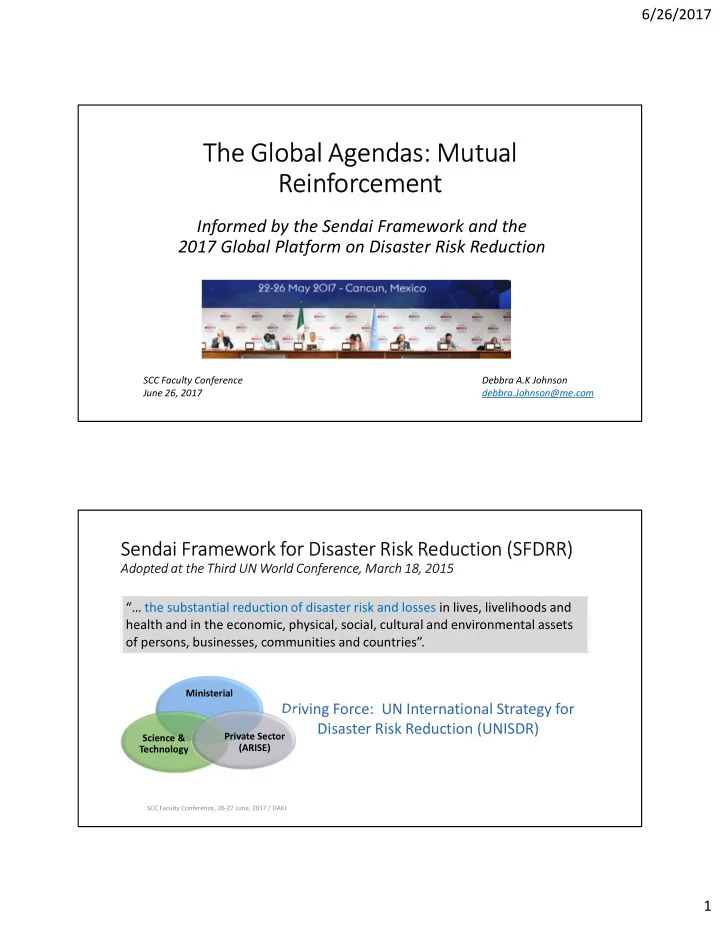
The Global Agendas: Mutual Reinforcement Informed by the Sendai - - PDF document

the global agendas mutual reinforcement
SMART_READER_LITE
LIVE PREVIEW

The Global Agendas: Mutual Reinforcement Informed by the Sendai - - PDF document

6/26/2017 The Global Agendas: Mutual Reinforcement Informed by the Sendai Framework and the 2017 Global Platform on Disaster Risk Reduction SCC Faculty Conference Debbra A.K Johnson June 26, 2017 debbra.Johnson@me.com Sendai Framework for


slide-1
SLIDE 1

6/26/2017 1

The Global Agendas: Mutual Reinforcement

Informed by the Sendai Framework and the 2017 Global Platform on Disaster Risk Reduction

SCC Faculty Conference Debbra A.K Johnson June 26, 2017 debbra.Johnson@me.com

Sendai Framework for Disaster Risk Reduction (SFDRR)

Adopted at the Third UN World Conference, March 18, 2015 “… the substantial reduction of disaster risk and losses in lives, livelihoods and health and in the economic, physical, social, cultural and environmental assets

  • f persons, businesses, communities and countries”.

Driving Force: UN International Strategy for Disaster Risk Reduction (UNISDR)

Ministerial Science & Technology Private Sector (ARISE)

SCC Faculty Conference, 26-27 June, 2017 / DAKJ

slide-2
SLIDE 2

6/26/2017 2

The Sendai Framework = 4 Priorities, 7 Targets

Priority 1: Understanding disaster risk Priority 2: Strengthening disaster risk governance to manage DR Priority 4: Enhancing disaster preparedness to “Build Back Better” in recovery, rehabilitation and reconstruction Priority 3: Investing in DRR for resilience  GLOBAL MORTALITY BY 2030  # AFFECTED PEOPLE GLOBALLY:  ECONOMIC LOSSES IN RELATION TO GDP BY 2030  DISASTER DAMAGE TO CRITICAL INFRASTRUCTURE & DISRUPTION TO BASIC SERVICES & RESILIENCE BY 2030  # OF CONTRIES WITH NATIONAL & LOCAL DRR STRATEGIES BY 2020  ENHANCE INT’L COOPERATION TO DEVELOPING COUNTRIES BY 2030  AVAILABILITY & ACCESS TO MULTI-HAZARD EARLY WARNING SYSTEMS & DRR INFO & ASSESSMENTS BY 2030

REDUCE INCREASE

SCC Faculty Conference, 26-27 June, 2017 / DAKJ

DRR Global Platform – Cancun

“We come to Cancún not to talk, but to work.”

  • Robert Glasser, SRSG for DRR & Head of UNISDR

May 25 – 28, 2017

SCC Faculty Conference, 26-27 June, 2017 / DAKJ

slide-3
SLIDE 3

6/26/2017 3

Four Thematic Plenary Sessions

  • NATIONAL AND LOCAL DRR STRATEGIES
  • REDUCING VULNERABILITY OF COUNTRIES IN SPECIAL SITUATIONS
  • SENDAI FRAMEWORK MONITORING
  • COHERENCE -THE SENDAI FRAMEWORK, THE PARIS AGREEMENT & THE 2030

AGENDA FOR SUSTAINABLE DEVELOPMENT

Session Moderator Shri Kiren Rijiju, State Minister, India

DRR Strategies

Session Co-Chair Concetta Fierravanti-Wells, Minister for Int’l Development and the Pacific, Australia

Special Situations

Session Co-Chair Luis Felipe Puente Espinosa, Secretaría de Gobernación, Mexico

SF Monitoring

Session Co-Chair Manuel Bessler, Head of the Swiss Humanitarian Aid Unit, Switzerland

Coherence

SCC Faculty Conference, 26-27 June, 2017 / DAKJ

Plenary Key Priorities: National And Local DRR Strategies

  • Greater accountability & compliance
  • People-centered & inclusive DDR strategies
  • Promote Int’l, Reg’l, and Nat’l disaster coordination

centers

  • Greater coordination among institutions of higher learning to foster

local and national leadership in DRR Strategy Design

SCC Faculty Conference, 26-27 June, 2017 / DAKJ

Session Moderator Shri Kiren Rijiju, State Minister, India

DRR Strategies

slide-4
SLIDE 4

6/26/2017 4

Plenary Key Priorities: Reducing Vulnerability of Countries in Special Situations

  • Take advantage of opportunities presented by the mutually

reinforcing 2030 Agenda & the Paris Agreement when implementing the Sendai Framework

  • Promote stronger multi-stakeholder partnerships (finance, knowledge

transfer and best practices) to drive DRR efforts

  • Call for effective disaster risk governance & inclusive

institutions to drive implementation / preventative approach to DRR

SCC Faculty Conference, 26-27 June, 2017 / DAKJ

Session Co-Chair Concetta Fierravanti-Wells, Minister for Int’l Development and the Pacific, Australia

Special Situations

Plenary Key Priorities: Sendai Framework Monitoring

A Need for:

  • A system-wide, multi-disciplinary, multi-stakeholder understanding;
  • Multi stakeholder partnerships (financing, knowledge transfer…);
  • Standardized reporting and common indicators;
  • A simplification of monitoring systems;
  • Leveraging opportunities of mutual reinforcement

when implementing the Sendai Framework:

  • Effective DR governance & inclusive institutions to drive prevention

SCC Faculty Conference, 26-27 June, 2017 / DAKJ

Session Co-Chair Luis Felipe Puente Espinosa, Secretaría de Gobernación, Mexico

SF Monitoring

slide-5
SLIDE 5

6/26/2017 5

Monitoring: Pre – and Post-Cancun

A readiness review was undertaken by 87 countries assessing the availability

  • f national disaster-related data, gaps and type of resources needed to fill

gaps and a country’s current ability to set up baselines

  • Findings:
  • Target A: reducing mortality - 83% of reporting countries
  • Target B: reducing # of people directly affected - 66%
  • Target C: reducing economic loss re GDP – 50%
  • Target D: reducing damage to critical infrastructure/disruptions to basic services – 60%
  • Target E: national & local DRR Strategies & Target F: enhancing international warning systems

and disaster risk information = wide data variances

SCC Faculty Conference, 26-27 June, 2017 / DAKJ

Monitoring global targets progress for reducing disaster losses will get underway early 2018

Coherence – World Economic Forum Report

  • Taken individually, none of the frameworks engage with the full range
  • f risk drivers within the system
  • Delivery on one framework should be consistent with the attainment
  • f others
  • A wider systems view of the interconnected challenges and involves a

larger more diverse set of actors is required

SCC Faculty Conference, 26-27 June, 2017 / DAKJ

“The confluence of risks around water scarcity, climate change, extreme weather events and involuntary migration remains a potent cocktail and a “risk multiplier”, especially in the world economy’s more fragile environmental and political contexts

Source: The Global Risks Report 2017, World Economic Forum (2017)

slide-6
SLIDE 6

6/26/2017 6

Key Priorities: Coherence -The Sendai Framework, The Paris Agreement & The 2030 Agenda For Sustainable Development

  • UN, Government & Stakeholders taking action in a coherent

manner

  • Build resilience amongst the most vulnerable communities
  • Determine the role of the High Level Political Forum in

promoting the Paris Agreement and the Sendai Framework

SCC Faculty Conference, 26-27 June, 2017 / DAKJ

“…the Sendai Framework, Paris Agreement and 2030 Agenda “is one framework with different elements.”

  • Saber Chowdhury, President of the Inter-Parliamentary

Union, Bangladesh,

Session Co-Chair Manuel Bessler, Head of the Swiss Humanitarian Aid Unit, Switzerland

Coherence

High Level Political Forum on Sustainable Development

[Convenes July 2017 under the Economic and Social Council – ECOSOC]

  • HLPF is used by civil society organizations (CSO’s) to hold

governments and others accountable for their commitments across agendas.

  • It brings together, global, regional, national and thematic

reviews. The theme: “Eradicating poverty and promoting prosperity in a changing world”

SCC Faculty Conference, 26-27 June, 2017 / DAKJ

slide-7
SLIDE 7

6/26/2017 7

High Level Political Forum on Sustainable Development

[Convenes July 2017 under the Economic and Social Council – ECOSOC] HLPF will closely review the following SDG goals in 2017:

  • 1,2,3: End poverty, hunger, Ensure healthy lives & promote well-

being;

  • 5, 9: Achieve gender equality & empower women, & Build resilient

infrastructure, sustainable industrialization, and foster innovation;

  • 14: conserve and sustainably use the oceans, seas & marine

resources for SD;

  • 17: Global Partnership for Sustainable Development (reviewed each

year).

SCC Faculty Conference, 26-27 June, 2017 / DAKJ

Disaster Resilience & the 2030 Global Agenda

SCC Faculty Conference, 26-27 June, 2017 / DAKJ

Target 1.5 Build the resilience of the poor and those in vulnerable situations, and reduce their exposure and vulnerability to climate- related extreme events and

  • ther economic, social and

environmental shocks and disasters Target 9.1 Develop quality, reliable, sustainable and resilient infrastructure Target 2.4 Ensure sustainable food production systems and implement resilient agricultural practices. Target 11.5 Significantly reduce the number of deaths and the number of people affected and decrease the economic losses relative to GDP gross domestic product caused by disasters… Target 11.b Substantially increase the number of cities and human settlements adopting and implementing integrated policies and plans towards inclusion, resource efficiency, mitigation and adaptation to climate change, resilience to disasters, develop and implement, in line with the Sendai Framework for Disaster Risk Reduction, holistic disaster risk management at all levels Target 13.1 Strengthen resilience and adaptive capacity to climate-related hazards and natural disasters in all countries

slide-8
SLIDE 8

6/26/2017 8

ARISE Canada – New Regional Network

SCC Faculty Conference, 26-27 June, 2017 / DAKJ

VISION BUILD A SAFE & RESILIENT CANADA OBJECTIVE MAKE INVESTMENTS DISASTER RISK-SENSITIVE 5 COMMITMENTS Global lead

Source: ARISE Canada Launch, PwC, June 15, 2017

7 THEMES

1

ARISE U.S. – New Regional Network

  • U.S. Launch Scheduled for October 12 at FIU
  • Led by the Resilience Action Fund & Disaster Risk Institute

SCC Faculty Conference, 26-27 June, 2017 / DAKJ

5 COMMITMENTS 7 THEMES Global lead