Operationalizing the Cancun Agreements in Southeast Asia: NAMAs and - - PDF document

operationalizing the cancun agreements in southeast asia
SMART_READER_LITE
LIVE PREVIEW

Operationalizing the Cancun Agreements in Southeast Asia: NAMAs and - - PDF document

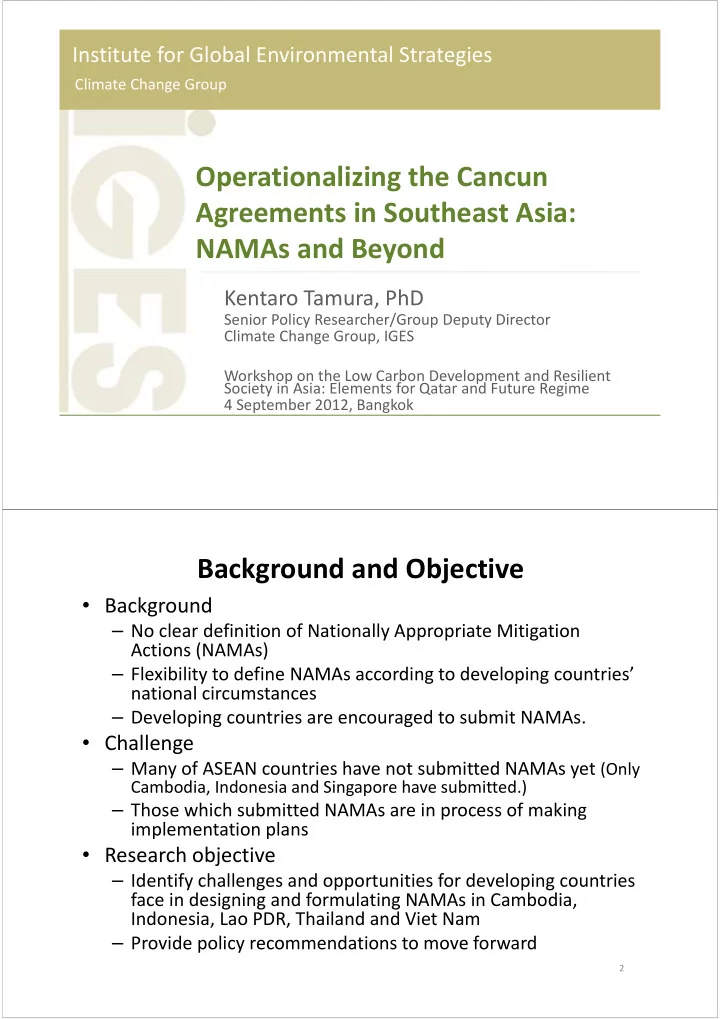
Institute for Global Environmental Strategies Climate Change Group Operationalizing the Cancun Agreements in Southeast Asia: NAMAs and Beyond Kentaro Tamura, PhD Senior Policy Researcher/Group Deputy Director Climate Change Group, IGES Workshop on


slide-1
SLIDE 1

Institute for Global Environmental Strategies

Operationalizing the Cancun Agreements in Southeast Asia: NAMAs and Beyond

Kentaro Tamura, PhD

Senior Policy Researcher/Group Deputy Director Climate Change Group, IGES Climate Change Group Workshop on the Low Carbon Development and Resilient Society in Asia: Elements for Qatar and Future Regime 4 September 2012, Bangkok

Background and Objective

  • Background

– No clear definition of Nationally Appropriate Mitigation Actions (NAMAs) – Flexibility to define NAMAs according to developing countries’ national circumstances – Developing countries are encouraged to submit NAMAs.

  • Challenge

– Many of ASEAN countries have not submitted NAMAs yet (Only

Cambodia, Indonesia and Singapore have submitted.)

– Those which submitted NAMAs are in process of making implementation plans

  • Research objective

– Identify challenges and opportunities for developing countries face in designing and formulating NAMAs in Cambodia, Indonesia, Lao PDR, Thailand and Viet Nam – Provide policy recommendations to move forward

2

slide-2
SLIDE 2

Essential Elements for NAMA Formulation: Three Dimensions

NAMAs should be formulated on national consensus, and linked to national development priorities.

  • NAMAs need to be based a good understanding of the current

and future emissions trends and cost implications.  Technical dimension

  • NAMAs need to be embedded in national priorities.

 Mainstreaming dimension

  • NAMAs need to be formulated through a cross‐ministerial

decision‐making process which can coordinate and reconcile diverse interests.  Institutional dimension

3

Institutional Dimension Institutional Dimension

Priority setting for mitigation options in the context of national development Priority setting for mitigation options in the context of national development

Essential Elements of Formulating a NAMA: Three Dimensions

4

National consensus on NAMAs National consensus on NAMAs

Mainstreaming Dimension Mainstreaming Dimension

Climate Change agenda mainstreamed into national development plans and priorities Priority sectors and measures /options Action plans/strategy with operational details

(actions, costs, actors, durations, expected impacts, etc)

Technical Dimension Technical Dimension

GHG inventory and measurement rules Future GHG emission trend Potential mitigation

  • ptions and their cost

estimation

Understanding of current/future emission status and cost implication Understanding of current/future emission status and cost implication

National decision‐ making process on CC established (i.e. inter‐ ministerial council) Task allocations on NAMAs among stakeholders (i.e. ministries, sectors, international donors) Existing institutional arrangements for mitigation efforts

Foundation for national decision making for NAMAs Foundation for national decision making for NAMAs

slide-3
SLIDE 3

Technical Dimension

Cambodia Lao PDR Viet Nam Indonesia Thailand

GHG inventory, measure‐ ment rules

  • First National

Communication 2002 (INC)

  • INC 2000
  • INC 2003,

Second National Commination (SNC) 2010

  • INC 1999, SNC

2011/12

  • Legal base for

inventory

  • FNC 2000,

SNC 2011

  • T‐VER scheme

(2013)

Future GHG emission projection

  • 2020 projection

(INC)

  • No

reference in INC

  • SNC
  • Sector‐based

projection, 2020 BAU (SNC)

  • No projection

(SNC)

  • Sector‐based

projections

Potential mitigation

  • ptions and

their cost estimation

  • Mitigation

potential estimate in key sectors

  • No reference to

cost

  • No

reference in INC

  • 28 mitigation
  • ptions in three

sectors and their cost estimates (SNC)

  • Mitigation
  • ptions in six

sectors, some

  • f which have

cost estimation

  • Renewable

Energy Development Plan (REDP)

  • Energy

Efficiency Plan

5

  • While there is difference in capacity level, room for improving technical capacity

to develop inventories and capture emission trends

  • Data collection and sharing among different ministries is a challenge. Preparation

for institutional arrangements for inventories in Viet Nam, legalization in Indonesia, T‐VER in Thailand

  • Room for improving capacity to analyze mitigation potentials and mitigation costs

Mainstreaming Dimension

Cambodia Lao PDR Viet Nam Indonesia Thailand

Mainstream ‐ing mitigation

  • National

Develop‐ ment Strategies and Plans 2009‐2013 (NDSP)

  • 7th National

Socio‐ Economic Development Plan (NEDP7)

  • Schedule and

leading agency (National Target Program to

Respond to Climate Change:

NTPRCC 2008)

  • National Climate

Change Strategy (NCCS 2010)

  • Mid‐term

National Development Plan (RPJM 2010‐2014)

  • Indonesia Climate

Change Sectoral Roadmap (ICCSR)

  • National

Master Plan for Climate Change (draft)

  • National

Economic and Social Development Plan (NESDP) Identifica‐ tion of priority sectors and policies

  • Priority

actions (NDSP)

  • Five sectors

(National Strategy on Climate Change 2010)

  • Six sectors

(NCCS)

  • National Action

Plan for GHG Emissions Reduction (RAN‐ GRK)

  • ICCSR
  • 6 Strategies

(National Climate Change Strategic Plan NCCSP) Action plan /strategy

  • Cambodian

Climate Change Strategic Plan (draft)

  • National

Action Plan for Climate Change (draft)

  • Action Plans by

line ministries, and local governments

  • RAN‐GRK
  • REDP, Energy

Conservation Plan

6

  • Mainstreaming at the national level is on progress in all five countries.

 But, further analysis is necessary to assess actual implementation.

  • By using existing sectoral policies and programmes (energy efficiency, renewable

energy, forestry, agriculture) as a starting point for considering NAMAs, most of the countries try to ensure NAMAs’ contribution to SD.

slide-4
SLIDE 4

Institutional Dimension

Cambodia Lao PDR Viet Nam Indonesia Thailand

National decision‐ making process

  • National

Climate Change Committee

  • National

Steering Committee

  • n Climate

Change

  • National

Climate Change Committee

  • National Climate

Change Committee

Existing institutional arrangements for mitigation efforts

  • REDD+
  • Green

growth strategy ―

  • Various

sectoral initiatives REDD+

  • Green growth

strategy

  • Various

sectoral and local initiatives

  • NCCSP
  • REDP
  • Energy Efficiency

Plan

  • BKK’s low carbon

action plan

Task allocations on NAMAs formulation

  • MOE seeks

playing a coordination role ―

  • MONRE taking

a coordination role

  • BAPENAS

taking a coordination role

  • Thai Greenhouse

gas Organization playing a coordination role

7

  • Establishment of cross‐ministerial decision‐making process in all five countries

But, further analysis is necessary to examine how it actually works

  • Institutional congestion
  • Among NAMA‐related initiatives
  • With similar but different initiatives (REDD+, green growth strategies)
  • Limited capacity of coordinating bodies (esp. MOE/MONR); various sectoral

support‐led initiatives

Conclusions and Recommendations (1)

  • Challenges in the three dimensions remain.

However,

  • NAMAs can be a tipping point toward low carbon

development

– LDCs: Opportunity to take the late comer’s advantage, thereby avoiding the carbon lock‐in associated with conventional modernization and urbanization – Middle‐income countries: Opportunity to escape from the “middle income trap” by transforming resource‐intensive growth to more efficient and competitive one

  • Developing countries governments need to regard NAMAs

as an opportunity, rather than burdensome outcome of international negotiations.

8

slide-5
SLIDE 5

Conclusions and Recommendations (2)

For policymakers and stakeholders in developing countries

  • Resource allocation for improving in‐house human resources:

For the sense of ownership to grow, engagement of in‐house capable staff is critical. Further resource allocations should be given to capacity building of human resources.

  • Incentives and awareness: Key domestic actors should be given

incentives (e.g. budget allocation) and their awareness on how NAMAs could benefit national development should be improved.

  • National institutional arrangements for NAMAs: Coordinating

capacity of a leading agency should be improved, especially in case of MOE.

9

Conclusions and Recommendations (3)

For international donors

  • More attention to human resources development: More

consideration should be given to how best domestic know‐ how can be accumulated in recipient countries

  • Facilitating mutual learning within the region: Each

country’s effort to formulate NAMAs can provide good lessons from which neighboring countries could learn.

  • Ensuring coordination and complementary relationship

among various NAMA‐related support: More effort to support coordination should be made. It is also important to consider how each NAMA‐related support can fit into national grand design toward low carbon development

10