Operationalizing Operationalizing Political Economy: Political - - PowerPoint PPT Presentation

operationalizing operationalizing political economy
SMART_READER_LITE
LIVE PREVIEW

Operationalizing Operationalizing Political Economy: Political - - PowerPoint PPT Presentation

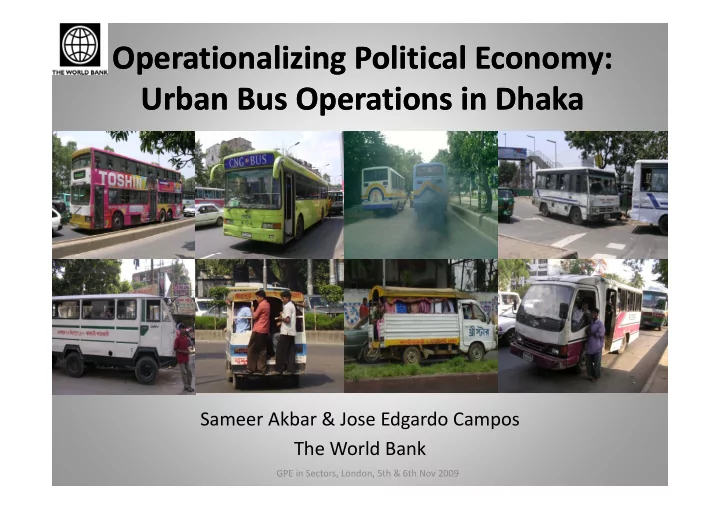
Operationalizing Operationalizing Political Economy: Political Economy: Urban Bus Operations in Dhaka Urban Bus Operations in Dhaka Sameer Akbar & Jose Edgardo Campos g p The World Bank GPE in Sectors, London, 5th & 6th Nov 2009 Structure

slide-1
SLIDE 1

Operationalizing Operationalizing Political Economy: Political Economy: Urban Bus Operations in Dhaka Urban Bus Operations in Dhaka

Sameer Akbar & Jose Edgardo Campos g p The World Bank

GPE in Sectors, London, 5th & 6th Nov 2009

slide-2
SLIDE 2

Structure of Presentation

CONTEXT & BACKGROUND CONTEXT & BACKGROUND WHAT problems have persisted ? WHAT problems have persisted ? Systemic problems Systemic problems Underlying “rules of the game” Underlying “rules of the game” WHY these problems WHY these problems persist ? persist ? y g g y g g Stakeholder analysis Stakeholder analysis Stakeholder analysis Stakeholder analysis HOW to address the HOW to address the problems ? problems ? Managing the process of change Managing the process of change p

GPE in Sectors, London, 5th & 6th Nov 2009 Akbar & Campos

slide-3
SLIDE 3

Context & Background g

Akbar & Campos GPE in Sectors, London, 5th & 6th Nov 2009

slide-4
SLIDE 4

P j t Projects

  • Failed attempt in the past (1999 2005) to reform
  • Failed attempt in the past (1999‐2005) to reform

bus operations in Dhaka through a World Bank funded urban transport project

  • New World Bank project (launched in October

New World Bank project (launched in October 2009) proposed initiating reform of bus

  • perations
  • perations
  • Pilot investments in franchised operations of buses

d i d

  • n designated routes

GPE in Sectors, London, 5th & 6th Nov 2009 Akbar & Campos

slide-5
SLIDE 5

Industry Structure & Accountability Industry Structure & Accountability

  • Bus Fleet of approx. 6700

– Big Buses: 1650 ; Minibuses : 4050 ; Human Haulers: 1000

  • Industry Structure

– Mostly individual owned buses till mid‐1990’s – More than 60 bus companies now with 10‐150 buses – Bus companies organized under umbrella associations

  • Key Institutions of Accountability

– Bangladesh Road Transport Authority (BRTA): regulation – Dhaka Metropolitan Police (DMP): enforcement – Dhaka Transport Coordination Board (DTCB): plan & coordinate – BRTA constitutes the Regional Transport Committee (RTC): award g p ( )

  • f bus route permits

GPE in Sectors, London, 5th & 6th Nov 2009 Akbar & Campos

slide-6
SLIDE 6

What problems have persisted? p p

Akbar & Campos GPE in Sectors, London, 5th & 6th Nov 2009

slide-7
SLIDE 7

Governance, Institutional, Service Go e a ce, st tut o a , Se ce

  • Many operators

– Varied ownership competition “in the market” etc – Varied ownership, competition in the market etc.

  • Ad hoc route network

No franchised routes individual bus permits etc – No franchised routes, individual bus permits etc.

  • Rampant corruption and rent seeking

R b DMP BRTA RTC i b ib b b – Rents by DMP, BRTA, RTC, pro‐active bribery by bus owners etc.

  • Poor regulation and lack of enforcement

– Unlicensed drivers, illegal vehicles, extra charges for gate‐lock etc.

  • Poor physical and service quality

– Broken windows and lights, gender insensitive etc.

  • Congestion

– Average speeds down to 10 kmph

GPE in Sectors, London, 5th & 6th Nov 2009 Akbar & Campos

slide-8
SLIDE 8

Why these problems persist? Why these problems persist?

Akbar & Campos GPE in Sectors, London, 5th & 6th Nov 2009

slide-9
SLIDE 9

Patriarchy & Patronage y g

  • Key ruling political party leaders dominate bus owners /

company associations company associations

  • Association leaders are members of the RTC and work as

conduits for politicians conduits for politicians

  • RTC, through its role in route allocations, is the hub for

patronage distribution p g

  • Routes are created to accommodate many clients: “Political

government in consideration of politics (i.e. own party g f p ( p y interest) created many routes, issued many route permits, and now there is no space on the road to move.”

  • In addition to key routes, control of bus terminals is

important for politicians since they provide additional rent ki t iti seeking opportunities

GPE in Sectors, London, 5th & 6th Nov 2009 Akbar & Campos

slide-10
SLIDE 10

Co‐opting Industry Associations p g y

  • The association leadership changes with change in

li t Thi h b f ruling government. This happens because of

– supply‐side factors: forceful takeover and incentives (“carrots and sticks”) ( carrots and sticks ) – but mostly is demand‐led by the associations: they change party affiliations for the “larger common good”

  • But rents continue to be shared with the opposition

(albeit in asymmetrical proportions) so as to not “b b id ” l l “burn bridges” completely

  • For the ruling party, this “duopolistic” control over

i ti i h d d associations is much needed.

– It helps maintain stability through the chaos of bus

  • perations
  • perations

GPE in Sectors, London, 5th & 6th Nov 2009 Akbar & Campos

slide-11
SLIDE 11

Colonizing Institutions of Accountability g y

  • Institutions of Accountability (BRTA, RTC, and DMP)

serve a key function for the politicians in a “patron serve a key function for the politicians in a “patron‐ client” relationship f h f ll d – Appointment of BRTA chairman is carefully managed – The RTC membership is rigged – DMP uses its muscle and acts as facilitator – DTCB is deliberately kept as a weak institution DTCB is deliberately kept as a weak institution

  • Examples:

i i h i f il f – Resisting enhancement in transparency: e.g. failure of ADB’s VIC center – Parallel de facto rules for getting a bus route permit

GPE in Sectors, London, 5th & 6th Nov 2009 Akbar & Campos

slide-12
SLIDE 12

A Perverse Equilibrium A Perverse Equilibrium

  • Dhaka has not seen frequent agitations by the bus

Dhaka has not seen frequent agitations by the bus

  • wners and employees perhaps due to the perverse

consensus of the leaders of all shades who tend to benefit from the de facto rules of the game

  • Such perverse consensus or equilibrium does not

Such perverse consensus or equilibrium does not enhance welfare of the citizen, but ensures huge rents for all politicians linked to this sector rents for all politicians linked to this sector

  • It has serious negative implications in terms of

generation of incentives for reform among the generation of incentives for reform among the political actors even in a seemingly competitive political setting political setting

GPE in Sectors, London, 5th & 6th Nov 2009 Akbar & Campos

slide-13
SLIDE 13

How to address the problems? p

Akbar & Campos GPE in Sectors, London, 5th & 6th Nov 2009

slide-14
SLIDE 14

Understanding Stakes & Holders Understanding Stakes & Holders

  • Power of the most influential anti‐reform

stakeholders (politicians, leaders of bus association) is essentially derived from the broader nature of the political governance structure of the country

  • Stakes in preserving the status quo are very high

for them (massive rents, political compulsion for for them (massive rents, political compulsion for distributing patronage etc)

  • Any reform initiative without proper assessments
  • Any reform initiative without proper assessments
  • f how to handle such incentives would enhance

risk of reform being stalled or abandoned risk of reform being stalled or abandoned

GPE in Sectors, London, 5th & 6th Nov 2009 Akbar & Campos

slide-15
SLIDE 15

Reform: Influence‐Interest Matrix

Bus Owners Association Politicians

High Influence

  • f Stakeholders

World Bank DCC DMP BRTC World Bank Media Human Haulers BRTA RTC Rickshaw 3 wheelers DTCB 3‐wheelers Civil Society

High Interest i R f Low Interest in R f

Bus Staff Union Large Bus Companies

in Reform Reform

Progressive Bus Companies Bus Commuters

Low Influence

Bus Commuters

  • f Stakeholders

GPE in Sectors, London, 5th & 6th Nov 2009 Akbar & Campos

slide-16
SLIDE 16

Political Economy Grounded Strategy Political Economy Grounded Strategy

  • Short/Medium term:

/

– Promote collective action of those in the lower left quadrant – Get some in the upper right quadrant (CNG, Rickshaw) to join in the collective action efforts Targeted communication efforts should be launched – Targeted communication efforts should be launched – Media and civil society to play a major role

  • Long term:

Long term:

– Reduce the power and influence of those in the top right hand quadrant q – Ensure autonomy, integrity and capacity of BRTA and RTC – Empower DTCB to play an active role in planning and di i coordination

GPE in Sectors, London, 5th & 6th Nov 2009 Akbar & Campos

slide-17
SLIDE 17

Impact on Project Design Impact on Project Design

  • The scope of the Bus component was modified

and made much more modest

  • Focus shifted from

H d il ti i t t t – Hardware: piloting investments ; to – Software: institutional strengthening and consensus building

Akbar & Campos GPE in Sectors, London, 5th & 6th Nov 2009

slide-18
SLIDE 18

Thank You! Thank You!

This study was conducted by Mirza Hassan and Abul Hossain (Consultants) in 2007 under the guidance of Sameer Akbar (Task Team Leader) and Jose Edgardo Campos. It was part of a two‐ part study on political economy, the other focusing on the Brick Manufacturing industry in Bangladesh The study was financed using DFID Trust Fund resources

  • Bangladesh. The study was financed using DFID Trust Fund resources.

Akbar & Campos GPE in Sectors, London, 5th & 6th Nov 2009