The future's bright, the future's solar Photovoltaics for - - PowerPoint PPT Presentation

the future s bright the future s solar
SMART_READER_LITE
LIVE PREVIEW

The future's bright, the future's solar Photovoltaics for - - PowerPoint PPT Presentation

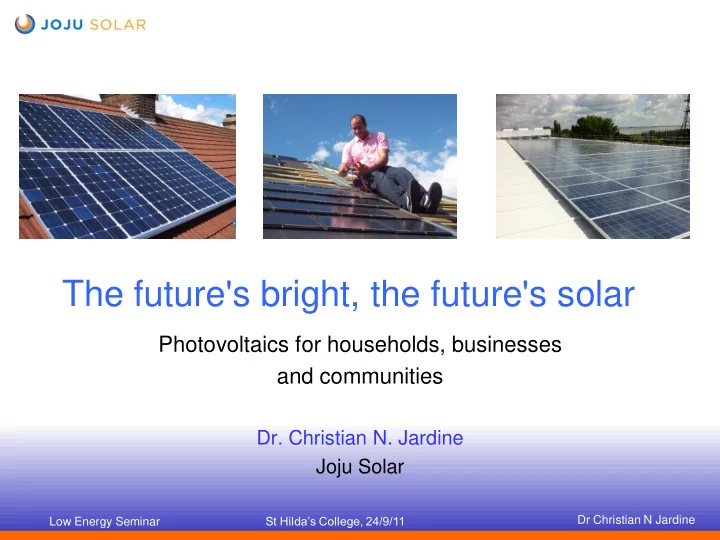
The future's bright, the future's solar Photovoltaics for households, businesses and communities Dr. Christian N. Jardine Joju Solar St Hildas College, 24/9/11 Dr Christian N Jardine Low Energy Seminar Energy of Sunlight Solar


slide-1
SLIDE 1

Low Energy Seminar St Hilda’s College, 24/9/11 Dr Christian N Jardine

The future's bright, the future's solar

Photovoltaics for households, businesses and communities

  • Dr. Christian N. Jardine

Joju Solar

slide-2
SLIDE 2

Low Energy Seminar St Hilda’s College, 24/9/11 Dr Christian N Jardine

Energy of Sunlight

  • Solar energy10,000 times global power demand
  • In the UK, 900-1300 kWh/ m2 per year
  • Our summer days receive almost as much energy as the

Mediterranean

  • Even on a cloudy day we receive 1/3 the energy of a clear

day

slide-3
SLIDE 3

Low Energy Seminar St Hilda’s College, 24/9/11 Dr Christian N Jardine

Orientation

  • Large hotspot of high light intensities
  • SE to SW and 20 to 50º receive 95% the energy of an
  • ptimally pitched roof
  • Flat arrays receive 90% insolation of optimally pitched

array

slide-4
SLIDE 4

Low Energy Seminar St Hilda’s College, 24/9/11 Dr Christian N Jardine

What are Photovoltaics?

  • Photovoltaics are made out of materials called

semiconductors

  • Semiconductors can absorb the energy of light to generate

electric current

  • Photovoltaics are typically made out of silicon
  • Silicon is the second most abundant element on earth
  • Supplies of silicon are truly sustainable
slide-5
SLIDE 5

Low Energy Seminar St Hilda’s College, 24/9/11 Dr Christian N Jardine

Why Photovoltaics?

  • No CO2 emissions during operating lifetime
  • No moving parts
  • Secure supply of energy; distributed energy production
  • Suitable for use within an urban environment
  • Architecturally attractive product
  • Modular
  • Massive energy producing potential
slide-6
SLIDE 6

Low Energy Seminar St Hilda’s College, 24/9/11 Dr Christian N Jardine

Photovoltaics for Businesses

  • Helps meet Carbon Reduction Commitment (CRC) targets

– At negative cost, with feed-in tariff

  • Hedges against future electricity price rises

– De-risks business

  • Provides diversity of income stream

– Guaranteed payments provide baseline income

  • Boosts environmental credentials and ‘green image’

– Competitive advantage

slide-7
SLIDE 7

Low Energy Seminar St Hilda’s College, 24/9/11 Dr Christian N Jardine

System components

  • PV modules – to generate DC

electricity

  • Inverter – to turn DC electricity

in 240V AC electricity and match this to the phase of the grid – Implies no production if grid goes down for safety reasons

  • Isolation switches
  • String fuses and G57 relay for

larger installations

  • Generation meter
  • Optional export meter
slide-8
SLIDE 8

Low Energy Seminar St Hilda’s College, 24/9/11 Dr Christian N Jardine

Solar Generation

  • Solar PV is sold on the basis of its kWpeak rating
  • A 1kW system will generate 860 kWh per year
  • Domestic

– A typical sized 2 kW system will provide around 1700 kWh per year – An average home uses 3300 kWh on lights and appliances – But possible to use ½ this if you are energy efficient

  • Businesses

– 50kW likely maximum, 43000 kWh per annum

slide-9
SLIDE 9

Low Energy Seminar St Hilda’s College, 24/9/11 Dr Christian N Jardine

Modules

  • Modules can be simply roof mounted
  • Mounted on a frame that attaches to roof joists
  • Permitted development if <20cm from plane of roof
slide-10
SLIDE 10

Low Energy Seminar St Hilda’s College, 24/9/11 Dr Christian N Jardine

  • Dr. Christian N. Jardine
slide-11
SLIDE 11

Low Energy Seminar St Hilda’s College, 24/9/11 Dr Christian N Jardine

Large Scale Installation Process

Video at http://www.jojusolar.co.uk/media/large-scale-solar-pv-installation.html

slide-12
SLIDE 12

Low Energy Seminar St Hilda’s College, 24/9/11 Dr Christian N Jardine

Solar Roof Tiles

  • Simple to install
  • Can be installed by a conventional roofer
slide-13
SLIDE 13

Low Energy Seminar St Hilda’s College, 24/9/11 Dr Christian N Jardine

Glass-glass Laminates

  • Semi-transparent PV laminates
  • Very attractive architectural material
slide-14
SLIDE 14

Low Energy Seminar St Hilda’s College, 24/9/11 Dr Christian N Jardine

Solar PV Costs

  • Little to choose between suppliers
  • Prices reduced significantly this year
  • £3200/kW + £2000 +VAT(5%)
  • Large scale <£2400-2900/kW +VAT (20%)
slide-15
SLIDE 15

Low Energy Seminar St Hilda’s College, 24/9/11 Dr Christian N Jardine

PV Income

Rewards depending on use Rewards for generation

Feed-in tariff 43 p/kWh Cheque from Utility Measured Used on site 13p/kWh Saving off bills Measured Exported 3p/kWh Cheque from utility Estimated as 50% of generation

%? %?

slide-16
SLIDE 16

Low Energy Seminar St Hilda’s College, 24/9/11 Dr Christian N Jardine

The Feed-in tariffs

  • Payments to be inflation adjusted – payments are protected and

will increase over time

  • BUT – Future tariff levels to be decided by Government, and will

reduce by at least 10% in April 2012.

slide-17
SLIDE 17

Low Energy Seminar St Hilda’s College, 24/9/11 Dr Christian N Jardine

Avoided Imports

  • Any electricity used on site gives an additional saving

because you don’t have to pay for imported electricity anymore

  • Current market price 13p/kWh (10p commercial)
  • Likely to increase over time due to

– Oil shortages increasing cost of electricity – Need to replace nuclear and much of our coal plant – Cost of meeting supply gap from renewables – Target of 40% electricity generation from renewables by 2020

slide-18
SLIDE 18

Low Energy Seminar St Hilda’s College, 24/9/11 Dr Christian N Jardine

Exported electricity

  • Feed-in tariff is reward for green electricity generation
  • Paid even if you use it yourself
  • Additional payment to reflect value of exported electricity
  • Additional 3p/kWh for exported electricity
  • Too small to meter – assumed to be 50% of generation
slide-19
SLIDE 19

Low Energy Seminar St Hilda’s College, 24/9/11 Dr Christian N Jardine

Putting it all together

  • Payback depends on:
  • Size, orientation, local factors (shading)
  • Feed-in tariff band
  • Cost
  • Percentage of electricity used on site
  • Assumed rates of inflation and electricity price rise
  • Should see returns in excess of 9-12% per annum,

domestic.

  • 12-17% at large scale.
slide-20
SLIDE 20

Low Energy Seminar St Hilda’s College, 24/9/11 Dr Christian N Jardine

Typical returns

[1] Based on: feed-in tariff of 43.3p, inflation of 2.5% p.a., domestic electricity at 13p/kWh, electricity price rise of 4% pa. , 50% of electricity used on site.

Size 12m2 16m2 24m2 System size 1.5 kW 2 kW 3 kW Our Price £6,800 £8,400 £11,600 Feed-in tariff payments £17,990 £23,980 £35,970 Avoided Imports £2,880 £3,830 £5,750 Export Payment £650 £870 £1,310 Total Benefits £21,510 £28,680 £43,000 Return on Investment 10.2% 11.1% 12.1% Payback 9.8 years 9.2 years 8.5 years

£- £200 £400 £600 £800 £1,000 £1,200 £1,400 £1,600 Income Time

Avoided Imports Exported electricity FiT Payment
slide-21
SLIDE 21

Low Energy Seminar St Hilda’s College, 24/9/11 Dr Christian N Jardine

Commercial Project Returns

  • At £2700/kW, IRR of 15.2% (ex VAT)

– Standard modules, difficult access

  • At £2400/kW, IRR of 17% (ex VAT)

– Cheaper modules, simple roof access

  • Projects for 2012 still viable (est. 25% reduction in income)

£- £5,000 £10,000 £15,000 £20,000 £25,000 £30,000 £35,000 £40,000 Year 1 Year 3 Year 5 Year 7 Year 9 Year 11 Year 13 Year 15 Year 17 Year 19 Year 21 Year 23 Year 25

Exported electricity Avoided Imports FiT Payment

slide-22
SLIDE 22

Low Energy Seminar St Hilda’s College, 24/9/11 Dr Christian N Jardine

Community Solar

  • Benefits from building at scale
  • Opportunity to generate ongoing revenue streams for

community projects

  • Highly visible means of engaging a wider audience with

the low carbon agenda

  • Allows participation from

– Those that can’t afford their own solar system – Those without favourable roofs – Those who rent – Supports those

slide-23
SLIDE 23

Low Energy Seminar St Hilda’s College, 24/9/11 Dr Christian N Jardine

Community Investment Model

  • Project returns ca. 13%
  • Benefits split between

– Host building free electricity (3%) – Investors (10%) – Some admin costs

  • E.g. Wey Valley Solar Schools
  • www.weyvalleysolar.co.uk
  • £1m share offer opens 16th

Sept 2011

slide-24
SLIDE 24

Low Energy Seminar St Hilda’s College, 24/9/11 Dr Christian N Jardine

Community Benefit Model

  • Project returns ca 13%
  • Benefits split between

– Host building free electricity (3%) – Investors (4%) – Return to community group (6%)

  • E.g. Low Carbon West Oxford

(>£1m project grants), Oxford North Community Renewables (£150k share offer)

slide-25
SLIDE 25

Low Energy Seminar St Hilda’s College, 24/9/11 Dr Christian N Jardine

Joju Solar Community Offer

  • Our thank you, to celebrate our 5th birthday
  • We are giving away a solar PV system of up to 4kW

including installation

  • What would you do with this income?
  • www.jojusolar.co.uk/birthday-giveaway
  • To community

groups, charities

  • All benefits, FiT

and electricity given away

  • Estimated worth

£1400 per annum, inflation linked

slide-26
SLIDE 26

Low Energy Seminar St Hilda’s College, 24/9/11 Dr Christian N Jardine

Thank you for you Attention!!

www.jojusolar.co.uk 0207 695 1000

Official Solar Energy Partners of: