The Future for Biodiversity in Queensland Tim Low , consultant, for - - PowerPoint PPT Presentation

the future for biodiversity in queensland
SMART_READER_LITE
LIVE PREVIEW

The Future for Biodiversity in Queensland Tim Low , consultant, for - - PowerPoint PPT Presentation

The Future for Biodiversity in Queensland Tim Low , consultant, for the Department of Environment & Resource Management (Queensland) The rainforest trees in this study showed maximum growth at temperatures (2830+ C ) higher than the


slide-1
SLIDE 1

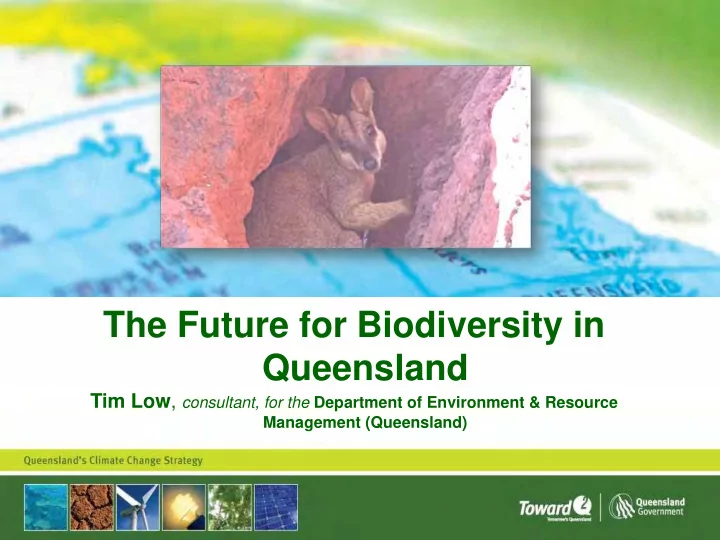
The Future for Biodiversity in Queensland

Tim Low, consultant, for the Department of Environment & Resource

Management (Queensland)
slide-2
SLIDE 2

“The rainforest trees in this study showed maximum growth at temperatures (28–30+ °C ) higher than the annual maximum temperature of their warm limit (16–31 °C … This is consistent with many tree species in the Northern Hemisphere showing their greatest growth rates at or beyond the warm limits of their distributions”

Acmena smithii

slide-3
SLIDE 3
slide-4
SLIDE 4

Onthophagus macrocephalus Nothofagus above 900 m + 1 low site

slide-5
SLIDE 5

Management Implications

Conserve upland forests on fertile soils Replant winter fruits for bowerbirds Remove competitors Manage Fraser Island as a climatic refuge Be cautious about corridors Question translocation

slide-6
SLIDE 6

Bertya sharpeana Eucalyptus pachycalyx Lindsaea repens Burmannia disticha Pseudanthus ligulatus

Climatically Incoherent Distributions

slide-7
SLIDE 7

Bertya sharpeana Atalaya collina Lophostemon confertus

slide-8
SLIDE 8

Gamba Grass Fire

Feral Goats

slide-9
SLIDE 9
slide-10
SLIDE 10

“the majority of species occupy small discrete regions defined by very narrow temperature ranges… If they are to survive they must migrate”

  • Tim Flannery, The Weather Makers

“Extensive local speciation among major tree species in Australia (ag. Acacia and Eucalyptus) reflects in situ persistence rather than widespread distribution changes”

  • Michael Dunlop and Peter Brown, CSIRO
slide-11
SLIDE 11
slide-12
SLIDE 12
slide-13
SLIDE 13

Drought near Winton, 2005

slide-14
SLIDE 14

Lophostemon confertus

slide-15
SLIDE 15

Dead Ironbarks near Aramac*

slide-16
SLIDE 16

Some Lessons learned: Northern Hemisphere paradigms reduce management options Priorities and goals should reflect Australian ecological realities Species distribution models should not replace ecological analysis Historical narratives are needed

slide-17
SLIDE 17

Report:

Queensland Climate Change & Biodiversity

Commissioned by the Department of Environment & Resource Management

Images courtesy of Bureau of Meteorology, CSIRO, Queensland Herbarium, Queensland Museum, Jon Norling, Brett Taylor