
SLIDE 1
Guidelines for Biodiversity Management Committees (BMCs)
National Biodiversity Authority
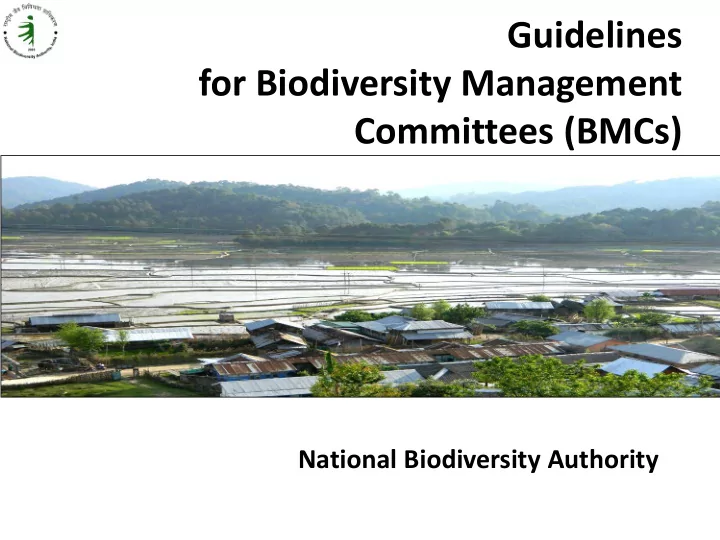
Guidelines for Biodiversity Management Committees (BMCs) National - - PowerPoint PPT Presentation
Guidelines for Biodiversity Management Committees (BMCs) National Biodiversity Authority Formation of BMC Section 41 of the Biological Diversity Act states as follows:- Every local body shall constitute a Biodiversity Management Committee
National Biodiversity Authority
follows:- Every local body shall constitute a Biodiversity Management Committee within its area for the purpose
promoting conservation, sustainable use and documentation
biological diversity including preservation of habitats, conservation of land races, folk varieties and cultivars, domesticated stocks and breeds of animals and microorganisms and chronicling
knowledge relating to biological diversity.
maintain and validate People’s Biodiversity Registers in consultation with the local people.
Authority for granting approval, to maintain data about the local vaids and practitioners using the biological resources.
person(s) accessing or collecting bioresource for commercial purpose from its territorial jurisdiction. Section 41 & Rule 22
1.Integration of BMCs to other village level committees related to natural resource management
village level committees to find representation in the BMCs
included in the BMCs
in the village/ region for conservation of local knowledge and traditions
establishment Office space to be provided by local bodies, staff of the line dept. like forest guard/gram sevak/Village agriculture officer shall be nominated to function as Secretary to the BMC.
Each BMC shall have a Technical Co-ordinator (TC) to assist the BMC in its functioning. The cost for the TC shall be borne by SBB / BMC.
The Chairperson of the BMC shall have a tenure of 3 years. The non-official members of the BMC shall have a tenure of five years
whichever is lesser
The BMCs would, in addition to the preparation of the People’s Biodiversity Register (PBR), participate in following activities: Conservation and sustainable utilization of biological resources Eco-restoration of the local biodiversity Proper feedback to the SBB in the matter of IPR, Traditional Knowledge and local Biodiversity issues, wherever feasible and essential feedback to be provided to the NBA. Management of Heritage Sites including Heritage Trees, Animals/ Micro organisms etc., and Sacred Groves and Sacred Water bodies.
5 Roles and Functions of the BMCs
Continued……….
Regulation of access to the biological resources and/ or associated Traditional Knowledge, for commercial and research purposes. Sharing of usufructs arising out of commercial use of bio- resource Conservation
traditional varieties/breeds
economically important plants/animals. Biodiversity Education and Awareness building Documentation, enable procedure to develop bio- cultural protocol.
groups comprising of officials/ institutions /people of excellence and expertise in the biodiversity issues at local level, which should guide the BMC in its operation.
authenticated and validated by the Biodiversity Management Committees with the assistance/guidance
which would be made available to the SBB.
BMCs and preparation of PBRs
validated in the People’s Biodiversity Register.
action plan.
a) conservation of the bio-resources, b) training needs identified for the personnel of the BMC and c) list of potential items for consideration for registration as Geographical Indicators (G.I).
medicinal plants associated traditional knowledge.
Levy and Benefit Sharing
and management of heritage sites, sacred groves, water bodies etc., can be done in consultation with the technical support of the SBB,
to assist BMCs.
BMC shall ensure the protection of the knowledge recorded in the People’s Biodiversity Register principally in the matters
individuals outside the village limits. Access to registers need to be recorded in writing and maintained in consultation with SBB/ Technical Support group.
(PBRs) and information therein
and meet once at least in every 3 months.
member elected by the members present.
including the chairperson and excluding official members.
shall be drawn and a copy sent to the SBB and the local body.
minutes of the meetings, maintenance of meeting registers and alike, lay down the procedures for updating the registers & record
which would facilitate Process Documentation at the BMC level.
11 Suggested format for Annual Reports
year
the year
committee
(PBR):
Continued…….
the BMC
resources and traditional knowledge by BMC
communication between BMC-SBB- NBA
12 Funding BMCs and maintenance of their accounts
designate Nodal officers for each of the districts to oversee the various matters of the BMC.
sources such as – NBA, SBB, Grants, Donations, Various line departments
State Boards, Institutions, Corporate Bodies etc.,
government may make appropriate provision in the budget for funding SBBs and provide financial support through SBBs to the BMCs.
Enabling Letter that BMC have been formed in accordance with The Biological Diversity Act,2002.
the BMC. The accounting procedures will be drawn up and format for the maintenance of the accounts will be provided by the SBB. The SBB will also draw a check list to ensure that there is proper maintenance and submission of accounts.
appropriate authority from whom they received the Fund and NBA/SBB as required.
specially appointed for the purpose and after being passed by the BMC will be given to the local body and the SBB.
Continued ………
should be trained and educated on the procedure for giving Utilization certificate (UC) and accounting procedures including preparation of Annual Report and utilization of the resources in accordance with the Action Plan drawn up by the BMC, prioritizing the conservation of the local biodiversity.
the SBB shall provide adequate fund and support staff at Nodal/district levels, to carry out the implementation of the Act, keeping in view the priorities and importance of the regional issues.
Continued ………
14 Disputes with regard to BMCs
In case any dispute arises between a BMC and another BMC or BMCs, the aggrieved BMC or BMCs, shall prefer the point or points of dispute to the State/Central Government which shall refer the same to the Authority or the SBB. Aggrieved BMCs may refer disputes to SBBs. Cases that cannot be resolved by SBB shall be referred to the State / Central
attended to by District level Nodal officers viz., Collector/CEO/DCF as per nature of the dispute and the State Government would decide the procedure.
BMC Model for NE States: There are a large number of major and sub tribes in the NE States. There are geographical and cultural variations with regard to the structure of communities in the NE States. In addition, different NE states have different levels of autonomy, which further complicate
those elected by the law. In other situations, the village council undertakes all activities related to the development in the village. The NE region can not be clubbed as a single entity. Hence a uniform model for the NE States is not possible. The NBA and SBB should allow for flexibility, to take into account local conditions, traditions and customary laws and practices. In many instances the local tradition of these states is far advanced than the rest of the country.
Continued ………
Community Conserved Areas (CCA): In many locations there are Community Conserved Areas (CCA) that offer protection to biodiversity. This is a unique feature with regard to the NE states and the BMCs of the NE states need to be supported, where they are quite advanced and already operational. Land Tenure and BMCs and importance of raising awareness about the BD Act: Land tenure with regard to cultivated and non cultivated lands in the NE states is fairly complex. For example land in the Apatani Plateau is classified into: Community lands (Common to all groups in the villages), Clan lands (Owned by members of a clan only) and Individual land (Owned by a family) apart from the Reserved Forests which is in the custody of the State. In most NE states, the area under the control of the forest department is limited. Hence the role of BMCs in Biodiversity Management in such regions will be
BMCs and Shifting Cultivation (Jhum) the BMCs may be involved in raising awareness about the loss of Biodiversity arising out of shifting cultivation.
Continued ………
Peoples’ Biodiversity Registers: Preparation of PBRs is critical given the fact that NE states are both Global Biodiversity Hotspot and very rich in traditional knowledge of
is systematic, logical and realistic. Data is collected over a period of time, cross-checked and validated before
Involvement of Research and Educational Institutions in PBR preparation and maintenance: Strengthening village communities with regard to preparation of PBRs with the help
symbiotic relationship with such institutions, the State Biodiversity Boards and the BMCs is required. In a meeting in Arunachal Pradesh, members of the Apatani communities expressed the need for a Technical Support Group (TSG) for assisting in the preparation of PBRs, and require guidelines for sustainable harvest of resources and conservation.
Continued ……