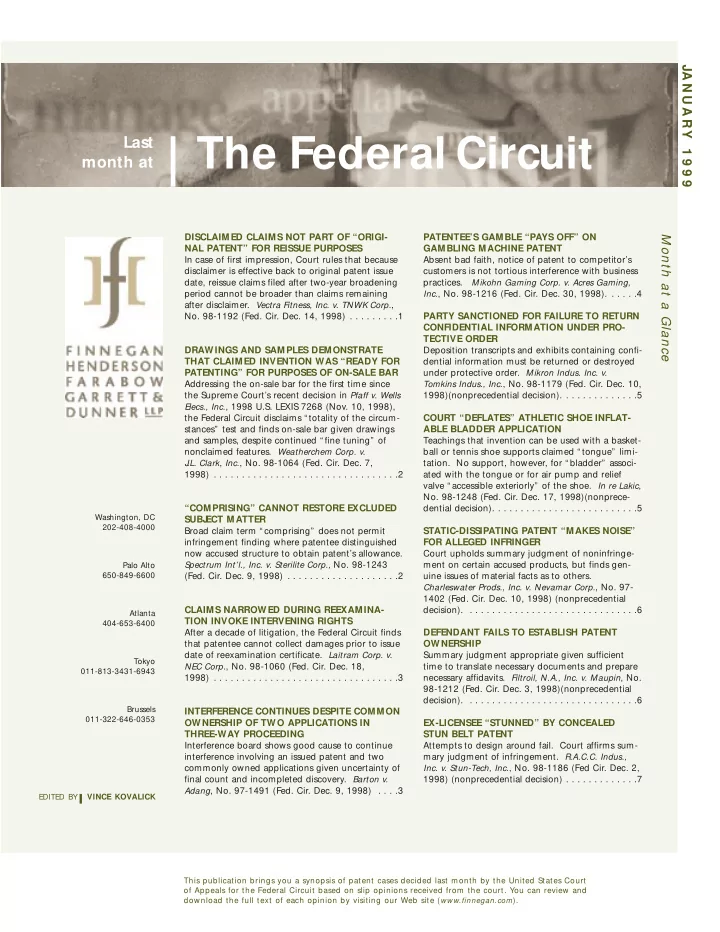
The Federal Circuit month at DISCLAIMED CLAIMS NOT PART OF ORIGI- - - PDF document

the federal circuit
SMART_READER_LITE
LIVE PREVIEW

The Federal Circuit month at DISCLAIMED CLAIMS NOT PART OF ORIGI- - - PDF document

JA N U A RY 1 9 9 9 Last The Federal Circuit month at DISCLAIMED CLAIMS NOT PART OF ORIGI- PATENTEES GAMBLE PAYS OFF ON M ont h at a Glance NAL PATENT FOR REISSUE PURPOSES GAMBLING MACHINE PATENT In case of first


slide-1
SLIDE 1

EDITED BY VINCE KOVALICK This publication brings you a synopsis of patent cases decided last month by the United States Court

  • f Appeals for the Federal Circuit based on slip opinions received from the court. You can review and

download the full text of each opinion by visiting our Web site (www.finnegan.com). Washington, DC 202-408-4000 Palo Alto 650-849-6600 Atlanta 404-653-6400 Tokyo 011-813-3431-6943 Brussels 011-322-646-0353

DISCLAIMED CLAIMS NOT PART OF “ORIGI- NAL PATENT” FOR REISSUE PURPOSES In case of first impression, Court rules that because disclaimer is effective back to original patent issue date, reissue claims filed after two-year broadening period cannot be broader than claims remaining after disclaimer. Vectra Fitness, Inc. v. TNWK Corp.,

  • No. 98-1192 (Fed. Cir. Dec. 14, 1998) . . . . . . . . .1

DRAWINGS AND SAMPLES DEMONSTRATE THAT CLAIMED INVENTION WAS “READY FOR PATENTING” FOR PURPOSES OF ON-SALE BAR Addressing the on-sale bar for the first time since the Supreme Court’s recent decision in Pfaff v. Wells

E lecs., Inc., 1998 U.S. LEXIS 7268 (Nov. 10, 1998), the Federal Circuit disclaims “ totality of the circum- stances” test and finds on-sale bar given drawings and samples, despite continued “ fine tuning” of nonclaimed features. Weatherchem Corp. v. J .L. Clark, Inc., No. 98-1064 (Fed. Cir. Dec. 7, 1998) . . . . . . . . . . . . . . . . . . . . . . . . . . . . . . . . .2

“COMPRISING” CANNOT RESTORE EXCLUDED SUBJ ECT MATTER Broad claim term “ comprising” does not permit infringement finding where patentee distinguished now accused structure to obtain patent’s allowance.

Spectrum Int’l., Inc. v. Sterilite Corp., No. 98-1243 (Fed. Cir. Dec. 9, 1998) . . . . . . . . . . . . . . . . . . . .2

CLAIMS NARROWED DURING REEXAMINA- TION INVOKE INTERVENING RIGHTS After a decade of litigation, the Federal Circuit finds that patentee cannot collect damages prior to issue date of reexamination certificate. Laitram Corp. v.

NE C Corp., No. 98-1060 (Fed. Cir. Dec. 18, 1998) . . . . . . . . . . . . . . . . . . . . . . . . . . . . . . . . .3

INTERFERENCE CONTINUES DESPITE COMMON OWNERSHIP OF TWO APPLICATIONS IN THREE-WAY PROCEEDING Interference board shows good cause to continue interference involving an issued patent and two commonly owned applications given uncertainty of final count and incompleted discovery. Barton v.

Adang, No. 97-1491 (Fed. Cir. Dec. 9, 1998) . . . .3

PATENTEE’S GAMBLE “PAYS OFF” ON GAMBLING MACHINE PATENT Absent bad faith, notice of patent to competitor’s customers is not tortious interference with business

  • practices. Mikohn Gaming Corp. v. Acres Gaming,

Inc., No. 98-1216 (Fed. Cir. Dec. 30, 1998). . . . . .4

PARTY SANCTIONED FOR FAILURE TO RETURN CONFIDENTIAL INFORMATION UNDER PRO- TECTIVE ORDER Deposition transcripts and exhibits containing confi- dential information must be returned or destroyed under protective order. Mikron Indus. Inc. v.

Tomkins Indus., Inc., No. 98-1179 (Fed. Cir. Dec. 10, 1998)(nonprecedential decision). . . . . . . . . . . . . .5

COURT “DEFLATES” ATHLETIC SHOE INFLAT- ABLE BLADDER APPLICATION Teachings that invention can be used with a basket- ball or tennis shoe supports claimed “ tongue” limi-

  • tation. No support, however, for “ bladder” associ-

ated with the tongue or for air pump and relief valve “ accessible exteriorly” of the shoe. In re Lakic,

  • No. 98-1248 (Fed. Cir. Dec. 17, 1998)(nonprece-

dential decision). . . . . . . . . . . . . . . . . . . . . . . . . .5 STATIC-DISSIPATING PATENT “MAKES NOISE” FOR ALLEGED INFRINGER Court upholds summary judgment of noninfringe- ment on certain accused products, but finds gen- uine issues of material facts as to others. Charleswater Prods., Inc. v. Nevamar Corp., No. 97- 1402 (Fed. Cir. Dec. 10, 1998) (nonprecedential decision). . . . . . . . . . . . . . . . . . . . . . . . . . . . . . .6 DEFENDANT FAILS TO ESTABLISH PATENT OW NERSHIP Summary judgment appropriate given sufficient time to translate necessary documents and prepare necessary affidavits. Filtroil, N.A., Inc. v. Maupin, No. 98-1212 (Fed. Cir. Dec. 3, 1998)(nonprecedential decision). . . . . . . . . . . . . . . . . . . . . . . . . . . . . . .6 EX-LICENSEE “STUNNED” BY CONCEALED STUN BELT PATENT Attempts to design around fail. Court affirms sum- mary judgment of infringement. R.A.C.C. Indus.,

  • Inc. v. Stun-Tech, Inc., No. 98-1186 (Fed Cir. Dec. 2,

1998) (nonprecedential decision) . . . . . . . . . . . . .7

JA N U A RY 1 9 9 9

The Federal Circuit

Last month at

M ont h at a Glance

slide-2
SLIDE 2

Disclaimed Claims Not Part of “Original Patent” for Reissue Purposes

J acqueline D. Wright

[J udges: Schall (author), Plager, and Rader]

The central issue in Vectra Fitness, Inc. v. TNWK Corp.,

  • No. 98-1192 (Fed. Cir. Dec. 14, 1998), concerned

whether a reissue application filed more than two years after the grant of the original patent is bounded by the claims originally contained in the patent or by the claims remaining in the patent after a disclaimer has been filed. The claims at issue were narrower than claims contained in the original patent, but broader than claims remaining in the patent after a disclaimer had been filed. The Federal Circuit, addressing the issue for the first time, ruled that because the dis- claimer was effective back to the original patent issue date such that the disclaimed claims were not part of the original patent, the reissue claims improperly broadened the scope of the patent. On March 7, 1989, U.S. Patent No. 4,809,972 (“ the ‘972 patent” ) issued to Vectra Fitness, Inc. (“ Vectra” ). The ‘972 patent covered multistation exercise machines that allowed multiple exercise stations to be connected to a single weight stack. On February 16, 1990, Vectra submitted a disclaimer to the U.S. Patent and Trademark Office (“ PTO” ) after learning of prior art that invalidated eight original claims. The dis- claimer was mishandled by the PTO. Although the disclaimer had been added to the file wrapper of the ‘972 patent, it was not entered on either the cover page or the contents page of the wrapper, nor was it published in the Official Gazette. On May 9, 1991, more than two years after the ‘972 patent issued, Vectra filed a reissue application that sought to add three new claims (claims 28-30). The three claims were narrower in scope than the claims originally contained in the ‘972 patent, but broader in scope than the claims remaining in the patent after the 1990 disclaimer. The reissue applica- tion, including the three new claims, issued as U.S. Patent No. Re. 34,572 (“ the ‘572 patent” ). After Vectra sued TNWK for infringement of the ‘572 patent, the district court granted TNWK’s partial summary judgment (“ SJ ” ) motion, holding claims 28-30 invalid because the claims impermissibly enlarged the scope

  • f the ‘972 patent more than two years after the date
  • f its original issue.

On appeal, the Federal Circuit first addressed Vectra’s argument that the mishandling of the dis- claimer by the PTO had prevented it from being “ recorded,” as required under 35 U.S.C. § 253. The Federal Circuit explained that recording a disclaimer is not dependent on the actions taken by the PTO. Rather, to be “ recorded” by the PTO, a disclaimer must: (1) be signed by the patentee, or attorney, or agent of record; (2) identify the patent and complete claim or claims, or term being disclaimed; (3) state the present extent of patentee’s ownership interest in the patent; and (4) be accompanied by a fee. 37 C.F .R. § 1.32(a)(1997). Since Vectra’s disclaimer had been received by the PTO in the proper form and with the appropriate filing fee, the disclaimer was “ recorded” regardless of its handling by the PTO. The Federal Circuit then turned to the issue of whether the patent had been broadened. The Court noted that since claims 28-30 were broader than the claims remaining after the disclaimer, but narrower than the disclaimed claims, the validity of claims 28-30 depended upon whether or not the disclaimed claims were considered part of the “ original patent” under 35 U.S.C. § 251. Vectra argued that the plain meaning of the term “ claims of the original patent” in § 251 refers to the claims contained in the patent when it reissued, that the reissued patent was unaffected by any disclaimer pursuant to § 253, and that § 253 has nothing to do with the interpretation of the term “ original patent” in § 251. In other words, Vectra argued that the “ origi- nal patent” excludes the disclaimed claims under § 253, but includes the disclaimed claims for purposes of § 251. The Federal Circuit concluded that Vectra’s reading

  • f §§ 251 and 253 was contrary to the plain language
  • f the statute and pertinent case law. The Court stat-

ed that it cannot be presumed that the term “ original patent,” used in both §§ 251 and 253, has two differ- ent meanings in those closely related statutes. The Federal Circuit also explained that the public is entitled to rely upon the public record of a patent in determin- ing the scope of the patent’s claims. Similarly, after the two-year window for broadening claims by reissue has passed, the public should be able to rely on the scope of the nondisclaimed claims. Under the approach urged by Vectra, the Court feared, a patent- ee would be able to reclaim through reissue previously disclaimed subject matter at any time during the term

  • f the patent.

The Federal Circuit concluded that when Vectra had disclaimed the broadest claims in the ‘972 patent by invoking § 253, it effectively eliminated those claims from the original patent for purposes of both §§ 253 and 251. Likewise, any reissue application that enlarged the scope of the nondisclaimed claims must have been applied for within two years of the grant of the original patent. Since claims 28-30 of Vectra’s reis- sue application (which were broader in scope than the claims remaining in the original ‘972 patent after the disclaimer) were sought more than two years after the grant of the original ‘972 patent, the Federal Circuit affirmed the district court’s partial SJ invalidating those claims.

page 01 L A ST M O N T H A T

T H E F E D E R A L C I R C U I T

FI N N EG A N H EN D ERSO N FA RA B O W G A RRET T D U N N ER L L P.

slide-3
SLIDE 3

1 9 9 9 JA N U A RY

02 page

FI N N EG A N H EN D ERSO N FA RA B O W G A RRET T D U N N ER L L P.

Drawings and Samples Demonstrate That Claimed Invention Was “Ready for Patenting” for Purposes of On- Sale Bar

[J udges: Rader (author), M ayer, and M ichel] The Federal Circuit, in Weatherchem Corp. v.

J .L. Clark, Inc., No. 98-1064 (Fed. Cir. Dec. 7, 1998), affirmed a district court’s decision holding certain patent claims invalid because the claimed invention was on sale more than one year prior to the filing date

  • f the patent application. This case involved the

Federal Circuit’s first encounter with the on-sale bar since the Supreme Court’s recent decision in Pfaff v. Wells E

  • lec. Inc., 1998 U.S. LEXIS 7268 (Nov. 10, 1998).

The Federal Circuit abandoned the “ totality of the cir- cumstances” test and applied the Supreme Court’s two-step analysis, requiring: (1) a commercial sale or

  • ffer for sale, and (2) an invention that is ready for

patenting at the time of the sale or offer for sale. Weatherchem, assignee of U.S. Patent Nos. 4,693,399 (“ the ‘399 patent” ) and 4,936,494 (“ the ‘494 patent” ), filed a patent infringement action against J .L. Clark, Inc. (“ Clark” ) asserting infringement

  • f certain claims of both patents. The ‘399 patent and

the ‘494 patent are directed to two-flap, shake-and- spoon plastic caps that fit on containers for spices and

  • ther condiments. The ‘399 patent explains that prior

art shake-and-spoon plastic caps often become disfig- ured in the molding process, taking on an oval shape that does not achieve a good seal with the mouth of the container, and discloses an annular sealing ledge to overcome this problem. In early 1985, Weatherchem began work on a cap design for Durkee Foods. On February 8, 1985, Weatherchem produced a drawing of the cap, which as admitted by one of the ‘399 patent coinventors showed all claimed features of the ‘399 patent claims. On February 19, 1985, Durkee issued a purchase order for 500 sample caps per the February 8, 1985 draw-

  • ing. Weatherchem accepted the purchase order on

May 13, 1985, and later provided the sample caps to

  • Durkee. Durkee evaluated the sample caps and noti-

fied Weatherchem that the “ ovality of the bottom edge of the cap skirt” was unacceptable. In a reply dated August 23, 1985, Weatherchem disclosed plans to modify its mold design to cure the “ ovality” prob-

  • lem. On September 13, 1985, Durkee issued a second

purchase order for 275,000 caps in accordance with the revisions enumerated in the August 23, 1985 let-

  • ter. Thereafter, Weatherchem continued to “ work out

some ‘kinks’ in the cap mold.” Weatherchem, slip op. at 7. In J anuary 1986, Weatherchem began mass pro- duction of caps for Durkee. After a bench trial, the district court held the assert- ed claims of the ‘399 patent invalid because the inven- tion had been on sale prior to the “ critical date.” The patent application, which resulted in the ‘399 patent, had been filed on October 17, 1986, making October 17, 1986 the “ critical date” for purposes of 35 U.S.C. § 102(b). In addition, the district court held the asserted claims of the ‘494 patent invalid for obvious- ness over the ‘399 patent in combination with a cap used by the Rosam Spice Company to seal glass spice containers (“ the Rosam II cap” ). Turning first to the on-sale bar issue, the Federal Circuit abandoned the multifactor “ totality of the cir- cumstances” analysis of the on-sale bar in favor of the two-part test announced in Pfaff. With respect to the first part of the on-sale bar test, the Court affirmed the district court’s finding that an actual sale occurred prior to the critical date. The only question then, the Court continued, was whether the invention was ready for patenting at the time of the premature sale. Answering the second question affirmatively, the Court found no clear error in the district court’s find- ings that: (1) the prematurely sold caps included each limitation of the asserted claims, and (2) the February 8, 1985 drawing disclosed each limitation of the asserted claims. Based on these findings, the Court concluded that the invention was ready for patenting at the time of the offers and sales, even though Weatherchem continued to “ fine-tune” features not recited in the asserted claims. The Court noted two additional facts demonstrating that the invention was ready for patenting. First, as in Pfaff, the manufacturer was able to produce the caps based on the February 8, 1985 drawing. Second, Durkee had ordered a large quantity of caps (275,000) prior to the critical date, showing that it was satisfied that the invention was complete despite any ovality problems. Turning to the ‘494 patent, the Federal Circuit affirmed the district court’s holding that the asserted claims would have been obvious to one of ordinary skill in the art over the ‘399 patent and the Rosam II

  • cap. Citing Graham v. J
  • hn Deere Co., 383 U.S. 1, 17-

18 (1966), the Court analyzed the district court’s fac- tual findings underlying the obviousness determina-

  • tion. The only claimed feature not disclosed in the

‘399 patent involved a “ radial rib” to stiffen the cap. The Court found this feature in the Rosam II cap. Finding no clear error in the district court’s findings under the Graham factors, the Court held that the dis- trict court had not erred in determining that the claims would have been obvious based on the ‘399 patent and the Rosam II cap.

“Comprising” Cannot Restore Excluded Subject Matter

E sther H. Lim

[J udges: Clevenger (author), Schall, and Bryson] In Spectrum International, Inc. v. Sterilite Corp., No. 98-1243 (Fed. Cir. Dec. 9, 1998), the Federal Circuit affirmed the district court’s grant of summary judg- ment of noninfringement in favor of Sterilite Corporation (“ Sterilite” ), based on different grounds than the district court, ruling that prosecution history precluded a finding of infringement as a matter of law.

slide-4
SLIDE 4

Spectrum International, Inc.’s (“ Spectrum” ) reexam- ined U.S. Patent No. 4,971,202 relates to stackable recycling crates with four walls and a bottom. The critical claim limitation at issue requires that the bot- tom side of the crate merge with at least a substantial portion of the bottom edge of the central portion of the crate’s front wall. During reexamination, the U.S. Patent and Trademark Office (“ PTO” ) had sustained the patentability of the asserted claims based on Spectrum’s argument that a prior art crate’s bottom side merges with the top edge of the central portion of the front wall, but not the bottom edge. The district court found that Sterilite’s accused prod- uct did not have a front wall. In doing so, the district court relied on the ordinary meaning of the claim term “ wall” because Spectrum had not provided any special definition of that term. The Federal Circuit affirmed, but for other reasons. In particular, for literal infringe- ment, the Court found that the merger of the accused crate’s bottom side and its front wall occurs at the top, not the bottom, of the central portion, in direct con- travention of the claim requirements. The Court also agreed that Spectrum had explicitly relinquished dur- ing reexamination the very embodiment it alleged to

  • infringe. Noting that the doctrine of prosecution his-

tory estoppel applies with equal force during reexami- nation, the Federal Circuit found that the doctrine pre- cluded a finding of infringement under the doctrine of equivalents. In affirming the judgment, the Federal Circuit reject- ed Spectrum’s argument that Moleculon Research Corp.

  • v. CBS, Inc., 793 F

.2d 1261, 1271 (Fed. Cir. 1986) sup- ported its attempt to encompass additional, unrecited elements in the accused crate through the claim term “ comprising.” The Court clarified, instead, that Moleculon limited the broad scope of the transitional term “ comprising” to avoid altering the scope of a claim, and ruled that the term “ comprising” cannot restore excluded subject matter. The Court further rejected Spectrum’s argument that nothing of record imposed physical dimensions on the claim term “ wall” so as to exclude crates in which the bottom side merges with both the bottom and the top of the front wall’s central portion, like in the accused product. Spectrum, according to the Court, had expressly dis- tinguished this configuration from its invention during prosecution.

Claims Narrowed During Reexamination Invoke Intervening Rights

Vince Kovalick

[J udges: Lourie (author), Newman, and M ichel] In Laitram Corp. v. NE

C Corp., No. 98-1060 (Fed. Cir.

  • Dec. 18, 1998), the Federal Circuit reversed a district

court ruling concerning the “ identicality” of reexam- ined claims. In particular, the Federal Circuit found that during reexamination, the claims were substan- tively changed by amendment; therefore, the Laitram

  • Corp. (“ Laitram” ) was not entitled to infringement

damages prior to the issuance of the reexamination certificate. This decision was the fourth decision by the Federal Circuit concerning litigation between the parties span- ning the last decade. The patented invention con- cerns a high speed electro-optical printing apparatus

  • f the type employing radiation-sensitive image-

recording media to produce records of information as type characters and/or in graphic form. During a reex- amination proceeding, Laitram gained allowance of its claims by incorporating speed, type-quality, and direc- tion of movement limitations into the original claims. Once the district court finally got to the “ claim identi- cality” issue, it found that the original claims implicitly included these speed, type-quality, and direction of movement limitations. Thus, the amended claims were identical in scope to the original claims, such that intervening rights did not apply. The Federal Circuit disagreed, finding that Laitram had substantively changed the claims to obtain their

  • allowance. The Federal Circuit ruled that the original

claims appeared to cover a printer or method of print- ing that generates any quality of alphanumeric charac- ters, while the amended claims seemed to cover only a printing apparatus or method of printing that gener- ates “ type-quality” alphanumeric characters. The Court found it “ most significant” and “ highly influen- tial” that this “ type-quality” limitation had been added by amendment and resulted in the allowance of the

  • claims. The Federal Circuit refused to read the “ type-

quality” limitation into the original claims, finding that doing so improperly read limitations from the pre- ferred embodiment into the claims. Because of this

  • ne substantive change, the Federal Circuit ruled that

the district court had erred in concluding that the amended claims were identical to the original claims. Accordingly, the Federal Circuit ruled that the reex- amined claims had been narrowed, such that interven- ing rights applied, and Laitram was not entitled to infringement damages prior to the issuance of the reexamination certificate.

Interference Continues Despite Common Ownership of Two Applications in Three-Way Proceeding

E lizabeth A. Hurley

[J udges: Rich (author), Rader, and Gajarsa] In Barton v. Adang, No. 97-1491 (Fed. Cir. Dec. 9, 1998), the Federal Circuit reversed a ruling of the Board of Patent Appeals and Interferences (“ Board” ), and found that good cause had been shown under 37 C.F .R. § 1.602(a) to continue an interference involving an issued patent and two applications as a three-way

page 03 L A ST M O N T H A T

T H E F E D E R A L C I R C U I T

FI N N EG A N H EN D ERSO N FA RA B O W G A RRET T D U N N ER L L P.

slide-5
SLIDE 5

1 9 9 9 JA N U A RY

04 page

FI N N EG A N H EN D ERSO N FA RA B O W G A RRET T D U N N ER L L P.

proceeding, even though the two applications had become commonly owned. The interference involved pending applications to junior parties Kenneth A. Barton and David A. Fischhoff et al., and an issued patent to senior party Michael J . Adang et al. The single count of the interference defined a method of modifying an insect-resistance gene so that the modified gene was expressed at a high level when introduced into plants to confer resist- ance to insects. Shortly after the interference had been declared, Monsanto, the owner of the Fischhoff application, bought the company that owned the Barton application. Monsanto filed a notification of

  • wnership of both the Fischhoff and Barton applica-

tions, and stated in the notification that the interfer- ence should be continued as a three-way proceeding under 37 C.F .R. § 1.602(a), which requires a showing

  • f “ good cause” to continue an interference between

applications owned by a single party, or applications and a patent owned by a single party. Monsanto argued that good cause had been shown, because the precise content of the count in an interfer- ence is subject to change following preliminary motions, which were not yet due. In addition, the legal uncertainties involved in determining priority for biotechnology inventions, where the rule of “ simulta- neous conception and reduction to practice” might be applied, made it impossible for Monsanto to choose the best application with which to defend the interfer-

  • ence. Adang argued that Monsanto had failed to

show good cause, because the interests of the two jun- ior parties were no longer adverse, and Monsanto had all the information necessary to make an informed decision of priority between its two applications. The Board found that Monsanto had not shown good cause why the interference should be continued as a three-way proceeding, because no showing had been made that the count needed to be modified, or that there were separately patentable inventions involved in either application. Monsanto therefore elected to proceed with the Fischhoff application, and petitioned the Commissioner of the Patent and Trademark Office (“ Commissioner” ) for review of the Board’s order under 37 C.F .R. § 1.644(a)(1) and (3), again asserting the indefiniteness of the count, and the uncertainty concerning the applicable legal standard for priority determinations in biotechnology cases. The petition was denied on the ground that even if Monsanto had been correct that the count was indefi- nite, that fact would not constitute good cause under 37 C.F .R. § 1.602(a), since Monsanto only had to com- pare the inventions disclosed in its own applications to decide which one had priority. Monsanto’s motion to have judgment entered against Barton immediately was granted by the Board, and Monsanto appealed. The Federal Circuit rejected Monsanto’s argument that the plain meaning of 37 C.F .R. § 1.602(a) does not support a requirement that Monsanto choose between its applications, because the regulation does not clearly address the situation where some, but not all, of the applications in an interference are common- ly owned. The Court found that the Commissioner’s decision that § 1.602(a) applies to a multiparty inter- ference where all of the applications or patents are not commonly owned, and requiring election between the commonly owned applications or patents, was not clearly erroneous or inconsistent with the language of the regulation. However, the Court held that Monsanto had shown good cause to continue the interference as a three-way

  • proceeding. The Court noted that the Commissioner

has generally declined to find good cause to continue an interference when two applications or patents become commonly owned, except where information necessary to determine priority was unavailable to the common owner. Although Monsanto had not alleged that any information necessary to a priority determina- tion was unavailable, Monsanto was forced to choose between its applications shortly after the interference had begun, and prior to a decision on the preliminary motions and the completion of discovery. Both Adang and Fischhoff had filed preliminary motions to substi- tute a different count. Thus, it was not yet clear what the content of the final count would be, or what proofs on dates of conception and reduction to prac- tice Adang would seek to establish. Moreover, if the final count excluded subject matter disclosed in Barton but not Fischhoff, Monsanto might lose patentable subject matter by early dismissal of Barton. Therefore, the Court held that Monsanto had shown good cause to continue the interference as a three-way proceeding until the preliminary motions to finalize the count were decided and discovery was complete.

Patentee’s Gamble “Pays Off” on Gambling Machine Patent

Vince Kovalick

[J udges: Newman (author), Rader, and Bryson] In Mikohn Gaming Corp. v. Acres Gaming, Inc., No. 98-1216 (Fed. Cir. Dec. 30, 1998), the Federal Circuit vacated a preliminary injunction prohibiting Acres Gaming, Inc. (“ Acres” ) from stating to customers and prospective customers of Mikohn Gaming Corp. (“ Mikohn” ) that Mikohn’s accused systems appeared to infringe Acres’s patent. Acres owns U.S. Patent No. 5,655,961 (“ the ‘961 patent” ) concerning a method for operating net- worked gaming devices. Mikohn sells a gaming sys- tem called the “ MoneyTime” system which Acres allegedly infringes. Acres sent a letter to several of Mikohn’s customers and potential customers stating: It appears that the MoneyTime system manufactured and sold by Mikohn Corp. infringes at least some of the claims of the enclosed patent, although this cannot be determined conclusively without a better understanding of the structure and operation

  • f the MoneyTime system.
slide-6
SLIDE 6

There are a number of pending US appli- cations owned by Acres Gaming which have the same disclosure as the ‘961 patent. . . . Y

  • u should be aware that when these

patents issue, Acres Gaming intends to use its patents to stop use of such systems. The district court granted Mikohn’s request to enjoin Acres after Mikohn had charged Acres with intentional interference with existing and potential business relationships. The Federal Circuit, applying Federal Circuit law, ruled that the communications were not improper because Acres had a good faith belief in the accuracy

  • f the information communicated. The Court stated

that in general, “ a threshold showing of incorrectness

  • r falsity, or disregard for either, is required in order to

find bad faith in the communication of information about the existence or pendency of patent rights.” Mikohn Gaming, slip op. at 11. Because no showing of bad faith had been found, the Federal Circuit ruled that Mikohn’s likelihood of success was negligible and vacated the preliminary injunction.

Party Sanctioned for Failure to Return Confidential Information Under Protective Order

Kenneth M. Lesch

[J udges: M ichel (author), Plager, and Lourie]

In Mikron Industries Inc. v. Tomkins Industries, Inc.,

  • No. 98-1179 (Fed. Cir. Dec. 10, 1998)(nonpreceden-

tial decision), the Federal Circuit affirmed a contempt

  • rder against VEKA Inc., Cohen & Grigsby P

.C., and Robert W. Doty (collectively, “ VEKA” ) for violating a protective order in the underlying patent litigation by refusing to return or destroy materials obtained in dis- covery, including deposition transcripts. On appeal, VEKA argued that issuing the con- tempt order was an abuse of discretion because the scope of the underlying protective order was unclear and ambiguous. The protective order stated that “ protected material,” which was defined to include deposition testimony and transcripts, must either be returned to the party that “ produced” it or be

  • destroyed. VEKA contended that it did not have to

return or destroy deposition transcripts and exhibits because they had not been “ produced” by a party, and thus the protective order was at least ambiguous. The Federal Circuit rejected VEKA’s argument, finding the language of the protective order clear. The Court concluded that such a narrow and literal interpretation

  • f the term “ produced” would be at odds with the

purpose of the protective order and would result in inconsistent results with other provisions in the protec- tive order. The Federal Circuit also rejected VEKA’s argument that a settlement agreement superseded the protective

  • rder. Instead, the Court found that the order was

incorporated by reference into the settlement agree-

  • ment. Further, the Court rejected VEKA’s argument

that retaining the protected materials was a de minimis violation of the protective order, because VEKA only had sought to retain the materials ostensibly for use in unspecified future litigation. Finally, the Court rejected VEKA’s argument that the contempt order violated public policy because it supported the destruction of evidence, noting that the order only required the return or destruction of the copies of documents that VEKA had retained.

Court “Deflates” Athletic Shoe Inflatable Bladder Application

Lawrence F . Galvin

[J udges: M ayer, Archer, and Clevenger (per curi- am)] In In re Lakic, No. 98-1248 (Fed. Cir. Dec. 17, 1998)(nonprecedential decision), the Federal Circuit affirmed a decision of the U.S. Patent and Trademark Office Board of Patent Appeals and Interferences (“ Board” ), which had rejected certain claims of Nikola Lakic’s application directed to athletic shoes with inflat- able bladders for failure to comply with the written description requirement and as being obvious. Regarding the written description requirement, the claims at issue recited an athletic shoe tongue, an inflatable bladder associated with the tongue, and both an air pump and relief valve accessible from the shoe’s exterior. The Board had found these elements missing from the specification. The Federal Circuit found adequate reference to the claimed tongue by the specification’s teachings that the invention could be used with basketball or tennis shoes, both of which include tongues. The Court found no support, however, for the other claimed elements. Thus, the Federal Circuit affirmed the § 112 rejections. Regarding obviousness, the Board had found the claims unpatentable based on a combination of several

  • references. Lakic argued that no motivation existed in

those references to combine them in the manner recit- ed in his claims, and that some of those references actually taught away from their mutual combination. The Court disagreed, finding fault with the latter premise and finding motivation to combine references based on the need to improve comfort, as taught by

  • ne of the references. Thus, the Federal Circuit

affirmed the § 103 rejections.

page 05 L A ST M O N T H A T

T H E F E D E R A L C I R C U I T

FI N N EG A N H EN D ERSO N FA RA B O W G A RRET T D U N N ER L L P.

slide-7
SLIDE 7

1 9 9 9 JA N U A RY

06 page

FI N N EG A N H EN D ERSO N FA RA B O W G A RRET T D U N N ER L L P.

Static-Dissipating Patent “Makes Noise” for Alleged Infringer

Margo A. Bagley

[J udges: Rich (author), Newman, and Lourie] In Charleswater Products, Inc. v. Nevamar Corp.,

  • No. 97-1402 (Fed. Cir. Dec. 10, 1998) (nonpreceden-

tial decision), the Federal Circuit affirmed a district court’s decision granting summary judgment (“ SJ ” ) of noninfringement of U.S. Patent No. 4,301,040 (“ the ‘040 patent” ) as to certain accused Nevamar products, but reversed SJ

  • f noninfringement as to other accused

products. Nevamar brought a declaratory judgment action against Charleswater Products, Inc. (“ Charleswater” ) contending that Nevamar Corp.’s (“ Nevamar” ) static- dissipating products did not infringe the ‘040 patent. Charleswater counterclaimed that Nevamar’s products

  • infringed. Claim 1 of the ‘040 patent defines a static-

dissipating, synthetic, surface-covering sheet material including an electrically nonconducting, synthetic sheet laminate material, an electrically conductive layer

  • f a polymeric film-forming particulate binder material

secured to the bottom surface of the synthetic sheet material, and a uniformly dispersed static-reducing amount of electrically conductive particulate material. On appeal, Charleswater first asserted that an affi- davit by the named inventor of the ‘040 patent alleg- ing that a Nevamar chemist had admitted that certain Nevamar products infringed the ‘040 patent created a genuine issue of material fact precluding a SJ

  • f nonin-
  • fringement. The Federal Circuit disagreed, affirming

the district court’s determination that, under Fed. R.

  • Evid. 403, the alleged admission would be inadmissible

at trial and thus could not be properly considered on a motion for SJ . On the issue of infringement, the Federal Circuit construed claim 1 of the ‘040 patent de novo and found the district court’s analysis flawed for three rea-

  • sons. According to the Federal Circuit, the district

court incorrectly construed the “ secured to the bottom surface of the synthetic sheet material” limitation to

  • nly read on a product where the electrically conduc-

tive layer is at the bottom of the finished material. The Federal Circuit likewise held that the district court incorrectly construed the “ uniformly dispersed static- reducing amount of electrically conductive particulate material” and “ polymeric film-forming particulate binder material” limitations. Properly construed, the Court concluded, these limitations read on the accused products. The Federal Circuit agreed, however, with the dis- trict court’s construction of the “ electrically conductive layer” limitation. Using a definition of “ non-conduc- tive” provided by the Federal Circuit in a prior case involving the ‘040 patent, the district court concluded that the “ electrically conductive” limitation did not read on accused Nevamar products in which the alleged conductive layer comprised a melamine resin either literally or under the doctrine of equivalents. However, the Federal Circuit found a genuine issue of material fact as to whether the limitation read on accused Nevamar products in which the alleged con- ductive layer comprised a phenolic resin. Consequently, based on its de novo claim construction, the Federal Circuit upheld the grant of SJ as to Nevamar’s accused melamine resin-containing prod- ucts, but reversed and remanded the grant of SJ as to Nevamar’s accused phenolic resin-containing products.

Defendant Fails to Establish Patent Ownership

J eremy M. Stipkala

[J udges: Bryson (author), Newman, and Plager] The Federal Circuit, in Filtroil, N.A., Inc. v. Maupin,

  • No. 98-1212 (Fed. Cir. Dec. 3, 1998)(nonprecedential

decision), affirmed a district court’s summary judg- ment (“ SJ ” ) that Maupin and Driveline Specialty, Inc. (collectively “ Driveline” ) failed to show adequate proof

  • f title to U.S. Patent No. 4,935,135 (“ the ‘135

patent” ). The Federal Circuit vacated the lower court’s holding that the ‘135 patent was invalid and unen- forceable because no party in the litigation was found to hold title, but upheld a permanent injunction bar- ring Driveline from asserting rights under the ‘135 patent. Alflow Co. Ltd. (“ Alflow” ) entered into an agree- ment with Filtroil, N.A., Inc. (“ Filtroil” ) to manufacture certain oil filters in J apan and supply them to Filtroil in the United States. Alflow later applied for a U.S. patent in the name of Alflow’s president, Mr. Y azura Nakashima, and Mr. Kiyomi Y amamoto, both of whom assigned their rights to Alflow. Alflow then entered into bankruptcy. After issuance, Alflow offered to sell the ‘135 patent to Filtroil, but Filtroil declined. Maupin, then a Filtroil employee, wrote to Nakashima and a Mr. Robert Iki, who acted as a liaison between Filtroil and Alflow, offering to purchase the ‘135

  • patent. In his letter, Maupin represented that Filtroil

had consented to Maupin’s purchase of the ‘135 patent. After making payments for the ‘135 patent, Maupin resigned from Filtroil and sought to enforce the ‘135 patent against his former employer. Filtroil sued for a preliminary injunction barring Driveline from asserting rights under the ‘135 patent, and Driveline counterclaimed for infringement damages or royalties under the previous license. The district court granted SJ in favor of Filtroil, on the grounds that the ‘135 patent was (1) invalid, (2) unenforceable, and (3) not owned by Driveline. The district court had found that the transaction for the ‘135 patent was void, because neither Nakashima nor Iki had authority to convey rights to the ‘135 patent at the time of Maupin’s transaction. Driveline argued that Nakashima could provide evidence at trial proving that Driveline did have rights

slide-8
SLIDE 8

to the ‘135 patent. The Federal Circuit found, howev- er, that Driveline had had ample time during discovery to provide the necessary translated corporate records and affidavit testimony to oppose SJ . Because Driveline had failed to demonstrate a genuine issue of material fact with respect to its ownership of the ‘135 patent, the Court affirmed SJ

  • n this ground.

The Court vacated SJ , however, with respect to findings of invalidity and unenforceability of the ‘135 patent, because none of the parties held title. Driveline also appealed the magistrate judge’s denial of a motion for his recusal. Although, the Federal Circuit found unfortunate certain references made by the magistrate judge, it held that no reason- able person would conclude that the magistrate judge’s decision on the merits had been based on fac- tors other than those presented in the matter.

Ex-Licensee “Stunned” by Concealed Stun Belt Patent

Leslie F . Bessenger

[J udges: Rader (author), Rich, and Schall] In R.A.C.C. Industries, Inc. v. Stun-Tech, Inc., No. 98-1186 (Fed. Cir. Dec. 2, 1998) (nonprecedential decision), the Federal Circuit affirmed a district court’s grant of summary judgment (“ SJ ” ) to R.A.C.C. Industries, Inc. (“ RACC” ), finding claims 1 and 4 of U.S. Patent No. 4,943,885 (“ the ‘885 patent” ) infringed by Stun-Tech, Inc.’s (“ Stun-Tech” ) remotely activated stun belts for restraining prisoners. The claims at issue concern an apparatus for con- trolling a dangerous prisoner while concealing the nature of such apparatus from public view. The appa- ratus in both asserted claims is a remotely activated device capable of stunning the prisoner with an elec- tric shock. The claims also require that the apparatus be concealable beneath clothing or adapted for con- cealment so that the prisoner is not marked by

  • bservers as being under restraint.

RACC had licensed Stun-Tech as the exclusive licensee of stun belts covered by the ‘885 patent. After attempting to design around the ‘885 patent, Stun-Tech ceased payments under the license. Soon thereafter, RACC terminated the license and brought suit, alleging infringement of its ‘885 patent by Stun- Tech. After losing on SJ at the district court, Stun-Tech appealed on two claim construction issues. First, Stun- Tech argued that the claims at issue (both apparatus claims) should be construed as hybrid apparatus and method of use claims. Stun-Tech further argued that the claims at issue, when construed in this manner, cannot be infringed unless the accused device is used according to the method of use limitations in the

  • claims. The Federal Circuit disagreed, stating that it

has never determined that functional language in a claim converts an apparatus claim into a method of use or hybrid claim. Moreover, the Federal Circuit

  • bserved that the prosecution history of the ‘885

patent showed that RACC had amended its claims to recite structural differences with the cited art after unsuccessfully arguing that merely a different intended use of the apparatus should establish patentability. Thus, the Federal Circuit found that the district court properly had construed the claims as apparatus claims. Stun-Tech next argued that the claims at issue require total concealment or unobservability of the

  • apparatus. Even though the accused devices produced

a noticeable bulge under a prisoner’s clothing, the dis- trict court held that this noticeable bulge did not avoid infringement of the ‘885 patent. The Federal Circuit affirmed that while concealability is a necessary limita- tion to the claims at issue, the district court properly had construed it to mean not noticeable, observable,

  • r discernable as a prisoner control apparatus, rather

than merely not noticeable at all. Thus, the Federal Circuit agreed that a noticeable bulge under a prison- er’s clothing (when the accused device is secured to a prisoner’s torso) does not remove the accused device from the proper scope of the claims.

page 07 FI N N EG A N H EN D ERSO N FA RA B O W G A RRET T D U N N ER L L P.

DISCLAIMER:

The case summaries reflect the understanding of the authors only and are not meant to convey legal opin- ions or advice of any kind. The firm disclaims any lia- bility for any errors or omis- sions in these summaries. This promotional newsletter does not establish any form

  • f attorney-client relation-

ship with our firm or with any of our attorneys.