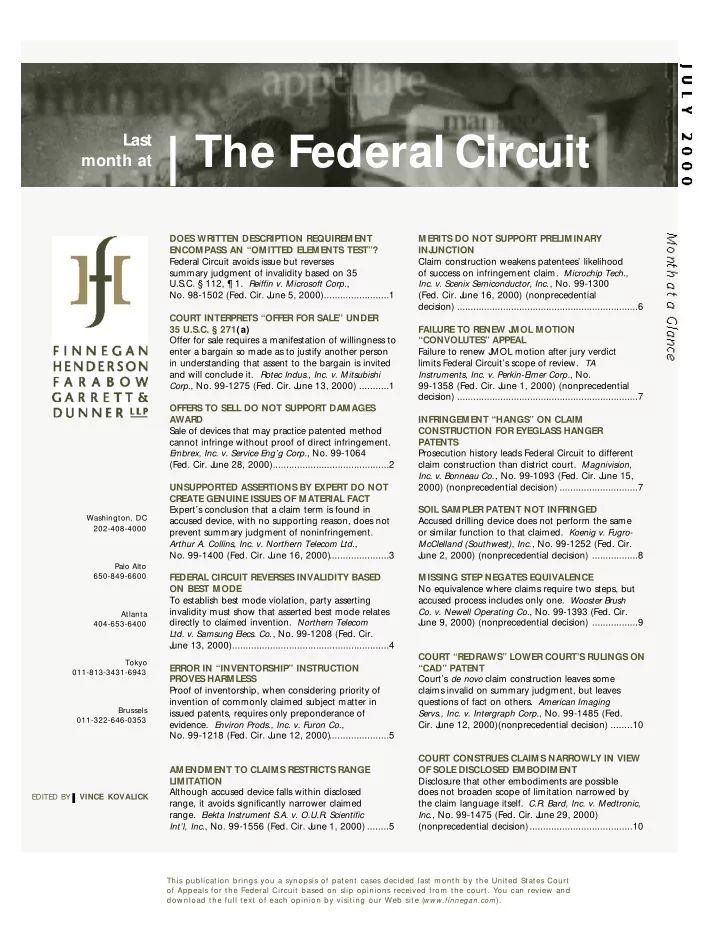
The Federal Circuit month at DOES WRITTEN DESCRIPTION REQUIREMENT - - PDF document

the federal circuit
SMART_READER_LITE
LIVE PREVIEW

The Federal Circuit month at DOES WRITTEN DESCRIPTION REQUIREMENT - - PDF document

Last The Federal Circuit month at DOES WRITTEN DESCRIPTION REQUIREMENT MERITS DO NOT SUPPORT PRELIMINARY ENCOMPASS AN OMITTED ELEMENTS TEST? INJ UNCTION Federal Circuit avoids issue but reverses Claim construction weakens patentees


slide-1
SLIDE 1

EDITED BY VINCE KOVALICK This publication brings you a synopsis of patent cases decided last m onth by the United States Court

  • f Appeals for the Federal Circuit based on slip opinions received from the court. You can review and

dow nload t he full t ext of each opinion by visit ing our Web sit e (www.finnegan.com). Washington, DC 202-408-4000 Palo Alto 650-849-6600 Atlanta 404-653-6400 Tokyo 011-813-3431-6943 Brussels 011-322-646-0353

DOES WRITTEN DESCRIPTION REQUIREMENT ENCOMPASS AN “OMITTED ELEMENTS TEST”? Federal Circuit avoids issue but reverses summary judgment of invalidity based on 35 U.S.C. § 112, ¶ 1. Reiffin v. Microsoft Corp.,

  • No. 98-1502 (Fed. Cir. J

une 5, 2000)........................1 COURT INTERPRETS “OFFER FOR SALE” UNDER 35 U.S.C. § 271(a) Offer for sale requires a manifestation of willingness to enter a bargain so made as to justify another person in understanding that assent to the bargain is invited and will conclude it. Rotec Indus., Inc. v. Mitsubishi Corp., No. 99-1275 (Fed. Cir. J une 13, 2000) ...........1 OFFERS TO SELL DO NOT SUPPORT DAMAGES AWARD Sale of devices that may practice patented method cannot infringe without proof of direct infringement. E mbrex, Inc. v. Service E ng’g Corp., No. 99-1064 (Fed. Cir. J une 28, 2000)...........................................2 UNSUPPORTED ASSERTIONS BY EXPERT DO NOT CREATE GENUINE ISSUES OF MATERIAL FACT E xpert’s conclusion that a claim term is found in accused device, with no supporting reason, does not prevent summary judgment of noninfringement. Arthur A. Collins, Inc. v. Northern Telecom Ltd.,

  • No. 99-1400 (Fed. Cir. J

une 16, 2000) ......................3 FEDERAL CIRCUIT REVERSES INVALIDITY BASED ON BEST MODE To establish best mode violation, party asserting invalidity must show that asserted best mode relates directly to claimed invention. Northern Telecom

  • Ltd. v. Samsung E
  • lecs. Co., No. 99-1208 (Fed. Cir.

J une 13, 2000)..........................................................4 ERROR IN “INVENTORSHIP” INSTRUCTION PROVES HARMLESS Proof of inventorship, when considering priority of invention of commonly claimed subject matter in issued patents, requires only preponderance of

  • evidence. E

nviron Prods., Inc. v. F uron Co.,

  • No. 99-1218 (Fed. Cir. J

une 12, 2000) ......................5 AMENDMENT TO CLAIMS RESTRICTS RANGE LIMITATION Although accused device falls within disclosed range, it avoids significantly narrower claimed

  • range. E

lekta Instrument S.A. v. O.U.R. Scientific Int’l, Inc., No. 99-1556 (Fed. Cir. J une 1, 2000) ........5

MERITS DO NOT SUPPORT PRELIMINARY INJ UNCTION Claim construction weakens patentees’ likelihood

  • f success on infringement claim. Microchip Tech.,
  • Inc. v. Scenix Semiconductor, Inc., No. 99-1300

(Fed. Cir. J une 16, 2000) (nonprecedential decision) ...................................................................6 FAILURE TO RENEW J MOL MOTION “CONVOLUTES” APPEAL Failure to renew J MOL motion after jury verdict limits Federal Circuit’s scope of review. TA Instruments, Inc. v. Perkin-E lmer Corp., No. 99-1358 (Fed. Cir. J une 1, 2000) (nonprecedential decision) ...................................................................7 INFRINGEMENT “HANGS” ON CLAIM CONSTRUCTION FOR EYEGLASS HANGER PATENTS Prosecution history leads Federal Circuit to different claim construction than district court. Magnivision,

  • Inc. v. Bonneau Co., No. 99-1093 (Fed. Cir. J

une 15, 2000) (nonprecedential decision) .............................7 SOIL SAMPLER PATENT NOT INFRINGED Accused drilling device does not perform the same

  • r similar function to that claimed. Koenig v. F

ugro- McClelland (Southwest), Inc., No. 99-1252 (Fed. Cir. J une 2, 2000) (nonprecedential decision) .................8

MISSING STEP NEGATES EQUIVALENCE No equivalence where claims require two steps, but accused process includes only one. Wooster Brush

  • Co. v. Newell Operating Co., No. 99-1393 (Fed. Cir.

J une 9, 2000) (nonprecedential decision) .................9 COURT “REDRAWS” LOWER COURT’S RULINGS ON “CAD” PATENT Court’s de novo claim construction leaves some claims invalid on summary judgment, but leaves questions of fact on others. American Imaging Servs., Inc. v. Intergraph Corp., No. 99-1485 (Fed.

  • Cir. J

une 12, 2000)(nonprecedential decision) ........10 COURT CONSTRUES CLAIMS NARROWLY IN VIEW OF SOLE DISCLOSED EMBODIMENT Disclosure that other embodiments are possible does not broaden scope of limitation narrowed by the claim language itself. C.R. Bard, Inc. v. Medtronic, Inc., No. 99-1475 (Fed. Cir. J une 29, 2000) (nonprecedential decision)......................................10

The Federal Circuit

Last month at

slide-2
SLIDE 2

Does Written Description Requirement Encompass an “Omitted Elements Test”?

Linda J . Thayer

[J udges: Newman, M ichel, and Schall ( per curiam)] In Reiffin v. Microsoft Corp., No. 98-1502 (Fed. Cir. J une 5, 2000), the Federal Circuit reversed the lower court’s summary judgment and remanded for further determination as to whether the claims of the two patents at issue (U.S. Patent No. 5,694,603 (“ the ‘603 patent” ) and U.S. Patent No. 5,694,604 (“ the ‘604 patent” )) are invalid for failure to comply with the written description requirement of 35 U.S.C. § 112, first paragraph. The Federal Circuit concluded that the lower court had erred by deciding whether the patents contained an adequate written description based on the original application filed in 1982, even though the Applicant, M artin Reiffen (“ Reiffen” ), had not claimed the benefit of the earlier application under 35 U.S.C. § 20. The ‘603 patent claims a memory product storing multithreaded software, and the ‘604 patent claims a method of multithreaded operation and a multi- threaded system. In 1985, Reiffin filed a continuation

  • f the 1982 application and, in 1990, filed a

continuation-in-part application of the 1985 applica- tion that contained additional text and modified claims and described the system as a “ multithreaded comput- er application.” Both the ‘603 and ‘604 patents issued

  • n December 2, 1997—the ‘603 patent from the 1990

continuation application and the ‘604 patent from a continuation of the 1990 application that was filed in

  • 1994. The claims of the ‘603 and ‘604 patents were

amended several times during the lengthy prosecu- tion. In determining compliance with section 112, ¶ 1, the district court had determined that, as a matter of law, the written description requirement encompasses an “ omitted element test,” that prevents a patent

  • wner from asserting claims that omit elements that

were essential to the invention as originally disclosed. The district court found that the 1982 specification described four elements as essential to the invention and, after concluding that none of the claims of the two issued patents contained all four elements, held all

  • f the claims invalid for failure to comply with the

written description requirement. On appeal, the Federal Circuit recognized that the district court had relied on Gentry Gallery, Inc. v. Berkline Corp., 134 F.3d 1473 (Fed. Cir. 1998) as estab- lishing or supporting an “ omitted elements test.” The Court did not address the issue, however, choosing instead to decide the case solely on the narrow issue of the lower court’s use of the 1982 specification. In par- ticular, the Court ruled that the descriptive texts of the ‘603 and ‘604 patents as based on the 1990 and 1994 applications met the section 112 requirements. The Court further ruled that the district court erred in look- ing to the 1982 application, particularly since Reiffin was not claiming the benefit of that application. In a concurrence, J udge Newman chastised the Court’s per curiam opinion, observing that it leaves the lower court in limbo concerning the “ omitted ele- ments test,” which she characterized as an incorrect statement of law. J udge Newman concluded that the Court’s opinion should confront the issue, not avoid it.

Court Interprets “Offer for Sale” Under 35 U.S.C. § 271(a)

Vince Kovalick

[J udges: Garjarsa (author), Newman, and M ichel] In Rotec Industries, Inc. v. Mitsubishi Corp., No. 99- 1275 (Fed. Cir. J une 13, 2000), the Federal Circuit affirmed a summary judgment of noninfringement to Mitsubishi Corp. et al. (“ Mitsubishi” ) on Rotec Industries, Inc.’s (“ Rotec” ) U.S. Patent No. 4,170,291 (“ the ‘291 patent” ), given the lack of evidence of an

  • ffer to sell in the United States.

Rotec owns the ‘291 patent, which concerns a tower-crane-supported, articulated, concrete conveyor belt system. In 1995, the Government of the People’s Republic of China (“ PRC” ) solicited bid proposals for five units of a concrete-placing system to be used in the Three Gorges Dams project on the Yangtze River. Accordingly, Mitsubishi approached Potain, a French corporation, proposing that Potain become a partner with M itsubishi to submit a joint bit proposal. Potain was working on the design of a conveyor system at that time with C.S. J

  • hnson; thus J
  • hnson was also

invited to join in the proposal. Shortly thereafter, J

  • hnson contacted Gary Tucker of Tucker Associates,
  • Inc. (“ TA” ) for additional help in preparing the bid.

On J anuary 16, 1996, Potain and M itsubishi submitted a bid to the PRC. Negotiations followed for about a year, and on December 16, 1996, Potain, M itsubishi, and the Chinese Three Gorges Dams Project Corporation (“ TGDPC” ) signed a purchase and sale agreement (“ the Agreement” ) for two of the concrete-placing sys

  • tems. As one proposal, Potain was to design and man -

ufacture the cranes, and J

  • hnson was to design and

manufacture the conveyors. In another proposal, Potain would provide all the necessary components. Under either proposal, M itsubishi was to provide the financing. In February 1997, Rotec filed suit against Mitsubishi, Tucker, Potain, and J

  • hnson for infringe-

ment of the ‘291 patent based on an offer to sell the

page 01

L A ST M O N T H AT T H E F E D E R A L C I R C U I T

F I N N EG A N H EN D ERSO N FA RA B O W G A RRET T D U N N ER L L P

.

slide-3
SLIDE 3

2 0 0 0

JU L Y 02

page F I N N EG A N H EN D ERSO N FA RA B O W G A RRET T D U N N ER LL P

.

claimed invention in the United States. The district court granted Defendants’ motion for summary judg- ment (“ SJ ” ) of noninfringement, finding that Rotec could not prove that the Defendants offered to sell the invention in the United States. The Defendants had argued that their offer was made in China, not the United States, thereby absolving them of any liability under 35 U.S.C. § 271(a). The Federal Circuit recognized that prior to sign- ing the agreement with TGDPC, the Defendants had conducted many activities concerning the Agreement both in and outside the United States. The question

  • n appeal, therefore, was whether the Defendants’

activities in the United States were sufficient to estab- lish an offer for sale under section 271(a). On appeal, Rotec argued that J

  • hnson’s work in

the United States. was evidence of an offer to sell. J

  • hnson’s work, however, focused only on the convey-
  • r components of the concrete delivery system. He

did not work, for example, on the system’s crane com- ponents, which were designated to be supplied from either France or the PRC. Therefore, J

  • hnson did not
  • ffer to sell the entire invention as claimed in the
  • patent. Citing the Supreme Court’s decision in

Deepsouth Packing Co. v. Laitram Corp., 406 U.S. 518 (1972), the Federal Circuit ruled that one may not be held liable under section 271(a) for making, selling, or

  • ffering to sell less than a complete invention.

Although the Court recognized that Congress enacted section 271(f) to avoid the Deepsouth situation, it con- cluded that the enactment of section 271(f) did not change the nature of section 271(a) liability. In determining whether the Defendants’ activities constituted an “ offer” under section 271(a), the Federal Circuit found that the evidence concerning the Defendants’ activities in the United States failed to show any communication with a third party, making it difficult to imagine any commercial detriment to the

  • patentee. Rotec’s only evidence of an offer was a dec-

laration by Rotec’s president concerning a meeting between TGDPC and the Defendants at J

  • hnson’s

headquarters in the United States, which the Federal Circuit agreed was inadmissible hearsay. Citing the Restatement (Second) of Contracts 24 (1979), the Court ruled that the Rotec evidence did not show a commu- nication of “ a manifestation of willingness to enter into a bargain so made as to justify another person in understanding that his assent to that bargain is invited and will conclude it.” Rotec, slip op. at 19. Accordingly, the Federal Circuit agreed that SJ was appropriate. The Federal Circuit also rejected Rotec’s argument that section 271(f)(2) now imposes liability for those who “ offer to supply.” If Congress wanted to amend section 271(f)(2), as it had amended section 271(a), the Court reasoned, it could have easily done so. J udge Newman concurred in the judgment but wrote separately concerning two aspects of the opin-

  • ion. First, J

udge Newman would have preferred to decide the case based on the ground that there was no issue of infringement under section 271 because no

  • ffer for sale had been made whereby the sale itself

could infringe the patent. If an actual sale of the device or system cannot infringe in the United States, she reasoned, then an offer to sell that device or sys- tem likewise cannot infringe. In addition, because Deepsouth had been over- ruled by Congress’s enactment of section 271(f), J udge Newman preferred not to rely on it.

Offers to Sell Do Not Support Damages Award

Lawrence F. Galvin

[J udges: Lourie, Clevenger, and Rader (concur- ring)(per curiam)] In Embrex, Inc. v. Service Engineering Corp., No. 99- 1064 (Fed. Cir. J une 28, 2000), the Federal Circuit affirmed-in-part a district court decision holding a Plaintiff’s patent infringed and awarding both treble damages and attorney fees. However, the Federal Circuit also reversed-in-part, vacating the district court’s award of direct damages and remanding on that issue. Embrex, Inc. (“ Embrex” ) is the exclusive licensee

  • f U.S. Patent No. 4,458,630 (“ the ’630 patent” ) from

the United States Government under the Bayh-Dole

  • Act. The ’630 patent claims methods for inoculating

birds against disease by injecting vaccines into a specif- ic region of their eggs prior to hatching. Embrex employs the patented method to immunize chickens, using Embrex-designed injection machines engineered for large-scale chicken farms. Also interested in the chicken-immunizing busi- ness, Service Engineering Corporation (“ SEC” ) collabo- rated with two other companies in an attempt to design around the ’630 patent. However, Embrex sued SEC and its collaborators for infringement of the ’630 patent, which resulted in a settlement agreement (“ the Agreement” ) specifically precluding SEC from further infringement. Despite the Agreement, SEC continued to try to build its own injection machine by designing around the ’630 patent and conducting tests. But some of the SEC-directed testing infringed the ’630 patent. SEC also attempted to market its injection machine. In response, Embrex sued SEC in the United States District Court for the District of North Carolina, alleg- ing willful infringement, breach of the Agreement, and violation of section 43(a) of the Lanham Act. After a jury found for Embrex on the breach of contract, infringement, and willfulness issues, the district court awarded Embrex treble damages and attorney fees. On appeal, the Federal Circuit found that the dis

  • trict court had not erred in construing the claims, or in

concluding that SEC’s testing infringed the ’630 patent

slide-4
SLIDE 4

and was not experimental use or de minimis. Additionally, the Federal Circuit held that despite plain error in a jury instruction, the willfulness finding involved no miscarriage of justice and the award of attorney fees was justified. However, because the Federal Circuit found insuf- ficient evidence to support the direct damages award, the Court vacated that award and remanded the case to the district court for a reasonable royalty determina-

  • tion. The Court concluded that because the sale of

devices that may be used to practice a patented method cannot infringe without proof of direct infringement, SEC’s offers to sell its machines do not supply adequate evidentiary support for a compensa- tory damage award. Thus, only certain testing per- formed by SEC was compensable. In a concurring opinion, J udge Rader clearly stated his belief that the Patent Act leaves no room for infringement “ excuses,” such as the experimental use

  • r de minimis excuses advanced by SEC and recog-

nized on occasion by various courts. J udge Rader would have preferred that the Court lay these excuses to rest permanently.

Unsupported Assertions by Expert Do Not Create Genuine Issues of Material Fact

Scott A. Herbst

[J udges: Bryson (author), Newman, and Gajarsa] The Federal Circuit affirmed a district court’s grants of summary judgment (“ SJ ” ) of no literal infringement or inducement to infringe in Arthur A.

Collins, Inc. v. Northern Telecom Ltd., No. 99-1400 (Fed.

  • Cir. J

une 16, 2000). Arthur A. Collins, Inc. (“ Collins” ) filed suit against Northern Telecom Limited and Northern Telecom, Inc. (collectively “ Nortel” ) in the District Court for the Eastern District of Virginia, assert- ing two patents directed to digital telecommunications networking and switching systems. The two patents, U.S. Patent No. 4,701,907 (“ the ‘907 patent” ) and U.S. Patent No. 4,797,589 (“ the ‘589 patent” ) are related and share the same written description (the ‘589 patent being a continuation of the ‘907 patent). Each asserted claim of the patents includes a “ time-space-time (TST) switch” limitation, the construction of which is central to the dispute. In particular, the ‘589 patent claims a switching system for use with a high speed transmission media that con - veys time-division-multiplexed channels with a frame

  • f data, the system including a “ TST switch having a

space switch including a plurality of inlet ports and a plurality of outlet ports each having a memory.” The ‘907 patent similarly recited a “ TST switch connected to receive said channels of data from the first line ter- minating unit at the inlet ports thereof.” The district court had construed the TST limitation as requiring a three-stage structure, i.e., time switches at the first and third stages and a single-stage space switch at the second stage. The district court had reached this construction based on the sole embodi- ment set forth in the written description and shown in Figure 3, declining to consider the teachings of prior art patents referred to in the specification. Although the Federal Circuit approved the district court’s reliance on the teaching of the specification and the figures, the Federal Court concluded that the district court had erred in refusing to consider the teachings

  • f the referenced prior art.

The Federal Circuit explained that “ when prior art that sheds light on the meaning of a term is cited by the patentee, it can have particular value as a guide to the proper construction of the terms, because it may indicate not only the meaning of the term to persons skilled in the art, but also that the patentee intended to adopt that meaning.” Collins, slip op. at 5. Accordingly, based on the way the term “ TST switch” was used in the cited prior art patents, and the absence of any indication from the intrinsic evidence that Collins had intended the term to mean something different in his patents, the Federal Circuit agreed with Collins that the TST switch limitation, properly con- strued, allows a multiple-stage space switch, not just a single-stage switch. The Federal Circuit rejected Collins’s attempt to further broaden the scope of the limitation, however, the Court concluded that the evi- dence did not support construing “ space-switch stage” broader to include structure for time translation. The prior art patents indicate that a space-switch stage contains no structure for time translation such as memory for channel storage. In opposing Nortel’s motion for SJ

  • f noninfringe-

ment, Collins relied on a declaration by its expert,

  • Dr. Helgert, which asserted that Nortel’s accused

switches included either a “ J NET” or an “ ENET” switching fabric and that both are TST switches. According to Collins, the grant of SJ was improper because Helgert’s declaration raised genuine issues of material fact. The Federal Circuit disagreed. In particular, the Federal Circuit concluded that SJ was proper because Helgert’s declaration contained

  • nly unsupported conclusions on the issue of infringe-
  • ment. Helgert’s statement that the “ so-called J

NET is a TST switch” amounted to an unsupported assertion that the accused device contained a critical claim limi- tation and, standing alone, was clearly insufficient to create a genuine issue of material fact. Helgert failed to support his assertion with an explanation of why the J NET structure rendered it a TST switch—no finder

  • f fact could conclude that a J

NET constitutes a TST switch based solely on the Helgert declaration. The Federal Circuit distinguished reliance on expert testimony in the context of a SJ motion from a

page 03

L A ST M O N T H AT T H E F E D E R A L C I R C U I T

F I N N EG A N H EN D ERSO N FA RA B O W G A RRET T D U N N ER L L P

.

slide-5
SLIDE 5

2 0 0 0

JU L Y 04

page F I N N EG A N H EN D ERSO N FA RA B O W G A RRET T D U N N ER LL P

.

trial setting. In the latter, the Court explained, the

  • pposing party can challenge the factual basis of the

expert’s opinion. In the SJ setting, however, the affi- davit must do more by setting forth specific facts showing that there is a genuine issue for trial. To carry the day, an affidavit must set forth sufficient detail for the court to determine whether that factual founda- tion would support a finding of infringement under the proper claim construction with all reasonable infer- ences drawn in favor of the nonmovant. Since Helgert’s declaration contained no discussion of the structure of the stages in the J NET, his statement that “ J NET is a TST switch” is an unsupported conclusion unable to preclude the grant of SJ . Collins’s evidence regarding the ENET was similarly deficient. The only other issue before the Federal Circuit was the propriety of the district court’s grant of SJ regarding inducement to infringe. There can be no liability for inducement to infringe in the absence of direct infringement. Since the Federal Circuit con- firmed that the accused switches did not literally infringe, and Collins had advanced no other theory of infringement (including infringement under the doc- trine of equivalents), there was no basis for finding a genuine issue of material fact with respect to direct infringement in connection with the claim of induced infringement. [NOTE: Nortel was successfully represented in this matter by M ike J akes and Dori J

  • hnson Hines of our

firm.]

Federal Circuit Reverses Invalidity Based on Best Mode

Gregory A. Chopskie

[J udges: Clevenger (author), M ichel, and Archer] In Northern Telecom Ltd. v. Samsung Electronics Co.,

  • No. 99-1208 (Fed. Cir. J

une 13, 2000), the Federal Circuit affirmed the district court’s claim construction and holding that the Defendants literally infringed the asserted claim, but reversed the district court’s holding that the asserted claim was invalid for failure to dis- close the best mode of carrying out the invention. Northern Telecom (“ Northern” ) charged Samsung Electronics Co. (“ Samsung” ) with infringement of its U.S. Patent No. 4,030,967 (“ the ‘967 patent” ). The ‘967 patent claims a process for the gaseous etching

  • f aluminum and aluminum oxide that includes an ini-

tial step of plasma etching in the presence of gaseous

  • trihalide. The process is useful in the manufacture of

integrated circuit semiconductors to create conductive lines of aluminum or aluminum alloy between elec- tronic devices on a silicon chip. These circuits are gen- erally manufactured by placing a mask of the desired pattern over a silicon chip coated with aluminum or aluminum alloy. The manufacturer next employs an aluminum etching process to remove the aluminum or aluminum alloy not protected by the mask, thus exposing the underlying silicon. The industry generally employs one of three types

  • f etching processes: sputter etching, a mechanical

etching process; plasma etching, a chemical etching process; or reactive ion etching, a combination of both sputter etching and plasma etching. After the etching process, the mask is removed, leaving the desired pat- tern on a silicon chip, and the chip is heated to improve the contact between the conductive lines and the silicon substrate. Samsung appealed the district court’s construc- tion of two disputed terms. First, the Federal Circuit affirmed the district court’s adoption of Samsung’s

  • wn construction that “ aluminum and aluminum
  • xide” referred to elemental aluminum, as opposed to

an aluminum alloy, and aluminum oxide formed when the aluminum is exposed to oxygen. Refusing to read in a limitation that the claimed aluminum or aluminum

  • xide must be in a “ layer,” the Federal Circuit affirmed

the district court’s holding that Samsung’s process, which employed an aluminum silicon alloy, literally infringed this limitation because pure aluminum, unre- acted with silicon, is present within Samsung’s alu- minum silicon alloy. Second, the Federal Circuit affirmed the district court’s holding that “ plasma etching” was a chemical process that did not necessarily exclude the mechani- cal process of ion bombardment. Rejecting Samsung’s arguments that the intrinsic and extrinsic evidence compels the conclusion that “ plasma etching” must be limited to circumstances in which plasma etching is the sole etching mechanism, the Federal Circuit affirmed the district court’s holding that Samsung’s reactive ion etching, which used both chemical and mechanical etching processes, infringed claim 1. Finally, the Federal Circuit reversed the district court’s holding that claim 1 of the ‘967 patent was invalid for failure to disclose the use of an aluminum silicon alloy. As the inventors knew at the time that they filed the application, the use of an aluminum sili- con alloy prevents formation of metal protrusions extending downward from the aluminum lines into the silicon substrate (“ spearing” ) that may cause short cir- cuits between multiple conductive layers. The district court had concluded that the best mode of the inven- tion was to avoid spearing in order to allow “ fine line” etching (etching of lines fewer than two microns in diameter). Accordingly, the district court held that Northern had failed to disclose the best mode of prac- ticing the invention. The Federal Circuit reversed, holding that the ‘967 patent did not claim a process for manufacturing fine line semiconductor devices, but rather claimed a method of plasma etching aluminum or aluminum

  • xide in the presence of a trihalide. Since fine line
slide-6
SLIDE 6

etching was not claimed in the patent and was unre- lated to the operation of the invention, the Federal Circuit held that the inventors were under no duty to disclose the best method of achieving fine line etching.

Error in “Inventorship” Instruction Proves Harmless

Barbara R. Rudolph

[J udges: Newman (author), M ayer, and Lourie] In Environ Products, Inc. v. Furon Co., No. 99-1218 (Fed. Cir. J une 12, 2000), the Federal Circuit held that proof of inventorship, as a defense to a charge of patent infringement, requires only a preponderance of evidence where patent applications that led to the patents in suit were pending at the U.S. Patent and Trademark Office (“ PTO” ) at the same time. Because an erroneous jury instruction imposing a clear and convincing standard of proof was harmless, however, the Federal Circuit affirmed the judgment entered on the jury verdict pertaining to inventorship and remanded the case for further proceedings. The improper jury instruction stemmed from a dispute centering on two issued patents and a pend - ing patent application, all directed to the same inven- tion, a flexible, double-walled pipe for containment of hazardous fluids. One of the patents in suit was assigned to Environ Products, Inc. (“ Environ” ) and named Michael Webb as the sole inventor. The other patent in suit was assigned to Furon Co. (“ Furon” ) and named Steven Skaggs as the inventor of the same

  • invention. Finally, the pending patent application,

assigned to Advanced Polymer Technology (“ APT” ) named Leo LeBlanc and Andrew Youngs as joint inven -

  • tors. These parties had been involved in various com-

mercial relationships before any of the patent applica- tions for the containment pipe invention were filed. Eventually, these commercial relationships deteriorat - ed, leading to various lawsuits involving charges of patent infringement, unfair competition, and conver- sion, and challenging the inventorship of the Environ

  • patent. The district court consolidated the actions and

tried the issue of inventorship to the jury. The jury was asked to determine whether the sen- ior party, M ichael Webb, independently conceived the invention before the respective dates of conception of the named inventor of the Furon patent, Steven Skaggs, and the coinventors of the APT application. The district court imposed a clear and convincing stan- dard of proof of inventorship on Skaggs and the APT inventors, the junior parties, but required only a pre- ponderance of evidence standard of proof of inventor- ship for Webb, the senior party. The jury returned a verdict for Environ, finding Webb to be the first inven - tor of the claimed subject matter. Upon review, the Federal Circuit held that the cor- rect standard of proof as to inventorship for all claimants in this case is the preponderance of evidence

  • standard. The Court distinguished this case from

those in which the 35 U.S.C. § 282 presumption of validity mandates a clear and convincing standard of proof of inventorship on the ground that, in this case, all three patent applications were pending before the PTO at the same time. The Court explained that, under these circumstances, the preponderance of evi- dence standard would have applied in an interference proceeding or district court proceeding under section 291 to determine the question of validity of interfering patents, had the parties elected either of these courses

  • f action. That Furon instead raised the inventorship

issue as a defense to a patent infringement claim does not, the Court continued, change this burden of proof. Although the Court concluded that the jury instruction requiring Furon to prove inventorship by clear and convincing evidence was in error, it found the error harmless. Because the jury had specifically found that Webb, and not Skaggs, was the first inven - tor, the only possible consistent view of the jury’s find - ings is, the Court concluded, that Webb was the

  • inventor. Any error as to the weight of proof could

not have changed the result, since the jury had to endorse one of two conflicting versions of the truth, and the Court found no ground for viewing the trial as unfair. Finally, the Court rejected Furon’s argument that the district court should have required Environ to prove Webb’s inventorship by clear and convincing evidence due to Environ’s claims of breach of fiduciary duty, conversion, fraud, and deceit. The Court noted that the only issue before the jury was that of priority

  • f invention, which was separate and distinct from the
  • ther charges. Accordingly, the Court remanded the

case for further proceedings on the remaining issues.

Amendment to Claims Restricts Range Limitation

Malcolm T. Meeks

[J udges: Lourie (author), Rader, Bryson] In Elekta Instrument S.A. v. O.U.R. Scientific

International, Inc., No. 99-1556 (Fed. Cir. J une 1, 2000), the Federal Circuit reversed the district court’s grant of summary judgment (“ SJ ” ) of infringement in favor of Elekta Instrument S.A. (“ Elekta” ), reasoning that the district court had misconstrued the asserted claim of U.S. Patent No. 4,780,898 (“ the ‘898 patent” ). The ‘898 patent is directed to medical devices, known as gamma units, used in the treatment of brain

  • tumors. Gamma units attack abnormal brain tissue

page 05

L A ST M O N T H AT T H E F E D E R A L C I R C U I T

F I N N EG A N H EN D ERSO N FA RA B O W G A RRET T D U N N ER L L P

.

slide-7
SLIDE 7

2 0 0 0

JU L Y 06

page F I N N EG A N H EN D ERSO N FA RA B O W G A RRET T D U N N ER LL P

.

using the combined energy of a plurality of radiation beams by focusing the beams on the abnormal brain

  • tissue. Independent claim 1 (the only claim asserted)
  • f the ‘898 patent claims a particular arrangement of

radiation beams within a gamma unit. Specifically, the claim recites that the radiation beams are located “ only within a zone extending between latitudes 30-45.” The words “ only” and “ between” were added during prosecution to overcome an obviousness rejection. O.U.R. Scientific International, Inc. (“ OSI” ) manu- factures and markets a gamma unit with radiation beams positioned at latitudes ranging from 14-43. Elekta sued OSI in the Southern District of New York alleging infringement of its ‘898 patent. OSI moved for SJ

  • f noninfringement, and Elekta cross-moved for

SJ

  • f infringement.

The district court had granted Elekta’s motion, reasoning that claim 1 of the ‘898 patent encompasses gamma units with radiation beams beginning at lati- tude 0 and extending to a point between latitudes 30-

  • 45. Based on this claim interpretation, the district

court ruled that OSI’s device literally infringed the ‘898 patent. On appeal, the Federal Circuit reversed the district court’s ruling because the district court had erred in its claim interpretation. The Court focused on the claim words “ only” and “ extending between” and ruled that the ordinary meaning of these words unambiguously limits the scope of the claim to gamma units having radiation beams between latitudes 30-45. The Court came to this conclusion despite the fact that the pre- ferred (and only) embodiment disclosed in the written description provides for gamma units having radiation beams located between latitudes 0-45. The Court rea- soned that the prosecution history requires that claim 1 be read to limit the range to latitudes 30-45. During prosecution, the word “ only” had been added, and the phrase “ extending to latitudes 30-45” was changed to “ extending between latitudes 30-45” (emphasis added) to distinguish the prior art. Thus, a person of ordinary skill in the art would read the claim to be limited exclusively to this range, according to the Court. Based on this interpretation, the Federal Circuit held that no reasonable jury could find that OSI’s device literally infringes claim 1 of the ‘898 patent; thus, the district court had erred in granting Elekta’s motion for SJ in this regard. The Federal Circuit chose not to opine on the issue of OSI’s infringement under the doctrine of equivalents because this issue was not addressed by the district court. In a footnote, however the Court hinted that under the correct interpretation

  • f claim 1, such infringement is highly improbable.

Merits Do Not Support Preliminary Injunction

Timothy M. Hsieh

[J udges: M ichel (author), Newman, and Bryson] In Microchip Technology, Inc. v. Scenix

Semiconductor, Inc., No. 99-1300 (Fed. Cir. J une 16, 2000) (nonprecedential decision), the Federal Circuit upheld the district court’s denial of Microchip Technology, Inc.’s (“ Microchip” ) motion for prelimi- nary injunction after affirming the district court’s claim construction of U.S. Patent No. 5,606,511 (“ the ‘511 patent” ). Microchip is the assignee of several patents cover- ing microcontroller devices, including the ‘511 patent and U.S. Patent No. 5,469,557 (“ the ‘557 patent” ). These microcontroller devices are typically embedded into semiconductor chips to control certain processes in a broad range of consumer and industrial products. Microchip filed suit in the U.S. District Court for the Northern District of California alleging that Scenix Semiconductor, Inc.’s (“ Scenix” ) SX series of microcon - trollers infringed, among other patents, the ‘511 and ‘557 patents. M icrochip also filed a motion to prelimi- narily enjoin Scenix from making, using, selling or

  • ffering for sale certain SX microcontrollers that

allegedly infringed claims 1 and 12 of the ‘511 patent and claim 2 of the ‘557 patent. The district court had deferred its decision on this motion until it conducted a Markman hearing. In the subsequent Markman hearing, the district court construed claims 1 and 12 of the ‘511 patent and claim 2 of the ‘557 patent. Claim 12 of the ‘511 patent, in particular, discloses a brown-out detection scheme that resets the microcontroller when the power supply drops below the brown-out detection

  • threshold. The district court had held that the term

“ reset” required that the microcontroller actively pre- serve the data in the data memory if the power dropped below the brown-out threshold. After the district court had issued its ruling on claims construction, Microchip filed a second motion for preliminary injunction based solely on claim 12 of the ‘511 patent. The district court determined that Scenix’s SX series of microcontrollers did not preserve data when the power dropped below two volts and, thus, was unlikely to satisfy the “ reset” element of claim 12. Holding that Microchip was unlikely to pre- vail on its infringement claim, the district court denied Microchip’s second motion for preliminary injunction. The district court further held that Scenix had raised a

slide-8
SLIDE 8

substantial question as to whether claim 12 was antici- pated by a prior art patent, but had failed to raise a substantial question as to the invalidity of claim 12 due to obviousness or failure to disclose the best mode. Both parties appealed. In construing the claims, the Federal Circuit focused on whether “ reset” required that the micro- controller actively preserve data in the data memory. The Court first noted that claim 12 expressly recites the phrase “ maintaining . . . data stored in the data memory.” The Federal Circuit explained that had the inventor intended “ reset” to only passively retain data in the data memory, the language “ maintaining . . . data stored in the data memory” would not have been necessary. Second, the Federal Circuit found that the written description clearly supported the preservation require-

  • ment. The Court determined that the specification of

the ‘511 patent discloses that data stored in the data memory is maintained as it was at the time of occur- rence of the reset. The specification further discloses that, subsequent to the end of the predetermined time interval of the reset, device operation is restored to a point corresponding to the status quo at which the reset was initially invoked. The Court concluded that the data in the data memory must be actively pre- served during a reset to avoid corruption, if a user is to rely upon the data when operation of the microcon - troller is restored. Holding that the district court had properly con - strued claim 12 of the ‘511 patent, the Federal Circuit affirmed the district court’s denial of M icrochip’s sec-

  • nd motion for preliminary injunction and dismissed

Scenix’s cross-appeal as to the invalidity of claim 12 as

  • moot. The Federal Circuit also refused to review the

district court’s construction of claim 1 of the ‘511 patent and claim 2 of the ‘557 patent, holding that those claims were not relevant to the appeal of M icrochip’s second motion for preliminary injunction.

Failure to Renew J MOL Motion “Convolutes” Appeal

Kara F. Stoll

[J udges: Schall (author), M ayer, and Gajarsa] In TA Instruments, Inc. v. Perkin-Elmer Corp., N o. 99-1358 (Fed. Cir. J une 1, 2000) (nonprecedential decision), the Federal Circuit affirmed the district court’s grant of judgment as a matter of law (“ J M OL” ) that the Perkin-Elmer Corp. (“ Perkin-Elmer” ) infringed certain claims of U.S. Patent No. 5,346,306 (“ the ‘306 patent” ) and claim 17 of U.S. Patent No. 5,224,755 (“ the ‘755 patent” ). The Court also affirmed the dis- trict court’s grant of J M OL that claim 73 of U.S. Patent

  • No. 5,439,291 (“ the ‘291 patent” ) is valid.

The ‘755, ‘306, and ‘291 patents, owned by TA Instruments, Inc. (“ TA” ), are directed to differential analysis technology for measuring the change in a physical property of a material in response to a con- trolled change in the environment. The dispute on appeal focused on the claimed step of processing a dif- ferential signal representative of the heat flow to and from a sample material to obtain meaningful informa- tion about the same material. In particular, the assert- ed claims of the ‘306 patent, as well as claim 17 of the ‘755 patent, require “ deconvoluting” the differential

  • signal. Claim 73, the only claim the jury found to be

infringed, requires “ separating” the differential signal. After the close of evidence, both parties moved for directed verdicts: TA for judgment that Perkin- Elmer infringed the asserted claims, and Perkin-Elmer for judgment that the asserted claims were not infringed and were invalid. Reserving judgment on the parties’ J MOL motions, the district court submitted the case to the jury. After deliberation, the jury concluded that only claim 73 of the ‘291 patent was infringed under the doctrine of equivalents (“ DOE” ), but also found that claim 73 was invalid for obviousness. Following the jury verdict, only TA renewed its J M OL motion. The district court granted TA’s motion, and Perkin-Elmer subsequently appealed. Perkin-Elmer’s failure to renew its J MOL motion played a significant role in shaping the Federal Circuit’s infringement analysis. Indeed, in these circumstances, the Federal Circuit had no choice but to accept the jury’s verdict that claim 73 of the ‘291 patent was infringed under the DOE. Thus, the Court concluded that its inquiry boiled down to whether, given that the accused device falls into the scope of claim 73, there is substantial evidence that the accused device does not fall within the scope of the other asserted claims. The Federal Circuit initially noted that the primary difference between claim 73 and the other asserted claims is that claim 73 requires “ separating” the differ- ential signal while the other claims require “ deconvo - luting” the differential signal. But, under the district court’s unchallenged claim construction, “ deconvolut- ing” simply means the process of separating . . . into two or more component parts. Unconvinced that the district court’s claim construction imposed a different requirement on the claims reciting “ deconvolution” than claim 73, and given the unchallenged jury verdict that Perkin-Elmer infringed claim 73, the Federal Circuit held that substantial evidence does not support the verdict that the other claims are not similarly infringed. Turning next to the validity of claim 73 of the ‘291 patent, the Federal Circuit held that substantial evidence does not support the finding implicit in the jury verdict that the prior art teaches the claimed step

page 07

L A ST M O N T H AT T H E F E D E R A L C I R C U I T

F I N N EG A N H EN D ERSO N FA RA B O W G A RRET T D U N N ER L L P

.

slide-9
SLIDE 9

2 0 0 0

JU L Y 08

page F I N N EG A N H EN D ERSO N FA RA B O W G A RRET T D U N N ER LL P

.

  • f “ separating” the differential signal. In particular,

the Federal Circuit rejected the conclusory statement

  • f Perkin-Elmer’s expert that if the patents encom-

passed the accused device, then the patents were

  • bvious, as “ not substantial evidence.”

Infringement “Hangs” on Claim Construction for Eyeglass Hanger Patents

Stacy D. Lewis

[J udges: Rader (author), Newman, and Friedman] In Magnivision, Inc. v. Bonneau Co., No. 99-1093 (Fed. Cir. J une 15, 2000) (nonprecedential decision) the Federal Circuit reversed the district court’s judg - ment of noninfringement of Magnivision, Inc.’s (“ M agnivision” ) U.S. Patent No. 5,144,345 (“ the ‘345 patent” ), affirmed the noninfringement judgment of Magnivision’s U.S. Patent No. 5,521,911 (“ the ‘911 patent” ), affirmed the summary judgment (“ SJ ” ) of no best mode violation, and vacated the grant of SJ to M agnivision on the issue of contractual release. Magnivision’s ‘345 patent claimed an eyeglass display member and an eyeglass hanger comprising a cantilever support including two rods parallel to each

  • ther in a horizontal plane forming a first rod receiv-

ing area and a second rod receiving area. The district court had construed the claim to require that the rod receiving areas must be within, or enclosed by, the hanger card, so that the hanger can receive either a single arm or a double arm bar. The Bonneau Co. (“ Bonneau” ) devices included rod receiving areas with slots that are not enclosed by the hanger card. Thus, the district court had concluded that Bonneau’s device did not infringe. The Federal Circuit did not agree with the district court’s claim construction because nothing in the claim or prosecution history requires that the rod receiving areas be enclosed. By construing the claim more narrowly, the district court had impermissibly imported limitations from the specification into the

  • claim. Construed properly, the Federal Circuit ruled,

the rod receiving areas read on slots, and the accused Bonneau device literally infringes the ‘345 patent. Magnivision’s ‘911 patent claims an eyeglass dis

  • play member and an eyeglass contacting member

having an encircling portion adapted to encircle a part

  • f said frame of said pair of eyeglasses and a cantilever

support, which maintained “ a selected orientation” for the eyeglasses. The district court had construed the phrase a “ selected orientation” to mean a horizontal

  • rientation. Since Bonneau’s vertical hanger did not

support the eyeglasses horizontally, the district court had concluded that Bonneau’s hanger did not infringe. The Federal Circuit found that statements in the prosecution history limited the “ selected orientation” limitation to a horizontal orientation by distinguishing prior art vertical displays. Thus, the Federal Circuit affirmed the district court’s finding of no infringement. Bonneau also alleged that Magnivision’s ‘345 patent was invalid for failure to disclose a best mode. M agnivision’s inventor had learned of a better material for the hanger after applying for the patent in J anuary 1988, but before filing a continuation-in-part (“ CIP” )

  • n December 1, 1988. The Federal Circuit agreed

that there was no best mode violation because the retaining member associated with the better hanger material was adequately described in the original application and the CIP had not added new informa- tion about the retaining member. M agnivision moved to disqualify the judge for bias because the judge had visited an eyeglasses store and then stated: “ [A]n idiot could have invented a way to display these glasses, either vertically or hori- zontally . . . .” The motion was denied because the judge did not state that an idiot could have invented the patented products and there was no material and identifiable harm from the comments. On M arch 31, 1995, M agnivision and Accessories Associates, Inc. (“ AAI” ) had signed an settlement agreement (“ the Agreement” ) irrevocably releasing AAI from all claims under the ‘345 patent (and all con- tinuations, CIPs, and divisionals thereof, e.g., the ‘911). AAI later acquired Bonneau. The Federal Circuit found that once Bonneau was acquired by AAI, it was in privity with AAI and therefore its accused product is covered within the scope of the Agreement. Prior to AAI’s acquisition, however, Bonneau had not been in privity with AAI, so the Agreement did not protect Bonneau from an infringement suit prior to the date of acquisition. Accordingly, the Federal Circuit reversed the district court’s grant of SJ to M agnivision on the contractual release issue.

Soil Sampler Patent Not Infringed

Wendy S. Vicente

[J udges: Clevenger (author), Plager, and Schall] In Koenig v. Fugro-McClelland (Southwest), Inc.,

  • No. 99-1252 (Fed. Cir. J

une 2, 2000)(nonprecedential decision), the Federal Circuit affirmed the district court’s grant of summary judgment (“ SJ ” ) that Fugro- McClelland (Southwest), Inc.’s (“ Fugro” ) accused product did not infringe Arthur Koenig’s (“ Koenig” )

slide-10
SLIDE 10

U.S. Patent No. 5,076,392 (“ the ‘392 patent” ) for a portable drilling device used to take soil samples. The ‘392 patent claims define the drilling device (a member) to include “ means positionable in a hole . . . for positively engaging the material within which the member is to be forced.” On appeal, the parties disputed the trial court’s construction of the term “ means for positively engag- ing.” Although the trial court had not treated this lim - itation as a means-plus-function claim subject to the requirements of 35 U.S.C. § 112, ¶6, the Federal Circuit found the error harmless because the same result, i.e., no infringement, was required under a proper claim construction. This proper construction turned on the meaning

  • f the phrase “ positively engaging.” Koenig argued

that an ordinary meaning of “ positively engaging” controlled in this case. The Federal Circuit disagreed because, during prosecution, Koenig had chosen to act as his own lexicographer and presented an alternative definition for “ positively engaging” while distinguish- ing over prior art. On the basis of the prosecution, the Federal Circuit construed “ positively engaging” as: (1) resisting axial movement by the interaction of a collar with a discontinuity or groove in the wall of a hole; and (2) introduction of an interference so that lock-up is achieved. Turning to the infringement question, the Court concluded that no reasonable jury could find that Fugro’s accused device performed the identical claimed function of preventing axial movement by interacting with a groove or discontinuity in the wall by means of a lip or liplike structure. Fugro’s device clamps the foundation between a top and a bottom plate and only parts of the Fugro device are bolts that do not contact the side of the hole at all. The Court also found that Fugro’s device did not infringe under the doctrine of equivalents because the accused device also lacked a substantially similar function to the pre- venting axial movement function. Finally, the Court affirmed the district court’s grant of SJ

  • f no trade secret misappropriation on the

ground that Koenig had failed to present proof from which a reasonable jury could conclude that Koenig’s business and technical operating procedures its propri- etary cement composition information, and its billing procedures were entitled to trade secret status.

Missing Step Negates Equivalence

Leslie A. McDonell

[J udges: M ichel (author), Rader, and Linn] In Wooster Brush Co. v. Newell Operating Co., No. 99-1393 (Fed. Cir. J une 9, 2000) (nonprecedential decision), the Federal Circuit upheld a decision by the District Court for the Northern District of Ohio granting summary judgment (“ SJ ” ) of no infringement

  • f a process patent for making paint rollers owned by

the EZ Paintr Company (“ EZ” ). EZ and Wooster Brush Co. (“ Wooster” ) both man- ufacture paint rollers. Wooster sought a declaratory judgment that it did not infringe U.S. Patent No. 5,195,242 (“ the ‘242 patent” ) assigned to EZ. Wooster manufactures its rollers using a process taught by U.S. Patent No. 5,572,790 (“ the ‘790 patent” ). The processes of the ‘242 patent and the ‘790 patent were invented by the same person. The process claim at issue in the ‘242 patent involves a two steps for pro- ducing paint rollers whereas the process taught by the ‘790 patent involves a single step. EZ did not dispute that Wooster did not literally infringe the ‘242 patent, but alleged that Wooster’s

  • ne-step process did infringe under the doctrine of

equivalents (“ DOE” ). The district court, however, granted SJ against equivalent infringement. On appeal, the Federal Circuit concurred with the district court’s construction of the relevant claim

  • language. The Court then analyzed the issue of

infringement under the DOE to determine whether the district court had improperly resolved any genuine issues of infringement or other material fact and whether Wooster was entitled to judgment as a matter

  • f law.

Applying the Supreme Court’s analysis in Warner- J enkinson Co. v. Hilton Davis Chemical Co., 520 U.S. 17, 40 (1997) that “ [the determination of equivalence should be applied as an objective inquiry on an ele- ment-by-element basis,” the district court had found that the accused Wooster process was missing a step claimed in the ‘242 patent. The Federal Circuit acknowledged, however, that the language in Corning Glass Works v. Sumitomo Electronics, U.S.A., Inc., 868 F.2d 1251, 1259 (Fed. Cir. 1989) stating that “ [a]n equivalent must be found for every limitation of the claim somewhere in an accused device, but not neces- sarily in a corresponding component,” requires an examination of the entire accused process to deter- mine whether or not the plainly missing limitation or step is present in another form in the accused process. The Federal Circuit relied on testimony from the inventor about the differences in the processes claimed in the ‘242 and ‘790 patents. The inventor testified that the ‘242 process required two extruders and because he could only afford to rent one extruder, he was unable to practice the process claimed in the ‘242

  • patent. This led him to invent the process taught in

the ‘790 patent, which he considered an improvement

  • ver the ‘242 process. The Court found that the ‘242

process requires two sequential applications of two dif- ferent bonding agents, whereas the ‘790 patent process requires only one application of adhesive and contains no step equivalent to the second application

  • f adhesive required by the ‘242 patent process. The

Court concluded that “ to find equivalence would entirely vitiate the limitation of the second,

page 09

L A ST M O N T H AT T H E F E D E R A L C I R C U I T

F I N N EG A N H EN D ERSO N FA RA B O W G A RRET T D U N N ER L L P

.

slide-11
SLIDE 11

2 0 0 0

JU L Y 10

page F I N N EG A N H EN D ERSO N FA RA B O W G A RRET T D U N N ER LL P

.

post-cooling application of an adhesive,” which under Warner-J enkinson was legally wrong. Finally, the Federal Circuit dismissed EZ’s argu- ment that because the inventor had filed a terminal disclaimer during the prosecution of the ‘790 patent (limiting the patent term to the term of the ‘242 patent) there is no patentable difference between the patented processes. The Court stated that an

  • bviousness-type double patenting rejection is not the

same as a rejection under 35 U.S.C. § 103 over prior art and noted that it has previously held that “ a termi- nal disclaimer . . . is not an admission of obviousness

  • f the later filed claimed invention in light of the earli-

er-filed disclosure.” Quad Envtl. Techs. Corp. v. Union Sanitary Dist. , 946 F.2d 870, 874 (Fed. Cir. 1991).

Court “Redraws” Lower Court’s Rulings on “CAD” Patent

Kevin W. McCabe

[J udges: Gajarsa (author), Lourie, and Linn] In American Imaging Services, Inc. v. Intergraph

Corp., No. 99-1485 (Fed. Cir. J une 12, 2000)(non - precedential decision), the Federal Circuit affirmed the district court’s summary judgment (“ SJ ” ) that certain claims of U.S. Patent No. 5,353,393 (“ the ‘393 patent” ) were invalid as either anticipated or obvious, but reversed the SJ

  • f obviousness for certain other

claims because genuine issues of material fact remained. The ‘393 patent, owned by American Imaging Services, Inc. (“ AIS” ), describes and claims an appara- tus and method for manipulating scanned documents using computer-aided design (“ CAD” ) commands. The ‘393 patent addresses the need for converting a paper document into computer-readable electronic form, permitting changes to that document using computer tools and producing an edited version of that docu - ment in both hard copy and electronic form. AIS filed suit for patent infringement against Intergraph in the United States District Court for the Southern District of Texas. On May 26, 1998, Intergraph filed a motion for SJ asserting that the ‘393 patent was anticipated and obvious, and therefore, invalid. Following a M arkman hearing, the district court found that the intrinsic evidence broadly defined CAD systems as packages commonly used to create and edit drawings and other graphic displays on a comput- er screen or other cathode ray tube (“ CRT” ) display. Based upon this definition, the district court found that SuperPaint, a computer graphics program compatible

  • nly with an Apple Macintosh, was a CAD system

because it had the ability to create and edit drawings and other graphic displays on a computer screen. The district court, accordingly found the claims of the ‘393 patent to be either anticipated or rendered obvious by the SuperPaint program. On appeal, AIS argued that the district court had adopted an unduly broad definition of “ CAD system” and ignored the more narrow definition provided by the specification. AIS also argued that the doctrine of claim differentiation precluded the broad definition adopted by the district court. The Federal Circuit agreed that the district court’s definition of “ CAD systems” was unduly broad in view

  • f the written description of the ‘393 patent.

According to the Federal Circuit, the district court had improperly focused on one sentence of the specifica- tion, which describes a CAD system as a package “ commonly used to create and edit drawings and

  • ther graphic displays on a computer screen or other

cathode ray tube (CRT) display.” In applying this defi- nition of a CAD system, the district court had ignored additional language in the specification, including the very next sentence, which further refined and nar- rowed the broad description found in the sentence relied upon by the district court. According to the more refined and narrow definition adopted by the Federal Circuit, a CAD system, as used in the ‘393 patent, “ refers to graphic editors particularly well-suited for engineering design drawings.” Even applying the more refined and narrow defi- nition of CAD system to the claims of the ‘393 patent, however, the Federal Circuit upheld the district court’s ruling that claims 1-7 and 14-29 were anticipated by SuperPaint as a matter of law because these claims were not limited to use in a CAD environment. The Federal Circuit, however, reversed the district court’s ruling that claims 8-11, 13, 30-34, and 37-41 were anticipated because these claims were further limited to use in a CAD environment. Applying the more refined and narrow definition, the Federal Circuit held that SuperPaint did not contain this limitation as found in these other claims because SuperPaint did not enable an operator to utilize commands to edit or to manipulate engineering drawings. Nonetheless, the Federal Circuit found claims 11, 13, 30-34, and 37-41

  • bvious in view of SuperPaint because SuperPaint

teaches one of ordinary skill in the art of computer programming the solution sought by the ‘393 patent for a general graphics program. Thus, according to the Federal Circuit, it would have been well within the knowledge of one of ordinary skill in the art to apply the teachings provided by SuperPaint within a CAD system, which itself is a species of graphic programs. With respect to claims 12, 35, 36, and 42, the Federal Circuit rejected the district court’s determina- tion that these claims were invalid as obvious as a mat- ter of law. AIS argued that these claims added a fur- ther limitation to the ‘393 patent by describing a sys- tem for manipulating interrupt vector tables. The Federal Circuit agreed, finding that SuperPaint does not include the ability to operate with an interrupt vector table, which is a feature of a conventional DOS

  • system. Whether such a reconfiguration would not

have been obvious to a person of ordinary skill in the art presented issues of fact negating a SJ .

slide-12
SLIDE 12

Court Construes Claims Narrowly in View of Sole Disclosed Embodiment

Michael J . Flibbert

[J udges: Schall (author), Newman, and Smith] In C.R. Bard, Inc. v. Medtronic, Inc., No. 99-1475 (Fed. Cir. J une 29, 2000) (nonprecedential decision), the Federal Circuit rejected a district court’s claim con - struction, vacated the district court’s judgment of infringement and denial of Medtronic Inc.’s (“ Medtronic” ) motion for judgment as a matter of law (“ J M OL” ) of noninfringement, and remanded for fur- ther proceedings consistent with the Court’s construc- tion of the claims. U.S. Patent No. 5,484,474 (“ the ‘474 patent” ) is directed to a filter for removing gas bubbles and par- ticulate material from liquid, such as blood. The filter is used in cardiopulmonary bypass procedures, blood transfusions, and dialysis treatments. The claims of the patent recite, among other limitations, “ a housing defining a substantially toroidal flow path.” The dis

  • trict court construed this language to mean that the

housing itself need not be toroidally shaped. In addi- tion, the claims recite “ a filter element support located within the housing and centrally disposed with respect to the toroidal flow path.” The district court deter- mined that the “ support” need not provide support from the top by a structure descending from the hous

  • ing cap. Based on this claim construction, a jury

found infringement by M edtronic and awarded C.R. Bard, Inc. (“ Bard” ) over three million dollars in damages. On appeal, Medtronic challenged the district court’s construction of the “ housing” and “ filter ele- ment support” claim limitations. With respect to the “ housing” limitation, Medtronic argued that a flow path can only exist as a consequence of defined boundaries, and therefore, the housing must be toroidally shaped in order to define a toroidal flow

  • path. Medtronic further argued that the specification
  • f the ’474 patent only describes the housing as hav-

ing a toroidal structure. Bard responded that it is the flow path, not the housing, that must be toroidally

  • shaped. Bard pointed out that the patent states that

“ shapes other than a toroid may be used for further embodiments.” The Federal Circuit rejected the district court’s rea- soning, concluding instead that, although the patent states that shapes other than a toroid may be used for further embodiments, it does not indicate that a hous

  • ing of any other shape would “ defin[e] a substantially

toroidal flow path,” as recited in the claims. The Court stressed that the only structure described in the patent as providing a toroidally shaped flow path is a toroidally shaped housing. Accordingly, the Federal Circuit construed the “ housing” limitation as requiring that the housing itself be toroidally shaped. With respect to the “ filter element support” limi- tation, Medtronic argued that this claim limitation requires a filter element support provided at the top of the filter element and centrally disposed within the toroidal housing. Medtronic contended that the pros- ecution history supported its proposed construction. Bard responded that Medtronic’s proposed construc- tion would impermissibly limit the scope of the claims to the preferred embodiment described in the ’474 patent. The Federal Circuit determined that the patent discloses “ only one embodiment of the filter element support,” in which the filter element support is formed by an indentation in the housing cap that forms the center of the toroid. In view of this limited patent dis

  • closure and the prosecution history, the Court con -

strued the “ filter element support” limitation to require a structural support for the filter element that is cen- trally disposed with respect to the toroidal flow path, at the top of the filter element. The Court concluded that the district court had erred when it construed the “ filter element support” more broadly. Because the jury verdict of infringement and the district court’s denial of Medtronic’s motion for J MOL

  • f noninfringement were based on an erroneous claim

construction, the Federal Circuit vacated the judgment

  • f infringement and denial of M edtronic’s J

M OL motion for noninfringement, and remanded for a determination of the infringement issue under a cor- rect claim construction. The Court affirmed the district court’s denial of Medtronic’s motion for J MOL that the ’474 patent is invalid for obviousness.

page 11 F I N N EG A N H EN D ERSO N FA RA B O W G A RRET T D U N N ER L L P

. DISCLAIMER:

The case summaries reflect the understanding

  • f the authors only and are not meant to con-

vey legal opinions or advice of any kind. The firm disclaims any liability for any errors or

  • missions in these summaries. This promotion-

al newsletter does not establish any form of attorney-client relationship with our firm or with any of our attorneys.