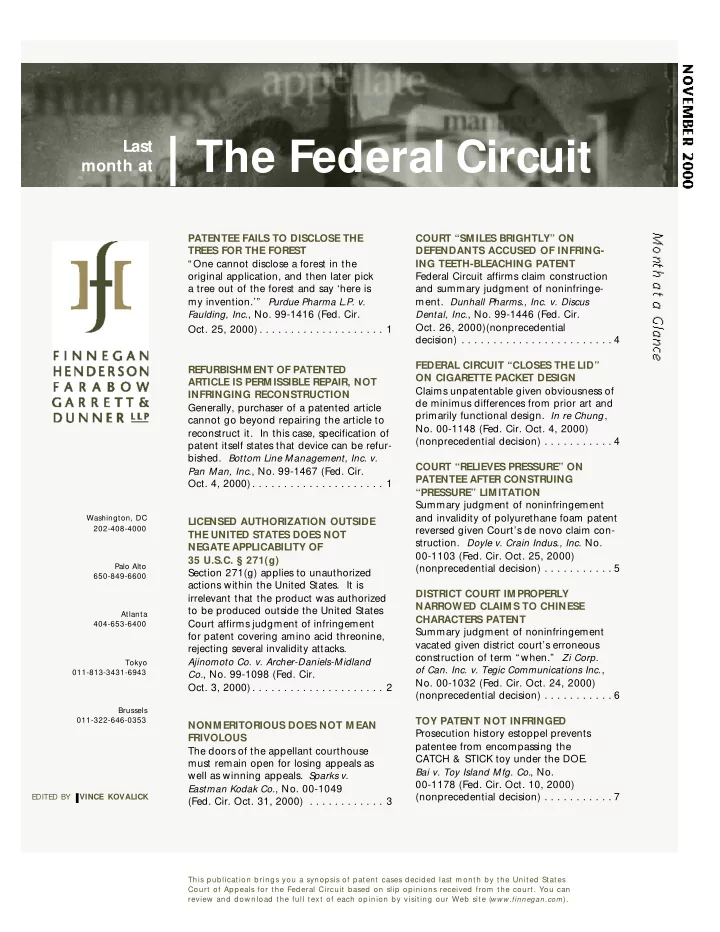
The Federal Circuit month at PATENTEE FAILS TO DISCLOSE THE COURT - - PDF document

the federal circuit
SMART_READER_LITE
LIVE PREVIEW

The Federal Circuit month at PATENTEE FAILS TO DISCLOSE THE COURT - - PDF document

Last The Federal Circuit month at PATENTEE FAILS TO DISCLOSE THE COURT SM ILES BRIGHTLY ON TREES FOR THE FOREST DEFENDANTS ACCUSED OF INFRING- One cannot disclose a forest in the ING TEETH-BLEACHING PATENT original application,


slide-1
SLIDE 1

EDITED BY VINCE KOVALICK This publication brings you a synopsis of patent cases decided last m onth by the United States Court of Appeals for the Federal Circuit based on slip opinions received from the court. You can review and dow nload the full text of each opinion by visiting our Web site (www.finnegan.com). Washington, DC 202-408-4000 Palo Alto 650-849-6600 Atlanta 404-653-6400 Tokyo 011-813-3431-6943 Brussels 011-322-646-0353

PATENTEE FAILS TO DISCLOSE THE TREES FOR THE FOREST “ One cannot disclose a forest in the

  • riginal application, and then later pick

a tree out of the forest and say ‘here is my invention.’” Purdue Pharma L.P. v. Faulding, Inc., No. 99-1416 (Fed. Cir.

  • Oct. 25, 2000) . . . . . . . . . . . . . . . . . . . . 1

REFURBISHM ENT OF PATENTED ARTICLE IS PERM ISSIBLE REPAIR, NOT INFRINGING RECONSTRUCTION Generally, purchaser of a patented article cannot go beyond repairing the article to reconstruct it. In this case, specification of patent itself states that device can be refur-

  • bished. Bottom Line Management, Inc. v.

Pan Man, Inc., No. 99-1467 (Fed. Cir.

  • Oct. 4, 2000) . . . . . . . . . . . . . . . . . . . . . 1

LICENSED AUTHORIZATION OUTSIDE THE UNITED STATES DOES NOT NEGATE APPLICABILITY OF 35 U.S.C. § 271(g) Section 271(g) applies to unauthorized actions within the United States. It is irrelevant that the product was authorized to be produced outside the United States Court affirms judgment of infringement for patent covering amino acid threonine, rejecting several invalidity attacks.

Ajinomoto Co. v. Archer-Daniels-Midland Co., No. 99-1098 (Fed. Cir.

  • Oct. 3, 2000) . . . . . . . . . . . . . . . . . . . . . 2

NONM ERITORIOUS DOES NOT M EAN FRIVOLOUS The doors of the appellant courthouse must remain open for losing appeals as well as winning appeals. Sparks v.

Eastman Kodak Co., No. 00-1049 (Fed. Cir. Oct. 31, 2000) . . . . . . . . . . . . 3

COURT “SM ILES BRIGHTLY” ON DEFENDANTS ACCUSED OF INFRING- ING TEETH-BLEACHING PATENT Federal Circuit affirms claim construction and summary judgment of noninfringe-

  • ment. Dunhall Pharms., Inc. v. Discus

Dental, Inc., No. 99-1446 (Fed. Cir.

  • Oct. 26, 2000)(nonprecedential

decision) . . . . . . . . . . . . . . . . . . . . . . . . 4 FEDERAL CIRCUIT “CLOSES THE LID” ON CIGARETTE PACKET DESIGN Claims unpatentable given obviousness of de minimus differences from prior art and primarily functional design. In re Chung,

  • No. 00-1148 (Fed. Cir. Oct. 4, 2000)

(nonprecedential decision) . . . . . . . . . . . 4 COURT “RELIEVES PRESSURE” ON PATENTEE AFTER CONSTRUING “PRESSURE” LIM ITATION Summary judgment of noninfringement and invalidity of polyurethane foam patent reversed given Court’s de novo claim con-

  • struction. Doyle v. Crain Indus., Inc. No.

00-1103 (Fed. Cir. Oct. 25, 2000) (nonprecedential decision) . . . . . . . . . . . 5 DISTRICT COURT IM PROPERLY NARROWED CLAIM S TO CHINESE CHARACTERS PATENT Summary judgment of noninfringement vacated given district court’s erroneous construction of term “ when.” Zi Corp.

  • f Can. Inc. v. Tegic Communications Inc.,
  • No. 00-1032 (Fed. Cir. Oct. 24, 2000)

(nonprecedential decision) . . . . . . . . . . . 6 TOY PATENT NOT INFRINGED Prosecution history estoppel prevents patentee from encompassing the CATCH & STICK toy under the DOE . Bai v. Toy Island Mfg. Co., No. 00-1178 (Fed. Cir. Oct. 10, 2000) (nonprecedential decision) . . . . . . . . . . . 7

The Federal Circuit

Last month at

slide-2
SLIDE 2

Patentee Fails to Disclose the Trees for the Forest

Gregory A. Chopskie

[J udges: Bryson (author), Plager, and Smith] In Purdue Pharma L.P. v. F

aulding, Inc., No. 99- 1416 (Fed. Cir. Oct. 25, 2000), the Federal Circuit affirmed a district court’s holding of invalidity of the asserted claims for failure to comply with the writ - ten description requirement. Purdue Pharma L.P. (“ Purdue” ) charged Faulding, Inc. (“ Faulding” ) with infringement of its U.S. Patent No. 5,672,360 (“ the ‘360 patent” ), which claims methods of treating pain in patients by administering an opioid, such as morphine, once a day. Specifically, independent claims for the

  • nce-a-day treatment of patients requires that the

“ maximum plasma concentration (Cmax) . . . is more than twice the plasma level of said opioid at about 24 hours after administration of the dosage form [C24].” (This requirement is referred to as “ the Cmax/C24 ratio limitation” .) After a bench trial, the district court found the asserted claims infringed but invalid because the Cmax/C24 ratio limitation lacked support in the specification of the ‘360 patent. Purdue appealed the finding of invalidity and Faulding cross- appealed the infringement finding. On appeal, Purdue argued that the district court had clearly erred in its factual findings. Specifically, Purdue argued that the Cmax/C24 ratio limitation found support in a passage of the specifi- cation describing the invention as lacking a “ gener- ally flat” or “ substantially flat” morphine plasma concentration curve. Rejecting the expert testimo- ny and publications cited by Purdue, the Federal Circuit affirmed the district court’s finding that the specification referring to a “ substantially flat serum concentration curve” did not support the Cmax/C24 ratio limitation. Similarly, the Federal Circuit reject - ed Purdue’s arguments that the examples in the specification provided support for the Cmax/C24 ratio limitation, holding that while the relevant data were present, the specification did not emphasize the required Cmax/C24 ratio. The Court explained that “ [w]hat the patentees [had] done [was] to pick a characteristic possessed by two of their formulations, a characteristic that is not dismissed even in passing in the disclosure, and then make it the basis of claims that cover not just those two formulations, but any formulation that has that characteristic.” Purdue Pharma, slip op. at

  • 14. The Court described this as “ exactly the type
  • f overreaching the written description requirement

was designed to guard against.” Id. Finally, the Federal Circuit rejected Purdue’s contentions that the district court was bound by the Examiner’s finding that the asserted claims were supported by the specification, particularly in light

  • f the fact that the district court had heard exten-

sive evidence on the issue that was not before the E

  • xaminer. Having affirmed the district court’s find-

ings of invalidity, the Federal Circuit did not reach Faulding’s cross-appeal on infringement.

Refurbishment of Patented Article Is Permissible Repair, Not Infringing Reconstruction

Stephanie S. Conis

[J udges: Friedman (author), M ayer, and M ichel] In Bottom Line Management, Inc. v. Pan Man,

Inc., No. 99-1467 (Fed. Cir. Oct. 4, 2000), the Federal Circuit affirmed a lower court’s SJ dismissing a complaint after finding the refurbishment of a patented article to be a permissible repair, not an infringing reconstruction. Bottom Line Management, Inc.’s (“ Bottom Line” ) U.S. Patent No. 5,070,775 (“ the ‘775 patent” ) is directed to a cooking surface device for an upper movable heated platen of a two-sided cooking device and a method of producing it. In particular, the two-sided cooking device is used pri- marily to cook hamburgers in fast-food restaurants. This device has a clam shell design, with a lower half and a movable upper half (or lid) that are both cooking surfaces. Hamburgers are placed on the lower cooking surface and the lid is closed, placing the upper cooking surface on top of the food. Bottom Line manufactures a removable upper cooking surface (“ platen” ) for these two-sided

  • cookers. The platen is a flat rectangular aluminum

plate with a Teflon coating on the side that comes into contact with the food. The other side of the plate has a number of studs welded to it, which are used to attach or bolt the platen to the cooker’s upper half. The studs are welded to the back of the plate, which gives the side that touches the food a smooth surface with no seams. This facilitates uni- form Teflon coating on the platen. However, the Teflon coating eventually wears off with use. In removing a worn platen, customers often bend or break off some of the studs on the back, which must be repaired or replaced before a refurbished platen may be reused.

page 01

L A ST M O N T H AT T H E F E D E R A L C I R C U I T

F I N N EG A N H EN D ERSO N FA RA B O W G A RRET T D U N N ER L L P

.

slide-3
SLIDE 3

2 0 0 0

N O V EM B ER 02

page F I N N EG A N H EN D ERSO N FA RA B O W G A RRET T D U N N ER LL P

. Pan Man, Inc. (“ Pan Man” ) refurbishes and resells used platens manufactured by Bottom Line. Pan Man cleans the platen, replaces the old Teflon coating on the cooking surface, and repairs or replaces any broken or bent studs by unbending them or by hand-welding new ones. Platen users send in their old platens, and Pan Man provides them with reconditioned platens. Normally, the replacement platens are not the same articles that Pan Man receives from a particular user. The Federal Circuit recognized that a purchaser

  • f a patented article has an implied license not only

to use and sell it, but also to repair it to function properly, relying on the Supreme Court’s decision in Aro Manufacturing Co. v. Convertible Top Replacement Co., 365 U.S. 336 (1961). The purchaser of a prod- uct, however, cannot go beyond repairing the arti- cle to reconstruct it. The Federal Circuit reviewed its precedent on the repair versus reconstruction issue and concluded that, although there is no bright-line test to determine whether reconstruction

  • r repair has occurred, the Court does recognize a

number of factors in this analysis. These factors include the nature of the actions by the defendant, the nature of the device and how it is designed (namely, whether one of the components of the patented combination has a shorter useful life than the whole), whether a market has developed to manufacture or service the part at issue, and objec- tive evidence of the intent of the patentee in addressing the issue. The Federal Circuit noted that the patented article in this case is the entire platen, and not any particular element of it. Claim 1 of the ‘775 patent recites, inter alia, (1) a planar plate, (2) a layer of synthetic material coating the lower surface, and (3) threaded studs welded to and projecting from the upper surface of the plate. To refurbish the “ planar plate,” all Pan Man did was (1) clean it, (2) reapply the Teflon coating to its bottom surface, and (3) repair or replace any studs that had been bent or broken in removing the platen from the top

  • f the cooker. The Federal Circuit further noted

that the ‘775 patent specification states that the device can be refurbished by removing the platen from the cooker and installing a new or refurbished

  • platen. The Court concluded that the refurbishing

that Pan Man did was relatively minor, and was “ a far cry” from “ a second creation of the patented entity,” as is necessary for refurbishing to constitute reconstruction rather than repair. Bottom Line Mgm’t, slip op. at 7.

Licensed Authorization Outside the United States Does Not Negate Applicability of 35 U.S.C. § 271(g)

J ill K. MacAlpine

[J udges: Newman (author), Smith, and Rader] In Ajinomoto Co. v. Archer-Daniels-Midland Co.,

  • No. 99-1098 (Fed. Cir. Oct. 3, 2000), the Federal

Circuit affirmed a district court’s decision finding infringement under 35 U.S.C. § 271(g), but modi- fied the damages period. Ajinomoto Co., Inc. (“ Ajinomoto” ) sued Archer- Daniels-Midland Co. (“ ADM” ), invoking 35 U.S.C. § 271(g) and charging that the genetically engi- neered bacteria imported by ADM and used in the United States infringed certain claims of U.S. Patent

  • No. 4,278,765 (“ the ‘765 patent” ). The ‘765

patent claims a method for preparing bacterial strains that produce amino acids in increased quan-

  • tities. This method comprises modifying bacteria to

block both the regulatory mechanism that limits amino acid production and the degradation path- way for the amino acid that is produced. The inventors of the ‘765 patent are scientists at Genetika in the former Soviet Union. An applica- tion for an Inventors’ Certificate was filed in the Soviet Union in 1978. In 1979, a corresponding U.S. patent application was filed, which later issued as the ‘765 patent. In 1986, the Soviet agency, Licensintorg, granted a license to the Genetika technology and a certain bacterial strain to A.C. Biotechnics, the predecessor to ABP International (“ ABP” ), the producer of the bacteria sold to ADM. This license granted the exclusive right to use the licensed strain for the purpose of manufacturing of L-threonine and the nonexclusive right to use and sell L-threonine worldwide except in the United States and J apan. In 1991, Licensintorg returned patent owner- ship and license agreements to the various entities from which they had originated and, in May of that year, Genetika assigned the ‘765 patent to

  • Ajinomoto. In October 1991, the inventors execut-

ed an assignment directly to Ajinomoto. In 1993, ADM commenced the production of threonine using a patented bacterial strain made in Sweden by ABP. ADM purchased the bacterial strains and the right to use the bacteria for the production of threonine from ABP. The district court held that ADM’s use infringed the ‘765 patent under 35 U.S.C. § 271(g), and

slide-4
SLIDE 4

awarded damages calculated as a royalty of $1.23/kg of threonine produced by ADM from May 1993 to March 27, 1998. ADM appealed. ADM asserted that the ‘765 patent was invalid, arguing primarily that the district court had erred in requiring evidence of fraud or deceptive intent to invalidate a patent based on certain allegedly improper signing procedures of the ‘765 applica- tion and a declaration. In particular, certain inven- tors signed the ‘765 application on behalf of others. ADM asserted that the inventor must personally sign the oath or the patent is invalid. The district court held that technical errors, made without deceptive intent, could not be the basis for holding the patent invalid or unenforceable. The Federal Circuit affirmed and held that the law does not bar the correction of defects when the defect was not the product of fraud, and therefore, the district court had not erred in requiring proof of fraud or inequitable conduct to preclude corrective action. The Federal Circuit also affirmed the district court’s determination that the claims of the ‘765 patent are enabled. The district court had found that the claimed process used conventional and well-known genetic engineering techniques, and further, that the enablement requirement had been met by deposit of the bacterial products in accor- dance with 35 U.S.C. § 122. ADM also argued that the ‘765 patent is invalid for failure to disclose the best mode of making and using the invention. In particular, ADM argued that the inventors did not explicitly state that the recipi- ent bacterial strain was required to contain a certain gene to achieve increased amino acid production. Despite the fact that this information had been publicly available in two articles published by the inventors four months before their application for the Soviet Inventors’ Certificate, ADM argued that it should have been included in the patent applica- tion if it were to be relied upon for compliance with the best mode requirement. The Federal Circuit concluded that requiring inclusion of known information would add impreci- sion to the requirements of the content of patent specifications, could unnecessarily increase the cost

  • f preparing and prosecuting patent applications,

and could obscure the contribution of the patent to the pertinent art. ADM’s principal defenses to infringement were that the importation and use were authorized and that the imported bacteria did not infringe correctly construed claims. ADM argued that section 271(g) does not prohibit importation into the United States of goods produced abroad with authority. Therefore, ADM argued, it had authorization because it had bought the bacteria from ABP whose predecessor, A.C. Biotechnics, was granted a license to the technology. The Federal Circuit affirmed the district court’s holding, however, that ABP’s license did not pro- vide authority to use and sell in the United States. Because the process used abroad is the same as the process covered by a U.S. patent, liability for infringement arises upon importation, sale or offers,

  • r use in the United States as set forth in section

271(g). Concerning damages, the Federal Circuit held that the district court’s assessment of royalties for the period up to the filing of ADM’s motion to amend judgment on March 27, 1998, was erro-

  • neous. This postjudgment motion was based on

the allegation that the day after testimony had closed, ADM switched to a noninfringing bacterial

  • strain. Therefore, ADM asserted, there was no evi-

dentiary basis for the court’s award of damages for the production after the trial had ended. The Federal Circuit agreed and held that, for the period after entry of judgment, ADM is entitled to raise the defense of noninfringement because ADM’s motion to amend reasonably placed at issue its infringe- ment after judgment. Thus, the Federal Circuit held that liability for infringement after the date of judgment requires further proceedings during which ADM may raise the defense of noninfringement for that period. The Federal Circuit then modified the district court’s damages award, excluding from the royalty obliga- tion production after March 13, 1998.

Nonmeritorious Does Not Mean Frivolous

Vince Kovalick

[J udges: Lourie (author), Rader, and Linn] In Sparks v. E

astman Kodak Co., No. 00-1049 (Fed. Cir. Oct. 31, 2000), the Federal Circuit denied a motion by E astman Kodak Company (“ Kodak” ) for an assessment of damages for a frivolous appeal, but took the opportunity to comment on the con- cept of frivolous appeals. In particular, the Federal Circuit rejected Kodak’s assertion that because the Federal Circuit had previously decided this case without a written

  • pinion, under Federal Circuit Rule 36, an award of

sanctions was justified. The Court commented that its practice of entering judgment without opinion under certain circumstances may indicate that the appeal lacked merit but not necessarily that it was frivolous.

page 03

L A ST M O N T H AT T H E F E D E R A L C I R C U I T

F I N N EG A N H EN D ERSO N FA RA B O W G A RRET T D U N N ER L L P

.

slide-5
SLIDE 5

2 0 0 0

N O V EM B ER 04

page F I N N EG A N H EN D ERSO N FA RA B O W G A RRET T D U N N ER LL P

. The Court identified two types of appeals that may be deemed frivolous: those that are “ frivolous as filed” and those that are “ frivolous as argued.” A frivolous-as-filed appeal occurs when an appellant has raised issues that are beyond the reasonable contemplation of fair-minded people, and no basis for reversal in law or fact can be or is even arguably

  • shown. A frivolous-as-argued appeal occurs when

an appellant has not dealt fairly with the court, has significantly misrepresented the law or facts, or has accused the judicial process by repeatedly liti- gating the same issue in the same court (citations

  • mitted).

In the end, the Court concluded, the doors of the appellant courthouse must remain open for los

  • ing appeals as well as winning appeals.

Court “Smiles Brightly” on Defendants Accused of Infringing Teeth-Bleaching Patent

Scott J . Popma

[J udges: Linn (author), M ichel, and Lourie] In Dunhall Pharmaceuticals, Inc. v. Discus Dental,

Inc., No. 99-1446 (Fed. Cir. Oct. 26, 2000)(non- precedential decision), the Federal Circuit affirmed a district court’s claim construction and nonin- fringement findings of the asserted claims of U.S. Reissue Patent No. 34,196 (“ the ‘196 patent” ). Dunhall Pharmaceutical, Inc.’s (“ Dunhall” ) is the holder of the ‘196 patent, which claims meth-

  • ds and a device for bleaching teeth. Discus

Dental, Inc. (“ Discus” ) markets take-home, teeth- whitening kits containing a composition used for bleaching teeth surfaces and materials for making bleaching trays/appliances that fit over a patient’s

  • teeth. Dunhall sued Discus for patent infringement,

alleging literal infringement and infringement under the DOE . After conducting a Markman hearing, the dis

  • trict court construed the term “ substantially liquid

tight mechanical barrier” as having the same mean- ing and contemplating the same structure as the term “ substantially liquid tight splint.” The district court granted Defendants’ motion for SJ for nonin- fringement, finding that Defendants did not literally infringe based on its conclusion that each of the asserted claims of the ‘196 patent required a “ rigid” splint, and that Defendants’ trays did not fall within its definition of “ rigid.” The district court also found that the Defendants’ trays were soft flexible trays and thus did not infringe under the DOE . Dunhall contended on appeal that the district court’s claim construction of the term “ substantially liquid tight” to require a “ rigid” appliance, was clearly erroneous, because the term “ substantially liquid tight” was defined in the ‘196 patent specifi- cation and the term “ rigid” did not appear any- where in that definition or anywhere else in the

  • specification. The Federal Circuit rejected this argu-

ment concluding that during prosecution Dunhall had distinguished the claimed “ splint” or “ mechan- ical barrier” that engages the tooth/teeth in a “ sub- stantially liquid tight” manner as a “ rigid” custom- made appliance. The Court also rejected Dunhall’s argument that the district court had erred in determining that “ rigid” means that the appliance must be “ as firm as possible.” Dunhall argued for an interpretation

  • f rigid that would only require that the appliance

be structurally sound enough to perform the func- tions of the claimed invention. The Federal Circuit noted that to get its claims allowed, Dunhall had distinguished the “ rigidity” of the claimed appli- ances over prior art appliances, and in doing so had clearly indicated to the PTO that the term “ rigid” required something more than being structurally sound enough to perform the functions of the invention. Finally, Dunhall asserted that the district court had improperly granted SJ

  • f noninfringement

because even if the claims at issue were properly construed to require a “ rigid” splint, Defendants’ trays possessed the degree of rigidity requisite to finding literal infringement. The Federal Circuit did not find this argument persuasive, again noting that Dunhall’s claimed splint requires rigidity that exceeds that of the prior art flexible trays and that Dunhall did not provide the district court with any evidence that Defendants’ trays were more rigid than the prior art trays. The Court thus concluded that Dunhall had not met its burden of establishing a genuine issue of material fact and affirmed the district court’s grant of SJ .

Federal Circuit “Closes the Lid” on Cigarette Packet Design

Matthew T. Latimer

[J udges: Bryson, Archer, and Gajarsa (per

curiam)]

In In re Chung, No. 00-1148 (Fed. Cir. Oct. 4, 2000) (nonprecedential decision), the Federal Circuit affirmed the Board’s final rejection of design

slide-6
SLIDE 6

patent application No. 07/781,290 as obvious under 35 U.S.C. § 103 over U.S. Patent No. 3,948,389 (“ the ‘389 patent” ) in view of U.S. Patent No. 2,163,828 (“ the ‘828 patent” ) and U.S. Patent No. 2,090,723 (“ the ‘723 patent” ), finding any differences between Chung’s cigarette packet design and the prior art to be de minimus. The Court also ruled the claims unpatentable under 35 U.S.C. § 171 as being primarily functional. Chung’s patent application claimed a design for a cigarette packet having an opening on the longer dimensional side of the packet, for removal

  • f stored cigarettes. The cigarette packet also com-

prised two depressions in the packet liner that rein- forced the inner frame of the packet. The ‘389 patent cigarette packet differed in design from Chung’s only in that the packet opening of the ‘389 patent was across the shorter dimensional rather than across the longer dimensional side of the packet. However, the ‘828 patent discloses a cigarette packet design with a packet opening along the longer dimensional side. The ‘723 patent discloses a packet from which cigarettes could be removed “ horizontally,” like Chung’s design. Chung argued before the Board that his packet differed in appearance from that of the ‘389 and ‘828 patents due to two depressions in Chung’s packet liner. The Board, however, found this differ- ence to be de minimus and rejected it because the depressions are not observable when the cigarette packet is closed, and therefore, do not enhance the saleable value of the packet. On appeal, Chung argued that the packet of the ‘828 patent was different from his because it

  • pened on the top, whereas his design’s packet
  • pened on the right-hand vertical side. The Court

rejected Chung’s argument, agreeing that such a difference is de minimus and taught by the ‘723 patent. The Court also ruled Chung’s cigarette packet design unpatentable under 35 U.S.C. § 171, finding it primarily functional, rather than ornamental. The Court relied on Chung’s own statements that he was motivated to design a cigarette case that allowed users to remove cigarettes without having to touch the filter end, and that the two depres- sions in Chung’s packet were designed to reinforce the inner frame of the packet.

Court “Relieves Pressure” on Patentee After Construing “Pressure” Limitation

J ames R. Barney

[J udges: Lourie (author), DYK, and Friedman (dissenting)] In Doyle v. Crain Industries, Inc., No. 00-1103 (Fed. Cir. Oct. 25, 2000) (nonprecedential deci- sion), the Federal Circuit reversed the district court’s claims construction, vacated its conclusion of inva- lidity, and remanded the case for further fact- finding concerning a process of manufacturing polyurethane foam covered by U.S. Patent No. 5,120,770 (“ the ‘770 patent” ). J udge Friedman dissented. The ’770 patent is directed to a process for producing flexible, open-cell polyurethane foam. The foam is produced by mixing a number of com- ponents, including a blowing agent, in a mixing area at specific temperatures and pressures. Under the patented process, the blowing agent is subject- ed to a pressure in a mixing zone sufficient to main- tain it in liquid form throughout the mixing process (the “ pressure limitation” ). After the mixture has been formed, it is “ ejected” from the mixing zone to allow the blowing agent to vaporize at atmos- pheric pressure, which causes the mixture to

  • expand. The resultant foam is then cured.

Claim 21, the only independent claim asserted, defines a mixture as “ being subjected to a pressure in said mixing zone which is sufficient to maintain said blowing agent in the liquid state at ambient temperatures,” and further recites a step of “ eject - ing said mixture from said mixing zone to atmos- pheric pressure.” The district court construed the “ pressure limi- tation” to mean the pressure required to keep the blowing agent in liquid form “ at ambient tempera- tures,” which the specification defines as 70o to

  • 100oF. Based on this, the district court concluded

that dependent claim 22, which lists six specific blowing agents, was invalid because many of the listed blowing agents, including helium and nitro- gen, cannot be maintained in liquid form at tem- peratures of 70o to 100oF .

page 05

L A ST M O N T H AT T H E F E D E R A L C I R C U I T

F I N N EG A N H EN D ERSO N FA RA B O W G A RRET T D U N N ER L L P

.

slide-7
SLIDE 7

2 0 0 0

N O V EM B ER 06

page F I N N EG A N H EN D ERSO N FA RA B O W G A RRET T D U N N ER LL P

. The district court had construed the “ ejection limitation” of claim 21 as requiring a “ direct” ejec- tion from the mixing zone to atmospheric pressure. According to the district court, the accused device did not meet this limitation because it employed a “ froth laydown device,” which gradually lowered the pressure of the mixture to atmospheric pressure in a controlled manner. The Federal Circuit held that, although the dis

  • trict court had been correct in defining “ ambient

temperature” as 70 o to 100oF, it had erred in inter- preting the phrase to modify “ blowing agent” rather than “ mixing zone.” According to the Federal Circuit, the ordinary meaning of “ ambient temperature” is the temperature of the environ- ment in which an experiment is conducted, rather than a particular compound, e.g., the blowing

  • agent. Since the ‘770 patent does not set forth a

special definition of “ ambient temperature” that differs from this ordinary meaning, the Federal Circuit reversed the district court’s claim construc- tion and vacated the district court’s conclusion that claim 22 is invalid for inoperability instructing the district court consider whether any of the blowing agents of claim 22 would fail to work when the agents themselves are not restricted to the temper- ature range of 70o to 100oF . The Federal Circuit also held that the district court’s interpretation of the ejection limitation was

  • erroneous. The Court noted that the ordinary

meaning of “ ejecting” does not require the ejection to be either direct or indirect; the term merely requires that the mixture leave the mixing zone and end up at atmospheric pressure. In his dissent, J udge Friedman agreed with the district court’s interpretation of the ejection limita- tion of claim 21 as requiring a “ direct” ejection to atmospheric pressure. J udge Friedman cited several portions of the specification that support the “ direct” ejection construction and reasoned that a person of ordinary skill in the art, reading the ‘770 patent, would conclude that claim 21 only covers the “ direct” ejection method.

District Court Improperly Narrowed Claims to Chinese Characters Patent

E rika H. Arner

[J udges: Lourie (author), Newman, and Rader] In Zi Corp. of Canada Inc. v. Tegic

Communications Inc., No. 00-1032 (Fed. Cir. Oct. 24, 2000) (nonprecedential decision), the Federal Circuit vacated a district court’s SJ

  • f noninfringe-

ment, because the district court had erred in con- struing the claim term “ when” too narrowly in light

  • f the written description, dependent claims, and

prosecution history. Zi Corporation of Canada Inc. (“ Zi” ) is the assignee of U.S. Patent No. 5,109,352 (“ the ‘352 patent” ) that relates to software for coding, select - ing, and displaying ideographic characters electron-

  • ically. A user of the patented system enters a string
  • f code numbers corresponding to pen strokes

making up an ideographic (e.g., Chinese) character, and the system displays the corresponding charac-

  • ter. Tegic Communications Inc. (“ Tegic” ) manufac-

tures and sells a Chinese T9 software program that displays Chinese characters corresponding to a string of numbers entered by a user. Chinese T9 software displays candidate characters before the user enters any numbers and then adjusts the can- didate characters as the user enters more identify- ing numbers until the target character is selected. Zi sued Tegic, alleging that the Chinese T9 software infringed the ‘352 patent. Tegic filed a motion for SJ

  • f noninfringement, which the district

court granted. The claim element at issue recites a means for displaying a character “ when the code numbers entered by the entering means uniquely identify said character.” The district court con- strued this limitation to require that the claimed system wait to display the target character until the entire corresponding string of numbers had been

  • entered. The Federal Circuit held, however, that

the district court had construed the “ when” claim limitation too narrowly and remanded for further proceedings. Looking first at the claim language itself, the Federal Circuit noted that the “ comprising” transi- tion term in the claim preamble opened up the claim to covering systems in which characters are displayed at different times. Although Tegic point - ed to a statement in the specification describing an embodiment in which the character is displayed

  • nce the string of numbers has been entered, the

Court cited other embodiments disclosed in which target characters are displayed for selection before they are uniquely identified, i.e., after only a portion

  • f the identifying numbers have been entered.

The use of the term “ comprising” in the claim pre- amble opened the claim up to covering both such systems. The Federal Circuit also addressed a discussion in the specification of a problem with the preferred embodiment, namely the occasional existence of more than one character with the same identifying string of numbers. Tegic argued that because the

slide-8
SLIDE 8

patent teaches that this problematic feature should be minimized, the claims should not cover such an

  • embodiment. The Court disagreed, finding that the

discussion of the problem in the specification con- templates that such a problem is inherent in the claimed system. The Court also looked to the dependent claims for help in construing the independent claims. Two preferred embodiments—for handling the duplica- tion problem and for displaying compound charac- ters—were recited in dependent claims. Both of these embodiments contemplated a system for dis- playing the target character before all of the corre- sponding numbers had been entered. Therefore, the Court refused to limit the independent claims to a system in which the character is only displayed after all of the numbers have been entered to preserve the consistency of the independent claims with the claims depending therefrom. Tegic attempted to use statements made during the prosecution of the ‘352 patent to limit the scope

  • f the contested claims. The Federal Circuit exam-

ined the patentee’s arguments regarding a prior art patent and found that a narrow claim construction was not necessary to the validity of the ‘352 patent

  • ver the prior art. Specifically, the Court noted that

the prior art system never displayed candidate char- acters before unique identification occurred.

Toy Patent Not Infringed

Vince Kovalick

[J udges: Plager, Archer, and Gajarsa (per curiam)] In Bai v. Toy Island Manufacturing Co., No. 00- 1178 (Fed. Cir. Oct. 10, 2000)(nonprecedential deci- sion), the Federal Circuit affirmed a SJ that claim 1 of U.S. Patent No. 4,017,076 (“ the ‘076 patent” ) was not infringed by the CATCH & STICK produced by Toy Island Manufacturing Co., Ltd. (“ Toy Island” ). The decision turned on the Federal Circuit’s pre- vious construction of the claim term “ hemispherical” to mean “ less than a sphere, but nevertheless part of a sphere.” The Court concluded that the dish- shaped subject matter surrendered by insertion of the term “ hemispherical” into the claim during pros- ecution is precisely what Carl Bai now needed to recover to encompass the CATCH & STICK within his

  • claim. Thus, he is estopped from asserting such

infringement under the DOE .

page 07 F I N N EG A N H EN D ERSO N FA RA B O W G A RRET T D U N N ER L L P

. DISCLAIMER:

The case summaries reflect the understanding

  • f the authors only and are not meant to con-

vey legal opinions or advice of any kind. The firm disclaims any liability for any errors or

  • missions in these summaries. This promotion-

al newsletter does not establish any form of attorney-client relationship with our firm or with any of our attorneys.

In Last M onth at the Federal Circuit, certain terms, titles, and names of feder- al agencies that are frequently referred to in text, appear in abbreviated forms

  • r as acronyms. These abbreviated forms and acronyms are listed below.

ALJ Administrative Law J udge APJ Administrative Patent J udge Board Board of Patent Appeals and Interferences Commissioner Commissioner of Patents and Trademarks DJ Declaratory J udgment DOE Doctrine of Equivalents J M OL J udgment as a Matter of Law M PEP Manual of Patent Examining Procedure PCT Patent Cooperation Treaty PTO United States Patent and Trademark Office SM Special Master SJ Summary J udgment