The Federal Circuit month at M ont h at a Glance RES J UDICATA - - PDF document

the federal circuit
SMART_READER_LITE
LIVE PREVIEW

The Federal Circuit month at M ont h at a Glance RES J UDICATA - - PDF document

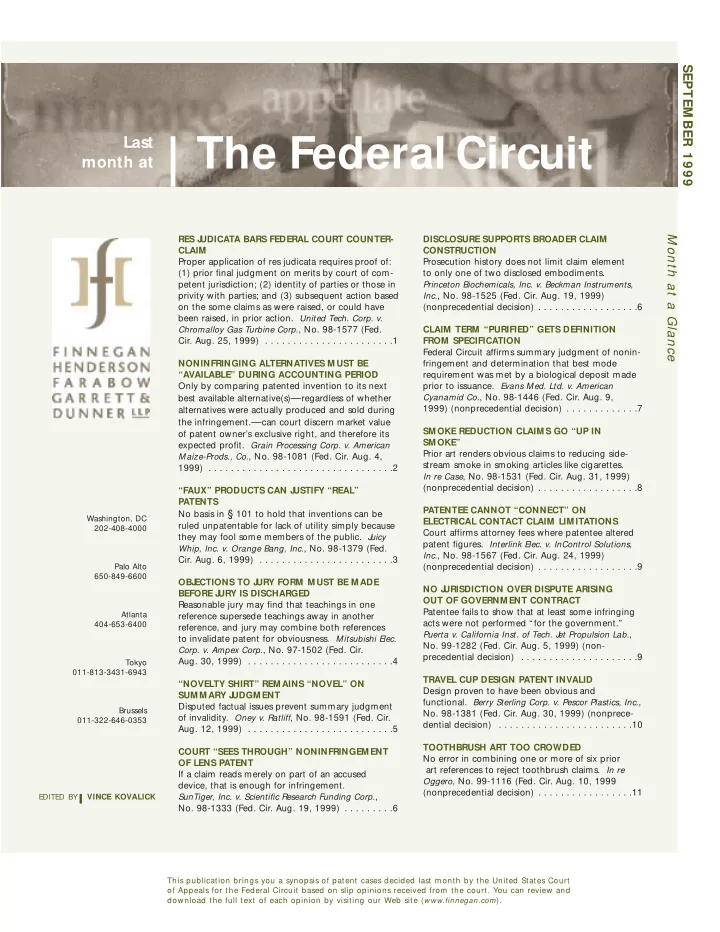
SEPTEM BER 1999 Last The Federal Circuit month at M ont h at a Glance RES J UDICATA BARS FEDERAL COURT COUNTER- DISCLOSURE SUPPORTS BROADER CLAIM CLAIM CONSTRUCTION Proper application of res judicata requires proof of: Prosecution


slide-1
SLIDE 1

EDITED BY VINCE KOVALICK This publication brings you a synopsis of patent cases decided last month by the United States Court

  • f Appeals for the Federal Circuit based on slip opinions received from the court. You can review and

download the full text of each opinion by visiting our Web site (www.finnegan.com). Washington, DC 202-408-4000 Palo Alto 650-849-6600 Atlanta 404-653-6400 Tokyo 011-813-3431-6943 Brussels 011-322-646-0353

RES J UDICATA BARS FEDERAL COURT COUNTER- CLAIM Proper application of res judicata requires proof of: (1) prior final judgment on merits by court of com- petent jurisdiction; (2) identity of parties or those in privity with parties; and (3) subsequent action based

  • n the some claims as were raised, or could have

been raised, in prior action. United Tech. Corp. v. Chromalloy Gas Turbine Corp., No. 98-1577 (Fed.

  • Cir. Aug. 25, 1999) . . . . . . . . . . . . . . . . . . . . . . .1

NONINFRINGING ALTERNATIVES M UST BE “AVAILABLE” DURING ACCOUNTING PERIOD Only by comparing patented invention to its next best available alternative(s)—regardless of whether alternatives were actually produced and sold during the infringement.—can court discern market value

  • f patent owner’s exclusive right, and therefore its

expected profit. Grain Processing Corp. v. American Maize-Prods., Co., No. 98-1081 (Fed. Cir. Aug. 4, 1999) . . . . . . . . . . . . . . . . . . . . . . . . . . . . . . . . .2 “FAUX” PRODUCTS CAN J USTIFY “REAL” PATENTS No basis in § 101 to hold that inventions can be ruled unpatentable for lack of utility simply because they may fool some members of the public. J uicy Whip, Inc. v. Orange Bang, Inc., No. 98-1379 (Fed.

  • Cir. Aug. 6, 1999) . . . . . . . . . . . . . . . . . . . . . . . .3

OBJ ECTIONS TO J URY FORM M UST BE M ADE BEFORE J URY IS DISCHARGED Reasonable jury may find that teachings in one reference supersede teachings away in another reference, and jury may combine both references to invalidate patent for obviousness. Mitsubishi E

lec.

  • Corp. v. Ampex Corp., No. 97-1502 (Fed. Cir.
  • Aug. 30, 1999) . . . . . . . . . . . . . . . . . . . . . . . . . .4

“NOVELTY SHIRT” REM AINS “NOVEL” ON SUM M ARY J UDGM ENT Disputed factual issues prevent summary judgment

  • f invalidity. Oney v. Ratliff, No. 98-1591 (Fed. Cir.
  • Aug. 12, 1999) . . . . . . . . . . . . . . . . . . . . . . . . . .5

COURT “SEES THROUGH” NONINFRINGEM ENT OF LENS PATENT If a claim reads merely on part of an accused device, that is enough for infringement.

SunTiger, Inc. v. Scientific Research Funding Corp.,

  • No. 98-1333 (Fed. Cir. Aug. 19, 1999) . . . . . . . . .6

DISCLOSURE SUPPORTS BROADER CLAIM CONSTRUCTION Prosecution history does not limit claim element to only one of two disclosed embodiments.

Princeton Biochemicals, Inc. v. Beckman Instruments, Inc., No. 98-1525 (Fed. Cir. Aug. 19, 1999) (nonprecedential decision) . . . . . . . . . . . . . . . . . .6

CLAIM TERM “PURIFIED” GETS DEFINITION FROM SPECIFICATION Federal Circuit affirms summary judgment of nonin- fringement and determination that best mode requirement was met by a biological deposit made prior to issuance. E

vans Med. Ltd. v. American Cyanamid Co., No. 98-1446 (Fed. Cir. Aug. 9, 1999) (nonprecedential decision) . . . . . . . . . . . . .7

SM OKE REDUCTION CLAIM S GO “UP IN SM OKE” Prior art renders obvious claims to reducing side- stream smoke in smoking articles like cigarettes.

In re Case, No. 98-1531 (Fed. Cir. Aug. 31, 1999) (nonprecedential decision) . . . . . . . . . . . . . . . . . .8

PATENTEE CANNOT “CONNECT” ON ELECTRICAL CONTACT CLAIM LIM ITATIONS Court affirms attorney fees where patentee altered patent figures. Interlink E

  • lec. v. InControl Solutions,

Inc., No. 98-1567 (Fed. Cir. Aug. 24, 1999) (nonprecedential decision) . . . . . . . . . . . . . . . . . .9

NO J URISDICTION OVER DISPUTE ARISING OUT OF GOVERNM ENT CONTRACT Patentee fails to show that at least some infringing acts were not performed “ for the government.”

Puerta v. California Inst. of Tech. J et Propulsion Lab.,

  • No. 99-1282 (Fed. Cir. Aug. 5, 1999) (non-

precedential decision) . . . . . . . . . . . . . . . . . . . . .9 TRAVEL CUP DESIGN PATENT INVALID Design proven to have been obvious and

  • functional. Berry Sterling Corp. v. Pescor Plastics, Inc.,
  • No. 98-1381 (Fed. Cir. Aug. 30, 1999) (nonprece-

dential decision) . . . . . . . . . . . . . . . . . . . . . . . .10 TOOTHBRUSH ART TOO CROWDED No error in combining one or more of six prior art references to reject toothbrush claims. In re Oggero, No. 99-1116 (Fed. Cir. Aug. 10, 1999 (nonprecedential decision) . . . . . . . . . . . . . . . . .11

SEPTEM BER 1999

The Federal Circuit

Last month at

M ont h at a Glance

slide-2
SLIDE 2

Res J udicata Bars Federal Court Counterclaim

Lawrence F . Galvin

[J udges: Gajarsa (author), Schall, and Cudahy (sitting by designation)] In United Technologies Corp. v. Chromalloy Gas

Turbine Corp., No. 98-1577 (Fed. Cir. Aug. 25, 1999), the Federal Circuit reversed a district court’s denial of a motion for partial summary judgment (“ SJ ” ) to bar a defendant’s counterclaim for breach

  • f contract and vacated the district court’s grant of

specific performance grounded on that same coun-

  • terclaim. The Court based its decision on the dis-

trict court’s failure to apply the doctrine of res judi- cata (“ RJ ” ) following a state law antitrust action adjudicated in a different state. United Technologies Corporation (“ United” ) manufactures jet aircraft gas-turbine engines through its Pratt & Whitney (“ Pratt” ) aircraft divi-

  • sion. Many of these Pratt engines power commer-

cial airliners. United owns and licenses proprietary technology, including patented processes, for repairing certain components of these engines. In 1985, United and Chromalloy Gas Turbine Corporation (“ Chromalloy” ) entered into an agree- ment (“ the Repair Agreement” ). Under the Repair Agreement, United would license some of its pro- prietary technology to Chromalloy and assist Chromalloy in meeting Federal Aviation Administration regulatory requirements for engine

  • repair. In exchange, Chromalloy owed royalties to

United for each repair using the proprietary tech-

  • nology. Over time, United and Chromalloy mutual-

ly had agreed to expand the proprietary technology included under the Repair Agreement to encompass various newly developed engines and repair processes. In 1992, the federal government began to investigate Chromalloy regarding alleged defective engine repair, including repair of Pratt engines cov- ered by the Repair Agreement. In 1995, a United royalty audit disclosed alleged underpayment of royalties and unauthorized uses of proprietary tech- nology by Chromalloy. As a result, United filed suit against Chromalloy in the United States District Court for the District of Delaware, alleging patent infringement and breach of contract. In lieu of an antitrust counterclaim in Delaware, Chromalloy filed an antitrust action in Texas state court, seeking both damages and injunctive relief. The Texas court denied United’s motion to stay the Texas case in favor of the Delaware case, so both cases pro- ceeded simultaneously. However, the Texas court granted a motion in limine by United to prevent Chromalloy from arguing any breach of contract claims in the Texas case. The jury in the Texas case found that United had attempted to engage in monopolistic conduct, but returned a zero damages award. In the Delaware case, Chromalloy filed various counterclaims, including a third counterclaim for breach of contract. Chromalloy sought declaratory relief and specific performance under the Repair Agreement and mandatory licensing of new tech-

  • nology. Following judgment in the Texas case,

United moved for partial SJ in the Delaware case under RJ . United’s motion attempted to bar Chromalloy’s third counterclaim to the extent it sought relief for repairs that had been or could have been litigated in the Texas case. The Delaware court denied United’s motion, finding that the claims and relief sought differed in the two

  • cases. Following a bench trial on the issues con-

tained in the third counterclaim, the Delaware court found that United had breached the Repair

  • Agreement. As a result, the court granted

Chromalloy’s request for specific performance. United appealed both the denial of its RJ motion and the Delaware court’s final judgment. On appeal, the Federal Circuit applied Texas law to the RJ issue, as required by the “ full faith and credit” statute. Under Texas’s transactional approach, RJ prevents the relitigation of a claim or cause of action that has been fully adjudicated or that should have been litigated in a prior suit. United argued that RJ applied regardless of any dif- ferences in the legal theories presented or relief requested because the factual basis of a claim con- trols whether RJ bars that claim. United contended that in both cases Chromalloy had actually litigated the same facts and had even sought the same relief, but under two different names. The Federal Circuit initially observed that United had properly appealed the denial of its SJ motion because the motion involved a purely legal question and the factual disputes resolved in the Delaware case had not affected the resolution of that legal question. The Court then determined that United had preserved its RJ

  • defense. The

Federal Circuit also rejected Chromalloy’s waiver argument because, at an earlier Delaware case hearing, both parties had declared their intent to

page 01 L A ST M O N T H A T

T H E F E D E R A L C I R C U I T

FI N N EG A N H EN D ERSO N FA RA B O W G A RRET T D U N N ER L L P.

slide-3
SLIDE 3

1 9 9 9 SEPT EM B ER

02 page

FI N N EG A N H EN D ERSO N FA RA B O W G A RRET T D U N N ER L L P.

use RJ depending on the outcome of the Texas

  • case. Thus, based upon the Texas case’s prior final

judgment on the merits and its identity of parties with the Delaware case, the only remaining ques- tion was whether Chromalloy’s third counterclaim in the Delaware case had or could have been raised in the Texas case. Applying Texas’s transactional approach, the Federal Circuit found sufficient factual overlap between the Texas case and the third counterclaim in the Delaware case to apply RJ . In particular, both cases presented evidence regarding the propriety of United’s actions, the scope of the Repair Agreement, and the validity and coerciveness of United’s agreements with other repair facilities. Additionally, the Court found unpersuasive Chromalloy’s argument asserting that the two cases involved different transactions demonstrating limit- ed overlap, because United’s actions at issue in both cases had been substantially of the same sort and similarly motivated. Finally, the Federal Circuit found little difference between Chromalloy’s request for a Texas “ injunction” and its demand for Delaware “ specific performance.” Both effectively required a mandatory licensing agreement. Because Chromalloy had sought very similar relief in both cases based on the same or similar conduct, the Federal Circuit reversed the Delaware court’s denial of United’s motion for partial SJ bar- ring Chromalloy’s third counterclaim and vacated the Delaware court’s grant of specific performance grounded on that same counterclaim.

Noninfringing Alternatives Must Be Available During Accounting Period

J

  • hn R. Alison

[J udges: Rader (author), Friedman, and Bryson] In Grain Processing Corp. v. American Maize-

Products, Co., No. 98-1081 (Fed. Cir. Aug. 4, 1999), the Federal Circuit affirmed a judgment by the Northern District of Illinois refusing to award lost profits in light of evidence of noninfringing alterna- tives. Grain Processing Corp.’s (“ Grain Processing” ) U.S. Patent No. 3,849,194 (“ the ‘194 patent” ) claims a waxy starch hydrolysate having a “ dextrose equivalent,” or “ D.E.,” of between five and twenty- five having certain physical properties. After American Maize-Products, Co.’s (“ American Maize” ) maltodextrin product had been found to infringe in 1988, American Maize switched to an alternative process using the enzyme alpha amylase (identified in the opinion as “ Process III” ). When Process III also had been found to infringe in 1991, American Maize quickly adopted a fourth process (identified in the opinion as “ Process IV” ), which involved adding a second enzyme, glucoamylase, to Process III. Specifically, the trial court found that it had taken American Maize only two weeks to perfect Process IV and begin mass producing maltodextrin using Process IV—a development period that the trial court considered “ practically instantaneous” for large-scale production. For Process IV , American Maize did not need to change any equipment, source starches, or other ingredients from Process

  • III. The trial court further found that American

Maize had not used Process IV to produce mal- todextrin earlier due to the relatively higher cost of the glucoamylase used in that process. Glucoamylase was available and known throughout the infringement period. Consumers discerned no difference between the noninfringing products made by Process IV and infringing product made by Processes I-III. At the first damages trial, Grain Processing claimed lost profits in the form of lost sales of its maltodextrin product, price erosion, and American Maize’s accelerated market entry after the patent had expired. Grain Processing further claimed that, for any of American Maize’s infringing sales not covered by a lost profits award, Grain Processing should receive a twenty-eight percent royalty. However, after a three-day bench trial, the trial court denied lost profits and determined that a three percent reasonable royalty was adequate to compensate Grain Processing. Moreover, that roy- alty applied from 1981 (the date when Grain Processing had filed suit) until the expiration of Grain Processing’s ‘194 patent in 1991—even though American Maize did not actually develop, produce, or sell its noninfringing Product IV substi- tute until April 1991, seven months before the ‘194 patent had expired. On appeal, the Federal Circuit initially reversed the trial court’s damages decision, ruling that the mere fact of switching to a noninfringing product years after the period of infringement did not estab- lish the presence of a noninfringing substitute dur- ing the infringement period. On remand, however, the trial court amplified its original decision and again denied Grain Processing’s demand for lost profits, holding that Process IV had been “ available” throughout the infringement period. Grain

slide-4
SLIDE 4

Processing again appealed, arguing that nothing in the record established that Process IV had been available from 1981 until its actual development in early 1991. This time, however, the Federal Circuit agreed with the trial court, observing that a substi- tute that was “ not on the market” or “ for sale” dur- ing the infringement nonetheless may figure promi- nently in determining whether a patentee would have made additional profits “ but for” the infringement. The Federal Circuit observed that the process

  • f reconstructing the “ but for” market required the

patent owner to project economic results that did not occur because of the infringement. To this end, the patent owner was permitted to present market reconstruction theories showing all of the ways in which they would have been better off in the “ but for” world. By the same token, the Court reasoned that a fair and accurate reconstruction of the “ but for” market also must take into account, where rel- evant, alternative actions the infringer foreseeably would have undertaken, had it not infringed. Without the infringing product, a rational, would-be infringer would be likely to offer an acceptable noninfringing alternative, if available, to compete with the patent owner rather than leave the market altogether. The Court concluded that “ only by comparing the patented invention to its next best available alternative(s) regardless of whether the alternative(s) were actually produced and sold during the infringement [could] the court discern the market value of the patent owner’s exclusive right, and therefore his expected profit or reward, had the infringer’s activities not prevented him from taking full economic advantage of this right.” Grain Processing, slip op. at 17. With regard to the trial court’s key finding that Process IV was “ available” during the entire infringement period, i.e., 1981-91, the Federal Circuit observed that the critical time period for determining availability of an alternative is the infringement period for which the patent owner claims damages, i.e., the “ accounting period.” Thus, evidence of switching to a noninfringing sub- stitute after the accounting period does not alone show availability of the noninfringing substitute during this critical time. Here, however, the trial court did not base its finding that Process IV was available no later than October 1979 on speculation

  • r possibilities, but on several specific, concrete fac-

tual findings. In particular, the trial court found: (1) that American Maize could readily have obtained all of the materials needed for Process IV , including the glucoamylase enzyme, before 1979; (2) the effects

  • f the enzymes in starch hydrolysis were well

known in the field at that time; (3) American Maize had all of the necessary equipment, know-how, and experience to use the noninfringing product, when- ever it chose to do so during the time it was instead using infringing processes; (4) American Maize thus did not have to “ invent around” the patent, rather all it had to do was use a more expensive glu- coamylase enzyme in its production process; and (5) the sole reason American Maize had not used Process IV prior to 1991 was economic, i.e., because glucoamylase was more expensive and because American Maize reasonably had believed that Process III produced a noninfringing product. In addition, the Court also considered whether and to what extent American Maize’s alleged alter- native was “ acceptable” as a substitute. Although the parties on appeal vigorously disputed the pre- cise scope of the relevant market, the trial court found that both products in the eyes of consumers were the same and available for the same price from the same supplier. Here, American Maize’s sales records (supported by witness testimony) showed no significant changes when it had intro- duced its Process IV product at the same price as previous versions, indicating that consumers consid- ered its important properties to be effectively iden- tical to previous versions. Thus having been shown no clear error in the trial court’s findings that the noninfringing Process IV had been both “ available” and “ acceptable” to consumers, the Federal Circuit affirmed the trial court’s denial of lost profits.

“Faux” Products Can J ustify “Real” Patents

Rouget F . Henschel

[J udges: Bryson (author), Rich, and Schall] In J

uicy Whip, Inc. v. Orange Bang, Inc., No. 98- 1379 (Fed. Cir. Aug. 6, 1999), the Federal Circuit reversed a district court’s holding that a patent to a product designed to deceive the public by imitating another product to increase product sales is invalid for lack of utility. J uicy Whip, Inc. (“ J uicy Whip” ) had sued Orange Bang, Inc. and Unique Beverage Dispensers,

  • Inc. (collectively “ Orange Bang” ) in the U.S. District

Court for the Central District of California, alleging

page 03 L A ST M O N T H A T

T H E F E D E R A L C I R C U I T

FI N N EG A N H EN D ERSO N FA RA B O W G A RRET T D U N N ER L L P.

slide-5
SLIDE 5

1 9 9 9 SEPT EM B ER

04 page

FI N N EG A N H EN D ERSO N FA RA B O W G A RRET T D U N N ER L L P.

infringement of U.S. Patent No. 5,575,405 (“ the ‘405 patent” ). The district court had granted Orange Bang’s motion for summary judgment of invalidity of the ‘405 patent, holding that the invention was invalid under 35 U.S.C. § 101 as lacking utility. The ‘405 patent claimed a postmix beverage dispenser that simulated the appearance of a pre- mix beverage dispenser. Postmix beverage dis- pensers provide for separate sources of syrup con- centrate and water, which are combined and mixed

  • n demand to yield the beverage. Premix beverage

dispensers contain a premixed beverage in a display bowl, from which the beverage is directly dispensed without combining or mixing ingredients. The dis- play bowl promotes impulse buying, but has limit- ed capacity and is subject to bacterial contamina- tion. The postmix dispenser of the ‘405 patent includes a display bowl that only appears to be the source of the dispensed beverage but actually has no fluid connection with the outlet. The display bowl contains a fluid that appears identical to the dispensed beverage but is resistant to bacterial con-

  • tamination. The postmix dispenser of the ‘405

patent thus provides the advantage of a premix dis- penser—promotion of impulse buying—while avoiding the disadvantages of contamination and limited capacity. In holding the ‘405 patent invalid for lack of utility, the district court had relied on two Second Circuit cases. In the first case, Rickard v. Du Bon, 103 F . 868 (2d Cir. 1900), the court had held invalid a patent drawn to a process for spotting tobacco leaves to fool consumers who believed such spotting to be a sign of quality. In the second case, Scott & Williams, Inc. v. Aristo Hosiery Co., 7 F . 2d 1003 (2d Cir. 1925), the court had held invalid a patent drawn to a seamless stocking hav- ing a structure that simulated a seam. Following these two cases, the district court had held that the invention of the ‘405 patent lacked utility because

  • f its deceptive purpose of increasing sales by imi-

tating another product. In reversing the district court’s decision, the Federal Circuit rejected the precedent relied on by the district court, stating that these cases do not reflect the utility requirement under the Patent Act

  • f 1952. The Federal Circuit ruled that the utility

requirement is met if a product can be modified to imitate another product, because that capability is a specific benefit sufficient to meet the utility require-

  • ment. To support this ruling, the Federal Circuit

identified such products as cubic zirconium, imita- tion gold leaf, synthetic fabrics, and imitation

  • leather. The Federal Circuit also referred to three

recent U.S. patents on products designed to imitate another product: a patent to a method for produc- ing imitation grill marks on food, a patent to lami- nated flooring that imitates wood, and a patent to imitation hamburger. The Federal Circuit further noted that even if the invention of the ‘405 patent had involved deception, the utility requirement does not direct the U.S. Patent and Trademark Office or the courts to decide issues of deceptive trade practices. That task is assigned to other agencies, e.g., the Federal Trade Commission and the Food and Drug

  • Administration. The Federal Circuit noted that

while Congress could declare deceptive inventions unpatentable, it has not yet done so, and § 101 does not support a holding that an invention has no utility simply because the invention may deceive some members of the public.

Objections to J ury Form Must Be Made Before J ury Is Discharged

Michael L. Kiklis

[J udges: Newman (author), Skelton, and Lourie] In Mitsubishi E

lectric Corp. v. Ampex Corp., No. 97-1502 (Fed. Cir. Aug. 30, 1999), the Federal Circuit affirmed a jury verdict that U.S. Patent No. 4,336,612 (“ the ‘612 patent” ) and U.S. Patent No. 4,665,533 (“ the ‘533 patent” ), both assigned to Mitsubishi, were invalid. The Federal Circuit found no error in the jury instructions and found that the jury’s verdict was supported by substantial evidence. The ‘612 patent is directed to a system for cor- recting errors that occur during the transmission, recording, or reproduction of digital information. This error-correction system arranges the digital information into a two-dimensional array and encodes the information such that when the information is decoded, errors can be detected and corrected. In reviewing the jury verdict form, the Federal Circuit noted that the jury had not been asked to distinguish among the three principal grounds of invalidity that had been argued at trial, including an invalidating public use. Mitsubishi argued that if any one of these three grounds had not been con- sidered by the jury, the verdict must be vacated and a new trial granted because it would not be possible for the appellate court to have known whether the verdict had been based on the erro- neous ground.

slide-6
SLIDE 6

Ampex argued that Mitsubishi had waived any

  • bjection when it submitted a revised form that

combined these grounds into a single question of

  • invalidity. The Federal Circuit agreed that

Mitsubishi had waived its objection as to the form

  • f the verdict form, pointing out that Mitsubishi

had only argued for special interrogatories for each claim, but had not pressed the argument for sepa- rate theories of invalidity. The Federal Circuit then reviewed whether there was substantial evidence to support the jury

  • verdict. In so doing, the Federal Circuit reviewed

documentary evidence and concluded that the doc- umentary evidence could support a finding that the claimed invention had been in public use more than one year before the filing date of the patent. The ‘533 patent describes a method of improv- ing the transmission of digital data by placing syn- chronizing codes into a stream of data. When transmitting digital data, a segment of the data can be represented as a matrix of rows and columns where the matrix constitutes a block. This block comprises multiple frames where each frame is equated to one row of the matrix. Prior art systems transmitted such data as a stream of frames, with a number of the frames forming an individual block, and placed synchronization codes before each frame and before each block to indicate where a frame or block began or ended. Thus, two codes were needed to indicate the point in a data stream where both a new frame and a new block began. The ‘533 patent uses one code for the start of a frame that also begins a new block and a second code for the start of a frame that does not begin with a new block. As a result, the ‘533 patent does not require the insertion of two codes. The Federal Circuit reviewed the jury’s verdict

  • n the ‘533 patent in a similar manner to that of

the ‘612 patent, and again found, for the same rea- sons it had stated with respect to the ‘612 patent, that any argument regarding the verdict form had been waived. The Federal Circuit also reviewed sufficiency of the evidence supporting the verdict and noted that expert testimony had showed that all of the ele- ments of the contested claim, except for one, appeared in a single reference by Willard (“ Willard II” ). This missing element could be found in either

  • f two additional references: another article by

Willard that predated Willard II (“ Willard I” ) or an article by Goode and Phillips (“ the G& P article” ). Mitsubishi argued that the Willard II article could not be combined with the Willard I article because the Willard I article had stated that use of the miss- ing element was “ never the answer.” Mitsubishi, slip op. at 22. Mitsubishi thus argued that this arti- cle taught away from a combination with the Willard II article. The Federal Circuit, however, concluded that a reasonable jury could have found that the teachings

  • f Willard II superseded the broadly stated negative

teachings of Willard I. Furthermore, the Federal Circuit found that according to the documentary evidence, a reasonable jury could have concluded that the G& P article could have taught one of ordi- nary skill to include the missing element. In conclusion, the Federal Circuit found that the suggestion to combine the subject matter of the Willard II article with the missing element could reasonably have been found in either the Willard II article or the G& P article, thus rendering the claimed invention obvious.

“Novelty Shirt” Remains “Novel”

  • n Summary J

udgment

Michael B. E isenberg

[J udges: Kelly (author), Newman, and Lourie] In Oney v. Ratliff, No. 98-1591 (Aug. 12, 1999), the Federal Circuit reversed a district court’s sum- mary judgment (“ SJ ” ) holding of invalidity, finding multiple issues of fact in dispute. Dale Oney (“ Oney” ) owns U.S. Patent No. 4,999,848 (“ the ‘848 patent” ) entitled “ Novelty Shirt,” which claims priority from a Canadian patent filed September 22, 1989. The claimed nov- elty garment includes a horizontal, freely hanging piece of material for displaying first information when the flap is open and second information, sequel to the first information, when the flap is closed. On August 23, 1995, Oney filed a patent infringement suit against Darrell Ratliff (“ Ratliff” ) for the sale of shirts having a flap that when open dis- plays an animal with an open mouth and when closed displays it with its mouth closed. The district court granted Ratliff’s motion for SJ based on evi- dence of prior use contained in affidavits from Ratliff’s sample maker and silk screen printer, and an independent recollection of purchases prior to the critical date by another witness. Oney argued that under Woodland Trust v.

Flowertree Nursery, Inc., 148 F . 3d 1368 (Fed. Cir. 1998), the evidence presented by Ratliff’s close associates was uncorroborated and insufficient for clear and convincing evidence. The district court had refused to apply this standard, concluding that Oney failed to produce significantly probative coun- tervailing evidence. Oney further argued that if the evidence were insufficient to meet the burden of proof, not only was SJ improper, but SJ should have been entered in his favor. According to the Federal Circuit, SJ “ is inappro- priate if a trier of fact applying the clear and con-

page 05 L A ST M O N T H A T

T H E F E D E R A L C I R C U I T

FI N N EG A N H EN D ERSO N FA RA B O W G A RRET T D U N N ER L L P.

slide-7
SLIDE 7

1 9 9 9 SEPT EM B ER

06 page

FI N N EG A N H EN D ERSO N FA RA B O W G A RRET T D U N N ER L L P.

vincing evidence standard could find for either party.” Oney, slip op. at 5. Citing the fact that the evidence of prior use had been controverted by

  • ther evidence presented by Ratliff, the Court held

that SJ in favor of Ratliff was improper. The Court further found that Oney had not sufficiently proven that the evidence of prior use was uncorroborated,

  • ral testimony of close associates of Ratliff’s as

required under Woodland Trust. The Court, there- fore, held that SJ for Oney would also be improper. Thus, it remanded the case to the district court for trial.

Court “Sees Through” Noninfringement of Lens Patent

Yitai Hu

[J udges: Plager (author), Friedman, and Lourie (dissenting)] In SunTiger, Inc. v. Scientific Research Funding

Corp., No. 98-1333 (Fed. Cir. Aug. 19, 1999), the Federal Circuit reversed a district court’s grant of summary judgment (“ SJ ” ) of noninfringement, con- cluding that at least part of the accused lens prod- uct met the claim limitations. The Court also affirmed the district court’s denial of SJ

  • f invalidity

and rejected the argument that SunTiger was collat- erally estopped from bringing this appeal. SunTiger, Inc. (“ SunTiger” ) owns U.S. Patent

  • No. 4,952,046 (“ the ‘046 patent” ) directed to an
  • ptical lens for sunglasses that screens out certain

wavelengths of visible light that may be harmful to human eyes after extended exposure. This lens incorporates an orange-colored, sharp cut-on dye that blocks out the potentially harmful blue light while allowing other colors of light to be transmitted. The claim language in dispute concerned the transmission properties of the lens with the dye. SunTiger argued that the specific transmission char- acteristics should be those of the dye. The Defendants (collectively “ BluBlocker” ) countered that the claim requires the characteristics for the lens, not the dye. The district court agreed with

  • BluBlocker. The Federal Circuit affirmed this ruling.

Although the Federal Circuit agreed with the district court’s claim construction, it held that the district court had erred in finding that no genuine issue of material fact existed regarding infringe-

  • ment. The accused BluBlocker lens incorporates an
  • range-colored, sharp cut-on dye that has the same

transmission characteristics as those recited in claim

  • 1. The accused lens, however, incorporates an

additional gray gradient surface coating that reduces the amount of visible light transmitted by the lens. The gray coating is darkest at the top and becomes progressively lighter toward the bottom of the lens. SunTiger submitted evidence that the “ right bottom” of the accused lens has transmission properties within the claim limitations. The Federal Circuit explained that it has never required that a claim read on the entirety of an accused device for the device to infringe that claim. The Court also explained that although in certain instances an addition of elements may avoid infringement, such as a claim that requires a specif- ic number of elements, the claim at issue is not spe- cific as to the number of elements. In addition, the Court found that a genuine dispute of material fact concerning certain evidence, rendering a grant of SJ improper. BluBlocker also argued that the district court had erred in denying its motion for SJ

  • f invalidity

because of the on-sale bar under 35 U.S.C. § 102(b). SunTiger and BluBlocker did not dispute that a sale had occurred or when the sale had

  • ccurred, but the parties disputed whether the ‘046

patent was entitled to the filing date of its parent

  • application. Each party submitted affidavits from its

experts to support its position and the district court found that there was “ an old-fashioned factual dis- pute” and denied BluBlocker’s motion. Holding that the district court had not abused its discretion in denying the motion for SJ , the Federal Circuit affirmed. J udge Lourie dissented, arguing that the ‘046 patent was “ plainly invalid” under the on-sale bar because the patent was not entitled to the filing date of its parent application.

Disclosure Supports Broader Claim Construction

Michael T. Siekman

[J udges: Gajarsa (author), Clevenger, and Rader] In Princeton Biochemicals, Inc. v. Beckman

Instruments, Inc., No. 98-1525 (Fed. Cir. Aug. 19, 1999), the Federal Circuit vacated a decision of the

slide-8
SLIDE 8

United States District Court for the District of New J ersey granting Beckman Instruments, Inc.’s (“ Beckman” ) motion for summary judgment (“ SJ ” )

  • f noninfringement of claim 32 of Princeton

Biochemicals, Inc.’s (“ Princeton” ) U.S. Patent No. 5,045,172 (“ the ‘172 patent” ). In doing so, the Federal Circuit held that the district court had improperly interpreted the prosecution history as limiting an element of claim 32 to only one of two disclosed embodiments. Claim 32 of the ‘172 patent is directed to a capillary electrophoresis apparatus comprising “ a holder for holding an end of said capillary tube in

  • perative relation to one of said cups.” A capillary

electrophoresis apparatus is used to separate pro- teins from fluid samples by application of an electri- cal charge, and the ‘172 patent discloses that its capillary electrophoresis apparatus could raise or lower sample cups or tables containing the sample cups. Despite this disclosure, the district court had construed the claim phrase “ in operative relation” to require that the arm that holds the capillary move toward stationary sample cups, not that the sample cups move toward the capillary, stating that the ‘172 patent consistently described the move- ment of the capillary to stationary sample cups. The district court had also based this claim con- struction on the prosecution history in which, in response to a rejection over prior art that the Examiner asserted as teaching a vertically moving capillary, Princeton added two claims that were lim- ited to a vertically moving capillary and canceled claims that recited vertically moving sample cups. The Federal Circuit agreed with the district court that, although claim 32 itself appeared to encompass both a vertically moving capillary and vertically moveable sample cups, the phrase “ in

  • perative relation” required clarification by resort to

the written description. However, the Federal Circuit stated that the argument of Beckman and the district court ignored the specification’s descrip- tion of vertically moving sample cups. The Federal Circuit also noted that original claims had been part

  • f the original specification and that original claims

22 and 24 had recited vertically moving sample cups. Regarding the prosecution history, the Federal Circuit found that the arguments on which the dis- trict court and Princeton had relied concerned claims that did not result in claim 32. Moreover, after amending one of the claims that had resulted in patent claim 32 to recite the vertical movement limitation, Princeton returned that claim to its origi- nal, unamended form when it filed the continua- tion-in-part (“ CIP” ) application resulting in the ‘172

  • patent. Because Princeton had not made any

amendments or arguments that would limit claim 32 to exclude vertically moving sample cups, Princeton’s arguments and amendments in the par- ent application regarding other claims could not limit patent claim 32, which was returned to the unamended form. The Federal Circuit also noted that its refusal to use the arguments in the parent application to limit the scope of the claim in the ‘172 patent did not depend upon the ‘172 patent being a CIP application. Although the Federal Circuit reversed the dis- trict court’s claim construction, it declined to grant Princeton’s motion for SJ

  • f literal infringement

because the district court had dismissed Princeton’s motion as moot in light of its claim construction. Since the district court had not decided Princeton’s motion, it was not before the Federal Circuit. Accordingly, the Federal Circuit remanded the case to the district court to determine the issue of literal infringement in light of the correct claim construc- tion.

Claim Term “Purified” Gets Definition from Specification

Anthony C. Tridico

[J udges: Clevenger, Skelton, and Gajarsa] In E

vans Medical Ltd. v. American Cyanamid Co.,

  • No. 98-1446 (Fed. Cir. Aug. 9, 1999) (nonprece-

dential decision), the Federal Circuit affirmed a dis- trict court’s grant of summary judgment (“ SJ ” ) of noninfringement and affirmed the district court’s determination that the patents in suit satisfy the best mode requirement of 35 U.S.C. § 112. In 1984, Paul Novotny filed a U.S. patent appli- cation from which issued the three asserted patents in the appeal—U.S. Patent Nos. 5,237,052 (“ the ‘052 patent” ); 5,438,120 (“ the ‘120 patent” ); and 5,648,080 (“ the ‘080 patent” ), all assigned to Evans Medical Ltd. (“ Evans Medical” ). The ‘052 patent and the ‘120 patent are both directed to a particular purified protein, or “ antigen,” derived from the whooping cough-causing bacterium, Bordetella pertussis (“ B. pertussis” ). The ‘080 patent is directed to a vaccine comprising the proteinaceous material of the ‘052 and ‘120 patents, i.e., the B. pertussis antigen described

  • therein. The antigen, which is useful as an acellular

vaccine against whooping cough, was initially iden-

page 07 L A ST M O N T H A T

T H E F E D E R A L C I R C U I T

FI N N EG A N H EN D ERSO N FA RA B O W G A RRET T D U N N ER L L P.

slide-9
SLIDE 9

1 9 9 9 SEPT EM B ER

08 page

FI N N EG A N H EN D ERSO N FA RA B O W G A RRET T D U N N ER L L P.

tified by binding to a specific monoclonal antibody called “ BB05.” Since 1986, Takeda Chemical Industries, Ltd., has been producing and marketing an acellular

  • B. pertussis vaccine containing a small amount,

approximately four percent, of a 69kD antigen. In May 1996, Evans Medical, Ltd.; Medeva PLC; SmithKline Beecham Biologicals S.A.; SmithKline Beecham Biologicals Manufacturing S.A.; and SmithKline Beecham Corporation (collectively “ Plaintiffs” ) sued American Cyanamid Company; Takeda Chemical Industries, Ltd.; and American Home Products Corporation (collectively “ Defendants” ) for infringement of the three Novotny patents. On cross-motions for SJ , the district court had construed the term “ purified” recited in the ‘052 and ‘120 patent claims as requiring that the claimed B. pertussis antigen must be composed of greater than fifty percent 69kD antigen. The dis- trict court had further ruled that the ‘080 patent claims are inherently limited to a “ purified” antigen. Based on its claim construction, the district court had granted Defendants’ motion for SJ . The district court had also concluded that Novotny’s failure to deposit the BB05 monoclonal antibody prior to or upon filing his original application did not run afoul

  • f the best mode requirement.

On appeal, the Federal Circuit agreed with the district court that the proper construction of “ puri- fied” in the ‘051 and ‘120 patent claims required that the claimed antigen comprise greater than fifty percent of the 69kD antigen. Additionally, state- ments in the prosecution history regarding the “ proteinaceous material” recited in the claims of the ‘080 patent required that the claimed vaccine formulations contain 69kD antigen isolates that are at least fifty percent pure. Because the Defendants’ antigen product contained no more than four per- cent of the 69kD antigen, the Court found that there had been no literal infringement and no infringement under the doctrine of equivalents. As to invalidity, the Federal Circuit held that the three asserted patents were not invalid for fail- ure to disclose the best mode. In particular, since production of monoclonal antibodies was within the ordinary skill of the art at the time the applica- tion was filed and the biological deposit had been

  • n file and had been referred to in the asserted

patents by the time the patents issued, Novotny had satisfied the best mode requirement. The requirement of access to the microorganism during pendency and the requirement of public access to the material after issuance had been met.

Smoke Reduction Claims Go “Up in Smoke”

Michele C. Bosch

[J udges: Schall (author), Rich (heard oral argu- ments), and M ayer] In In re Case, No. 98-1531 (Fed. Cir. Aug. 31, 1999), Paul Case and Alan Stephenson (collectively “ Case” ) appealed a decision on the merits and a decision on a request for rehearing of the Board of Patent Appeals and Interferences (“ Board” ), in which the Board had affirmed the final rejection of all the claims of U.S. Patent Application No. 07/814,779 (“ the ‘779 application” ) for obvious-

  • ness. The Federal Circuit affirmed the Board’s deci-

sion. The ‘779 application is directed to reducing sidestream smoke from smoking articles, such as

  • cigarettes. Sidestream smoke is the smoke that

passes through cigarette paper when cigarette is not being smoked, e.g., when resting in an ashtray. The prior art recognizes that sidestream smoke can be reduced by adding fillers, such as magnesium

  • xide and calcium carbonate, to cigarette paper.

Independent claims 1 and 17 of the ‘779 appli- cation, which are representative of all claims on appeal, recite that the total filler content of a ciga- rette paper is “ about 20% by weight or less,” of which “ about 4% to about 14%” is magnesium hydroxide or magnesium oxide. The Examiner had rejected the claims as obvious over various combi- nations of prior art, the primary reference being U.S. Patent No. 4,231,377 to Cline. Case appealed to the Board, which sustained the Examiner’s rejec- tions after concluding that the prior art had estab- lished the obviousness of the appealed claims and that the evidence of nonobviousness supplied by Case had failed to outweigh the evidence of obvi-

  • usness.

The Board found that Cline discloses the use of magnesium oxide as the sole filler in the disclosed cigarette paper, with the amount being as little as fifteen percent by weight of the paper. The Board determined that Cline rendered the claims obvious because Case had made no compelling arguments that the difference between “ about 14%” and “ at least 15%” produces any unexpected results and because the Case specification states that the range

  • f magnesium oxide may be “ about 4% to about

18% by weight” of the total weight of the cigarette paper, further indicating that the difference

slide-10
SLIDE 10

between Case and Cline at the margins (fourteen to fifteen percent) is inconsequential. Before the Federal Circuit, the Commissioner of Patent and Trademarks (“ Commissioner” ) argued that the Board had erred in concluding that Cline teaches using fifteen percent magnesium oxide as the sole filler and that both the plain language of the Cline specification and the examples teach this

  • amount. The Government argued that Case’s

“ about 14%” claim limitation is reasonably inter- preted to overlap Cline’s fifteen percent magnesium

  • xide because Case’s only clarification on the upper

limit of magnesium oxide is “ about 18%.” The Government further argued that Case had not shown any appreciable difference between the claimed “ about 14%” limitation and the prior art’s fifteen percent teaching. Thus, the Commissioner maintained that, before the Board, the Examiner had made out a prima facie case of obviousness that had not been rebutted. The Federal Circuit agreed with the Board’s findings as to what Cline teaches. The Court looked at the differences between Cline and Case and concluded that the only significant difference was the respective ranges of the magnesium oxide present in the paper—ranges that the Court found at the very least abut one another. Thus, the Court agreed with the Board’s conclusion that a prima facie case of obviousness had been established. The Court further disagreed with Case’s argument that Cline teaches away from the claimed inven- tion, stating that because the ranges of magnesium

  • xide in Cline and the claimed invention at the very

least abut one another, some evidence of unexpect- ed results is necessary to show why the claims should be patentable. Although Case presented some evidence that purported to contain compelling evidence of unex- pected results, the Federal Circuit found the evi- dence flawed because it did not compare the claimed invention to the closest prior art.

Patentee Cannot “Connect” on Electrical Contact Limitations

Rebecca M. McNeill

[J udges: M ayer, Skelton, and Newman (per curi- am)] In Interlink E

lectronics v. InControl Solutions, Inc.,

  • No. 98-1567 (Fed. Cir. Aug. 24, 1999) (nonprece-

dential decision), the Federal Circuit affirmed a summary judgment of noninfringement, which had been awarded to InControl Solutions, Inc. (“ InControl” ) by the U.S. District Court for the Central District of California. The patent in this case is directed to a switch

  • r transducer that controls cursor movement. The

claims require “ a first contact; a second contact; [and] at least one semiconducting layer . . . having a surface positioned in normally non-electrically- conducting relationship with at least one of the first and second contacts . . . [with] an external force for causing . . . the semiconductive layer and at least

  • ne of the first and second contacts to variably

press against one another . . . so that electricity conducts between the first and second contacts.” The Federal Circuit affirmed the district court’s decision of noninfringement, concluding that the accused device maintains a conductive connection at all times, in contrast to the patent which includes conductors held normally in a nonconductive rela- tionship and needing an external force for causing a connection between the contacts. The Court found this difference substantial enough to avoid infringement literally and under the doctrine of equivalents. The Federal Circuit also agreed that the case was “ exceptional” and that the award of attorney fees was proper because Interlink Electronics had submitted altered reproductions of figure 3 from the patent, so that the circuit in question appeared closed, making it more similar to the accused device.

No J urisdiction over Dispute Arising Out of Government Contract

Matthew T. Latimer

[J udges: M ichel, Rader, and Gajarsa (per curiam)] In Puerta v. California Institute of Technology J

et Propulsion Laboratory, No. 99-1282 (Fed. Cir. Aug. 5, 1999) (nonprecedential decision), the Federal Circuit affirmed a district court’s grant of summary judgment (“ SJ ” ) of noninfringement of U.S. Patent

  • Nos. 4,945,408 (“ the ‘408 patent” ) and 5,081,530

(“ the ‘530 patent” ), concluding that the district court had properly ruled that it did not have juris- diction and that the district court had properly denied Plaintiff’s request for further discovery.

  • Dr. Puerta (“ Puerta” ) had been employed by

the California Institute of Technology (“ CalTech” ) in the J et Propulsion Laboratory (“ J PL” ) until February 13, 1991, as part of contract NAS7-918 between the National Aeronautics and Space Administration

page 09 L A ST M O N T H A T

T H E F E D E R A L C I R C U I T

FI N N EG A N H EN D ERSO N FA RA B O W G A RRET T D U N N ER L L P.

slide-11
SLIDE 11

1 9 9 9 SEPT EM B ER

10 page

FI N N EG A N H EN D ERSO N FA RA B O W G A RRET T D U N N ER L L P.

(“ NASA” ) and CalTech, whereby NASA provided CalTech funding for research on a “ Rangefinder Project.” Under the contract, Puerta was to be the principal investigator. The contract was later amended, but Puerta was no longer needed as principal investigator. Puerta filed suit for infringement of the ‘408 and ‘530 patents, on which he is a named inventor. Both patents are directed to a three-dimensional camera and laser range finder. The suit was filed in district court under 28 U.S.C. § 1338(a) (1994), which gives district courts exclusive original jurisdic- tion over patent infringement cases. Defendants moved for SJ , asserting that the district court lacked jurisdiction under 28 U.S.C. § 1498(a), and Puerta moved for further discovery under Federal Rule of Civil Procedure 56(f). The district court granted SJ and did not rule on Puerta’s request in view of its finding of lack of jurisdiction. The Federal Circuit upheld the district court’s finding of SJ , stating that while 28 U.S.C. § 1338(a) gives district courts exclusive original jurisdiction

  • ver patent infringement suits, § 1498(a) provides

that the Court of Federal Claims has exclusive juris- diction over patent infringement claims against alleged infringing work performed “ for the govern- ment.” Puerta argued that since work had contin- ued on the Rangefinder Project after his termination but before a new contract was in place, at least some of the work performed at J PL had been for the express purpose of the federal government. However, the Federal Circuit found, among other things, that the evidence proffered by Puerta was insufficient to support his assertion. Thus, the Federal Circuit agreed with the district court that 28 U.S.C. § 1498(a) applies, and the district court did not have jurisdiction to hear the case. Concerning Puerta’s request for additional dis- covery, the Federal Circuit found that Puerta had failed to make clear, either at the district court or

  • n appeal, what facts he expected to discover that

would have precluded SJ in favor of the

  • Defendants. The Federal Circuit also found that

Puerta’s request was tardy because he failed to initi- ate discovery until eight months after he had been entitled to serve discovery notice.

Travel Cup Design Patent Invalid

Christopher W. Day

[J udges: Friedman (author), Schall, and Rich (heard oral argument)] In Berry Sterling Corp. v. Pescor Plastics, Inc., No. 98-1381 (Fed. Cir. Aug. 30, 1999) (nonprecedential decision), the Federal Circuit affirmed a district court’s decision upholding a jury’s verdict invalidat- ing U.S. Design Patent No. 362,368 (“ the ‘368 patent” ) by reason of obviousness and functionality. Moreover, the Court upheld the jury’s verdict that the Berry Sterling Corporation (“ Berry” ) committed a Lanham Act violation against Pescor Plastics, Inc. (“ Pescor” ). The Court, however, vacated the jury’s $150,000 damages award and ordered the district court to enter a damages award in the amount of $7,490. In response to encouragement from the Coca- Cola Co. (“ Coca-Cola” ), Berry agreed to design a beverage cup that had a distinctive appearance, would fit in a variety of car cup holders, and could be manufactured inexpensively. In J anuary 1994, Berry filed a patent application, which resulted in the ‘368 patent, to protect its design. When Pescor began commercially exploiting cups that Berry had alleged were copies of its design, Berry sent a letter warning Pescor of possible infringement of its design once a patent had issued. After the ‘368 patent had issued and no response had been received from Pescor, Berry filed an infringement

  • suit. Berry also issued a press release and sent let-

ters to Pescor’s customers stating that Pescor’s cups infringed its design patent. In issuing these state- ments, however, Berry had failed to identify the particular Pescor cups accused of infringement. A jury found that Pescor had willfully infringed the ‘368 patent by selling particular cups that were within the scope of the ‘368 patent. The jury also concluded, however, that the ‘368 patent was invalid for obviousness and functionality. In addi- tion, the jury found that Berry had violated the Lanham Act by making false and misleading state- ments in its press release and letters. As a result, the jury awarded $150,000 in damages based on Pescor’s lost sales of both its infringing and nonin- fringing cups.

slide-12
SLIDE 12

Concerning the obviousness of the design, Pescor asserted that it had created a requisite pri- mary travel cup by combining a cut-out bottom of a thirty-two ounce cup with an upper half of a twenty ounce cup. This hybrid cup, according to Pescor, had the same overall appearance as Berry’s patented cup. Pescor also contended that it had marketed its hybrid cup before Berry invented his travel cup. According to Berry, however, Pescor’s cups constituted two references combined, rather than the required single reference. The Federal Circuit disagreed. By introducing evidence that it had previously marketed such a travel cup, the Court held, Pescor had presented sufficient evi- dence to sustain the jury’s verdict. The Court also affirmed the invalidity of the ‘368 patent based on functionality. To render a design patent functional, the Court recognized, each of the features that create the design’s overall appearance must be dictated by functional con-

  • cerns. As such, Berry asserted that its design was

primarily ornamental, rather than functional. To support this argument, Berry pointed to the exis- tence of alternative cup designs, which perform the same function of fitting into car holders. The Court, however, recognized that each of the allegedly ornamental features, which Berry had used to distinguish its cup design from the prior art, were described as functional in a utility patent granted on the same article. Consequently, the Court held that the jury had reasonably concluded that Berry’s cup design was primarily utilitarian and, thus, invalid. Concerning the Lanham Act damages award, the jury had found that Berry’s failure to specify which of Pescor’s cups allegedly infringed the ‘368 patent constituted a false and misleading state-

  • ment. By failing to identify the infringing cup, the

Court noted, Berry had created customer confusion as to which cups were involved in the suit. However, the jury had also found that many of Pescor’s other cups actually infringed the ‘386

  • patent. As such, the Court held that Berry’s state-

ments had been false and misleading only to the extent that they applied to Pescor’s noninfringing

  • cups. Accordingly, the Court concluded that the

award of damages on the Lanham Act claim should be reduced to $7,490, which represented Pescor’s

lost sales of its noninfringing cups.

Toothbrush Art Too Crowded

Timothy M. Hsieh

[J udges: M ichel (author), M ayer, and Rader] The Federal Circuit, in In re Oggero, No. 99- 1116 (Fed. Cir. Aug. 10, 1999) (nonprecedential decision), upheld a decision of the Board of Patent Appeals and Interferences (“ Board” ), finding the toothbrush invention in question obvious in view of

  • ne or more of six prior art references.

Bonnilyn Oggero’s (“ Oggero” ) application con- cerns a toothbrush with an integral toothpaste con- tainer that allows a user to dispense toothpaste through the bristles of the brush head. In particu- lar, the claims provide for a transparent, disposable toothbrush having an integrated container holding at least four ounces of toothpaste. The Board affirmed the Examiner’s decision rejecting the claims as obvious in view of one or more of six prior art patents. The Board found that the prior art references that disclosed or suggested each of the limitations Oggero had asserted patentably distinguished her invention over the prior art. On appeal, Oggero argued that while one prior art reference disclosed a transparent housing for a toothbrush and another disclosed an integral brush head, none of the prior art references contained an explicit suggestion to combine their teachings. The Federal Circuit rejected this argument, holding that in the crowded art of toothbrushes, no explicit sug- gestion in the references is needed to combine their teachings where the prior art does not teach away from the combination. According to the Court, the motivation to combine the references arose from the apparent gains in convenience from an integral brush head that allows a user to dispense tooth- paste through the brush head and transparency that allows a user to see how much toothpaste is left. Oggero also argued that the Board had erred in concluding that disposability was disclosed in the prior art. Although the Federal Circuit agreed with the Board’s conclusion that any toothbrush is dis- posable after a certain length of time, the Court nonetheless found this feature in the prior art.

page 11 FI N N EG A N H EN D ERSO N FA RA B O W G A RRET T D U N N ER L L P.

DISCLAIMER:

The case summaries reflect the understanding

  • f the authors only and are not meant to con-

vey legal opinions or advice of any kind. The firm disclaims any liability for any errors or

  • missions in these summaries. This promotion-

al newsletter does not establish any form of attorney-client relationship with our firm or with any of our attorneys.