The Federal Circuit month at M ont h at a Glance SEEDS AND PLANTS - - PDF document

the federal circuit
SMART_READER_LITE
LIVE PREVIEW

The Federal Circuit month at M ont h at a Glance SEEDS AND PLANTS - - PDF document

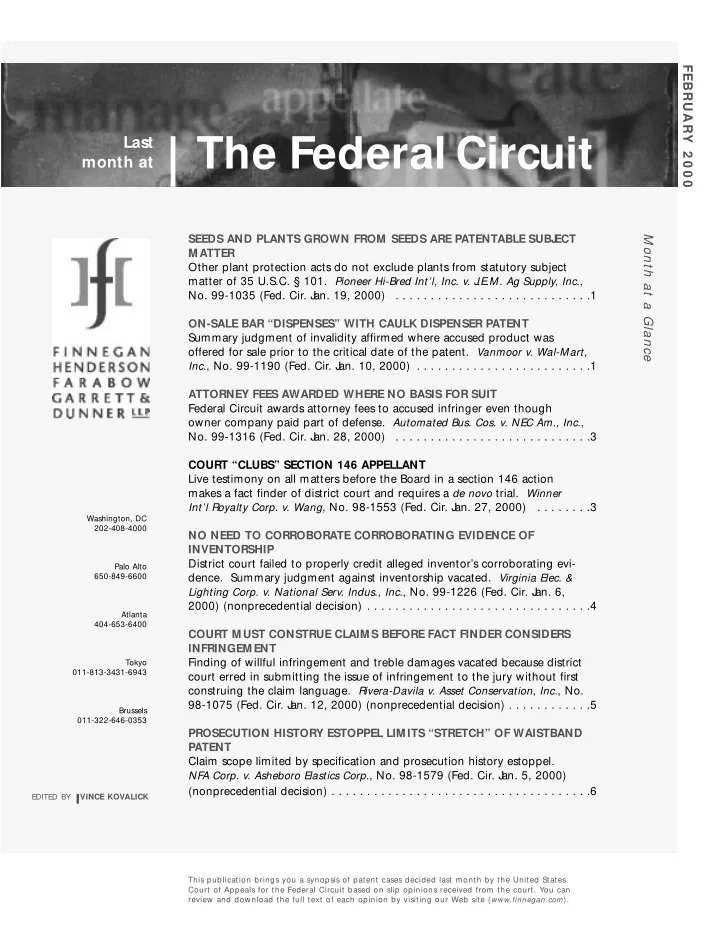
FEBRUARY 2 0 0 0 Last The Federal Circuit month at M ont h at a Glance SEEDS AND PLANTS GROWN FROM SEEDS ARE PATENTABLE SUBJ ECT M ATTER Other plant protection acts do not exclude plants from statutory subject matter of 35 U.S.C. 101.


slide-1
SLIDE 1

EDITED BY VINCE KOVALICK This publication brings you a synopsis of patent cases decided last month by the United States Court of Appeals for the Federal Circuit based on slip opinions received from the court. You can review and download the full text of each opinion by visiting our Web site (www.finnegan.com). Washington, DC 202-408-4000 Palo Alto 650-849-6600 Atlanta 404-653-6400 Tokyo 011-813-3431-6943 Brussels 011-322-646-0353

SEEDS AND PLANTS GROWN FROM SEEDS ARE PATENTABLE SUBJ ECT M ATTER Other plant protection acts do not exclude plants from statutory subject matter of 35 U.S.C. § 101. Pioneer Hi-Bred Int’l, Inc. v. J

.E .M. Ag Supply, Inc.,

  • No. 99-1035 (Fed. Cir. J
  • an. 19, 2000) . . . . . . . . . . . . . . . . . . . . . . . . . . . .1

ON-SALE BAR “DISPENSES” WITH CAULK DISPENSER PATENT Summary judgment of invalidity affirmed where accused product was

  • ffered for sale prior to the critical date of the patent. Vanmoor v. Wal-Mart,

Inc., No. 99-1190 (Fed. Cir. J

  • an. 10, 2000) . . . . . . . . . . . . . . . . . . . . . . . . .1

ATTORNEY FEES AWARDED WHERE NO BASIS FOR SUIT Federal Circuit awards attorney fees to accused infringer even though

  • wner company paid part of defense. Automated Bus. Cos. v. NE

C Am., Inc.,

  • No. 99-1316 (Fed. Cir. J
  • an. 28, 2000) . . . . . . . . . . . . . . . . . . . . . . . . . . . .3

COURT “CLUBS” SECTION 146 APPELLANT Live testimony on all matters before the Board in a section 146 action makes a fact finder of district court and requires a de novo trial. Winner

Int’l Royalty Corp. v. Wang, No. 98-1553 (Fed. Cir. J

  • an. 27, 2000) . . . . . . . .3

NO NEED TO CORROBORATE CORROBORATING EVIDENCE OF INVENTORSHIP District court failed to properly credit alleged inventor’s corroborating evi-

  • dence. Summary judgment against inventorship vacated. Virginia E
  • lec. &

Lighting Corp. v. National Serv. Indus., Inc., No. 99-1226 (Fed. Cir. J

  • an. 6,

2000) (nonprecedential decision) . . . . . . . . . . . . . . . . . . . . . . . . . . . . . . . .4 COURT M UST CONSTRUE CLAIM S BEFORE FACT FINDER CONSIDERS INFRINGEM ENT Finding of willful infringement and treble damages vacated because district court erred in submitting the issue of infringement to the jury without first construing the claim language. Rivera-Davila v. Asset Conservation, Inc., No. 98-1075 (Fed. Cir. J

  • an. 12, 2000) (nonprecedential decision) . . . . . . . . . . . .5

PROSECUTION HISTORY ESTOPPEL LIM ITS “STRETCH” OF WAISTBAND PATENT Claim scope limited by specification and prosecution history estoppel.

NFA Corp. v. Asheboro E lastics Corp., No. 98-1579 (Fed. Cir. J

  • an. 5, 2000)

(nonprecedential decision) . . . . . . . . . . . . . . . . . . . . . . . . . . . . . . . . . . . . .6

FEBRUARY 2 0 0 0

The Federal Circuit

Last month at

M ont h at a Glance

slide-2
SLIDE 2

Seeds and Plants Grown from Seeds Are Patentable Subject Matter

E lizabeth A. Hurley

[J udges: Newman (author), M ayer and Lourie] In Pioneer Hi-Bred International, Inc. v.

J .E .M. Ag Supply, Inc., No. 99-1035 (Fed. Cir.

J

  • an. 19, 2000), on interlocutory appeal of the

denial of summary judgment (“ SJ ” ), the Federal Circuit affirmed the district court’s rul- ing that seeds and plants grown from seeds are patentable subject matter. Pioneer Hi-Bred International, Inc. (“ Pioneer” ) sued Defendants for infringement

  • f certain patents directed to plants and seeds

for new varieties of hybrid and inbred corn. Defendants, J .E.M. Ag Supply, Inc. (“ J EM” ), moved for SJ , arguing that seeds and seed- grown plants do not constitute patentable subject matter under 35 U.S.C. § 101. The district court held that under the Supreme Court’s decision in Diamond v.

Chakrabarty, 447 U.S. 303, 309 (1980), there

is no basis in law for excluding living things such as seeds and plants from the subject mat- ter included in § 101. J EM argued that

Chakrabarty does not apply to plants, because

plants were intended to be excluded from the patent system, as evidenced by the enactment

  • f other statutes that provide protection to

plants, such as the Plant Variety Protection Act (“ PVP A” ), 7 U.S.C. § 2321 et seq. The PVP A, which does not include an extensive examina- tion system and is administered by the Department of Agriculture, was enacted in 1970 as a form of protection for new varieties

  • f seed-grown plants.

The district court observed that the Patent & Trademark Office (“ PTO” ) has been granting patent protection to new and unob- vious varieties of seed plants for at least fifteen years, and that the Board of Patent Appeals and Interferences had rejected J EM’s argument that plant-specific acts such as the PVP A are the exclusive forms of protection for plant life covered by those acts. In re Hibberd, 227 U.S.P .Q. 443 (Bd. Pat. App. & Int. 1985). The district court also did not discern any historical basis for the exclusion of seed-grown plants from the scope of § 101. In

Chakrabarty, the Supreme Court explained

that plants had not been previously deemed patentable because they are products of nature, and they could not be described with sufficient precision to satisfy the written description requirement of the patent statute. Now, however, the district court reasoned, plants can be modified by technology so they are not solely products of nature. In addition, impediments to fulfilling the written descrip- tion requirement have been lessened by the implementation of rules authorizing the deposit of new species in publicly available depositories, as well as advances in botanical understanding and analysis. On appeal, J EM argued that 35 U.S.C. as a general statute must give way to a specific

  • ne, such as the PVP
  • A. The Federal Circuit

agreed with the district court, however, that all of the statutes protecting plants could be read in harmony and that the PVP A did not effect an exclusion of new plant varieties from § 101. The Federal Circuit also agreed with the district court’s observation that any conflict between Title 35 and the PVP A is simply the difference in the rights and obligations imposed by the two statutes, and that more than one statute can apply to a property inter- est; the fact that laws are of different scope does not invalidate those laws.

On-Sale Bar “Dispenses” with Caulk Dispenser Patent

Brian M. Burn

[J udges: M ayer (author), Archer, and Rader] In Vanmoor v. Wal-Mart, Inc., No. 99-1190 (Fed. Cir. J

  • an. 10, 2000), the Federal Circuit

affirmed the district court’s summary judg- ment (“ SJ ” ) of invalidity, finding the asserted patent invalid as having been on sale prior to

page 01 L A ST M O N T H A T

T H E F E D E R A L C I R C U I T

FI N N EG A N H EN D ERSO N FA RA B O W G A RRET T D U N N ER L L P.

slide-3
SLIDE 3

2 0 0 0 FEB RU A RY

02 page

FI N N EG A N H EN D ERSO N FA RA B O W G A RRET T D U N N ER L L P.

the critical date. The Federal Circuit also affirmed the district court’s SJ

  • f no trade

secret misappropriation by manufacturers of the alleged infringing device, as the Plaintiff, Arthur Vanmoor, had proffered no evidence in support of this allegation. Vanmoor sued Wal-Mart Stores, Inc.; Builder’s Square, Inc.; Home Depot U.S.A., Inc.; and Red Devil, Inc. (collectively “ Wal- Mart” ) for infringement of U.S. Patent No. 5,582,331 (“ the ‘331 patent” ). The claimed invention is directed to a cartridge used to dis- pense caulking compound, comprising a tubu- lar body having a forward end with a dispens- ing opening and a moveable backwall (com- monly known as a plunger) disposed within the tubular body. Vanmoor initially filed a complaint in dis- trict court alleging that Wal-Mart infringed the ‘331 patent. Wal-Mart denied infringement and interposed an affirmative defense that the ‘331 patent was invalid and unenforceable. In an amended complaint, Vanmoor asserted a new trade secret misappropriation claim against, as newly added Defendants, two manufacturers of tubes and plungers used in the caulking cartridges, Federal Packaging

  • Corp. and Sonoco Products Co. (“ the manu-

facturers” ). The manufacturers denied all material allegations and sought a declaratory judgment of invalidity of the ‘331 patent. The district court, in granting Wal-Mart’s motion for SJ

  • n the issue of invalidity, con-

cluded that Vanmoor failed to raise a genuine issue of material fact that the allegedly infring- ing cartridges had not been on sale prior to the critical date of the patent, and that Wal- Mart showed by clear and convincing evi- dence that they had been on sale prior to the critical date. In addition, the district court granted SJ that the manufacturers had not misappropriated Vanmoor’s trade secrets because Vanmoor failed to present anything beyond conclusory allegations to support his claim. On appeal, Vanmoor argued that SJ

  • f

patent invalidity was inappropriate because Wal-Mart and the manufacturers did not meet their burden of proof that the cartridges that were the subject of the precritical date sales had anticipated the claims of the ‘331 patent. The Federal Circuit ruled, however, that the burden had been satisfied by Vanmoor’s own allegations that the accused cartridges infringed the ‘331 patent. Vanmoor additionally argued that the accused cartridges were not ready for patent- ing because no single piece of evidence pre- sented at trial would enable a patent attorney to draft the ‘331 patent. The Court stated that this is not the test under Pfaff v. Wells

E lectronics, Inc., 525 U.S. 55 (1998), in which

the Supreme Court held that the ready for patenting “ condition may be satisfied in at least two ways: by proof of reduction to prac- tice before the critical date; or by proof that prior to the critical date the inventor had pre- pared drawings or other descriptions that were sufficiently specific to enable a person skilled in the art to practice the invention.” Id. at 67. According to the Federal Circuit, the precritical date sales were of completed car- tridges made to specifications that had remained unchanged, showing that any inven- tion embodied in the accused cartridges had been reduced to practice before the critical

  • date. Additionally, the Court found that the

Pfaff test was satisfied because the specifica-

tion drawings, available prior to the critical date, had been used to produce the infringing

  • cartridges. The Court concluded that,

because Wal-Mart and the manufacturers met their burden to prove both the Pfaff conditions for application of the on-sale bar, the ‘331 patent was invalid under 35 U.S.C. § 102. With regard to the trade secret misappro- priation claim, the Federal Circuit agreed with the district court that Vanmoor proffered no evidence in support of his conclusory allega-

  • tions. Accordingly, there was no genuine issue
  • f material fact for trial, and SJ

was properly granted on the trade secret misappropriation claim.

slide-4
SLIDE 4

Attorney Fees Awarded Where No Basis for Suit

Gregory A. Chopskie

[J udges: Plager (author), M ichel, and Bryson] In Automated Business Cos. v. NE

C America, Inc., No. 99-1316 (Fed. Cir. J

  • an. 28, 2000), the

Federal Circuit affirmed the district court’s grant of attorney fees where the accused infringer’s grandparent company paid for part

  • f the defense.

Automated Business Companies, Inc. (“ ABC” ) filed a patent infringement suit against NEC America, Inc. (“ NEC” ) for infringement of U.S. Patent No. 4,837,797 (“ the ‘797 patent” ), which claims facsimile machines that can differentiate between a voice call and a fax call. The ability to differ- entiate between voice and fax calls is a critical limitation to the claims of the patent. At a pretrial settlement discussion, NEC had advised ABC that NEC’s accused products could not infringe the ‘797 patent because none of them could differentiate between voice and fax calls. ABC admitted that none

  • f the accused devices could possibly infringe,

but argued nevertheless, that the case should continue so that ABC could determine whether other NEC devices infringed the ‘797 patent. After granting summary judgment, the district court found the case exceptional because ABC had filed and pursued a baseless lawsuit and therefore granted NEC its attorney

  • fees. NEC submitted to the court invoices for

legal services, some of which, however, were addressed to and paid by NEC Corp., NEC’s grandparent company which was not a party to the suit. On appeal, ABC challenged only the amount of the district court’s award, arguing that NEC was not entitled to attorney fees paid for by NEC Corp. The Federal Circuit rejected ABC’s argument, concluding that NEC was entitled to an award of attorney fees for the total amount it would have paid had it defended against the action on its own.

Court “Clubs” Section 146 Appellant

Lawrence F . Galvin

[J udges: M ichel (author), Rader, and Gajarsa] In Winner International Royalty Corp. v.

Wang, No. 98-1553 (Fed. Cir. J

  • an. 27, 2000),

the Federal Circuit affirmed a district court judgment overturning a decision of the United States Patent and Trademark Office Board of Patent Appeals and Interferences (“ Board” ) in an interference and holding that selected claims from a patent and a patent application were not obvious. Winner International Royalty Corp. (“ Winner” ) owns intellectual property related to antitheft devices for automobile steering wheels which prevent theft by blocking the wheel from turning. This property includes U.S. Patent Nos. 4,738,127 (“ the ‘127 patent” ) and 4,935,047 (“ the ’047 patent” ), and U.S. Patent Application No. 07/478,411 (“ the ’411 application” ). The ‘127 patent claims a device commercially known as “ The Club,” which includes a dead-bolt lock mecha-

  • nism. Commercial embodiments of the later

’047 patent use a self-locking ratcheting mechanism. Ching-Rong Wang (“ Wang” ) manufactures an antitheft device known as “ The Gorilla Grip” under U.S. Patent No. 4,887,443 (“ the ’443 patent” ). J inn Wu (“ Wu” ), the inventor of both the ’047 patent and the ’411 application, pro- voked an interference with the ’443 patent. Eventually, the claims of the ’047 patent and the ’411 application were added to the inter- ference count. During the interference pro- ceeding, Wang conceded the invalidity of his ’443 patent, but sought to prove that the ’047 patent was unpatentable as obvious in light of four specific prior art references, including the ‘127 patent and U.S. Patent No. 3,462,982 (“ Moore” ). After a final hearing, the Board held all affected claims invalid except for two claims of the ’047 patent. Wu appealed to the United

page 03 L A ST M O N T H A T

T H E F E D E R A L C I R C U I T

FI N N EG A N H EN D ERSO N FA RA B O W G A RRET T D U N N ER L L P.

slide-5
SLIDE 5

2 0 0 0 FEB RU A RY

04 page

FI N N EG A N H EN D ERSO N FA RA B O W G A RRET T D U N N ER L L P.

States District Court for the District of Columbia under 35 U.S.C. § 146. After a bench trial, during which the district court admitted the record before the Board, heard testimony, and received documentary evi- dence, the court held that two additional claims of the ’047 patent would not have been obvious given the lack of evidence sug- gesting a motivation to combine the four prior art references. On appeal, the Federal Circuit considered whether the scope of the evidence admitted by the district court was sufficient to require a complete trial de novo, or whether the district court was instead required to give deference to some or all of the Board’s findings of fact. The Court concluded that although live testi- mony before a district court might be the same or similar to testimony before the Board in the form of affidavits and deposition tran- scripts, a district court should still make de

novo factual findings, while treating the record

before the Board when offered by a party as if it had been produced at the district court. Regarding the merits, the Federal Circuit determined that the district court had not erred in concluding that there was no motiva- tion to combine the prior art as suggested by the Board. As a result, the Federal Circuit affirmed the district court’s judgment.

No Need to Corroborate Corroborating Evidence of Inventorship

Linda J . Thayer

[J udges: M ichel (author), Plager, and Bryson] In Virginia E

lectronics & Lighting Corp. v. National Service Industries, Inc., No. 99-1226

(Fed. Cir. J

  • an. 6, 2000) (nonprecedential deci-

sion), the Federal Circuit affirmed in part a dis- trict court summary judgment (“ SJ ” ) ruling that Virginia Electronics & Lighting Corp. (“ Velcorp” ) failed to establish its ability to prove at trial that it had taken the requisite reasonable steps to protect the secrecy of its light emitting diode (“ LED” ) lamp design, but vacated in part and remanded because the district court had erred by holding that Velcorp had not provided sufficient evidence

  • f prior conception of the claimed invention.

In spring 1993, National Service Industries, Inc., d/b/a/ Lithonia Lighting (“ Lithonia” ) was developing LEDs for use as replacement bulbs in exit signs. Lithonia approached Velcorp for assistance while Lithonia continued development efforts on its

  • wn. Gregory Stepp, president of Velcorp,

had Mori Denshi Sango Co. (“ MDS” ) produce a series of prototype LEDs beginning in J une

  • r J

uly 1993. On J anuary 6, 1994, Stepp signed a confidentiality agreement that Velcorp would not disclose or use confidential information received from, but not given to, Lithonia regarding LED lamps. In an attempt to further clarify their rela- tionship, the parties exchanged subsequent correspondence regarding confidentiality and

  • nondisclosure. In a J

anuary 26, 1994, letter to Lithonia, Stepp stated that it was Velcorp’s understanding that all information exchanged between the parties prior to the signing of the J anuary 6, 1994, agreement had not been protected and was considered public disclo-

  • sure. In another confidentiality and nondisclo-

sure agreement signed J anuary 31, 1994, and amended February 2, 1994, Lithonia agreed to control and limit access to information provid- ed by Velcorp; however, the agreement excluded preexisting information exchanged between the parties. Velcorp provided two more prototype lamps to Lithonia in February 1994. On March 4, 1994, J ames J

  • hnson, a Lithonia

employee, filed a patent application on an LED lamp, which issued on October 31, 1995, as U.S. Patent No. 5,463,280 (“ the ‘280 patent” ), assigned to Lithonia. In August 1996, Velcorp filed suit against Lithonia alleg- ing misappropriation of Velcorp’s trade secrets under Georgia Trade Secrets Act, O.C.G.A. § 10-1-760 et seq., and alleging that Stepp, not J

  • hnson, was the true and sole inventor of
slide-6
SLIDE 6

the LED lamp in the ‘280 patent. The district court granted Lithonia’s motion for SJ

  • n both

counts, and Velcorp appealed. The Federal Circuit affirmed the district court’s SJ

  • n the misappropriation of trade

secrets count. The Court found that because Velcorp had admitted in writing that informa- tion given to Lithonia prior to J anuary 6, 1994, was not protected and was considered public disclosure, and because Velcorp had failed to supply any evidence of efforts to protect the secrecy of its alleged LED lamp design, Velcorp had failed to demonstrate that it could carry its burden of establishing elements essential to its case at trial. The Federal Circuit vacated the lower court’s grant of SJ

  • n the inventorship issue,
  • however. Velcorp had presented Stepp’s testi-

mony that he conceived the claimed invention and directed MDS to prepare prototypes, the LED lamp prototypes, a manufacturer’s draw- ing by MDS, prototype shipping receipts from MDS to Velcorp and Velcorp to Lithonia, and testimony of officers at Lithonia that they had seen the Velcorp prototypes at Lithonia prior to the filing date of the ‘280 patent. The Court reiterated that, in the SJ con- text, all reasonable inferences from evidence should be drawn in favor of the nonmoving party, in this case Velcorp, and that the district court had not properly credited Velcorp’s evi-

  • dence. For example, Stepp’s testimony con-

flicted with that of Lithonia’s witnesses, which at least raised a genuine issue of material fact. Furthermore, the Court reiterated that, while an inventor’s testimony cannot by itself sup- port a claim of invention, the corroboration rule requires only that the testimony be cor-

  • roborated. It does not require that the cor-

roborating evidence also be corroborated.

Virginia E

  • lec. & Lighting Corp., slip op. at 4

(citation omitted). The Court found that Stepp’s testimony, together with the rest of Velcorp’s supporting evidence, taken as a whole, had created a genuine issue of material fact regarding the identity of the true inventor and therefore vacated the district court’s grant

  • f SJ

.

Court Must Construe Claims Before Fact Finder Considers Infringement

E rika H. Arner

[J udges: Smith (author), M ayer, and Rich (heard oral argument)] In Rivera-Davila v. Asset Conservation, Inc.,

  • No. 98-1075 (Fed. Cir. J
  • an. 12, 2000) (non-

precedential decision), the Federal Circuit affirmed a district court’s finding of validity and its evidentiary rulings, but vacated the finding of willful infringement because the dis- trict court had failed to construe the claim lan- guage before submitting the infringement issue to the jury. Aureo Rivera-Davila (“ Rivera-Davila” ) sued Asset Conservation, Inc. (“ Asset Conservation” ) along with its officers and sole shareholder for infringement of U.S. Patent

  • No. 3,548,373 (“ the ‘373 patent” ), which

describes a theft-preventing system for vehi-

  • cles. Although the district court failed to con-

strue the claims for the jury, the jury found that certain car systems sold by Asset Conservation infringed claim 11 of the ‘373 patent, that the infringement was willful, and that the sole shareholder of Asset Conservation was personally liable for inducing infringe-

  • ment. The district court awarded treble dam-

ages and attorney fees. The Federal Circuit noted that to find infringement, the district court must construe the claim in question, and then the fact finder must compare the claim to the accused

  • device. Rivera-Davila and Asset Conservation
  • ffered different interpretations of the asserted

claim, but the district court failed to construe the disputed claim language. The jury found infringement but did not indicate whether the claims were infringed literally or under the doctrine of equivalents. The Federal Circuit ruled that it could not apply the substantial evidence standard of review to the jury’s find- ing of infringement because a deferential stan- dard requires the jury to apply the evidence to

page 05 L A ST M O N T H A T

T H E F E D E R A L C I R C U I T

FI N N EG A N H EN D ERSO N FA RA B O W G A RRET T D U N N ER L L P.

slide-7
SLIDE 7

2 0 0 0 FEB RU A RY

06 page

FI N N EG A N H EN D ERSO N FA RA B O W G A RRET T D U N N ER L L P.

a properly construed claim. Having no way to know what interpretation the jury used in find- ing infringement, the Federal Circuit vacated the finding of infringement and the related findings of willfulness, damages, and personal liability of the sole shareholder of Asset Conservation, and remanded to the district court for further proceedings. On the issue of validity, the Federal Circuit affirmed the district court’s finding that Asset Conservation did not prove the invalidity of the ‘373 patent by clear and convincing evi- dence. Affirming the district court’s evidentiary rulings, the Federal Circuit noted that when reviewing evidentiary rulings that raise proce- dural issues not unique to patent law, the Court applies the law of the regional circuit where appeals from the district court would normally lie. Applying First Circuit law, the Federal Circuit affirmed the district court’s rul- ing that a summary of sales data offered to show the amount of allegedly infringing sales was inadmissible because the underlying doc- uments were not made available during dis- covery. The Federal Circuit also affirmed the exclu- sion of a letter on the issue of willfulness as being more prejudicial than probative because it was obtained by Asset Conservation after lit- igation had begun even though Asset Conservation had prior notice of the patent.

Prosecution History Estoppel Limits “Stretch” of Waistband Patent

Robert A. Pollock

[J udges: Plager, Lourie, and Clevenger (per curiam)] In NFA Corp. v. Asheboro E

lastics Corp., No.

98-1579 (Fed. Cir. J

  • an. 5, 2000) (nonpreceden-

tial decision), the Federal Circuit affirmed the district court’s (1) entry of a jury verdict of non- infringement; (2) denial of NFA Corp.’s (“ NFA” ) renewed motion for judgment as a matter of law (“ J MOL” ); and (3) denial of NFA’s motion for a new trial, on grounds that the verdict was based on substantial evidence and any errors made by the court were harmless. NFA is the owner of reissued U.S. Patent

  • No. 33,586 (“ the ‘586 patent” ) which provides

a method of manufacturing elastic waistbands having an intermeshed pull cord. The only claim at issue, claim 5, recites in relevant part, a method of constructing a band comprising an elongated web of material elastic in as [sic] longitudinal direction by inter- connecting elastic threads having an

  • rientation in said longitudinal direc-

tion;

intermeshing with a portion of said web

in said longitudinal direction a pull cord . . . . (Emphasis added.) Asheboro Elastics Corp. (“ Asheboro” ) mar- kets a waistband in which a pull cord is sewn, by means of cover threads, onto the outside of an elastic web. The parties disputed whether Asheboro’s sewing technique reads on the “ intermeshing” step of claim 5. The district court’s instructions to the jury defined “ intermeshing” to mean that the pull cord can be embedded within the web or can be entrenched, implanted, or engrafted on the web by means of cover threads either sewn or knitted to the web. The jury returned a special verdict finding that Asheboro’s processes do not infringe the ‘586 patent, either literally or under the doctrine of equivalents. Thereafter, NFA renewed its motion for J MOL and moved for a new trial on the ground that the court’s jury instructions were erroneous and prejudi-

  • cial. Both motions were denied.

On appeal, a jury verdict will only be upset if the record lacks substantial evidence to sup- port the verdict, whereas a district court’s deci- sion on a J MOL motion is reviewed de novo. Because either analysis demands a correct claim interpretation, the Federal Circuit first under-

slide-8
SLIDE 8

took a de novo review of the district court’s claim interpretation. The Court reasoned that “ intermeshed” required the pull cord to be intermeshed with at least some of the interconnecting threads form- ing the elastic web. NFA had argued that the term “ intermeshing” was broad enough to cover Asheboro’s technique of sewing the pull cord to the web because cover threads themselves became a portion of the web. Under this inter- pretation, Asheboro’s pull cord would be inter- meshed with a portion of the web as recited in claim 5. Finding NFA’s interpretation contrary to the ordinary meaning of the word, the Court pointed out that although the ‘586 specification provided several examples of intermeshing, none

  • f these included sewing. Indeed, the patents

reference to sewing equated it to “ affixing.” The ‘586 prosecution history also indicated that “ intermeshing” was not broad enough to cover

  • sewing. Specifically, in overcoming a prior art

reference, the Applicant had distinguished prior art where a braid was not disposed adjoining elastic threads, but was spaced above the elastic threads. Accordingly, the Court found that the pull cord must be disposed between the longitudinal threads of the elastic web. In contrast, Asheboro’s processes, resulting in a pull cord affixed above the web, could not literally

  • infringe. Moreover, because the ‘586 prosecu-

tion history amended and construed the claim to avoid prior art disclosing a cord affixed above the web, NFA was estopped from redefining the claim to cover that which would encompass the prior art. Thus, the Court refused to upset the jury’s findings of noninfringement. The Court then applied the abuse of discre- tion standard to the district court’s denial of a motion for a new trial and determined that no error was so grievous as to have rendered the trial unfair. NFA argued that it was prejudicial error to instruct the jury that it could consider Asheboro’s intent and efforts to design around the ‘586 patent. The Court agreed that such instruction was erroneous, insofar as it implied that evidence of designing around creates an inference that the accused processes have “ sub- stantial differences.” Nevertheless, the instruc- tion was harmless in light of the ample evidence supporting the jury’s findings.

page 07 FI N N EG A N H EN D ERSO N FA RA B O W G A RRET T D U N N ER L L P.

DISCLAIMER:

The case summaries reflect the understanding

  • f the authors only and are not meant to con-

vey legal opinions or advice of any kind. The firm disclaims any liability for any errors or

  • missions in these summaries. This promotion-

al newsletter does not establish any form of attorney-client relationship with our firm or with any of our attorneys.