
SLIDE 1
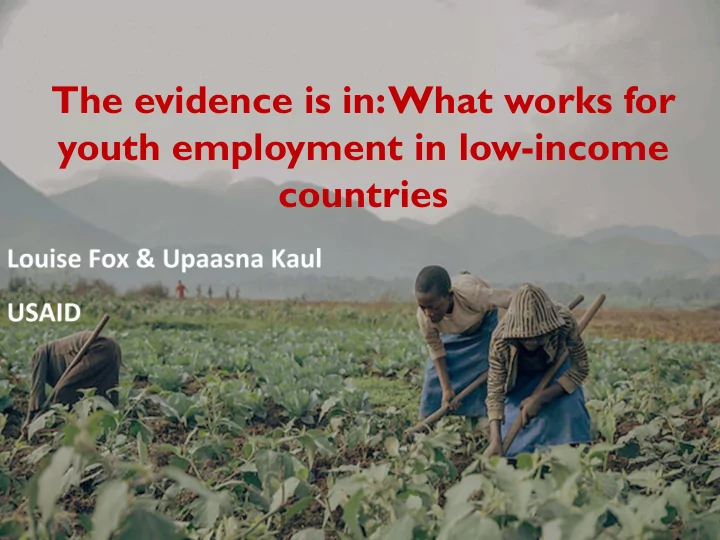
The evidence is in: What works for youth employment in low-income - - PowerPoint PPT Presentation
The evidence is in: What works for youth employment in low-income countries Informal is normal until economic transformation takes place Employment Structure 100% 2% 4% 2% 2% 19% Employers 34% 75% Wage & Salaried 67% Workers
26% 14% 5% 1% 53% 50% 26% 9% 19% 34% 67% 86% 2% 2% 2% 4%
0% 25% 50% 75% 100%
Low Income Lower-Middle Income Upper-Middle Income High Income
Employment Structure
Employers Wage & Salaried Workers Own-Account Workers Contributing Family Workers
Source: ILO STAT, 2017
A C B
Q2 W2
Wage Rage
Labor Quantity
Classical Labor Market
DEMAND SUPPLY SUPPLY*
Q3 W1 Q1 W*
Q1 Q2 Q3
Wage Rate
Employment (Quantityof Labor)
Developing Country Labor Market
DEMAND SUPPLY* SUPPLY
4
characteristics for increased employment.
youth lack the skills needed to get them.
(factors out of control of youth).
jobs and opportunities available.
9/14/2018 5
T echnical, vocational training (TVT), life skills, work experience, or combination
Life skills only Jordan & Kenya TVT only Kenya & Turkey; India (females only) TVT +Life Skills + Work Exp. Colombia (Jovenes), Kenya, Nepal, Peru (2016), and Yemen. Argentina, Dominican Republic, Peru (2010) Female only programs: Kenya (ICT), Liberia Work Exp. Malawi (male only program)
Employment matching services and counselling
Job fairs Ethiopia & Philippines Recruitment services India (females program) Matching services Jordan Apprentice matching Ghana
Incentives for Job Search
Transport subsidies Bangladesh; Ethiopia Wage Subsidies South Africa
6
Access to Finance Microcredit & small loans Bosnia, Ethiopia, India, Mexico, Morocco, and Mongolia (Microcredit) Uganda (small loan) Larger Loans Brazil, Colombia, and larger Indian firms India (microenterprises) Grants Positive effect: Nigeria ($50K) Uganda ($200) Financial Literacy & BDS Business Development consulting Positive effects: Argentina, Chile, India, and Mexico South Africa (Marketing vs. Finance) Ghana (microenterprises) Formalizati
Tax policy Registration & Business formalization Argentina & Brazil (new firms, not existing) Sri Lanka (Paying firms to formalize) Tax simplification & incentives Brazil & Mexico (weak studies) Electricity Electricity access Ghana & India (model) Minimum wages, subsidies, and public works programs Minimum wage South Africa (varied by sector) Wage Subsidies Jordan, South Africa, & Sri Lanka (microenterprises), Mexico (bigger firms) Public works India (partial displacement), Malawi (no displacement)
9/14/2018 7
Intervention Employment Effect TVT & Work Experience TVT only Kenya; India (Female only) Vocational & Business skills Nepal Malawi (apprenticeships) TVT and Finance Uganda (stronger for males) Business skills, life skills & mentorship Business skills course Tunisia (University youth) Life Skills & Mentorship Uganda (EDUCATE!) Life skills, mentorship, and business skills Uganda (BRAC – ELA) and Liberia (Adolescent females) Tanzania (Replicated the Uganda ELA program) Microfranchising Kenya (speeds entry into self-employment) Access to finance Cash grants Kenya (grant only speeds entry) Business skills and small cash grant Ethiopia, Nicaragua, and Uganda (WINGS) Microcredit Bosnia, Ethiopia, India, Mexico, Morocco, and Mongolia (start-ups)
8
9/14/2018 FOOTER GOES HERE 9
Wallace, Mastercard Foundation
9/14/2018 10