SLIDE 1
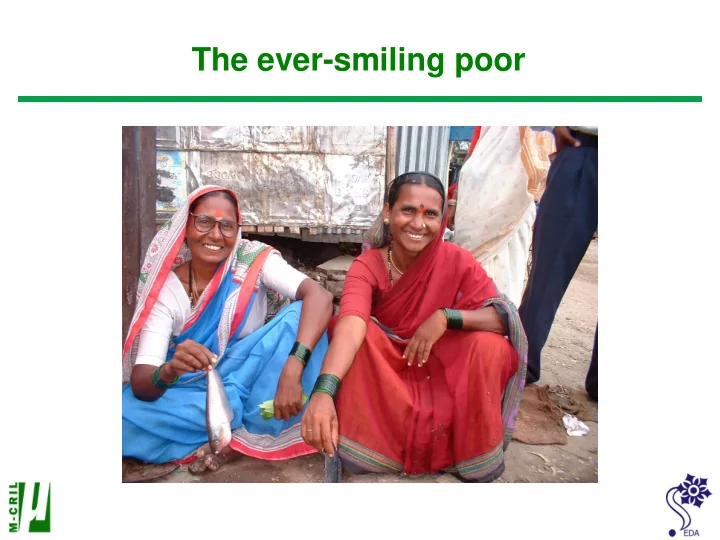
The ever-smiling poor
SLIDE 2 The Long March of BASIX and the Indian Microfinance Adventure
Savings and Credit Forum
Bern, 11 May 2012
Malcolm Harper
602 Pacific Square, 32nd Milestone NH8, Gurgaon 122 001 INDIA malcolm.harper@btinternet.com Tel: +91 124 230 9497, 230 9707 Fax: +91 124 230 9520
BASIX’ Long March from Credit to Livelihood Services (The Livelihoods Triad)
SLIDE 3
Microfinance, should it be more than happy ladies in groups?
SLIDE 4 BASIX basic history
- 1996 – started operations, funded by SRTT, SDC,
and Ford Foundation
- 2001 – 14,000 clients, $4 mn assets, $28,000
profits, 140 staff
- 2007 – 200,000 clients, $36 mn assets, $650,000
profits, 1100 staff
- 2010 – 1.1 mn clients, $300 mn assets, $ 7 m
profits, 2,000 staff
- 2011 – 1.6 mn clients
- 2012 – hanging in, debt restructuring…
SLIDE 5 BASIX – What’s so Special ?
- It’s not India’s largest MFI
- It was not India’s first MFI
- It is not India’s most profitable MFI
BUT BASIX is NOT just another big Hyderabad-based MFI
SLIDE 6 BASIX is a pioneer
- It was India’s first commercial for-profit MFI
- It was the first Indian MFI to raise a loan from a
commercial bank
- It was the first MFI to raise finance by a portfolio
securitisation
- It started KBSLAB, India’s first MF bank
- It offered the first viable small farmer crop
insurance product
SLIDE 7
An insured farmer
SLIDE 8 BUT, even more important….
BASIX is the world’s first for-profit livelihoods promotion institution. 2001 – impact evaluation study of BASIX’s typical MFI credit-only programme:
- 48% of clients no income increase
- 23% incomes unchanged
- 25% lower incomes
- Poorest least likely to benefit
SLIDE 9 Hence - Livelihoods Promotion
- The ‘Triad’ – livelihoods, institutions and finance
– NOT merely finance
- 650,000 clients are buying non-financial
services, about half BASIX total clients
- Financial services only one of the ‘five capitals’
- f livelihoods – natural, physical, human and
social capital may be more necessary
SLIDE 10 FINANCING LIVELIHOODS PROMOTION
- Vital ‘firewall’ between subsidised experiments,
and ‘real’ for-profit livelihoods promotion
- Indian Grameen Services, the NGO member of
the BASIX group - Supported by the SDC Livelihoods Triad Fund
- Proven livelihood products handed over to for-
profit company for scaling up
SLIDE 11
Integrated pest management
SLIDE 12 Value chain interventions
- Milk – Reliance
- Potatoes – Pepsi/Frito Lays
Paid for by fees from corporate buyer, margins
- n inputs and interest on credit
NOT ‘CSR’
SLIDE 13
The ‘Lac’ Value Chain in Jharkhand
SLIDE 14 Individual business interventions
- Local grocery shops – 55,000 clients
- Tailors – 120,000 clients
- Mushroom growers – 25,000 clients
- Mehndi artists, teashops, soy bean farmers…
Training, inputs, supply + market information Paid for by the business itself, flat one-off fee
SLIDE 15
Help with marketing
SLIDE 16 Conclusion – Livelihood services need not be ‘bundled’ with credit
- BKSL – separate company to sell livelihoods
services, to BASIX borrowers and others
- Shivia – partnership with BASIX, selling $10
poultry and mushroom ‘livelihood packages’ with NO credit attached
SLIDE 17
BASIX staff with a happy (male) client
SLIDE 18
BASIX’s role in developments in the microfinance industry, leading up to the crisis The Long March of BASIX and the Indian Microfinance Adventure
SLIDE 19 BASIX and the Andhra Pradesh mess
- 35% of loan portfolio in AP
- On-time recoveries – 98% went down to 84%
- Debt restructuring in process
- KBSLAB, the BASIX bank, partly in
- AP, but very little affected
SLIDE 20 BASIX and the build up to the mess
- Vijay Mahajan – personal pain, as newcomers
- vertook BASIX
- Lingering staff failure to accept the Triad and
resulting slower growth
- Hired new ambitious Citibank man to
build Samruddhi’s figures
- Matrix USA investors – looking to IPO
SLIDE 21 The charismatic leader problem
- Repeated departures of CEO
- Founded MFIN, to reform Indian MF
- Too late, BASIX was different, but was
linked to the errors of the industry as a whole
SLIDE 22
Alternative routes to microfinance in Africa Kenya and Somaliland Mobile microfinance: Musoni and Dahabshiil
SLIDE 23 Mobile phone penetration – 2009
World 68% India 45.4% Kenya 49.1% Somalia 7% (but…) (Switzerland 119.5%)
WB, 9.11.2011 data
SLIDE 24 Adult use of mobile money transfers:
Kenya – 68% Somalia – 33% Brazil, Argentina – 1%
The Economist, 28.4.2012
SLIDE 25 Why is Africa ahead of India?
- Technological leapfrogging –
bank branch coverage and landlines are worse than India
- More private players – reduced role of
government
SLIDE 26
MUSONI IN KENYA?
Netherlands based, 100% cashless, using Mpesa in Kenya, bank licence in process 5 branches, 6000 borrowers, $1.4 mn portfolio Uganda next in line Funded by individuals, + Oxfam-Novib, RABO, Hivos etc.
SLIDE 27
DAHABSHIIL of SOMALILAND
Africa’s own remittance company In-house mobile phone company + licensed bank + mpesa look alike + 300 branches Propose to start mobile-based microfinance Shariah-compliant, savings-led Funded by ???
SLIDE 28 WHAT CAN INDIA LEARN ?
- Recognise phone based finance
- Exploit forthcoming UID
- See that microfinance is more than an opportunity
for subsidy