The Effects of School Turnaround Strategies in Massachusetts John - - PDF document

the effects of school turnaround strategies in
SMART_READER_LITE
LIVE PREVIEW

The Effects of School Turnaround Strategies in Massachusetts John - - PDF document

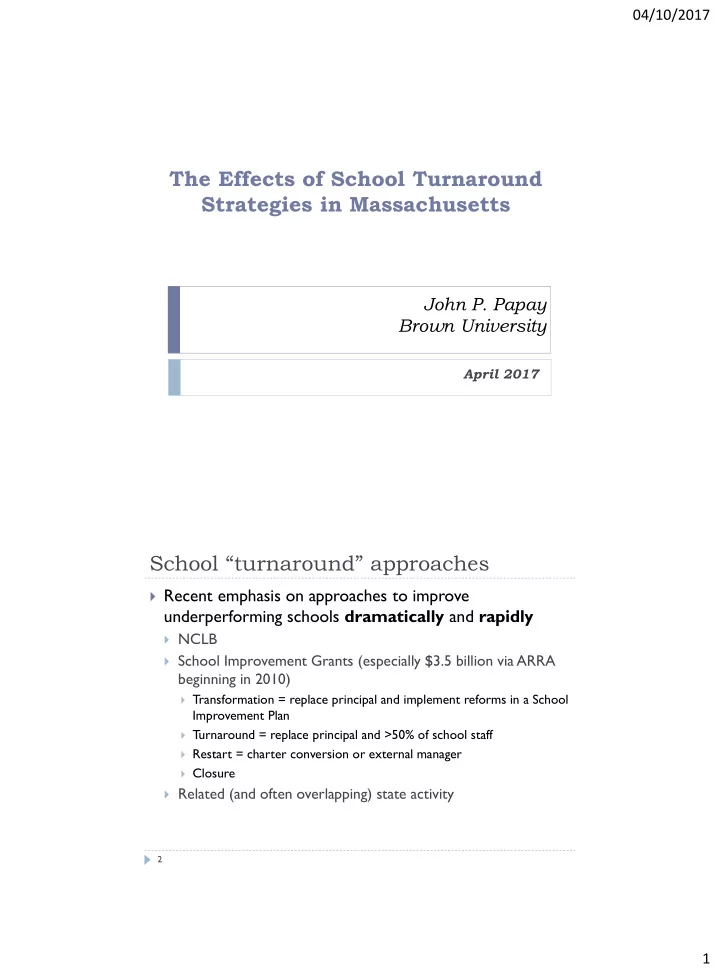
04/10/2017 The Effects of School Turnaround Strategies in Massachusetts John P. Papay Brown University April 2017 School turnaround approaches Recent emphasis on approaches to improve underperforming schools dramatically and rapidly


slide-1
SLIDE 1

04/10/2017 1

John P. Papay Brown University

April 2017

The Effects of School Turnaround Strategies in Massachusetts School “turnaround” approaches

2

 Recent emphasis on approaches to improve

underperforming schools dramatically and rapidly

 NCLB  School Improvement Grants (especially $3.5 billion via ARRA

beginning in 2010)

 Transformation = replace principal and implement reforms in a School

Improvement Plan

 Turnaround = replace principal and >50% of school staff  Restart = charter conversion or external manager  Closure

 Related (and often overlapping) state activity

slide-2
SLIDE 2

04/10/2017 2

School “turnaround” approaches

3

 Whether such approaches can improve student outcomes

is critical for policymakers to understand, but evidence is mixed.

 National study of SIG program found null effects

 Obama administration spent billions to fix failing schools, and it

didn’t work – Washington Post 2017

 The $7 billion school improvement grant program: Greatest failure in

the history of the US Department of Education? – Smarick 2017

 State studies have found more mixed evidence

School improvement in MA

4

 Massachusetts is one of the nation’s highest performing

school systems

 In 2010, legislature passed legislation to improve failing

schools

 MA DESE sought to identify the most “stuck” schools –

lowest performing and least improving – for intervention as Level 4 schools

 Required to implement an improvement strategy  Eligible for SIG funding  Provided an array of other supports

slide-3
SLIDE 3

04/10/2017 3

Identifying Level 4 schools

5

 Credible causal inferences enabled because of how the

policy was implemented

 In March 2010, MA DESE:

 Identified all 645 Title I schools in Corrective Action,

Restructuring, or Improvement status

 Identified the lowest performing 10% of these schools

 2006, 2007, 2008, and 2009 student achievement data

 Of these 65 schools, created movement indicators

 Bottom half on movement labeled Level 4

 Thus, there is a sharp cutoff for Level 4 eligibility

The current study

6

 (1) What is the effect of being identified as a Level 4

school on student performance?

 (2) What can we say about why this effect occurred?  Data from 2006 through 2014

 Student achievement and demographic data  Focus on students in grades 3-8  Focus here on math (very similar results in ELA)

slide-4
SLIDE 4

04/10/2017 4

Central approach: Intuition

7

 Difference-in-differences/time-series design

 Look for change in school performance over time in Level 4

schools, but not in other schools.

2005 2006 2007 2008 2009 2010 2011 2012 2013 2014 TIME

Central approach: Intuition

8

 Regression discontinuity design

 Disruption in trend on either side of an exogenous cut-point

  • 4
  • 3
  • 2
  • 1

1 2 3 4 Movement Score ATE

slide-5
SLIDE 5

04/10/2017 5

9

Key Findings

Level 4 schools tend to serve low-income, minority, low-performing students

10

slide-6
SLIDE 6

04/10/2017 6

Large, positive effects of Level 4 status

11

Level 4 intervention

DD: Effects consistent across models

12

Preferred model Effect in 2011 0.126 ** (0.047) [p=0.008] Effect in 2014 0.290 *** (0.073) [p<0.001] Year effects

X

School effects

X

Student controls

X

Note: ~, p<0.10; *, p<0.05; **, p<0.01; ***, p<0.001

For comparison, this is about the effect of reducing class size by 30% in elementary school. This is about 1/3 of the income-based test-score gap.

slide-7
SLIDE 7

04/10/2017 7

RDD: no difference in 2010

13

  • 1.75
  • 1.5
  • 1.25
  • 1
  • .75
  • .5
  • .25
  • 40
  • 20

20 40 Centered Movement Score level4=0 level4=1

RDD: large effect in 2011 (1st year)

14

  • 1.75
  • 1.5
  • 1.25
  • 1
  • .75
  • .5
  • .25
  • 40
  • 20

20 40 Centered Movement Score level4=0 level4=1

slide-8
SLIDE 8

04/10/2017 8

RDD: larger effect by 2014 (4th year)

15

  • 1.75
  • 1.5
  • 1.25
  • 1
  • .75
  • .5
  • .25
  • 40
  • 20

20 40 Centered Movement Score level4=0 level4=1

Average gain: 2010 to 2014

16

  • .5

.5 1

  • 40
  • 20

20 40 Centered Movement Score level4=0 level4=1

slide-9
SLIDE 9

04/10/2017 9

17

Mechanisms Changes in teacher effectiveness

18

 Two means by which teacher quality can improve in these

schools:

 Schools replaced ineffective teachers with new, more effective

teachers, AND/OR

 Existing teachers improved their performance

 Estimate standard value-added model before and after.  Make two central comparisons

 Teachers who move IN TO or OUT OF a Level 4 school

(before)

 Teachers who STAY in Level 4 school (before vs. after)

slide-10
SLIDE 10

04/10/2017 10

 Schools are replacing less effective teachers with more

effective ones

 Teachers in these schools improve substantially

Changes in teacher effectiveness

19

T eacher Level Fixed Effect Move Out (Pre-Level 4)

  • 0.239

Move In (Pre-Level 4)

  • 0.028

Difference 0.211 T eacher Level Fixed Effect Stayer (Pre-Level 4)

  • 0.143

Stayer (Post-Level 4) 0.023 Difference 0.166

Conclusion and implications

20

 Being identified as a Level 4 school improved student

  • utcomes significantly and substantially in the first year, on

average

 AND, it changed schools’ performance trajectories

 By 2014, being identified as a Level 4 school had improved

student outcomes by ~0.40 to 0.50 SD.

 These results are consistent using two very different

sources of identifying variation:

 Within school over time (DD)  Across schools in same time period (RDD)

slide-11
SLIDE 11

04/10/2017 11

Conclusion and implications

21

 Constellation of factors seems to be important for success

 Whole package included improvement strategy, support, and

accountability

 Teacher effectiveness in these schools changed

substantially

 Teachers who left had quite low value-added  Teachers who entered (from the district) had somewhat above

average value-added in other schools

 Teachers who remained in Level 4 schools improved

substantially

Conclusion and implications

22

 This serves as proof of concept that rapid and sustained

improvement is possible

 Effects are larger than in other contexts, suggesting that

something about the MA approach worked better

 Suggests that:

 Schools made wise human capital decisions that made a real

difference

 School context matters substantially for teacher effectiveness

slide-12
SLIDE 12

04/10/2017 12

Thank You

Questions/Comments john_papay@brown.edu

23