The Effects of LOCA Dose Estimation by Spray Droplet Surface Area - - PDF document

the effects of loca dose estimation by spray droplet
SMART_READER_LITE
LIVE PREVIEW

The Effects of LOCA Dose Estimation by Spray Droplet Surface Area - - PDF document

Transactions of the Korean Nuclear Society Virtual Spring Meeting July 9-10, 2020 The Effects of LOCA Dose Estimation by Spray Droplet Surface Area Seung Chan LEE* Korea Hydro Nuclear Power Co. Ltd., KHNP Central Research Institute , Reactor


slide-1
SLIDE 1

Transactions of the Korean Nuclear Society Virtual Spring Meeting July 9-10, 2020

The Effects of LOCA Dose Estimation by Spray Droplet Surface Area

Seung Chan LEE* Korea Hydro Nuclear Power Co. Ltd., KHNP Central Research Institute, Reactor Safety Laboratory, Yuseong- daero 1312-gil, Yuseong, Daejeon 34101 Korea.

*Corresponding author: eitotheflash@khnp.co.kr

  • 1. INTRODUCTION

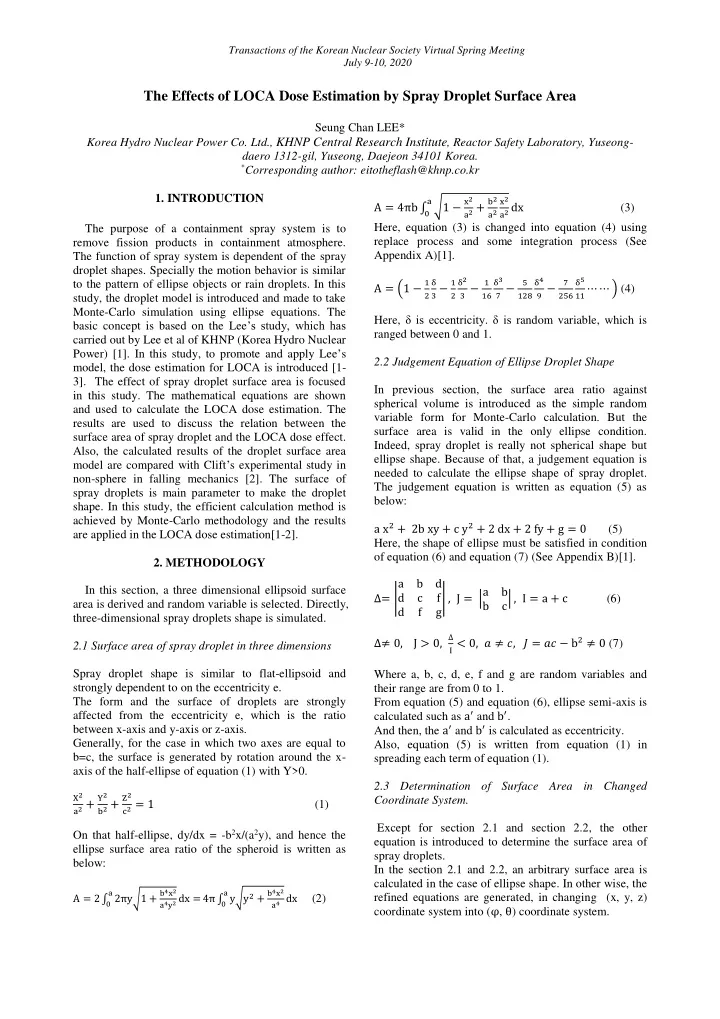
The purpose of a containment spray system is to remove fission products in containment atmosphere. The function of spray system is dependent of the spray droplet shapes. Specially the motion behavior is similar to the pattern of ellipse objects or rain droplets. In this study, the droplet model is introduced and made to take Monte-Carlo simulation using ellipse equations. The basic concept is based on the Lee’s study, which has carried out by Lee et al of KHNP (Korea Hydro Nuclear Power) [1]. In this study, to promote and apply Lee’s model, the dose estimation for LOCA is introduced [1- 3]. The effect of spray droplet surface area is focused in this study. The mathematical equations are shown and used to calculate the LOCA dose estimation. The results are used to discuss the relation between the surface area of spray droplet and the LOCA dose effect. Also, the calculated results of the droplet surface area model are compared with Clift’s experimental study in non-sphere in falling mechanics [2]. The surface of spray droplets is main parameter to make the droplet

  • shape. In this study, the efficient calculation method is

achieved by Monte-Carlo methodology and the results are applied in the LOCA dose estimation[1-2].

  • 2. METHODOLOGY

In this section, a three dimensional ellipsoid surface area is derived and random variable is selected. Directly, three-dimensional spray droplets shape is simulated. 2.1 Surface area of spray droplet in three dimensions Spray droplet shape is similar to flat-ellipsoid and strongly dependent to on the eccentricity e. The form and the surface of droplets are strongly affected from the eccentricity e, which is the ratio between x-axis and y-axis or z-axis. Generally, for the case in which two axes are equal to b=c, the surface is generated by rotation around the x- axis of the half-ellipse of equation (1) with Y>0.

X2 a2 + Y2 b2 + Z2 c2 = 1 (1)

On that half-ellipse, dy/dx = -b2x/(a2y), and hence the ellipse surface area ratio of the spheroid is written as below:

A = 2 ∫ 2πy√1 +

b4x2 a4y2 dx = a

4π ∫ y√y2 +

b4x2 a4 dx a

(2)

A = 4πb ∫ √1 −

x2 a2 + b2 a2 x2 a2 dx a

(3) Here, equation (3) is changed into equation (4) using replace process and some integration process (See Appendix A)[1]. A = (1 −

1 2 δ 3 − 1 2 δ2 3 − 1 16 δ3 7 − 5 128 δ4 9 − 7 256 δ5 11 ⋯ ⋯ ) (4)

Here, δ is eccentricity. δ is random variable, which is ranged between 0 and 1. 2.2 Judgement Equation of Ellipse Droplet Shape In previous section, the surface area ratio against spherical volume is introduced as the simple random variable form for Monte-Carlo calculation. But the surface area is valid in the only ellipse condition. Indeed, spray droplet is really not spherical shape but ellipse shape. Because of that, a judgement equation is needed to calculate the ellipse shape of spray droplet. The judgement equation is written as equation (5) as below: a x2 + 2b xy + c y2 + 2 dx + 2 fy + g = 0 (5) Here, the shape of ellipse must be satisfied in condition

  • f equation (6) and equation (7) (See Appendix B)[1].

∆= | a b d d c f d f g | , J = |a b b c| , I = a + c (6) ∆≠ 0, J > 0,

∆ I < 0, 𝑏 ≠ 𝑑, 𝐾 = 𝑏𝑑 − b2 ≠ 0 (7)

Where a, b, c, d, e, f and g are random variables and their range are from 0 to 1. From equation (5) and equation (6), ellipse semi-axis is calculated such as a′ and b′. And then, the a′ and b′ is calculated as eccentricity. Also, equation (5) is written from equation (1) in spreading each term of equation (1). 2.3 Determination of Surface Area in Changed Coordinate System. Except for section 2.1 and section 2.2, the other equation is introduced to determine the surface area of spray droplets. In the section 2.1 and 2.2, an arbitrary surface area is calculated in the case of ellipse shape. In other wise, the refined equations are generated, in changing (x, y, z) coordinate system into (φ, θ) coordinate system.

slide-2
SLIDE 2

Here, cosθ=z/c.

x2 a2 + y2 b2 = sin2θ (8)

Equation (8) can be changed into equation (9), using some integral process (See Appendix C)[1].

A = (1 −

1 2 p 3 π − 1 2 p2 3 π∙1∙3 2∙2∙4 − 1 16 p3 7 π∙1∙3∙5 2∙2∙4∙6 − 5 128 p4 9 π∙1∙3∙5∙7 2∙2∙4∙6∙8 − 7 256 p5 11 π∙1∙3∙5∙7∙9 2∙2∙4∙6∙8∙10 ⋯ ⋯ ) (9)

Here, p is random variable and its range is from 0 to 1. 2.4 Monte-Carlo Simulation of Droplet Surface Area The distribution function of droplet size is known as the log-normal distribution shape. Clift’s experiment is used to simulate the droplet ellipse surface area. The function of surface area ratio of spherical volume is made by equation (9) using random variable p. Droplet size and volume is generated by log-normal random

  • distribution. Monte-Carlo strategy is written as below:

Step 1 : droplet size is selected. Step 2 : surface area ratio of spherical volume Step 3: matching between droplet size and spherical volume Step 4 : spherical volume multiply to surface area ratio Step 5: surface area determination and efficiency determination. 2.5 Dose Estimation Fig.1 shows the frame of LOCA modeling for dose estimation. Dotted lines are considered for the sump and containment purge model. Solid lines are considered for the containment leakage model. In the environment component of Fig.1, the dispersion behavior of fission products is simulated. This behavior can be simulated by the offsite dispersion factor from PAVAN code calculation.

  • Fig. 1 LOCA modeling concept in RADTRAD code
  • 3. RESULTS AND DISCUSSIONS

3.1 Monte-Carlo Simulation Results. From equations (9), the surface area ratio of spherical volume is generated as simple form. Fig.2 shows the surface area ratio of the spherical volume of spray droplets using the equation (9). In Fig. 2, 3 and 4, this study is compared with Clift’s experimental results in the case of the spray droplet surface ratio, the spherical volume, the ellipse surface area and iodine removal efficiency. This work results is in good agreement with Clift’s experimental results. From Fig2, Fig 3, Fig4 and Fig 5, we know that Monte Carlo simulation of this study is very similar to the results of experiments.

  • Fig. 2 Surface area ratio against spherical volume

comparing with other study

  • Fig. 3 Spherical volume and droplet size

Generally, Ellipse surface area is expressed by (

8π2a3 2πaE2/3).

This value is use as the aerosol capture reverse efficiency. From this relation, the result of Fig. 4 is generated as the fission products removal efficiency. This value is used as a input value for the calculation of LOCA dose. Fig.5 is the iodine removal efficiency (fission product removal efficiency). This results of Fig.5 is calculated from taking the reverse value of the ellipse surface area and multiplying correction constant to the reverse value.

Transactions of the Korean Nuclear Society Virtual Spring Meeting July 9-10, 2020

slide-3
SLIDE 3
  • Fig. 4 Ellipse surface area and droplet size
  • Fig. 5 Fission-products removal efficiency from ellipse

surface area 3.2 LOCA Dose Estimation From Fig 5, LOCA dose is carried out. Table 1 shows key parameters of the calculation results. From Monte- Carlo simulation, LOCA dose estimation results are shown in Table2. In Fig. 6, this work is compared with Clifft’s experiment work. Fig. 6 shows the conformity between the Monte-Carlo simulation of this work and the experimental work. This work is very similar to

  • ther study.
  • Table1. Key parameters for LOCA dose (OPR 1000)

Input Calculated results

Containment leakage flow rate (Vol% per day) Containment leakage

  • 0 ~ 24 hours : 0.1
  • 24 ~ 720 hours : 0.05

Removal rate or Decontamination Factors Natural deposition removal rate

  • Unsprayed region : 5.50
  • Sprayed region : 12.5

Iodine Decontamination Factor

  • Iodine by deposition : 100

Offsite Dispersion Factors (sec/cubic meter) EAB : 4.991e-04 (0~2hours) LPZ : 3.001e-05(0~8hours) 2.103e-05(8~24hours) 1.030e-05(24~96hours) 3.463-06(96~720hours) Iodine removal efficiency Droplet removal efficiency : 0.001 ~0.79 Droplet distribution : log-normal

  • Table2. Calculation results of LOCA analysis

Location Results of LOCA analysis

EAB : TEDE (rem) Containment leakage model :12.2 Purge leakage : 0.3 Sump leakage : 2.3 Total : 14.8 LPZ : TEDE (rem) Containment leakage model :9.3 Purge leakage : 0.2 Sump leakage : 2.1 Total : 11.6 Dose Criteria : TEDE (RG 1.183) (rem) EAB & LPZ : 25

  • Fig. 6 Comparison between this work and experiment

works

  • 4. CONCLUSIONS

The fission products removal simulation based on the spray droplet surface and eccentricity is carried out. From the simulation, LOCA dose is estimated inserting iodine removal efficiency(Table2). In this work, Monte- Carlo simulation results are in good agreement with Clift’s experiment (Fig.4 and Fig.5). The difference between the experimental results and Monte-Carlo simulation results is within 0.25%(Fig.6). And LOCA calculation results show the safety margin of more than 50%. REFERENCES

[1] Seung Chan Lee, Development of Elliptic Equation for Modeling of Containment Spray droplets Shape, Transactions

  • f the Korean Nuclear Society Spring Meeting, 2012.

[2] Application of Elliptic Equation and Ellipse nature, Berkely University, Pergamon Press, 1968. [3] FSAR, HANUL5,6 Final Safety Report.

Appendix A Generally, for the case in which two axes are equal to b=c, the surface area ratio against spherical volume is generated by rotation around the x-axis of the half- ellipse of equation (1) with Y>0.

X2 a2 + Y2 b2 + Z2 c2 = 1 (1)

On that half-ellipse, dy/dx = -b2x/(a2y), and hence the surface area of the spheroid is written as below:

A = 2 ∫ 2πy√1 +

b4x2 a4y2 dx = a

4π ∫ y√y2 +

b4x2 a4 dx a

(2)

Transactions of the Korean Nuclear Society Virtual Spring Meeting July 9-10, 2020

slide-4
SLIDE 4

A = 4πb ∫ √1 −

x2 a2 + b2 a2 x2 a2 dx a

(3) A = 4πab ∫ √1 − (1 −

b2 a2) u2 du 1

(4) A = 4πab ∫ √1 − δu2 du

1

(5) Where, u=x/a and δ=1 −

b2 a2, which is used for replace

integral. Where, this equation can be selected by three options as below: Option1: a>b A = 2πb (a ×

arcsin√δ √δ

+ b) (6) Option2: a=b A = 2πb(a + b) = 4πa2 (7) Option3: a<b A = 2πb (a ×

arcsinh√−δ √−δ

+ b) (8) Here, due to the falling spray droplet is crashed so the

  • ption1 is selected.

Continuously, option 1 is going on calculating the surface area of ellipse spray droplets. Applying Power series into equation (6), it is changed as below: A = π [2a2 + b2

1 √−δ log ( 1+√−δ 1−√−δ)] (9)

A = 2πb (a [1 +

1 6 δ + 3 40 δ2 + 5 112 δ3 + ⋯ ] + b) (10)

A = 4πab ∫ (1 − δu2 )1/2du

1

(11)

A = 4πab ∫ (1 −

1 2 δu2 + (1

2)(−1 2)

2!

δ2u2 −

(1

2)(−1 2)(−3 2)

3!

δ3u6 +

1 (1

2)(−1 2)(−3 2)(−5 2)

4!

δ4u8 +

(1

2)(−1 2)(−3 2)(−5 2)(−7 2)

5!

δ5u10 + ⋯ ) du (12)

Integrating equation (12), the results is written as equation (13). A = (1 −

1 2 δ 3 − 1 2 δ2 3 − 1 16 δ3 7 − 5 128 δ4 9 − 7 256 δ5 11 ⋯ ⋯ ) (13)

Here, equation (13) is resulted from Power series of

arcsin√δ √δ

. Appendix B a x2 + 2b xy + c y2 + 2 dx + 2 fy + g = 0 (14) Here, the shape of ellipse must be satisfied in condition

  • f equation (15) and equation (16)[1].

∆= | a b d d c f d f g | , J = |a b b c| , I = a + c (15) ∆≠ 0, J > 0,

∆ I < 0, 𝑏 ≠ 𝑑, 𝐾 = 𝑏𝑑 − b2 ≠ 0 (16)

The center of the ellipse (x0, y0) is given by x0 =

cd−bf b2−ac y0 = af−bd b2−ac (17)

The semi-axes lengths are below [1]: a′ = √

2(af2+cd2+gb2−2bdf−acg) (b2−ac)[√(a−c)2+4b2−(a+c)] (18)

b′ = √

2(af2+cd2+gb2−2bdf−acg) (b2−ac)[−√(a−c)2+4b2−(a+c)] (19)

Appendix C If (x, y, z) coordinate system is changed to ( φ, θ) coordinate system, cosθ=z/c.

x2 a2 + y2 b2 = sin2θ (20) x2 (a sinθ)2 + y2 (b sinθ)2 = 1 (21)

Letting cosφ=y/(b sinθ), so that sinφ=x/(a sinθ). That is written as below: X=a sinθsinφ , y=b sinθcosφ (22) Using the differential factor of (22), (22) is changed into (23). (dxdy)=ab sinθcosθdθdφ (23) S = ab ∫ ∫ sinθ√1 − p2sinθdθdφ

π/2 θ=0 π/2 φ=0

(24) Here, equation (24) is modified to reflect the previous section 2.2 using equation (5) and equation(10). Using the Power series of parameter p, we can integrate for θ from 0 to π/2. ∫ sinθ√1 − p2sinθdθ

π/2 θ=0

(24) Power series for term (24) is generated as below:

∫ sinθ (1 −

1 2 p sin2θ + (1

2)(−1 2)

2!

p2sin4θ −

(1

2)(−1 2)(−3 2)

3!

p3sin6θ +

π/2 (1

2)(−1 2)(−3 2)(−5 2)

4!

p4sin8θ + ⋯ ) du (25)

Using equation (25), surface area of spray droplet shape can be expressed into simple form as below:

A = (1 −

1 2 p 3 π − 1 2 p2 3 π∙1∙3 2∙2∙4 − 1 16 p3 7 π∙1∙3∙5 2∙2∙4∙6 − 5 128 p4 9 π∙1∙3∙5∙7 2∙2∙4∙6∙8 − 7 256 p5 11 π∙1∙3∙5∙7∙9 2∙2∙4∙6∙8∙10 ⋯ ⋯ ) (26)

Transactions of the Korean Nuclear Society Virtual Spring Meeting July 9-10, 2020