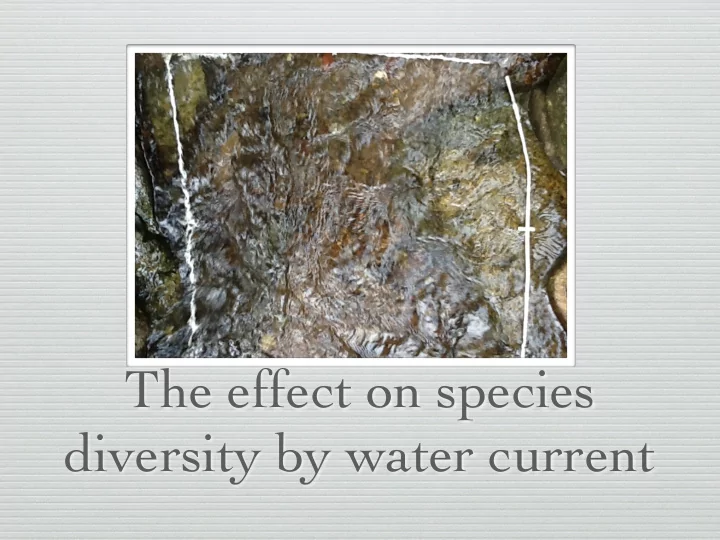
The effect on species diversity by water current Controlled - - PowerPoint PPT Presentation

the effect on species diversity by water current
SMART_READER_LITE
LIVE PREVIEW

The effect on species diversity by water current Controlled - - PowerPoint PPT Presentation

The effect on species diversity by water current Controlled Variables Water depth River bed substrate composition Light intensity Abundance of water plants Temperature Dependent variable Animal species Ind Rate of water flow Hypothesis


slide-1
SLIDE 1

The effect on species diversity by water current

slide-2
SLIDE 2

Controlled Variables

Water depth River bed substrate composition Light intensity Abundance of water plants Temperature

slide-3
SLIDE 3

Dependent variable

Animal species

Ind

Rate of water flow

slide-4
SLIDE 4

Hypothesis

Current has direct effect on the distribution of

  • rganisms.The biodiversity may be inversion

related to the speed of the water current

slide-5
SLIDE 5

Materials and methods

  • Light meter: measure the light intensity
  • Digital thermometer: measure the temperature
  • Forceps: pick out the species attached to the

surfaces

  • Water flow meter: measure the speed of the water

flow

slide-6
SLIDE 6

Materials and methods

  • Tray: temporarily hold the species for investigation
  • Brush pen: discard the species onto the tray
  • Metal sieve: catch the species which are difficult to

catch by using forceps flowing with the water current.

  • Meter: measure water depth
slide-7
SLIDE 7

Method to control the variables

  • Measure one-by-one by using the apparatus. Carry
  • ut experiment at regions with same water depth,

river bed substrate, light intensity, temperature and abundance of water plants.

slide-8
SLIDE 8

Methods of measuring water flow rate

  • Using water flow meter to measure the water flow

rate at the shallow and stony part of the stream where we did animal survey. Make a few measurements at different points and then take average of the readings.

slide-9
SLIDE 9

Method to record the data of dependent variables

  • Using quadrant sampling method to find out animal

species.

slide-10
SLIDE 10

Experiments

  • Fair test
  • Temperature: 22.5 Degree Celsius
  • Water depth: 8cm
  • Light intensity: 9920
  • Substrate: by observation
slide-11
SLIDE 11

Results (1)

  • Water flow rate: 0.16m/s
  • Species in different sizes are present, ranging from

1mm to 2cm

  • Greater abundance of species in smaller size
  • E.g. Dragonfly nymph, small stream leech, mayfly

nymph, bloodworm, water penny

slide-12
SLIDE 12

Results(2)

  • Water flow rate: 0.21m/s
  • Absence of species in large size
  • Presence of species in smaller size, particularly

Caddisfly larva attached to the rock surfaces

  • E.g. Caddisfly larva, large stream snail
slide-13
SLIDE 13

Results(3)

  • Water flow:0m/s
  • Presence of species in different sizes, ranging from

1mm to 5cm

  • E.g. Canton bee shrimp, toothed bee shrimp, large

stream snoil, Toby

slide-14
SLIDE 14

Analysis

  • Species smaller in size

are present in both high and low water current.

slide-15
SLIDE 15

Analysis

  • Species which are

greater in size are present in lower water current, while absent in greater water current.

slide-16
SLIDE 16

Analysis

  • Species in greater size may need to overcome a

greater fluid resistance. It may be more difficult for them to maintain stability.

  • Certain species may have special adaptations like

shells to protect them from high pressure.

  • Food may be washed away by the high water

current

slide-17
SLIDE 17

Summary

  • Clemency favors the growth and development of

the species perhaps due to malnutrition and instability

  • Species with adaptations may have greater

possibilities to survive in malevolence per