SLIDE 1
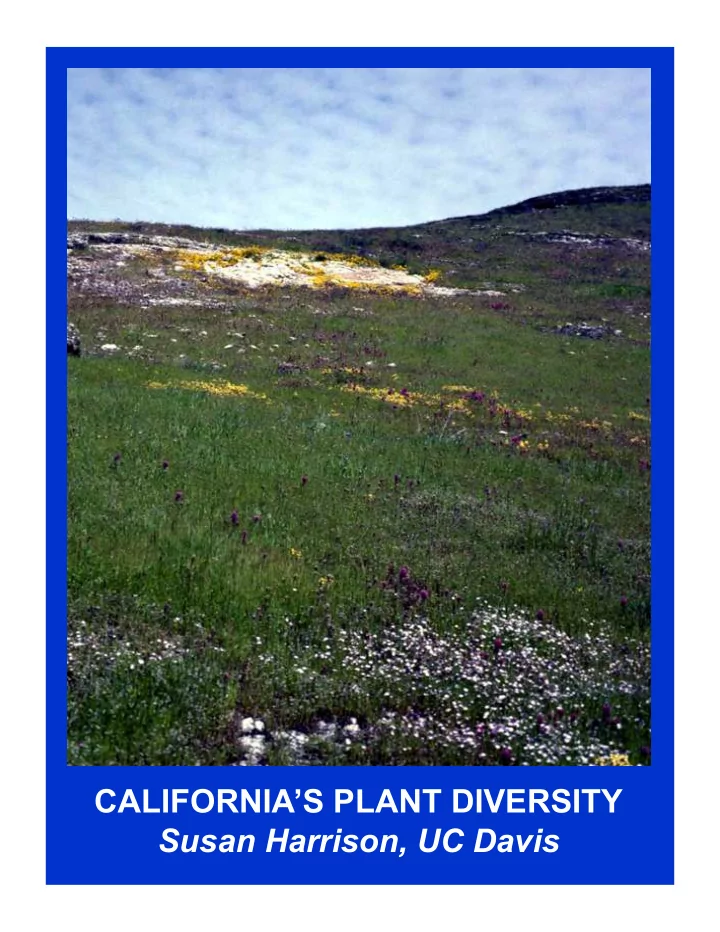
CALIFORNIA’S PLANT DIVERSITY Susan Harrison, UC Davis
SLIDE 2 WHAT IS DIVERSITY?
- Many native species in a given site
(alpha) or region (gamma)
- Much variation in species from site
to site within a region (beta)
- Geographically restricted (endemic)
species
- Taxonomically distinctive species
- What about California?
SLIDE 3
UNITED STATES “BIODIVERSITY HOTSPOTS” Stein et al., 1999
SLIDE 4 THE WORLD’S 25 BIODIVERSITY HOTSPOTS (Myers et al., 2000)
- Definition: > 1500 endemic plant
species.
- Tropical Andes, Central America,
Caribbean, Atlantic rainforest of Brazil, Madagascar, California Floristic Province…
- 44% of all plant species and 35% of
vertebrates in 4 groups.
- 1/2 to 2/3 of plants and vertebrates
- n the IUCN Red List are hotspot
endemics
- Only 1.4% of earth's land surface!
SLIDE 5 CALIFORNIA....*
species
endangered
Province
Roles of: climate, history, geology, topography, disturbance, invasions….
SLIDE 6
THE CALIFORNIA FLORISTIC PROVINCE
SLIDE 7
THE MEDITERRANEAN CLIMATE
SLIDE 8
THE WORLD’S MEDITERRANEAN CLIMATE REGIONS
SLIDE 9
DIVERSITY AND ENDEMISM IN MEDITERRANEAN REGIONS (from Dallman, 1998)
SLIDE 10
PLANT ADAPTATIONS IN MEDITERRANEAN CLIMATES
Evergreen, sclerophyllous shrubs
SLIDE 11
Chaparral
SLIDE 12
PLANT ADAPTATIONS IN MEDITERRANEAN CLIMATES
SLIDE 13
Spring annuals
SLIDE 14
THE EVOLUTION OF CALIFORNIA’S MEDITERRANEAN FLORA
SLIDE 15
THE EVOLUTION OF CALIFORNIA’S MEDITERRANEAN FLORA
SLIDE 16 ORIGINS OF THE CALIFORNIA FLORA Raven & Axelrod 1978
- Northern elements “Arcto-Tertiary”
50% From warm wet temperate forests that were widespread 50 mya
- Southern elements “Madro-Tertiary”
33% From semiarid habitats that developed about 20 mya
- Desert elements 14%
- California Floristic Province (CFP)
endemics
(% of species in the CFP belonging to genera or families of this origin; total = 4452 species)
SLIDE 17 Hotspots within California (Stebbins and Major 1964):
- Mt. St. Helena area, Santa Lucia Mts.
“Intermediate” climate; topographic and geologic complexity All three major elements present
SLIDE 18
Role of geology and topography
SLIDE 19
Serpentine (ultramafic) rocks
SLIDE 20 North Coast South Coast Napa, Lake, and Sonoma Counties
CALIFORNIA
Klamaths Sierra Nevada
SLIDE 21 Serpentine (ultramafic) rocks and soils: <2% of California’s surface area, >10% of its endemic species
Allium falcifolium (sickle-leaved onion) Serpentine mixed chaparral with leather oak and McNab’s cypress
SLIDE 22 ‘The redrock forest may seem hellish to us, but it is a refuge to its flora... it is the
- bdurate physical adversity of things
such as peridotite bedrock which often drives life to its most surprising transformations.’
The Klamath Knot (1983)
SLIDE 23
Role of fire in California’s Mediterranean vegetation
SLIDE 24 Sandstone chaparral 1 year post-fire
SLIDE 25 FIRE SPECIALISTS:
Emmenanthe penduliflora Dicentra chrysantha
SLIDE 26 Serpentine chaparral 1 year post-fire
SLIDE 27 Streptanthus breweri: Calystegia collina: Calochortus amabilis:
SLIDE 28 Post-fire increase in local diversity:
45% in serpentine chaparral, 140% in sandstone chaparral Fire is less severe and less frequent in serpentine chaparral
SLIDE 29
INVASIONS
1,045 naturalized non-native species Around 10% threaten biodiversity Many/most are from the Mediterranean
SLIDE 30
Napa vegetation mapping project
Partners: NatureServe, CDFG, Information Center for the Environment (UCD), regional stakeholders (BRBNA) For: local biodiversity hotspot analyses; conservation and planning decisions
SLIDE 31