The Economics of Coal as a Locomotive Fuel on US Class I Railroads By - - PowerPoint PPT Presentation

the economics of coal as a locomotive fuel on us class i
SMART_READER_LITE
LIVE PREVIEW

The Economics of Coal as a Locomotive Fuel on US Class I Railroads By - - PowerPoint PPT Presentation

The Economics of Coal as a Locomotive Fuel on US Class I Railroads By John Rhodes Overview Coal Burning Steam Locomotive: 73% Fuel Savings US Class I RRs $8.9 Billion 2007 Class I Diesel Fuel Bill $2.5 Billion Coal Bill Instead


slide-1
SLIDE 1

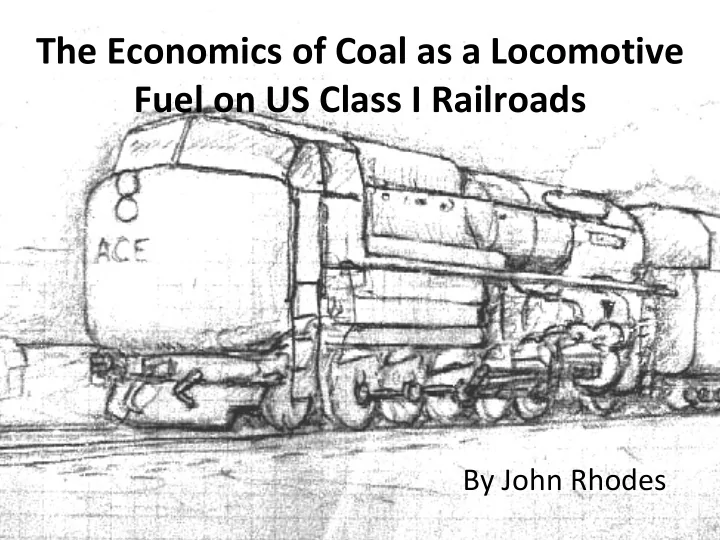
The Economics of Coal as a Locomotive Fuel on US Class I Railroads

By John Rhodes

slide-2
SLIDE 2

Overview

  • Coal‐Burning Steam Locomotive:

73% Fuel Savings US Class I RR’s

  • $8.9 Billion 2007 Class I Diesel Fuel Bill
  • $2.5 Billion Coal Bill Instead
  • $6.4 Billion Cost Saving
  • 2007 Operating Ratio Could Have Been

67% Instead Of 78%

slide-3
SLIDE 3
slide-4
SLIDE 4

Presentation Outline

  • Mechanical Engineers of Modern Steam
  • The Modern Steam Locomotive
  • Important Technologies Of Modern Steam
  • American Class I Railroad: Needs
  • Maintenance: Modern Steam and Diesel
  • Comparisons: Modern Steam and Diesel
  • Infrastructure and Servicing: Modern Steam
  • Next Steps
  • Other Locomotive Alternatives
slide-5
SLIDE 5

The Mechanical Engineers of Modern Steam

Pioneers (Deceased):

  • Andre Chapelon
  • Livio Dante Porta

Current:

  • David Wardale
  • Phil Girdlestone
  • Shaun McMahon
  • Roger Waller
  • Nigel Day
slide-6
SLIDE 6

Andre Chapelon

  • French Mechanical Engineer 1892‐1978
  • SNCF, Steam Locomotive Design Division
  • Grandfather Of Modern Steam
  • Applied Thermodynamics And Fluid Dynamics

To The Steam Locomotive

  • Chapelon’s Former Boss, George Chan, From

The SNCF Described Him As “The Man Who Gave New Life To The Steam Locomotive”

slide-7
SLIDE 7

Andre Chapelon cont.

  • 1946 Design And Construction Of The 3-

Cylinder Compound: SNCF 242A.1

– Rebuilt From A 3-Cylinder Simple Locomotive – Raised IHP From 2,800 To 5,500; 96% Increase – Twice The Thermal Efficiency Of American Steam

slide-8
SLIDE 8

Livio Dante Porta

  • Argentinean Mechanical Engineer

1922‐2003

  • Father Of Modern Steam
  • Developed 3 Most Important Parts Of

Modern Steam:

  • Clean High Efficiency Combustion
  • High Efficiency Exhaust
  • Heavy‐Duty Boiler Water Treatment
slide-9
SLIDE 9

Livio Dante Porta

Cont.

  • 1949 Built “Argentina” From A 4-6-2

– 2,100 DBHP – High Power-to-Weight Ratio: 65 lb. -1 HP – 50% Reduction In Fuel Consumption per HP – Double The Thermal Efficiency Of American Steam

slide-10
SLIDE 10

David Wardale

  • 1981 SAR Class 26 #3450 Rebuild Of Class 25NC

– Raised DBHP From 1,500 To 2,100; 40% Increase – 60% Reduction In Coal Consumption – 45% Reduction In Water Consumption – Double The Thermal Efficiency Of American Steam – GPCS – Lempor Exhaust – Porta Treatment

slide-11
SLIDE 11

Phil Girdlestone

  • Alfred County Railway Class NGG16A 141 & 155

– Modern Steam Selected For NG Pulpwood Hauler – 90% Availability And Utilization

  • Girdlestone & Associates

– Steam Locomotives & Equipment – Design, Manufacture & Consultancy

slide-12
SLIDE 12

Shaun McMahon

  • Employed By The Rio Turbio Railway

– Converting Railway To Steam From Diesel

  • Consultant Ferrocarril Austral Fueguino Railway

– Modernized Steam Fleet Of Tourist Hauler

slide-13
SLIDE 13

Roger Waller

  • Dampflokomotiv‐und Maschinenfabrik AG

(DLM)

– Produced 8 Modern Rack Steam Locomotives – The Netherlands Is Leasing A Modernized Steam Locomotive From DLM For Passenger Service With An Option To Buy A New Build Steam Locomotive

slide-14
SLIDE 14

Nigel Day

  • Modern Steam Technical Railway Services

– Dozens Of Steam Modernizations – Grand Canyon Railway 4960 & 29

slide-15
SLIDE 15

The Modern Steam Locomotive

Porta Classified Steam Locomotives As Follows:

  • Generation ‘Zero,’ Built Before The 1930’s
  • First Generation (FGS), Last Built Steam Locomotives:

NYC Niagara 4‐8‐4, South African 25 & 25NC, Etc.

  • Second Generation (SGS), Locomotives Incorporating

The Technological Advances From 1950 To Date

  • Third Generation (TGS), Yet‐to‐be Developed Engines
slide-16
SLIDE 16

First Generation Steam (FGS)

Generally:

  • 6% Thermal Efficiency
  • 245‐285 PSI, 650°F Steam
  • Single Expansion
  • One‐Piece Cast Steel Frames
  • Roller Bearing Axles
  • Mechanical & Pressure Lubrication
  • Primitive Combustion
  • Primitive Exhaust Design
  • Primitive Feed Water Treatment
slide-17
SLIDE 17

Second Generation Steam (SGS)

Porta’s Outline:

  • 14% Thermal Efficiency, Twice FGS
  • 290‐362 PSI, 840°F Steam
  • Compound Expansion
  • Advanced Exhaust Design
  • Economizer
  • Feedwater & Combustion Air Pre‐heating
  • Gas Producer Combustion System (GPCS)
  • Advanced Feed Water Treatment
slide-18
SLIDE 18

Third Generation Steam (TGS)

Porta’s Outline:

  • 21% Thermal Efficiency, Triple FGS
  • 870 PSI, 1020°F Steam
  • Triple Expansion
  • 3 Stage Feed Water And Combustion Air

Heating

  • Other Detail Improvements
  • 27% Thermal Efficiency With Condensing

By Comparison An EMD SD70ACe, An AC Traction Diesel‐Electric, Has 30.2% Thermal Efficiency

slide-19
SLIDE 19

Steam Diesel Cost Comparison

slide-20
SLIDE 20
slide-21
SLIDE 21

The Economics Look Great. But Can It Pull The Trains?

slide-22
SLIDE 22

DBPull Comparison

slide-23
SLIDE 23

DBHP Comparison

slide-24
SLIDE 24

Important Technologies

  • The Gas Producer Combustion System (GPCS)
  • The Lempor Exhaust
  • Porta Water Treatment (PT)
slide-25
SLIDE 25

Conventional Combustion

  • Coal Burned With 90% Primary Air Through Firebed
slide-26
SLIDE 26

The Gas Producer Combustion System (GPCS)

  • The Firebed Becomes A Gas Producer By

Making It Thick

  • Coal+Steam+Air React To Form: CO, H2 & CH4

Burned With Air

slide-27
SLIDE 27

Environmental Benefits Of GPCS

  • Smoke Disappears
  • CO & HC Emissions Virtually Disappear
  • NOX Emissions Are Very Low
  • Sulphur Can Also Be Controlled By

Blending The Fuel With A Calcite‐Dolomite Mixture

  • GPCS Can Burn Essentially Any

Reasonable Combination Of Solid Fuels

slide-28
SLIDE 28

The Lempor Exhaust

  • The Most Efficient Exhaust Ejector To Date
  • Heart Of The Steam Locomotive, Since Trevithick, 1804
  • Under Development By Porta Since 1952
  • Supplanted Chapelon’s Kylchap Of

1926

  • Shaun McMahon And Others

Continuing Lemprex Exhaust Development

  • Lempor Is 2 Or More Times As

Efficient As The Traditional American Design (Amount of Draft Created By Each PSI Of Backpressure On The Cylinders)

slide-29
SLIDE 29

Porta Water Treatment (PT)

  • Outgrowth Of Advanced Treatments Used

On The Railways Of France (TIA) And UK (Alfloc)

  • Developed For Ferrocarril Nacional

General Belgrano Railway, Argentina

  • Martyn Bane Of portatreatment.com,

Currently Markets The Treatment Outside Of Argentina

  • The Chemistry Of The Boiler Water Keeps

Any Scale Or Mud‐forming Material In Solution Or Suspension

slide-30
SLIDE 30

American Class I Railroad: Needs

  • Automated Boiler Controls
  • Multiple Unit Capability
  • Distributed Power And Remote

Control Capability

  • Traction Control
  • Dynamic Braking
  • Crew Comfort
slide-31
SLIDE 31

Automated Boiler Controls

  • Two Person Crews Are Unnecessary
  • A Person Can’t Finely Tune

Combustion & Evaporation At Optimum Operation

  • Power Plants Have Had Automated

Boiler Controls For Years

  • Allows MU Capability, Distributed

Power & Remote Control Operation

slide-32
SLIDE 32

Traction Control

  • A Computer Compares Speed Of The

Driving And Unpowered Wheels

  • Restricts Steam Being Exhausted From

Cylinders To Keep A Wheel Slip From Occurring

  • Available For Decades In Locomotives &

Cars

slide-33
SLIDE 33

Dynamic Braking

  • Counter‐Pressure or Compression Brakes

Installed On Many Steam Locomotives In Other Countries

  • Same Function As Dynamic Brakes
  • Most Common Used Type: “Water Brakes”
  • Henry Le Chatelier
  • Used By D&RGW In The US
slide-34
SLIDE 34

Crew Comfort

  • Cab Must Be As Comfortable As A Diesel
  • Should Include The Following:

– A Fully Enclosed Cab That Is Not Drafty – Air Conditioning, Ventilation And Heating – Advanced Sound And Thermal Insulation – “Thermal” Pane Windows – Wipers & Washers For The Front & Rear Windows – A Toilet, Most Likely In The Tender – Air Seats Similar To Those On Over‐the‐Road Trucks – Ample Work Space For The Engineer & Conductor – Ergonomically Designed Layout Of Controls – Microwave And/Or Coffee Pot

slide-35
SLIDE 35

Maintenance Benefits Of PT & GPCS

  • PT Eliminates The Formation Of Scale
  • Boiler Washouts: 6 Month Cycle Not 30 Day

Cycle

  • Boiler Blowdowns: 2 Month Cycle, Not Every

Shift

  • Boiler Tubes Can Last 30 Years
  • Firebox Plates Can Last 30 Years
  • Superheater Elements Can Last 30 Years
  • PT & GPCS (No Sandblasting By Unburned Coal):

– Virtual Elimination Of Boiler Maintenance – 91% Of The Maintenance Cost Steam

slide-36
SLIDE 36

Maintenance Comparisons

cont.

  • Prevailing View: Steam Locomotives More

Expensive To Maintain Than Diesels

  • True Comparing Old Generation “Zero” Steam With

New Diesel Locomotives

  • FGS Locomotives With One‐Piece Cast Frames,

Roller‐bearings On All Axles & Motion And Complete Mechanical & Pressure Lubrication Were Cheaper To Maintain Than Diesels

  • N&W’s New Class J 29% Cheaper Than Southern’s

New E6’s

  • 1963‐1986, SAR Class 25NC Was 20% Cheaper Than

Diesel

  • Modern Steam Locomotive Should Be As Cheap To

Maintain As A Diesel, If Not Cheaper

slide-37
SLIDE 37

Operating Comparisons

  • Idle Fuel Costs: (2006)

– $5.40 To $11.40 Per Hour Diesels w/o APU’s – $1.22 To $1.48 Per Hour Diesels w/ APU’s – $0.27 And $0.89 Per Hour Modern Steam

  • Running Time Comparison: (Fill Ups)
  • SGS: 2 Coal + Water And 2 Water Only = 1 Diesel
  • TGS: 1 Coal + Water And 1 Water Only = 1 Diesel
  • Condensing TGS: 1 Coal = 1 Diesel
slide-38
SLIDE 38

Infrastructure And Servicing

  • 3 Basic Types Of Facilities:

– Coaling Station: Coal, Water & Sand – Watering Station: Water Only – Servicing Facility: Modify Existing

  • Lubricating: 30 Days
  • Boiler Blowdown: 60 Days
  • Fire Cleaning: Only for Firebox Inspection

–Due To V Section Anti Clinker Grinding Grates

  • Boiler Washout: 180 Days
slide-39
SLIDE 39

Conclusion

  • Cost Savings Justifies Further Investigation
  • Technology Is Within Reach
  • Railroad Operating Parameters Virtually

Unchanged

slide-40
SLIDE 40

Next Steps

  • Feasibility Study
  • New Build Prototype
  • Test Locomotive

– Phase 1: Operations/Economics – Phase 2: Emissions

  • Preproduction Samples
  • Series Production
slide-41
SLIDE 41

Other Locomotive Alternatives

  • Steam Turbine Electric

– Coal And Any Solid Fuel

  • Gas Turbine Electric

– Liquefied Coal Gas, LNG Or LPG

  • Diesel Electric Conversion

– Liquefied Coal Gas, LNG Or LPG

slide-42
SLIDE 42

Further Resources:

  • http://www.portatreatment.com
  • http://www.martynbane.co.uk
  • http://www.trainweb.org/tusp
  • La Locomotive A Vapeur, Andre Chapelon
  • Advanced Steam Locomotive Development,
  • L. D. Porta
  • The Red Devil, David Wardale
slide-43
SLIDE 43

Questions